
TL;DR: The Concrete-Representational-Abstract (CRA) method is one of the most research-backed strategies for teaching math — especially for neurodiverse learners in K–3. Here's everything you need to know about how it works, why it works, and how to use it in your classroom or at home.
What Does CRA Stand For?
CRA stands for Concrete-Representational-Abstract. It's a structured teaching approach that guides children through three stages of understanding a math concept — from touching it, to drawing it, to writing it with numbers.
The idea is rooted in cognitive psychologist Jerome Bruner's learning theory from the 1960s, which described three modes of representation: enactive (action-based), iconic (image-based), and symbolic (language-based). Researchers in special education, particularly Mercer and Miller (1992), adapted Bruner's theory into a practical classroom framework that was field-tested with over 100 students with learning difficulties. The result was the CRA instructional sequence we use today.
You might also hear CRA called CPA (Concrete-Pictorial-Abstract) — the term used in Singapore Math and many UK curricula — or CSA (Concrete-Semi Concrete-Abstract) in older research. They all describe the same approach.
How the Three Stages Work
Stage 1: Concrete — "Touch It"
In the concrete stage, children use physical manipulatives to explore a math concept. They're not just watching the teacher — they're actively handling objects, grouping them, moving them around, and building meaning through their hands.
For example, if you're teaching addition (3 + 2), a child physically combines three counting chips with two more, then counts all five. For place value, students snap together base-ten blocks to build numbers. The goal is for the child to consistently solve problems using objects and explain their reasoning before moving on.
See also our guide to what skip counting is and how to teach it.
Common manipulatives for the concrete stage include:
Unifix cubes and snap cubes
Two-coloured counters
Base-ten blocks
Cuisenaire rods
Ten-frames with counters
Fraction bars and pattern blocks
If you're looking for hands-on activities you can do with everyday household items, our guide to 8 DIY dyscalculia math games with things you already have at home is a great place to start.
Stage 2: Representational — "Draw It"
In the representational stage (sometimes called the pictorial or semi-concrete stage), children move from physical objects to visual representations. They draw pictures, diagrams, tally marks, dot arrays, number lines, or bar models to show the same concept they explored with manipulatives.
For the same 3 + 2 problem, a student now draws three circles and two circles, then counts all five. The teacher explicitly connects this to what the child did before: "Remember how we used cubes? Now we're drawing them."
This stage is the critical bridge between hands-on experience and symbolic thinking. Research on visual math strategies for neurodivergent kids shows that many children — especially those who are visual thinkers — find this the most natural way to reason about numbers. Tools like number lines and ten-frames are particularly effective during this stage.
Stage 3: Abstract — "Write It"
In the abstract stage, students work with numerals, operation signs, and equations — the standard math notation they'll use going forward (e.g., writing 3 + 2 = 5).
Because the child has already built understanding through touching and drawing, these abstract symbols carry genuine meaning. The number "5" isn't just an arbitrary mark — the child knows what five feels like (five cubes in their hand) and what it looks like (five circles on paper). This depth of understanding is what separates CRA-based instruction from approaches that jump straight to abstract number work.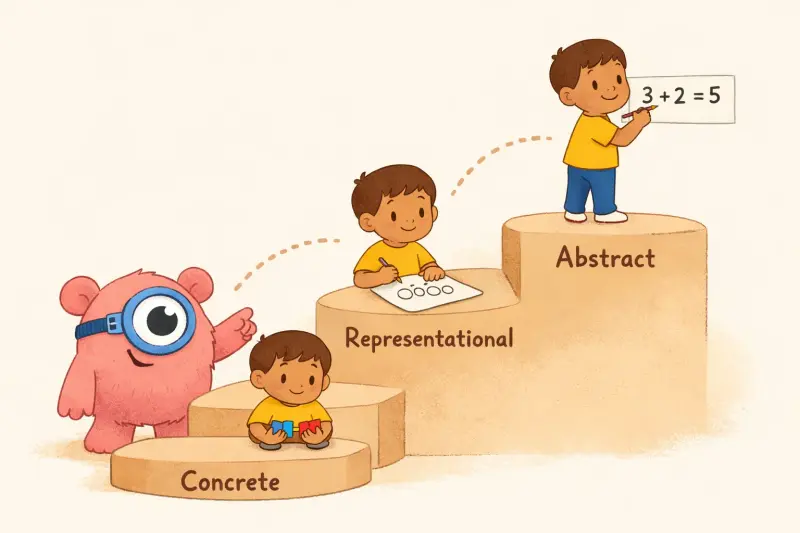
What the Research Says: Why CRA Works
The evidence behind CRA is exceptionally strong. Here are the key findings from peer-reviewed research:
A 2025 meta-analysis by Ebner, MacDonald, Grekov, and Aspiranti synthesised 30 studies using single-case design methodologies and found a statistically significant Tau-BC effect size of 0.9965 — a near-ceiling result — confirming CRA as a highly effective math intervention across diverse populations and mathematical content areas (Ebner et al., 2025).
Formally classified as evidence-based.Bouck, Satsangi, and Park (2018) applied rigorous quality indicators and standards to formally designate CRA as an evidence-based practice for students with learning disabilities — the first formal best-evidence synthesis for this framework (Bouck et al., 2018).
Builds conceptual understanding, not just computation.Agrawal and Morin (2016) showed that CRA bridges the gap between conceptual and procedural knowledge when embedded within explicit instruction, describing effective practices across basic operations, place value, fractions, and algebra (Agrawal & Morin, 2016).
Outperforms abstract-only instruction. When CRA was compared to repeated abstract-only explicit instruction for algebra with 231 students, the CRA group scored significantly higher on both post-tests and follow-up tests — and the advantage held across all prior achievement levels (Witzel, 2005).
CRA for Neurodiverse Learners: What the Evidence Shows
This is where the CRA method truly shines. The research base for CRA with neurodiverse populations spans multiple diagnoses and is remarkably consistent.
CRA is one piece of a broader toolkit — see our overview of neurodivergent math learning strategies.
Dyscalculia
Children with dyscalculia often struggle with number sense — the intuitive understanding of quantities and number relationships. They may have difficulty with subitizing (instantly recognising small quantities), and they often rely on memorising procedures they don't truly understand.
(New to the condition? Start with our parent's guide to what dyscalculia is.)
CRA directly addresses these challenges. Witzel and Mize (2018) describe the CRA method as the mathematical equivalent of Orton-Gillingham-style structured literacy programmes for reading — building understanding through multiple sensory channels rather than relying on memorisation of abstract procedures (Witzel & Mize, 2018). For a deeper dive, our step-by-step guide to the CRA ladder for dyscalculia walks through practical implementation.
ADHD
The CRA method is a natural fit for children with ADHD because each stage is multisensory, hands-on, and broken into manageable steps. The concrete stage provides tactile engagement that helps sustain attention. The structured progression reduces working memory demands by offloading information onto physical objects and drawings. And the explicit instruction framework provides the routine and predictability that ADHD learners benefit from.
Our parent's guide to the CRA approach for children with ADHD has more practical tips for using this method at home.
Autism
Flores, Hinton, Strozier, and Terry (2014) investigated CRA combined with the Strategic Instruction Model (CRA-SIM) for teaching basic addition and subtraction to 11 elementary students with autism spectrum disorders and developmental disabilities. The results showed significant improvements in computation performance across curriculum-based measures (Flores et al., 2014). The structured, predictable nature of CRA aligns well with the preference many autistic children have for routine and clear expectations. For guidance on choosing a math curriculum for autistic learners, CRA alignment is one of the most important features to look for.
Emotional and Behavioural Disorders (EBD)
Flores and Hinton (2022) found that the concrete phase is particularly valuable for students with EBD because it increases engagement and reduces the frustration that often accompanies abstract-only instruction. When a child can physically manipulate objects to solve a problem, the barrier to entry is much lower than staring at numbers on a page (Flores & Hinton, 2022b).

CRA by Grade Level: Practical Examples for K–3
Kindergarten: Number Sense and Counting
Concrete: Use counters or small toys to explore quantities 1–10. "Show me 4 bears." Build numbers on ten-frames with physical chips.
Representational: Draw dots in ten-frame templates. Stamp or colour circles to show quantities.
Abstract: Match numeral cards to quantities. Write the numeral that matches a set of objects.
Building subitizing skills — the ability to instantly recognise small quantities without counting — is a powerful complement to CRA at this stage.
Pair it with number bonds to make part–whole relationships visible.
Grade 1: Addition and Subtraction Within 20
Concrete: Combine two groups of Unifix cubes (3 + 4). Remove cubes for subtraction (7 – 3). Use two-coloured counters on a ten-frame.
Representational: Draw circles or tallies to represent groups. Use number paths or number lines to show jumps.
Abstract: Write number sentences: 3 + 4 = 7 and 7 – 3 = 4.
The Make 10 strategy is a CRA-aligned way to build addition fluency within 20.
Flores and Hinton (2022) demonstrated that a CRA-Integrated intervention produced measurable gains in both number sense and understanding of the commutative property of addition in elementary students (Flores & Hinton, 2022a).
Grade 2: Place Value and Two-Digit Operations
Concrete: Use base-ten blocks to build two-digit numbers (3 tens rods + 4 unit cubes = 34). Practice trading: exchange 10 unit cubes for 1 tens rod.
Representational: Draw quick-sketches of base-ten blocks (a line for a ten, a dot for a one). Use place value charts with drawn representations.
Abstract: Write numbers in expanded form (34 = 30 + 4). Add and subtract with the standard algorithm.
For a full walkthrough of this stage, see how to teach place value with base-ten blocks.
Grade 3: Multi-Digit Operations and Place Value Concepts
Concrete: Use base-ten blocks for three-digit numbers. Physically trade a tens rod for 10 unit cubes during subtraction with regrouping.
Representational: Draw the regrouping process. Use diagrams to model rounding to the nearest 10 or 100.
Abstract: Write expanded notation, round numbers, and use standard algorithms independently.
Milton, Flores, Hinton, Dunn, and Darch (2023) demonstrated that CRA-based place value instruction helped third graders with learning disabilities understand digit values, round numbers, and write expanded notation — and students even generalised their knowledge to estimate sums, showing genuine transfer of understanding (Milton et al., 2023).
CRA-Integrated: A Modern Variation
Traditional CRA moves through the three stages sequentially — mastering concrete before moving to representational, and so on. But more recent research describes a variation called CRA-Integrated (CRA-I), where all three representations appear from the very first lesson.
In a CRA-I lesson, the teacher shows manipulatives, drawings, and numbers side by side, then gradually fades the concrete and representational supports as the student gains confidence. This helps children see the connections between stages from the start.
Teachers, you can use the free teacher tools here to bring these visualisations to your classroom.
The 2025 meta-analysis found that both traditional sequential CRA and the integrated variation are effective, though the non-integrated approach showed slightly higher effect sizes in single-case studies (Ebner et al., 2025). In practice, many teachers blend the two: beginning with a sequential approach for new concepts, then using integration for review and reinforcement.
How Parents Can Use CRA at Home
You don't need a classroom full of specialised manipulatives to use the CRA approach at home. Everyday household objects work beautifully for the concrete stage:
Buttons, coins, dried pasta, or LEGO bricks for counting and grouping
Egg cartons as homemade ten-frames
Muffin tins for sorting and place value
Masking tape on the floor for a number line you can jump along
For the representational stage, encourage your child to draw what they did with the objects — circles for counters, lines for tens, dots for ones. And for the abstract stage, write the matching number sentence together.
The key rule: don't rush through the stages. If your child isn't confident with the manipulatives, stay there longer. The research is clear that skipping the concrete phase and jumping to abstract memorisation can actually block math reasoning — and may even contribute to math anxiety.
For more low-prep math games and everyday chores that double as math lessons, check out our parent resource library.
Some digital math apps like Monster Math also help - while digital tools cannot do the concrete step, they definitely can help with visual representations and the transition to abstract in a much more fun way.
Common Mistakes to Avoid
1. Rushing past the concrete stage. It can feel slow, and some teachers or parents worry that using objects is "babyish." But the concrete stage is where conceptual understanding is built. Without it, abstract skills sit on a shaky foundation.
2. Skipping the representational stage entirely. Going straight from objects to numbers misses the critical bridge. Drawings and diagrams help children internalise the structure of a concept before working with symbols alone.
3. Treating the three stages as disconnected lessons. Effective CRA instruction uses explicit "linking questions" that help children see the connection between what they touched, what they drew, and what they wrote. ("Remember how we used two groups of blocks? Now look at our drawing. Now look at the number sentence — it's the same thing!")
4. Switching manipulatives too often. If you introduce base-ten blocks for place value, stick with them through the concrete stage. Changing tools mid-concept adds unnecessary cognitive load.
5. Only using CRA for struggling students. CRA isn't a remediation-only strategy. It's a framework for building deep understanding in all learners. Research supports its use as a universal instructional practice, not just an intervention.
Frequently Asked Questions
What is the CRA method in math?
CRA (Concrete-Representational-Abstract) is a three-stage instructional approach where students first use physical objects to explore a concept, then draw visual representations, and finally work with numbers and symbols. It is grounded in Jerome Bruner's learning theory and has been formally classified as an evidence-based practice for students with learning disabilities.
Is CRA the same as CPA (Concrete-Pictorial-Abstract)?
Yes. CRA and CPA describe the same framework. CPA is the term used in Singapore Math and many UK curricula. CRA is the standard term in US special education research. You may also see it called CSA (Concrete-Semi Concrete-Abstract) in older literature.
Is the CRA method only for students with disabilities?
No. While CRA has the strongest evidence base for students with learning disabilities, it is effective for all learners at all ability levels. The multi-sensory approach benefits any child building new math concepts. Multiple studies confirm it outperforms abstract-only instruction for students across the achievement spectrum.
How long should students spend at each CRA stage?
There is no fixed timeline. Students should demonstrate mastery at each stage before moving to the next. Some children progress through all three stages in a single lesson; others may need weeks at the concrete stage. The guiding principle is mastery-based progression, not a set schedule.
What manipulatives work best for CRA?
The best manipulatives depend on the concept you're teaching. Base-ten blocks and place value mats work well for place value. Two-coloured counters and Unifix cubes are great for addition and subtraction. Cuisenaire rods and fraction bars suit fractions. Ten-frames support number sense. The key is to choose one tool per concept and stick with it.
Can parents use CRA at home?
Absolutely. You can use everyday household items — buttons, coins, pasta, LEGO bricks — as concrete manipulatives. Have your child draw pictures for the representational stage, and then practise writing number sentences. Apps with virtual manipulatives can also supplement physical materials.
How does CRA help children with ADHD or dyscalculia?
CRA is multisensory, hands-on, and broken into manageable steps — all of which reduce working memory demands and increase engagement. For children with dyscalculia, the concrete and representational stages build the number sense that doesn't develop naturally. For children with ADHD, the physical engagement of the concrete stage helps sustain focus, and the structured progression provides predictability.
How does CRA differ from traditional math instruction?
Traditional instruction often begins and stays at the abstract level — teaching procedures with numbers and symbols from the start. CRA ensures students build conceptual understanding through physical and visual experiences before working with symbols. Research shows CRA students significantly outperform those receiving abstract-only instruction.
What is CRA-Integrated (CRA-I)?
CRA-I is a modern variation where all three representations — manipulatives, drawings, and numbers — are presented together from the first lesson, then concrete and representational supports are gradually faded. Both the sequential and integrated approaches are supported by research, and many teachers combine the two.
How do I know when my student is ready to move to the next stage?
A student is ready to move from concrete to representational when they can consistently solve problems with manipulatives and explain their reasoning. They're ready for the abstract stage when they can solve problems using drawings alone and articulate the connection between the drawing and the math concept.
References
Agrawal, J., & Morin, L. L. (2016). Evidence-based practices: Applications of concrete representational abstract framework across math concepts for students with mathematics disabilities. Learning Disabilities Research & Practice, 31(1), 34–44. https://eric.ed.gov/?id=EJ1089034
Bouck, E. C., Satsangi, R., & Park, J. (2018). The concrete–representational–abstract approach for students with learning disabilities: An evidence-based practice synthesis. Remedial and Special Education, 39(4), 211–228. https://doi.org/10.1177/0741932517721712
Ebner, S., MacDonald, M. K., Grekov, P., & Aspiranti, K. B. (2025). A meta-analytic review of the concrete-representational-abstract math approach. Learning Disabilities Research & Practice, 40(1), 31–42. https://scholars.uky.edu/en/publications/a-meta-analytic-review-of-the-concrete-representational-abstract-/
Flores, M. M., & Hinton, V. M. (2022a). The effects of a CRA-I intervention on students' number sense and understanding of addition. Remedial and Special Education, 43(3), 183–194. https://doi.org/10.1177/07419325211038009
Flores, M. M., & Hinton, V. M. (2022b). Use of the concrete–representational–abstract instructional sequence to improve mathematical outcomes for elementary students with EBD. Beyond Behavior, 31(1), 16–28. https://doi.org/10.1177/10742956211072421
Flores, M. M., Hinton, V. M., Strozier, S. D., & Terry, S. L. (2014). Using the concrete-representational-abstract sequence and the strategic instruction model to teach computation to students with autism spectrum disorders and developmental disabilities. Education and Training in Autism and Developmental Disabilities, 49(4), 547–554. https://eric.ed.gov/?id=EJ1045769
Mercer, C. D., & Miller, S. P. (1992). Teaching students with learning problems in math to acquire, understand, and apply basic math facts. Remedial and Special Education, 13(3), 19–35. https://eric.ed.gov/?id=EJ450011
Milton, J. H., Flores, M. M., Hinton, V. M., Dunn, C., & Darch, C. B. (2023). Using the concrete–representational–abstract sequence to teach conceptual understanding of place value, rounding, and expanded notation. Learning Disabilities Research & Practice, 38(1), 15–25. https://doi.org/10.1111/ldrp.12299
Witzel, B. S., & Mize, M. (2018). Meeting the needs of students with dyslexia and dyscalculia. SRATE Journal, 27(1), 31–39. https://files.eric.ed.gov/fulltext/EJ1166703.pdf