TL;DR: For parents and educators navigating the complexities of neurodivergent learning, specifically developmental dyscalculia, the home environment presents a largely untapped reservoir of therapeutic potential. Dyscalculia, a specific learning disability characterized by impairments in acquiring arithmetic skills and processing numerical magnitude, affects approximately 3.5% to 6.5% of the population, a prevalence rate comparable to dyslexia.
Unlike general difficulties with mathematics, dyscalculia is rooted in neurobiological differences, particularly within the intraparietal sulcus (IPS) of the brain—the region responsible for the innate "number sense." This guide explores Do-It-Yourself (DIY) math interventions using common household items, grounded in the Concrete-Representational-Abstract (CRA) instructional framework.
Quick Takeaways:
Neurobiology of Touch: Multisensory intervention (VAKT) significantly improves mathematical achievement in dyscalculic learners.
Kitchen Math: Baking and measuring provide irrefutable physical evidence of abstract concepts like fractions and volume.
Textile Logic: Sorting laundry builds foundations for set theory and classification.
Gamification: Simple card and dice games target "subitizing" and working memory without math anxiety.
The Neurobiological Landscape of Dyscalculia
To effectively intervene at home, one must first understand the specific cognitive landscape of the dyscalculic learner. It is a misconception that dyscalculia is simply "being bad at math" or a result of poor instruction. It is a distinct neurodevelopmental disorder with biological underpinnings.
Defining the Deficit: The "Number Module" Hypothesis
Brian Butterworth, a leading researcher in the field, proposes the "defective number module hypothesis," which suggests that humans are born with a specialized capacity for recognizing and manipulating numerosities. This capacity, located primarily in the parietal lobes, acts as a "starter kit" for understanding arithmetic. In dyscalculic brains, this module fails to develop normally, leading to profound difficulties in understanding the concept of "set size" or the cardinality of numbers.
Consequently, a child with dyscalculia may not intuitively grasp that the number "5" represents a specific, consistent quantity. While a neurotypical child might instantly see five dots on a die and know it is "5" (a process called subitizing), a dyscalculic child might need to count each dot individually, every time. This lack of automaticity creates a bottleneck; because the brain is expending so much energy on basic processing, there is little cognitive reserve left for complex operations like addition or multiplication.
The Role of the Intraparietal Sulcus (IPS)
Neuroimaging studies utilizing fMRI have consistently shown that the intraparietal sulcus (IPS) is the core brain region for numerical magnitude processing. In typically developing children, this area lights up during tasks involving number comparison or estimation. In children with dyscalculia, the IPS often shows reduced activation or atypical structural characteristics.
This biological reality underscores the importance of Multisensory Intervention. Since the primary pathway for number sense is impaired, effective therapy must recruit other areas of the brain - such as the prefrontal cortex (for executive function) and the sensorimotor cortex (for touch and movement) - to build compensatory neural networks.
Comorbidities and Genetic Factors
It is also crucial to recognize that dyscalculia rarely travels alone. High rates of comorbidity exist with dyslexia (reading disability) and ADHD.
Dyslexia: The co-occurrence presents a "double deficit," affecting both the phonological loop (needed for counting words) and the visuospatial sketchpad (needed for visualizing quantities).
ADHD: Deficits in working memory - the ability to hold information in mind while manipulating it - are common in both conditions.
Theoretical Frameworks for Home Intervention
The activities detailed in this report are not merely "games"; they are applications of rigorous educational theory designed to remediate specific cognitive deficits.
The Concrete-Representational-Abstract (CRA) Sequence
The CRA sequence is the gold standard for teaching mathematics to students with learning disabilities. It is a graduated instructional sequence that moves from the physical to the symbolic.
Concrete (Enactive): The "doing" stage. Learning occurs through the manipulation of physical objects (e.g., counting beans, stacking blocks). For dyscalculic learners, this phase must be prolonged. They need to physically feel that 5 is heavier/larger/more numerous than 3.
Representational (Iconic): The "seeing" stage. Physical objects are replaced by pictures, tally marks, or drawings. Games like Monster Math start here.
Abstract (Symbolic): The "symbol" stage. This is where traditional math lives - using numerals (5) and operation signs (+, -).
Multisensory Integration (VAKT)
Research by Lin and Jiar (2017) (although on a small sample size) confirms that Multisensory Instruction - specifically Visual, Auditory, Kinesthetic, and Tactile (VAKT) - is superior to uni-sensory instruction for dyscalculic students. When a child traces a sandpaper number "3" while saying "three" and seeing three buttons, they create a robust, multi-modal memory trace that is more resistant to decay than a visual memory alone.
The Kitchen as a Math Laboratory
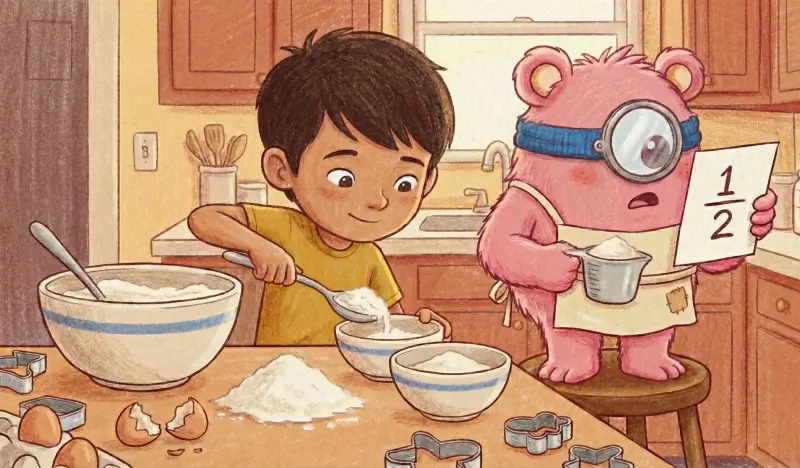
The kitchen is an ideal environment for "stealth math." It offers a natural setting for exploring measurement, ratio, and thermodynamics. For a detailed guide on cooking with neurodivergent kids, see our article on Math in the Kitchen: Real-Life Learning.
Game 1. The Great Liquid Transfer: Conservation and Volume
Target Concepts: Volume, Fractions, Conservation of Mass.
Activity: Use a large clear bowl of colored water and various containers (tall glass, wide mug). Ask the child to predict which holds more. Have them fill a "1 cup" measure and pour it into the tall glass, then mark the level. Repeat for the wide mug. This physical validation builds the concept of standard units of measure—an abstract concept that often eludes dyscalculic learners.
Game 2. Baking by Numbers: The Algebra of Cookies
Activity: The "Half-Batch" Challenge. Present a recipe for 12 cookies but explain you only have eggs for 6. Ask the child to help "cut the recipe in half." Physically measure out the full 4 cups of flour, then scoop it into two equal piles. This physical act demonstrates division (4 ÷ 2 = 2) and creates an episodic memory of what "halving" feels like.
Textile Mathematics: Patterning and Sorting
Laundry, specifically the humble sock, is an unexpectedly powerful tool for teaching classification.
For more tactile ideas, read our post on 8 Tactile Math Games for Dyscalculic Learners.
Game 3: The Sock Sort: Introduction to Set Theory
Target Concepts: Sorting, Attributes, Matching.
Pour a basket of unmatched socks onto the floor. Ask the learner to sort them by one attribute first (e.g., white vs. colored). Then sort by a secondary attribute (e.g., size). Finally, match the exact pairs. This requires Visual Discrimination, training the visual cortex to identify specific patterns amidst "noise," a skill directly transferable to identifying numbers on a crowded worksheet.
Game 4: Texture Tracing: The "Tactile Number" Project
Cut old denim or sandpaper into large shapes of numbers (0-9). Have the learner trace the textured number with their fingers while saying the number aloud. Blindfold them and ask if they can identify the number just by touch. This forces the brain to rely on the somatosensory cortex to build a mental image of the symbol.
Living Room Logic: Card, Dice, and Board Games
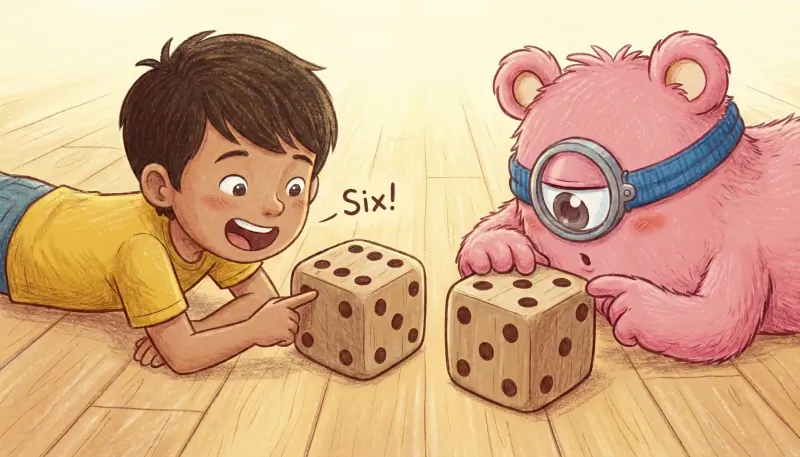
Tabletop games are effective because they inherently utilize the CRA sequence. Dice are "representational" (dots), and scoring is "abstract" (writing numbers).
Game 5: Dice Games and the Art of "Subitizing"
Typical brains can "subitize" (instantly recognize) up to 4 or 5 items. Dyscalculic brains often rely on counting one-by-one. Play "Dice War": Roll one die. The player must call out the number as fast as possible without counting. This builds automaticity.
Game 6: Card Games: Working Memory
Play "Make 10" Go Fish using a standard deck (Ace-10). Instead of matching pairs, the goal is to find a pair that adds up to 10. This requires the child to analyze their hand, calculate the complement ($10 - 3 = 7$), and hold that target in working memory—training mental flexibility.
6. Gross Motor & DIY Manipulatives
Game 7: The Floor Number Line
Create a number line on the floor using masking tape. Ask the child to stand on "5" and "add 3" by jumping forward three spaces. This utilizes the SNARC effect (Spatial-Numerical Association of Response Codes), linking quantity to physical space. The physical movement increases Neuroplasty and improves learning.
Game 8: The Pasta Abacus
Dye rigatoni pasta two colors (e.g., Red for 10s, Blue for 1s). String them to create numbers (e.g., 2 Red + 3 Blue = 23). This makes the invisible rules of place value visible and tangible.
Implementation & Emotional Support
Implementing these games requires a shift in the emotional climate. Many dyscalculic children suffer from Math Anxiety, which blocks working memory.
Micro-Dosing: Keep sessions to 15-20 minutes.
Rebranding: Call it "Game Night" or "Kitchen Science," not "Math Practice."
Environment: Reduce sensory clutter (turn off the TV) to help the child filter stimuli.
Digital Reinforcement using Monster Math
While concrete manipulatives are vital, the ultimate goal is for the child to function in the "Abstract" world of school math. Once concrete foundations are established through physical play, adaptive digital tools like Monster Math serve as an effective bridge. The app provides the visual learning and practice before moving to abstract math, and immediate feedback necessary for fluency without the fatigue of manual drills.
Frequently Asked Questions (FAQs)
Q1: How do I distinguish between dyscalculia and just "being bad at math"?
Dyscalculia is persistent. Key signs include an inability to subitize (must count dots one-by-one), difficulty reading analog clocks, and confusion with left/right orientation despite good instruction.
Q2: Is it okay to let my child use their fingers?
Yes! Research strongly supports finger counting as a necessary developmental stage. It bridges the gap between concrete objects and abstract numbers.
Q3: Can these games replace professional therapy?
No, but they are a critical supplement. They provide the "repetition" and "generalization" needed to make professional educational therapy stick.