TL;DR: The best ways to learn math aren't about speed, memorization, or drilling. Research consistently shows that these strategies work:
Build number sense - flexible thinking beats rote memorization
Use spaced & interleaved practice - spread problems out and mix types
Reduce math anxiety - stress actively blocks working memory
Use visual representations - connect symbols to pictures for deeper understanding
Cultivate a growth mindset - believing math ability can grow, changes outcomes
Connect to prior knowledge & real life - context makes concepts stick
Here's a frustrating truth: most of us learned math the wrong way. We were handed worksheets, rushed through timed drills, and told to memorize our times tables until they stuck. Then, if we got stuck, we were quietly sorted into the "not a math person" category.
But cognitive science and education research over the past two decades tell a very different story about how humans actually learn mathematics. The gap between what research shows and what happens in most classrooms (and at most kitchen tables) is enormous - and worth closing.
This guide pulls from peer-reviewed studies across neuroscience, cognitive psychology, and mathematics education to lay out the most effective ways to learn math. Whether you're a parent, a student, or a teacher, these strategies are grounded in evidence and not intuition.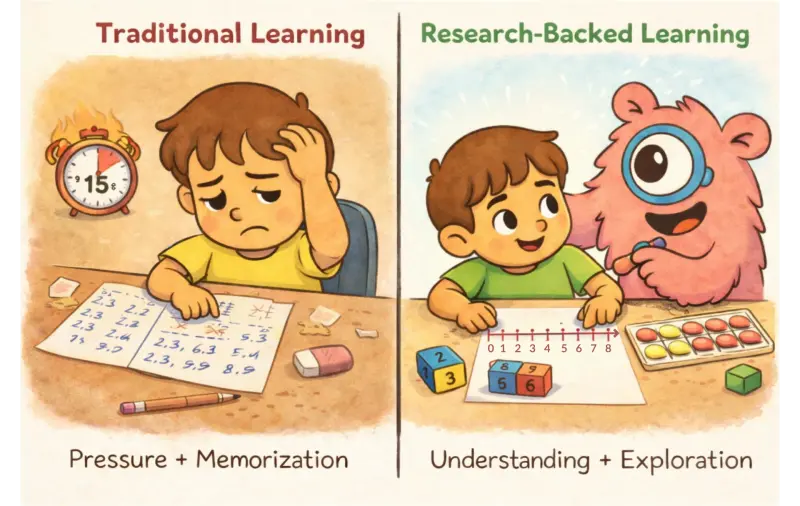
1. Build Number Sense, Not Just Fact Recall
The single most important foundation for math learning is what researchers call number sense: the ability to understand how numbers relate to each other and use them flexibly - not the memorization of math facts.
Professor Jo Boaler at Stanford Graduate School of Education describes this clearly in her widely cited paper "Fluency Without Fear." Students with number sense, when asked to solve 8 × 7, don't just retrieve 56 from memory - they might think "10 × 7 is 70, minus 2 × 7 (14), equals 56." They're computing, not recalling. And this flexibility is the mark of a high-achiever, not a shortcut.
"The low achievers are often low achievers not because they know less but because they don't use numbers flexibly." — Jo Boaler, Stanford GSE
This matters because a 2024 systematic literature review of post-pandemic mathematics learning strategies confirmed that connecting to prior knowledge and visual representation are among the most consistently effective cognitive strategies students can use. Number sense is, at its core, a web of prior numerical knowledge that students can call on flexibly.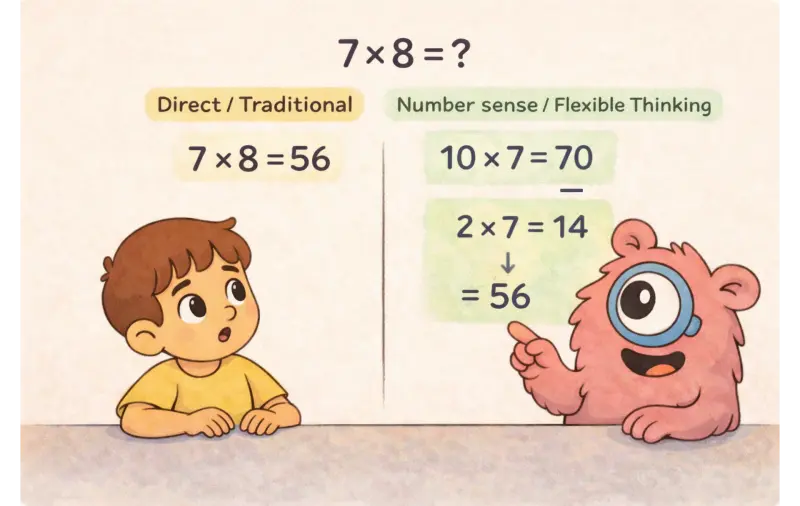
2. Use Spaced and Interleaved Practice
If there's one finding from cognitive psychology that every student should know, it's this: how you schedule your practice matters as much as how much you practice.
Spaced practice means distributing problems of the same type across multiple sessions, rather than cramming them all into one sitting. Interleaved practice means mixing different types of problems within the same session, rather than blocking all problems of one kind together. A meta-analytic review of applied classroom research found that distributing practice across sessions consistently produces better learning outcomes than massed practice - across subjects, age groups, and real classroom settings.
In a landmark randomized controlled trial across 54 seventh-grade math classes, students who used interleaved practice over four months outscored their peers 61% to 38% on an unannounced test one month later. Blocked practice stays popular because it feels easier - when all problems use the same strategy, students feel fluent. But that fluency is illusory. Interleaved practice forces students to identify the right strategy for each problem from scratch, which feels harder, but is exactly what prepares them for real tests and real life.
If your child finds mixed-problem practice frustrating, that frustration is often a sign it's working.
3. Ditch the Timer - Seriously
Speed pressure is one of the most damaging ideas in math education. Research suggests that time pressure and stress in math tasks can interfere with how students choose problem-solving strategies, sometimes leading them away from more effective ways of thinking.
A meta-analysis found a consistent negative correlation between math anxiety and math achievement meaning the more anxious a student feels about math, the lower they tend to score, and this pattern holds across ages, countries, and ability levels.
And it compounds: a longitudinal study that tracked students across four years of university found that math anxiety predicted both avoidance of STEM courses and lower STEM grades - independently of students' actual math ability. The more anxious a student feels, the less math they do; the less math they do, the worse they get; and the cycle continues.
Replacing timed drills with untimed, strategy-focused practice - the kind that builds number sense - is one of the most impactful changes a parent or teacher can make.
Note: You can still time how fast a child answers a question correctly to measure automaticity - just don't let them know they are being timed.
4. Use Visual Representations to Deepen Understanding
When students connect a visual representation of a number with its symbolic form, they activate multiple pathways in the brain simultaneously - and that's good for learning. Research shows that spatial reasoning and mathematics are closely linked, with spatial skills predicting performance across areas such as arithmetic, problem solving, algebra, and geometry.
Number lines, ten-frames, dot cards, bar models, and diagrams are cognitive scaffolds that help learners of all ages move from the concrete (physical objects or pictures) to the representational (diagrams) to the abstract (symbols) - a progression widely known in education research as the Concrete-Representational-Abstract (CRA) approach.
The 2024 systematic review referenced above also specifically highlighted that visual aids and charts help students build more precise and intuitive representations of mathematical concepts, improving both memory retention and problem-solving ability. Students who draw pictures or diagrams before writing equations consistently outperform peers who jump straight to abstract notation. Apps like Monster Math also help with this.
5. Compare Multiple Strategies - Don't Just Repeat One
One of the most powerful - and underused - tools in math learning is comparison. When students study two different ways to solve the same problem side by side, they understand each method more deeply than if they studied one method alone. Research confirms that comparing multiple solution strategies is an effective way to improve both conceptual understanding and procedural flexibility in mathematics.
This means that when your child solves a problem, asking "Is there another way you could have done that?" is genuinely one of the best math coaching moves available. It builds exactly the flexible thinking that characterizes strong mathematical reasoning.
6. Cultivate a Growth Mindset Around Math
The belief that math ability is fixed - that you're either a "math person" or you're not - is both widespread and wrong. And it's actively harmful. A 2025 study using PISA 2022 data found that a growth mindset significantly reduces math anxiety through pathways of autonomy, competence, and relatedness - and this effect holds across cultural contexts.
The good news is that mindset is teachable. Decades of research by Carol Dweck and colleagues show that students’ beliefs about ability can be shaped, and that emphasizing effort and strategies over innate ability helps foster a growth mindset. Saying "I can see you worked hard to figure that out" instead of "You're so smart" is a small language change with measurable academic outcomes.
For parents: one of the most powerful things you can do is avoid expressing your own math anxiety in front of your children. An intergenerational study of primary school children and both their biological parents found that children's math anxiety was significantly associated with their mothers' math anxiety - and that this pattern held even after accounting for parents' education level.
7. Connect Math to Real-World Problems
Abstract mathematics becomes far more learnable when it's grounded in something real. The 2024 systematic review found that connecting new concepts to real-life experience is one of the most consistently effective cognitive strategies students can use - more so than re-reading notes or passive review.
The best real-world math happens in the margins of everyday life - calculating change at a store, measuring ingredients while cooking, estimating travel times, or noticing patterns in nature.
8. Talk About Math - Out Loud
Mathematical communication is an underrated learning tool.
When students explain their thinking - to a parent, a peer, or even themselves - they consolidate understanding in ways that silent practice cannot. A research synthesis on meaningful learning in mathematics found that the quality of mathematical talk plays a greater role in learning outcomes than the quantity of problems solved, and that teachers who prompt students to verbalise their reasoning consistently produce stronger conceptual understanding.
For parents at home, this is as simple as asking your child to "teach you" how they solved a problem. If they can explain it clearly, they understand it. If they get stuck in the explanation, that's valuable diagnostic information - and an opportunity to explore together rather than simply correct.
The Bottom Line
The best ways to learn math share a common thread: they treat mathematics as something to understand and explore, not something to memorize and fear. Number sense, spaced practice, low-pressure learning, visual tools, meaningful comparison of strategies, a growth mindset, and real-world application - these are what the evidence says actually works.
The gap between how math is typically taught and how research says it should be taught is still large. But every parent who stops praising speed, every teacher who swaps timed tests for number talks, and every child who learns to see math as flexible rather than fixed - they're closing that gap, one problem at a time.
FAQs:
What is the most effective way to learn math?
Research consistently points to a combination of building number sense (flexible thinking with numbers), using spaced and interleaved practice, reducing math anxiety, and connecting new concepts to visual representations. No single strategy works in isolation - the most effective learners combine several of these approaches.
Does timed testing help kids learn math better?
No - and it may actively harm learning. Stanford research shows that time pressure triggers stress, which blocks working memory, preventing students from accessing the very math facts they've studied. Timed testing increases math anxiety and can cause students to disengage from math entirely.
How does math anxiety affect learning?
A large meta-analysis found a significant negative correlation between math anxiety and achievement. Anxiety consumes working memory resources that students need to solve problems, and it creates avoidance behaviour that compounds over time - leading to less practice and worse outcomes.
Can a growth mindset actually improve math skills?
Yes. Research found that a growth mindset reduces math anxiety and improves outcomes across different cultural contexts. Praising effort and strategy - rather than speed or innate ability - is one of the most effective things parents and teachers can do to shift children toward a growth orientation.
How important are visual strategies in learning math?
Very important. Spatial reasoning and mathematical ability are linked at the neural level, and students who use visual tools like number lines, ten-frames, and diagrams consistently outperform peers who rely on abstract notation alone. Visual strategies reduce working memory load and build deeper conceptual understanding.
References:
Boaler, J., Williams, C., & Confer, A. (2015). Fluency Without Fear: Research Evidence on the Best Ways to Learn Math Facts. YouCubed, Stanford University. https://www.youcubed.org/wp-content/uploads/2017/09/Fluency-Without-Fear-1.28.15.pdf
Tañola, M. D., & Lomibao, L. S. (2024). Understanding How Students Learn Mathematics: A Systematic Literature Review of Contemporary Learning Strategies in Mathematics Education Post-2020. Journal of Innovations in Teaching and Learning, 4(1), 66–75. https://pubs.sciepub.com/jitl/4/1/11/index.html
Firth, J., Rivers, I., & Boyle, J. (2021). The Distributed Practice Effect on Classroom Learning: A Meta-Analytic Review of Applied Research. npj Science of Learning.https://pmc.ncbi.nlm.nih.gov/articles/PMC12189222/
Rohrer, D., Dedrick, R. F., Hartwig, M. K., & Cheung, C.-N. (2020). A Randomized Controlled Trial of Interleaved Mathematics Practice. Journal of Educational Psychology, 112(1), 40–52. https://files.eric.ed.gov/fulltext/ED595322.pdf
Caviola, S., Carey, E., Mammarella, I. C., & Szűcs, D. (2017). Stress, Time Pressure, Strategy Selection and Math Anxiety in Mathematics: A Review of the Literature. Frontiers in Psychology, 8, 1488. https://pmc.ncbi.nlm.nih.gov/articles/PMC5585192/
Barroso, C., Ganley, C. M., McGraw, A. L., Geer, E. A., Hart, S. A., & Daucourt, M. C. (2021). A Meta-analysis of the Relation Between Math Anxiety and Math Achievement. Psychological Bulletin, 147(2), 134–168. https://pmc.ncbi.nlm.nih.gov/articles/PMC8300863/
Daker, R. J., Gattas, S. U., Sokolowski, H. M., Green, A. E., & Lyons, I. M. (2021). First-year students' math anxiety predicts STEM avoidance and underperformance throughout university, independently of math ability. npj Science of Learning, 6, 17. https://pmc.ncbi.nlm.nih.gov/articles/PMC8203776/
Gilmore, C. (2023). Understanding the complexities of mathematical cognition: A multi-level framework. Quarterly Journal of Experimental Psychology, 76(9), 1953–1972. https://pmc.ncbi.nlm.nih.gov/articles/PMC10466984/
Rittle-Johnson, B., Star, J. R., & Durkin, K. (2020). How Can Cognitive-Science Research Help Improve Education? The Case of Comparing Multiple Strategies to Improve Mathematics Learning and Teaching. Current Directions in Psychological Science, 29(6), 599–609. https://doi.org/10.1177/0963721420969365
Huang, M. (2025). How growth mindset reduces math anxiety across cultures: Mediating roles of autonomy, competence, and relatedness in PISA 2022. Acta Psychologica, 261. https://doi.org/10.1016/j.actpsy.2025.105902
Dweck, C. S., & Yeager, D. S. (2019). Mindsets: A View From Two Eras. Perspectives on Psychological Science, 14(3), 481–496. https://pmc.ncbi.nlm.nih.gov/articles/PMC6594552/
Vanbinst, K., Bellon, E., & Dowker, A. (2020). Mathematics anxiety: An intergenerational approach. Frontiers in Psychology, 11. https://doi.org/10.3389/fpsyg.2020.01613
Koskinen, R., & Pitkäniemi, H. (2022). Meaningful Learning in Mathematics: A Research Synthesis of Teaching Approaches. International Electronic Journal of Mathematics Education, 17(2), em0679. https://doi.org/10.29333/iejme/11715