TL;DR
Memorizing math facts too early can overload working memory and reduce reasoning ability.
Kids who rely only on recall often struggle when problems change or become more complex.
Strategy-based learning builds deeper number sense and long-term fluency.
Research shows that understanding must come before memorization - not the other way around.
If you’ve ever watched a child freeze on a simple math problem they once “knew,” you’re not imagining things. For many kids, especially those who learn differently, pushing math fact memorization too early can quietly undermine the very reasoning skills they need to succeed later.
This doesn’t mean math facts aren’t important. They are. But decades of research show that how children are first taught to engage with numbers shapes how they think about math later. Studies in cognitive development have found that early math success depends far more on building number sense - understanding quantities, relationships, and magnitude - than on memorizing isolated facts. When instruction emphasizes recall before meaning, children may appear fluent early on, but they often struggle as math shifts toward reasoning, flexibility, and problem solving.
The Hidden Cost of Early Memorization
When children are asked to memorize math facts before they understand what numbers represent, they often rely on fragile recall instead of reasoning. This creates a system where success depends on memory speed rather than comprehension.
Cognitive research using dual-task experiments shows that working memory is a limited resource during math. When learners must solve arithmetic problems while their working memory is simultaneously occupied - for example, by holding information in mind or retrieving effortful facts - their accuracy and reasoning reliably decline. This research demonstrates that when mental resources are spent on recall, there is less capacity available for thinking, estimating, and flexible problem-solving.
This is why some children can recite facts perfectly during drills but fall apart during word problems or unfamiliar tasks. The math never became meaningful - it was just stored, briefly, and easily lost.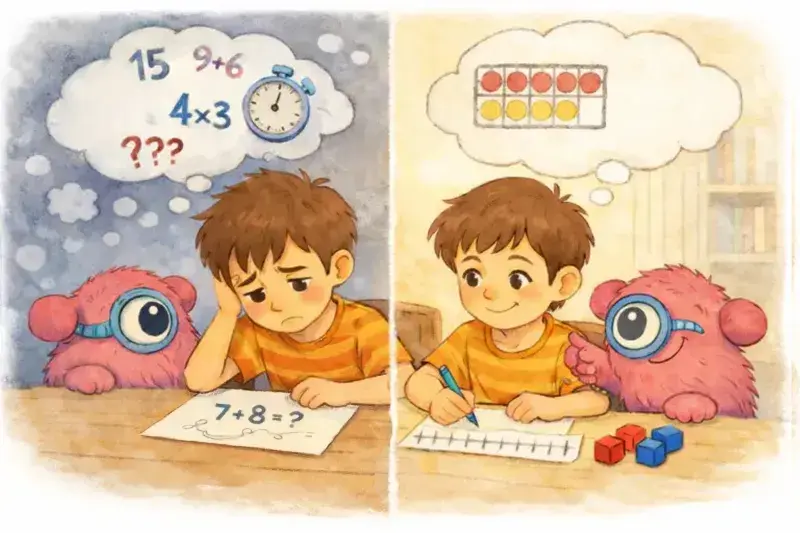
What Early Memorization Teaches Kids (Without Anyone Realizing)
The way math is taught early on shapes how kids approach it later.
When speed is rewarded over thinking, kids learn that:
fast answers matter more than good ideas
hesitation means failure
thinking is a liability
For children who need time to process - including many kids with ADHD, dyscalculia, or working-memory challenges - this can quietly erode confidence. They may understand the math, but they don’t feel safe showing how they think.
Over time, many stop trying strategies altogether. Not because they can’t reason - but because reasoning feels risky.
Why Reasoning Must Come First
Math makes sense when kids understand how numbers relate to each other, not when they’re just asked to remember answers.
Understanding that 7 + 8 can be broken apart and recombined in different ways - for example, as 7 + 7 + 1, or as 7 + (3 + 5), which becomes (7 + 3) + 5 = 10 + 5, or even as (5 + 2) + (5 + 3), which rearranges to 5 + 5 + (2 + 3) = 5 + 5 + 5 - builds flexibility that memorization alone never provides.
Studies on strategy-based instruction, show that strategy-focused math instruction helps students understand mathematical relationships through multiple approaches, building flexibility that supports transfer to novel problems, rather than relying on memorization alone.
In contrast, children trained to retrieve answers without understanding often struggle when facts are forgotten or when problems look slightly different.
Their confidence drops - not because they can’t think - but because they were never taught to.
Memorization Increases Math Anxiety - Especially for Some Kids
Timed drills and pressure to recall facts quickly can worsen math anxiety, especially for students with limited working memory capacity. Research on math anxiety demonstrates that anxiety-related thoughts consume working memory resources that would otherwise support thinking and problem solving, making it harder for students to access both memory and reasoning pathways under pressure.
A well-known study on performance breakdown under cognitive pressure explains why even capable students “choke” when recall is emphasized over understanding.
This helps explain a common classroom pattern: children who seem capable during low-stress exploration suddenly struggle during tests or timed practice. The issue isn’t ability - it’s how learning was structured.
What Happens When Memorization Comes Later (and Naturally)
When children first build number sense - using visual models, strategies, and patterns - memorization tends to emerge organically. Once numbers make sense, recall stops feeling like work - it just happens..
Educational research shows that students who engage in creative mathematical reasoning - building their own methods and sense of number - outperform peers on both familiar and novel math problems, indicating deeper retention and flexible fluency rather than rote memorization. This kind of reasoning-first learning is also reflected in evidence-based instructional frameworks, such as the Concrete-Representational-Abstract (CRA) progression, which emphasizes meaning before symbols.
Why “They’ll Fall Behind” Is a Myth
One of the biggest fears parents and teachers have is that delaying memorization will leave kids behind. But the opposite often happens.
Early on, memorization can look like progress. Later, it becomes a bottleneck.
Children who focus on reasoning early tend to adapt better as math becomes more complex. They self-correct, apply strategies flexibly, and don’t panic when they forget a fact - because they know how to rebuild.
Eventually they also build automaticity - which is often what parents and teachers are looking for (answering a math fact without having to think about it). But that need not come from memorization alone - deep understanding and building recognition for how numbers work can eventually lead to automaticity as well.
What Parents and Teachers Can Do Instead
The focus isn’t on memorizing facts early, but on building real understanding first. That happens when children understand numbers well enough that facts stop being something they have to remember - and start being something they recognize.
Here’s what that looks like in practice:
Invite multiple strategies for the same problem.
When kids see that 7 + 8 can be broken apart and recombined in different ways - for example, as 7 + 7 + 1, or as 7 + (3 + 5), which becomes (7 + 3) + 5 = 10 + 5, or even as (5 + 2) + (5 + 3), which rearranges to 5 + 5 + (2 + 3) = 5 + 5 + 5 - they learn that math is flexible and not rigid. That kind of thinking builds confidence and prepares them to solve unfamiliar problems later, rather than relying on memorization alone.
Anchor thinking in visual models.
Tools like ten-frames, number lines, arrays, and blocks offload working memory and make relationships visible. When kids can see the math, they’re free to reason - not just recall.
Slow down answers, speed up thinking.
Ask “How did you figure that out?” more often than “What’s the answer?” Thinking out loud strengthens strategies and sends a powerful message: reasoning matters more than speed.
Treat fluency as a milestone, not a starting line.
Fluency isn’t something kids start with - it’s something they grow into. Timed drills help only after strategies feel steady. Before that, they often add pressure without adding understanding. Once kids understand what they’re doing, they’re usually a lot more confident.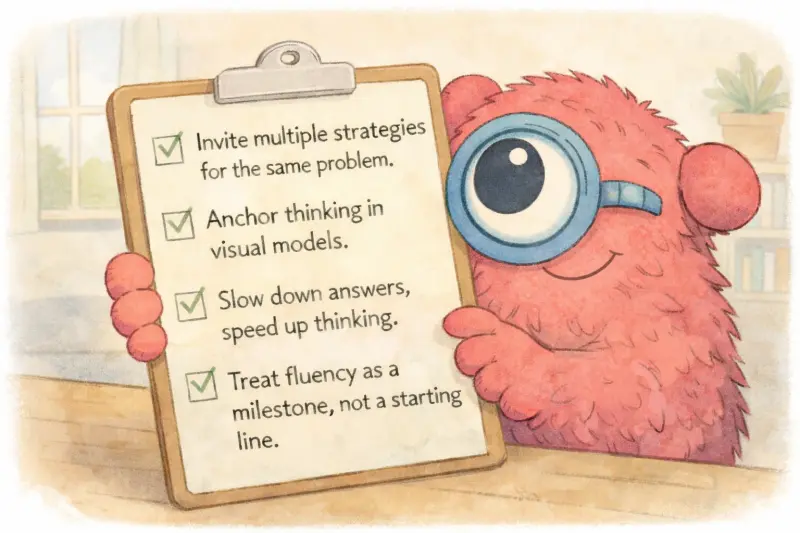
Final Thought
What matters most in math isn’t how quickly a child can recall a fact. It’s whether they know what to do when they don’t remember it. Kids who understand how numbers fit together don’t get stuck when something slips - they reason their way forward. That’s what lasts, long after drills are forgotten.
FAQs
Is memorization ever necessary in math?
No. Automaticity is useful - but only after understanding is in place. This works best as a byproduct of reasoning, not a replacement for it. Memorization for the sake of automaticity is not a good learning strategy.
What if my child’s school focuses heavily on drills?
You can support reasoning at home by asking “How did you figure that out?” instead of “What’s the answer?”
Does this apply to all kids?
All learners benefit from understanding-first instruction, but it’s especially important for children with math anxiety, ADHD, or working memory challenges.
References
Chen, Y., & Bailey, D. H. (2020). Dual-task studies of working memory and arithmetic performance: A meta-analysis. Psychological Bulletin. Retrieved from https://www.researchgate.net/publication/338558211_Dual-Task_Studies_of_Working_Memory_and_Arithmetic_Performance_A_Meta-Analysis
National Center on Improving Literacy. (2013). Working memory, math performance, and math anxiety. American Psychological Association. Retrieved from https://www.apa.org/news/press/releases/xge1302224.pdf
National Council of Teachers of Mathematics & Harvard Graduate School of Education. (2015). Developing flexibility in math problem solving. Retrieved from https://www.gse.harvard.edu/ideas/usable-knowledge/08/12/developing-flexibility-math-problem-solving
Beilock, S. L., & Carr, T. H. (2005). Why do high working memory individuals choke under pressure? An examination of attentional control. Retrieved from https://pure.rug.nl/ws/files/90030598/Why_do_high_working_memory_individuals_choke._An_examination.pdf
Geary, D. C. (2013). Early foundations for mathematics learning and their relations to learning disabilities. Current Directions in Psychological Science, 22(1), 23–27. https://pmc.ncbi.nlm.nih.gov/articles/PMC4517838/
Jonsson, B. (2020). Gaining Mathematical Understanding: The Effects of Creative Mathematical Reasoning. Frontiers in Psychology. https://pmc.ncbi.nlm.nih.gov/articles/PMC7775304/