
TL;DR: Subitizing is the ability to instantly recognize how many objects are in a small group — without counting. When your child glances at a die and immediately says "four," that's subitizing in action. Research shows this skill is hardwired from infancy, foundational to all later math learning, and one of the earliest predictors of math success years down the road. Children who struggle with subitizing — particularly those with dyscalculia — often fall behind in arithmetic. The good news: subitizing can be trained. Just 15 minutes a day of practice with dot cards, dice games, or ten frames can significantly improve both subitizing ability and overall math performance, sometimes in as little as three weeks.
Roll a die. Your child glances at the face and says "five" — instantly, confidently, without touching a single dot. That effortless moment of just knowing how many? Scientists have a name for it: subitizing. And it turns out this small, almost invisible skill is one of the most powerful predictors of your child's future math success.
Subitizing sits at the foundation of number sense, the intuitive understanding of numbers that everything from addition to algebra is built on. Yet most parents have never heard the word. This guide breaks down what subitizing is, why it matters so much, when children develop it, and how you can strengthen it at home — all grounded in peer-reviewed research.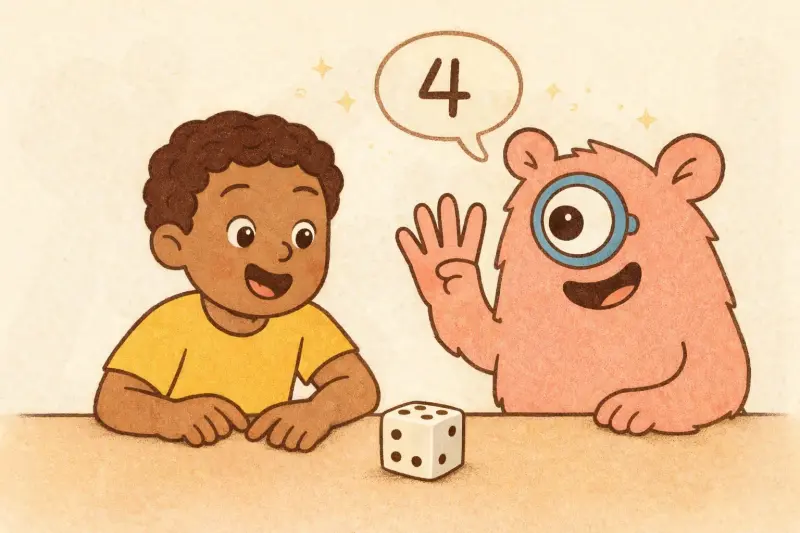
Where the Word "Subitizing" Comes From
The term subitizing was coined in 1949 by psychologists E.L. Kaufman, M.W. Lord, T.W. Reese, and J. Volkmann in their landmark paper "The Discrimination of Visual Number," published in The American Journal of Psychology. They derived it from the Latin word subitus, meaning "sudden" — the same root as the Italian subito, which means "immediately" (Kaufman et al., 1949).
Kaufman and his colleagues discovered something striking: when people were shown a small cluster of dots for a fraction of a second, they could report the exact number rapidly, confidently, and accurately — but only up to about four items. Beyond that threshold, speed plummeted and errors spiked. For groups of one to four, adding one more item slowed response time by only 40–100 milliseconds. For groups larger than four, each additional item cost 250–350 milliseconds — a dramatic jump that signaled a completely different cognitive process (counting or estimating) had kicked in.
This wasn't just fast counting. It was a distinct perceptual ability — a kind of number vision. Later research by George Mandler and Billie Jo Shebo confirmed that subitizing small quantities relies on pattern recognition, not mental counting, distinguishing it sharply from both counting and estimating as a cognitive process (Mandler & Shebo, 1982).
Two Types of Subitizing Every Parent Should Know
Not all subitizing is the same. In a highly influential 1999 paper published in Teaching Children Mathematics, researcher Douglas Clements identified two distinct types that develop at different ages and serve different purposes (Clements, 1999).
Perceptual subitizing is the more basic form. It's the instant, effortless recognition of a small quantity — typically one to three or four items — without using any learned mathematical knowledge. When a two-year-old looks at three crackers on a plate and says "three" without pointing at each one, that's perceptual subitizing. This ability appears to be innate, shared with many animal species, and emerges in children as young as two years old.
Conceptual subitizing is more advanced and develops later, typically around age five or six. It involves recognizing a larger quantity by quickly seeing it as composed of smaller groups. A child who looks at a domino showing eight dots and instantly sees "two groups of four" — and therefore "eight" — is using conceptual subitizing. This requires viewing number patterns as what researchers call "units of units" (Clements, 1999).
The distinction matters for parents because conceptual subitizing is a learned skill that directly supports arithmetic. As Clements put it, conceptual subitizing provides an early basis for addition, as students see the addends and the sum. Children who can look at seven dots arranged on a ten frame and instantly see "five and two" are building the mental architecture for addition and subtraction — without memorizing a single flash card.
This part–whole way of seeing numbers is exactly what number bonds make explicit.
Children who cannot subitize conceptually are handicapped in learning such arithmetic processes.
Your Baby Was Born Ready to Subitize
One of the most remarkable findings in numerical cognition research is how early subitizing appears. It's not a skill children learn in kindergarten — it's something their brains are equipped for from the first months of life.
In a groundbreaking 1980 study published in Science, Prentice Starkey and Robert Cooper showed that infants as young as 22 weeks old (about five months) could discriminate between small quantities. Using a habituation paradigm — showing babies the same number of dots until they got bored, then switching to a different number — they demonstrated that infants noticed the change from two dots to three and vice versa. The researchers concluded that some number capacity is present before the onset of verbal counting (Starkey & Cooper, 1980).
Just twelve years later, Karen Wynn pushed the finding even further. In a landmark 1992 paper in Nature, she showed that five-month-old infants could compute simple addition and subtraction. When babies watched one toy placed behind a screen, then a second toy added, they looked longer at the "impossible" outcome of one toy than the "possible" outcome of two — suggesting they expected 1 + 1 = 2. Wynn concluded that humans are innately endowed with arithmetical abilities (Wynn, 1992).
These early capacities are now understood as part of what Lisa Feigenson, Stanislas Dehaene, and Elizabeth Spelke called "core systems of number" — two built-in systems shared across species and present from birth. The first is an Object Tracking System that precisely represents small quantities (up to three or four items, closely linked to subitizing). The second is an Approximate Number System for estimating larger quantities. Together, these systems serve as the foundation for more sophisticated numerical concepts that are uniquely human (Feigenson et al., 2004).
Here's a rough developmental timeline for subitizing based on the research:
Birth to 5 months: Infants can discriminate between small quantities (2 vs. 3)
Around age 2: Perceptual subitizing of small sets (1–3) is clearly established
Ages 3–4: Children subitize quantities up to 3 reliably but still count one-by-one for larger sets
Ages 5–6: Conceptual subitizing begins developing, aided by instruction
First grade and beyond: Children can subitize scrambled arrangements of 4–5 items and begin using conceptual subitizing for quantities up to 10
Why Subitizing Predicts Math Success Years Later
Subitizing isn't just a neat party trick with dice. A growing body of research shows it's one of the strongest early predictors of mathematical achievement — not just in the short term, but years into the future.
Brian Butterworth, one of the world's leading researchers on numerical cognition, has argued that subitizing reflects an innate capacity to understand numerosity — the "number sense" upon which all arithmetic competence is built. In his influential 2005 review in the Journal of Child Psychology and Psychiatry, he presented evidence that this capacity is biologically rooted and that the child's concept of numerosity appears to be innate (Butterworth, 2005).
The longitudinal evidence is compelling. Reeve and Reynolds (2004) found that 6% of children in their first year of school showed no evidence of subitizing ability — and when tested one and two years later, those children were dramatically slower than peers at basic number tasks. Desoete and Grégoire (2006) found that subitizing ability at the end of kindergarten predicted mathematical performance in first grade. Most strikingly, Hannula-Sormunen and colleagues (2015) found that preschool children's subitizing predicted their math performance a full seven years later.
This makes intuitive sense when you think about what subitizing enables. Children who can instantly "see" that four dots is four — without laboriously counting each one — free up mental resources for higher-level thinking. They can compose and decompose numbers, understand number paths and number lines, grasp the meaning of addition as combining groups, and build toward math fact fluency. A child still counting dots one by one is working so hard at the basic level that the bigger picture stays out of reach.
As Clements noted in his 1999 paper, research by Fitzhugh (1978) found that some very young children could subitize sets of one or two but couldn't yet count them — yet none could count sets they couldn't subitize. In other words, subitizing appears to come before counting, not after it.
From there, skip counting is one of the next counting milestones to build.
What the Research Says About Subitizing and Neurodiverse Kids
For parents of children with dyscalculia, ADHD, or autism, subitizing research offers both important warnings and genuine hope.
(For the wider set of strategies across conditions, see our guide to neurodivergent math learning.)
Subitizing and Dyscalculia
The link between subitizing deficits and dyscalculia is one of the most robust findings in numerical cognition research. Butterworth has described a subitizing deficit as the earliest appearance of dyscalculia — a red flag that something in a child's core number processing is different.
In a key 2004 study published in Cognition, Karin Landerl, Anna Bevan, and Brian Butterworth compared children with dyscalculia to typically developing peers on basic number tasks. Children with dyscalculia showed steeper response-time slopes even in the subitizing range of one to three items, suggesting they were counting individual dots rather than instantly recognizing the quantity (Landerl et al., 2004).
Petra Schleifer and Karin Landerl confirmed this with eye-tracking data in 2011. Their study in Developmental Science showed that children with dyscalculia made more eye movements (saccades) even for sets of one to three items — concrete evidence that they were serially scanning and counting rather than subitizing (Schleifer & Landerl, 2011). Most concerning, a longitudinal follow-up by Landerl (2013) found this subitizing deficit was persistent across development: while typically developing children became more efficient subitizers over time, children with dyscalculia did not show the same improvement.
If your child struggles to instantly recognize small groups of dots, seems to count everything one by one even at age five or six, or is slow to answer "how many?" for very small quantities, it may be worth exploring whether a dyscalculia assessment could be helpful.
Subitizing and Autism
The relationship between subitizing and autism is more complex and nuanced. Research paints a mixed picture that likely reflects the wide variability within the autism spectrum itself.
On one hand, Kristina O'Hearn and colleagues found in a 2013 study in the Journal of Experimental Psychology: Human Perception and Performance that participants with autism had a smaller individuation capacity than typically developing controls, and that grouping strategies that helped neurotypical individuals did not provide the same benefit for autistic participants (O'Hearn et al., 2013). A follow-up neuroimaging study showed that adults with autism required more neural resources to process even small quantities, with brain activation patterns suggesting they used counting-like processes where subitizing would normally occur.
On the other hand, research also found that high-functioning preschoolers with autism showed similar early numerical competencies to typically developing peers — and that verbal subitizing had a higher predictive value for later math achievement in autistic children than in neurotypical children. This suggests subitizing may be an especially important skill to nurture in autistic learners.
For parents of autistic children, sensory-friendly math activities that incorporate tactile dot cards or structured visual patterns may be particularly effective approaches to building subitizing skills.
Subitizing and ADHD
Direct peer-reviewed research specifically examining subitizing in children with ADHD is surprisingly sparse. What we do know is that ADHD-related math difficulties tend to stem from working memory and executive function deficits rather than core number sense impairments. This means many children with ADHD may subitize just fine but struggle with the attentional demands of multi-step math problems.
The fast-paced, visual nature of subitizing activities — quick flashes of dot cards, dice rolls, brief pattern displays — may actually suit the ADHD learning profile well. These activities are engaging, require only brief bursts of attention, and deliver immediate feedback. For ADHD-specific math strategies, rapid dot-card practice can be a powerful replacement for slow, frustrating finger counting.
7 Subitizing Activities You Can Do at Home Tonight
The most encouraging finding from subitizing research is that this skill can be trained — and the improvements transfer to broader math ability. Burkhart Fischer and Klaus Hartnegg (2008) demonstrated that a daily training course of just a few weeks improved subitizing ability, and participants made 60% fewer errors on math tests afterward. Remarkably, their math skills continued to improve over the following year without additional subitizing training (Fischer et al., 2008). Sinem Özdem and Sinan Olkun (2021) confirmed these findings with a larger classroom study: eight weeks of conceptual subitizing activities produced significant, lasting improvements in basic number processing, calculation, and overall math achievement in second and third graders (Özdem & Olkun, 2021).
Here are seven research-backed subitizing activities you can start today, organized from simplest to most advanced.
1. Dot card flash. Make simple cards with 1–5 dots in different arrangements (or print free sets online). Flash a card for one to two seconds, cover it, and ask "How many?" Start with 1–3 dots for younger children. The brief exposure time is key — it prevents counting and encourages instant recognition.
2. Dice roll shout-out. Roll a single die and have your child call out the number as fast as possible — no counting allowed. Once they're quick with one die, try two dice: "How many altogether?" This bridges perceptual subitizing (recognizing each die face) into conceptual subitizing (combining the two groups).
3. Ten-frame fill. Draw a simple 2×5 grid (a ten frame) and place small objects in some of the squares. Flash the frame briefly and ask how many. Children naturally begin to see numbers in terms of their relationship to five and ten — "I see five full and two more, that's seven."
Once children can see those parts, the Make 10 strategy turns the same ten-frame into a powerful addition tool.
4. Finger flash. Hold up a number of fingers quickly, then hide your hands. Ask your child how many they saw. Vary which fingers you raise to avoid pattern dependence. This is especially effective because children always have their "manipulatives" with them.
5. Domino match. Spread dominoes face-up and call out a number. Your child races to find a domino that shows that total. This requires conceptual subitizing — seeing each side as a quantity and mentally combining them.
6. Snack-time subitizing. Place a small group of crackers, berries, or cereal pieces on a plate. Cover them briefly with a napkin after a quick peek. "How many goldfish did you see?" This embeds subitizing into daily routines without any setup.
7. Sound subitizing. Clap, tap, or ring a bell a certain number of times and ask your child to tell you the number without counting. This extends subitizing into the auditory domain, building cross-modal number sense.
For more playful ideas that require zero preparation, check out these 10 low-prep math games that use dice and cards — many of which double as subitizing practice. And for children who benefit from tactile, movement-based approaches, board and card games designed for dyscalculia learners like Tiny Polka Dot focus specifically on building subitizing through play.
A key research tip: Butterworth's work emphasizes that subitizing practice is most effective when dots are simple, the background is uncluttered, and arrangements vary. Don't rely only on standard dice patterns — mixing familiar and unfamiliar dot arrangements builds genuine number sense rather than mere pattern matching.
FAQs About Subitizing
What is subitizing in simple terms?
Subitizing is the ability to instantly know how many objects are in a small group without counting them one by one. When you glance at three coins on a table and immediately know there are three — that's subitizing.
At what age do children start subitizing?
Research shows that infants as young as five months can discriminate between small quantities, and clear perceptual subitizing of groups of one to three is established by age two. Conceptual subitizing — seeing larger groups as combinations of smaller ones — develops around age five or six with instruction.
What's the difference between perceptual and conceptual subitizing?
Perceptual subitizing is the instant, effortless recognition of very small quantities (1–3 or 4) and appears to be innate. Conceptual subitizing involves recognizing a larger quantity by quickly seeing it as composed of smaller groups (for example, seeing six dots as "three and three") and is a learned skill.
Is subitizing connected to dyscalculia?
Yes. Multiple peer-reviewed studies have found that children with dyscalculia show significant subitizing deficits — they tend to count even very small groups one by one instead of instantly recognizing the quantity. Difficulty subitizing is considered one of the earliest markers of dyscalculia.
Can subitizing be improved with practice?
Absolutely. Research shows that targeted subitizing training — as little as 15 minutes per day for three to eight weeks — can significantly improve subitizing ability, and these gains transfer to better performance on math tests. The improvements have been shown to persist for at least a year after training ends.
What are the best subitizing activities for kids?
Research-backed activities include dot card flashing, dice games, ten-frame activities, finger flash games, and domino matching. The key is to show quantities briefly (one to two seconds) so children must recognize the number instantly rather than counting.
Why is subitizing important for early math?
Subitizing is one of the strongest early predictors of later math achievement. It builds the foundation for counting, addition, subtraction, and understanding number relationships. Children who subitize well can compose and decompose numbers mentally — the basis of arithmetic fluency.
Does subitizing help kids with ADHD?
While direct research on subitizing and ADHD is limited, the fast-paced, visual nature of subitizing activities aligns well with ADHD learning profiles. Quick dot-card games provide engaging, bite-sized number practice that doesn't require sustained attention.
References
Butterworth, B. (2005). The development of arithmetical abilities. Journal of Child Psychology and Psychiatry, 46(1), 3–18. Open access PDF
Clements, D. H. (1999). Subitizing: What is it? Why teach it? Teaching Children Mathematics, 5(7), 400–405. Open access PDF
Feigenson, L., Dehaene, S., & Spelke, E. S. (2004). Core systems of number. Trends in Cognitive Sciences, 8(7), 307–314. https://doi.org/10.1016/j.tics.2004.05.002
Fischer, B., Gebhardt, C., & Hartnegg, K. (2008). Subitizing and visual counting in children with problems in acquiring basic arithmetic skills. Optometry and Vision Development, 39(1), 24–29.
Kaufman, E. L., Lord, M. W., Reese, T. W., & Volkmann, J. (1949). The discrimination of visual number. The American Journal of Psychology, 62(4), 498–525. https://doi.org/10.2307/1418556
Landerl, K., Bevan, A., & Butterworth, B. (2004). Developmental dyscalculia and basic numerical capacities: A study of 8–9-year-old students. Cognition, 93(2), 99–125. https://doi.org/10.1016/j.cognition.2003.11.004
Landerl, K. (2013). Development of numerical processing in children with typical and dyscalculic arithmetic skills — a longitudinal study. Frontiers in Psychology, 4, 459. Open access
Mandler, G., & Shebo, B. J. (1982). Subitizing: An analysis of its component processes. Journal of Experimental Psychology: General, 111(1), 1–22. Open access PDF
O'Hearn, K., Franconeri, S., Wright, C., Minshew, N., & Luna, B. (2013). The development of individuation in autism. Journal of Experimental Psychology: Human Perception and Performance, 39(2), 494–509. Open access (PMC)
Özdem, S., & Olkun, S. (2021). Improving mathematics achievement via conceptual subitizing skill training. International Journal of Mathematical Education in Science and Technology, 52(4), 565–579. https://doi.org/10.1080/0020739X.2019.1694710
Titeca D, et al. (2014). Preschool predictors of mathematics in first grade children with autism spectrum disorder. Research in Developmental Disabilities, 35(11), 2714–2727. https://doi.org/10.1016/j.ridd.2014.07.012
Schleifer, P., & Landerl, K. (2011). Subitizing and counting in typical and atypical development. Developmental Science, 14(2), 280–291. https://doi.org/10.1111/j.1467-7687.2010.00976.x
Starkey, P., & Cooper, R. G., Jr. (1980). Perception of numbers by human infants. Science, 210(4473), 1033–1035. https://doi.org/10.1126/science.7434014
Wilson, A. J., Revkin, S. K., Cohen, D., Cohen, L., & Dehaene, S. (2006). An open trial assessment of "The Number Race," an adaptive computer game for remediation of dyscalculia. Behavioral and Brain Functions, 2, 20. Open access
Wynn, K. (1992). Addition and subtraction by human infants. Nature, 358(6389), 749–750. https://doi.org/10.1038/358749a0