TL;DR
Differentiated math instruction means adjusting what you teach, how you teach it, and how students show what they know - so every learner can access the same mathematical goals. The 8 evidence-backed strategies covered here are: (1) tiered assignments, (2) flexible grouping, (3) formative assessment as a daily tool, (4) the Concrete–Representational–Abstract (CRA) sequence, (5) open-ended tasks with multiple entry points, (6) math centres / station rotations, (7) choice boards, and (8) scaffolded questioning. Used together, they reduce the achievement gap while keeping the classroom manageable for teachers.
Walk into almost any elementary or middle school math class and you will find a wide spectrum of learners sitting side by side. Some students arrive already comfortable with the day's concept; others are still consolidating skills from two units ago. Teaching one lesson to all of them - at the same pace, with the same worksheet - means someone is always lost and someone is always bored.
That gap is exactly what differentiated math instruction is designed to close. Research describes differentiation as a teacher's proactive response to learner needs, achieved by modifying content, process, product, and environment according to each student's readiness, interests, and learning profile. In plain terms: same destination, multiple routes to get there.
Below are eight strategies grounded in peer-reviewed research. They are practical, classroom-tested, and designed to work together rather than in isolation.
1. Tiered Assignments
Tiered assignments are the backbone of differentiation in math. All students work toward the same learning goal, but the complexity of the task is adjusted for different readiness levels. A lesson on fractions, for example, might have one group using paper shapes to explore halves and thirds, another group comparing unit fractions on a number line, and a third group reasoning about equivalent fractions in word problems.
The core principle is simple: every student should be working in their zone of proximal development - challenged, not overwhelmed, and not bored. Tiering works because it removes the compromise of whole-class instruction pitched at the middle, which routinely leaves struggling students lost and advanced students disengaged. When tasks are matched to readiness, all students spend more time doing productive mathematical thinking.
Research backs this up - a systematic review found that differentiated instructional approaches, including tiered tasks, were associated with predominantly positive effects on student achievement in mixed-ability classrooms.
A practical starting point: use Bloom's Taxonomy - a six-level framework for thinking about learning complexity - to design three versions of the same task by grouping the levels into lower, middle, and higher order thinking. Rotate which students access which tier based on ongoing assessment data, not fixed ability labels.
2. Flexible Grouping
Flexible grouping means students are organised into temporary groups based on their current learning needs - and those groups change regularly. Sometimes you group by readiness (skill-based groups for targeted instruction); other times by interest or learning style (mixed groups for collaborative problem-solving).
Research highlights the importance of flexible grouping in differentiated classrooms. Rather than relying on fixed ability groups, effective instruction shifts between whole-class, small-group, and individual work based on student needs. This flexibility helps avoid the trap of students being permanently labelled into “low” groups - something research has linked to lower motivation and self-efficacy.
Practically, consider running a "pull-aside" small group three to four times a week - five to eight students who need reteaching or enrichment - while the rest of the class works at stations. Shift group membership at least every two to three weeks based on formative data.
3. Formative Assessment as a Daily Compass
Differentiation without accurate data is guesswork. Formative assessment - exit tickets, mini whiteboards, thumbs-up/thumbs-down checks, observation notes - gives teachers the real-time information needed to adjust groupings, re-teach, or extend.
Research is explicit on this point: continuous monitoring and differentiated instruction are inseparable. High-quality differentiation is based on the frequent assessment of learning needs and flexible adaptations to meet those needs - not a one-time pre-test at the start of a unit.
A simple but powerful routine: end every math lesson with a three-question exit ticket. One question checks recall, one checks understanding, one asks students to apply the concept in a slightly new context. Sort the tickets into three piles before the next lesson, and use those piles to form your flexible groups.
4. The Concrete–Representational–Abstract (CRA) Sequence
The CRA framework is one of the most evidence-rich approaches in math education. Students move through three stages: first manipulating physical objects (concrete), then drawing or diagramming (representational), and finally working with symbols and equations (abstract). The progression is designed so that abstract notation is always rooted in something students have touched and seen.
A 2025 meta-analysis examined 30 single-case studies and found the CRA approach to be a highly effective math intervention. Students who first build a concept with base-ten blocks, then sketch it, then write the equation consistently outperform peers who start with abstract notation.
For differentiation specifically, CRA is powerful because students can work at different points along the sequence during the same lesson. Struggling learners stay at the concrete stage longer; students who have mastered the concept move to abstract extensions - all within the same lesson structure. We explored how this works in our piece on what the research says about the best ways to learn math.
5. Open-Ended Tasks with Multiple Entry Points
A well-designed open-ended task is naturally differentiated. Rather than a problem with one correct answer reached one correct way, an open task invites many solution strategies and allows students to engage at different levels of sophistication. "How many different ways can you make 24?" produces very different work from a student skip-counting in 2s and a student factoring - but both are doing meaningful math.
Research shows that open-ended, low-floor/high-ceiling tasks allow all students to engage with the same problem at their own level. This creates opportunities for more inclusive, whole-class mathematical experiences, reducing the need for rigid ability grouping. The key design principle: tasks should have a low enough floor that every student can begin, and a high enough ceiling that no student hits a dead end.
When planning, ask yourself: "Can a student who is still building foundational skills access this task, and can a student who has already mastered the concept extend it meaningfully?" If the answer to both is yes, the task earns its place in a differentiated classroom.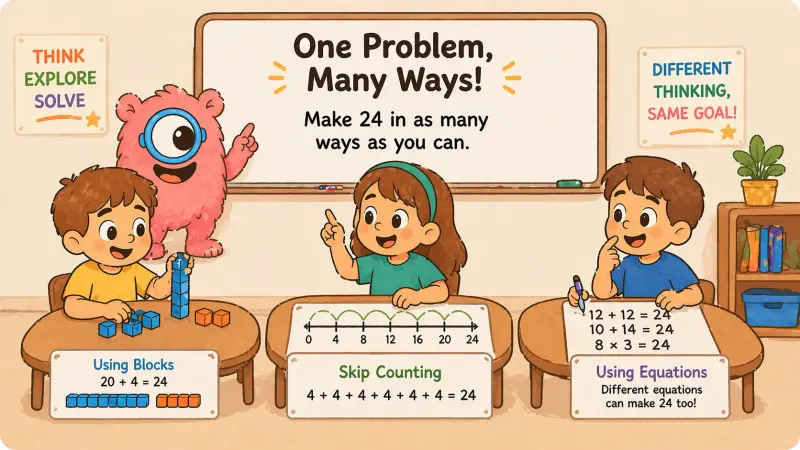
6. Math Centres and Station Rotations
Station rotations - where students cycle through different learning centres while the teacher pulls small groups - are one of the most practical structures for delivering differentiated math instruction at scale. Each station targets a different modality or level of practice: a hands-on manipulative station, a partner game, a digital practice tool, and a teacher-led group.
An action research study found that small-group interactions - where students think aloud and receive feedback from peers on their strategies - supported deeper mathematical engagement and learning.
The station model also protects the most valuable resource in a differentiated classroom: teacher time with small groups. We have a full breakdown of how to set this up in our guide to engaging math centre activities for elementary classrooms.
7. Choice Boards
A choice board is a grid of tasks - usually nine, arranged like a tic-tac-toe board - from which students select activities to complete. Tasks are designed to address the same learning objective but through different formats: a visual model, a written explanation, a real-world problem, a game, a creative project. Students choose the path that suits their learning style and readiness.
Choice is a core element of differentiation because it transfers some agency to the student. Research found that when teachers provide differentiated autonomy support - including meaningful choices about how students engage with tasks - it is directly linked to higher student motivation in elementary classrooms. When students feel they have some control over how they learn, participation tends to increase - particularly for students who have experienced repeated frustration in traditional math instruction.
Design tip: make sure every cell on the choice board genuinely practices the target skill, not just the most interesting-looking ones. A common mistake is placing the highest-value tasks at the "fun" activities and rote drill at the corners - students learn which boxes to avoid.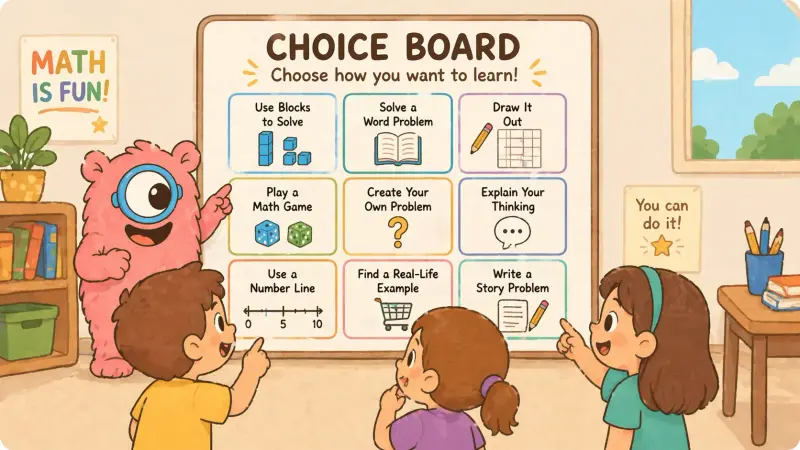
8. Scaffolded Questioning
How teachers ask questions is itself a differentiation tool. Scaffolded questioning means moving deliberately from simpler recall questions ("What do you notice about these numbers?") to deeper analysis ("Why does that pattern work?") to synthesis ("Can you create a problem that uses this same relationship?"). Different students can respond meaningfully at different points on that continuum during the same class discussion.
Equally important is giving students time to think. A study examined the role of wait time in classroom interactions and found that when teachers extended the pause after a question beyond the typical one second, students produced longer responses with more reasoning, showed more confidence in their answers, and engaged more actively in discussion.
A practical technique: after posing a question, give students 60 seconds of silent think time before accepting any answers. This levels the playing field between fast processors and students who need a moment to organise their thinking - and it dramatically increases the quality of responses across the board.
A Realistic Starting Point
Eight strategies can feel like a lot, and the research is clear that implementation takes time. A study found that teachers with less than three years of experience rated their differentiated instruction implementation significantly lower than more experienced colleagues - and that strategies implemented most often were also the easiest to learn. Start with one or two, build confidence, and layer in more over time.
A reasonable sequence: begin with formative exit tickets and use the data to form one flexible small group per week. Once that feels manageable, introduce tiered assignments for one lesson per unit. From there, build toward a full station rotation model. Each step makes the next one easier, because the classroom culture and student routines are already shifting to support differentiation.
FAQs
What is differentiated math instruction?
Differentiated math instruction is a teaching approach that adjusts the content, process, product, or environment of a lesson to meet the diverse readiness levels, interests, and learning profiles of students. All students work toward the same mathematical goals, but the path to get there is flexible.
Does differentiated instruction actually improve math achievement?
The evidence is generally positive when differentiation is implemented with fidelity. Studies on tiered assignments and small-group instruction consistently show moderate to strong positive effects. The key variable is quality of implementation - sporadic or surface-level differentiation shows weaker results than systematic, data-driven differentiation.
How is differentiated instruction different from individualised instruction?
Individualised instruction means crafting a unique plan for every single student - which is rarely sustainable at scale. Differentiated instruction works at the group level, creating a small number of pathways (typically two to four) that together cover the range of learners in the room. It is manageable precisely because it does not require a separate lesson plan for every child.
What is the easiest differentiated instruction strategy to start with?
Most teachers find formative exit tickets the lowest-barrier entry point. They take less than five minutes to administer, generate immediately useful data, and naturally lead to flexible grouping decisions the next day - without requiring any additional planning upfront.
How often should flexible groups change?
Research recommends reassessing group membership at least every two to three weeks, based on formative assessment data. Groups that stay fixed for an entire term begin to function more like ability tracks, which can negatively affect the motivation of students in lower groups.
Can differentiated instruction work with large class sizes?
Yes, though it requires deliberate structure. Station rotation models are particularly effective for larger classes because they allow the teacher to work with one targeted small group at a time while the rest of the class runs independently. Clear task cards and well-practised routines are essential for this to work smoothly.
References:
Hayden, S. M., Gubbins, E. J., Cody, R. A., & Boldt, G. T. (2024). Teachers' perceptions of differentiation following a math curriculum implementation study. Journal for the Education of the Gifted.https://journals.sagepub.com/doi/10.1177/01623532231215092
Ziernwald, L., Hillmayr, D., & Holzberger, D. (2022). Promoting high-achieving students through differentiated instruction in mixed-ability classrooms: A systematic review. Journal of Advanced Academics, 33(4), 540–573. https://journals.sagepub.com/doi/10.1177/1932202X221112931
Smale-Jacobse, A. E., Meijer, A., Helms-Lorenz, M., & Maulana, R. (2019). Differentiated instruction in secondary education: A systematic review of research evidence. Frontiers in Psychology, 10, 2366. https://pmc.ncbi.nlm.nih.gov/articles/PMC6883934/
Domen, J., Hornstra, L., Weijers, D., van der Veen, I., & Peetsma, T. (2020). Differentiated need support by teachers: Student-specific provision of autonomy and structure and relations with student motivation. British Journal of Educational Psychology, 90(2), 403–423. https://pmc.ncbi.nlm.nih.gov/articles/PMC7318603/
Ingram, J., & Elliott, V. (2016). A critical analysis of the role of wait time in classroom interactions and the effects on student and teacher interactional behaviours. Cambridge Journal of Education, 46(1), 37–53. https://ora.ox.ac.uk/objects/uuid:86174d4a-c191-404e-ab49-e80b5e6718ad/files/r8c97kr18g
Ebner, S., MacDonald, M. K., Grekov, P., & Aspiranti, K. B. (2025). A meta-analytic review of the concrete-representational-abstract math approach. Learning Disabilities Research & Practice.https://journals.sagepub.com/doi/10.1177/09388982241292299
Cannon, M. A. (2017). Differentiated mathematics instruction: An action research study. Doctoral dissertation, University of South Carolina. https://scholarcommons.sc.edu/cgi/viewcontent.cgi?article=5235&context=etd
Van Geel, M., Keuning, T., & Safar, I. (2022). How teachers develop skills for implementing differentiated instruction: Helpful and hindering factors. Teaching and Teacher Education: Leadership and Professional Development, 1, 100007. https://www.sciencedirect.com/science/article/pii/S2667320722000069
Bobis, J., Russo, J., Downton, A., Feng, M., Livy, S., McCormick, M., & Sullivan, P. (2021). Instructional moves that increase chances of engaging all students in learning mathematics. Mathematics, 9(6), 582. https://www.mdpi.com/2227-7390/9/6/582