TL;DR: Skip counting means counting forward or backward in equal jumps - by 2s, 5s, 10s, or any number - instead of one by one. It's one of the most important early math skills because it builds number sense, reveals number patterns, and lays the groundwork for multiplication and division. Children typically start learning to skip count in kindergarten. Peer-reviewed research confirms that fluency in skip counting is linked to stronger math performance all the way through elementary school.
If you've ever watched a child count a pile of coins by fives - "5, 10, 15, 20!" - you've already seen skip counting in action. It looks simple, almost playful. But don't be fooled by the apparent simplicity: underneath that rhythmic chant is some seriously foundational math.
In this article, we're going to break down exactly what skip counting is, why educators and researchers care so much about it, how it connects to multiplication, and what you can do at home to help your child build this skill confidently.
What Is Skip Counting?
Skip counting is the practice of counting forward or backward by a number other than 1. When you skip count, you're "jumping over" a set number of places in the counting sequence each time. Here are the most common examples children learn first:
By 2s: 2, 4, 6, 8, 10, 12 …
By 5s: 5, 10, 15, 20, 25 …
By 10s: 10, 20, 30, 40, 50 …
By 3s: 3, 6, 9, 12, 15 …
Notice anything? If you read down that list of 3s, you're looking at the 3 times table. That's not a coincidence - and we'll come back to it.
Skip counting can start from any number, not just zero. Counting by 4s starting from 2 gives you 2, 6, 10, 14… That flexibility is part of what makes it such a versatile mathematical tool.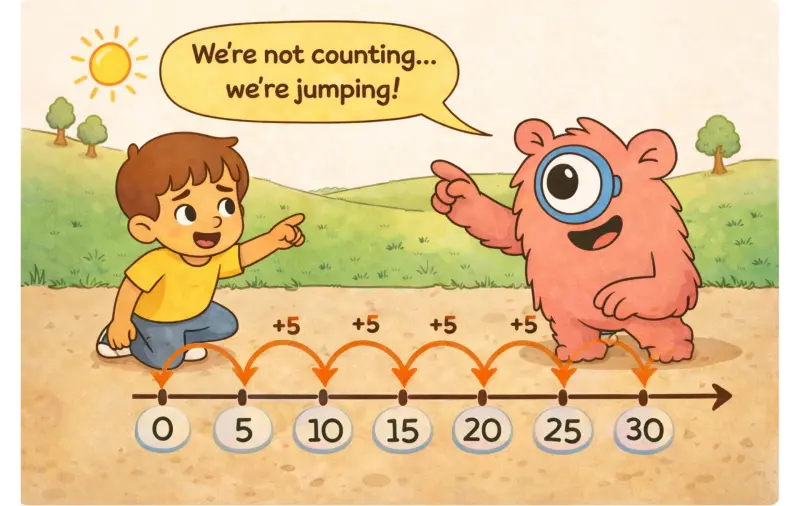
When Do Children Learn Skip Counting?
Most children begin skip counting in kindergarten, typically starting with 5s and 10s because those patterns are the easiest to see and hear. By first grade, skip counting by 2s is introduced, and by second grade, children are expected to be comfortable with 2s, 5s, and 10s. More complex intervals - 3s, 4s, 6s - usually come later as children develop greater numerical confidence.
That said, there's no harm in introducing skip counting informally before school even starts. Many 4 and 5-year-olds who are comfortable counting to 10 are ready to try jumping by 2s - especially if it's framed as a game.
Why Is Skip Counting So Important?
Here's where things get interesting. Skip counting isn't just a faster way to count - it's an early exercise in mathematical thinking. Let's unpack why it matters so much.
It Builds Number Sense
Number sense is the ability to understand how numbers work, relate, and can be used flexibly. It's the difference between a child who can only retrieve "7 + 5 = 12" from memory and a child who thinks, "Well, 7 + 5 is the same as 7 + 3 + 2, which is 12." Skip counting is one of the earliest ways children start developing this intuitive relationship with numbers.
Before skip counting, subitizing — instantly recognising small quantities — lays the groundwork.
A 2025 review synthesizes research showing that skip counting with visual manipulatives, such as number lines, helps learners develop stronger conceptual understanding, improved recall, and greater confidence in solving mathematical problems - highlighting that skip counting is a sense-making process rather than mere memorisation.
That visual/concrete-to-abstract progression is the CRA method — see our complete guide.
It Reveals Number Patterns
One of the most underappreciated benefits of skip counting is the way it makes patterns visible. When children count by 10s, they quickly notice that every answer ends in a 0. When they count by 2s, every answer is even. These aren't trivial observations - they're a child's first encounter with mathematical structure, and research shows they matter.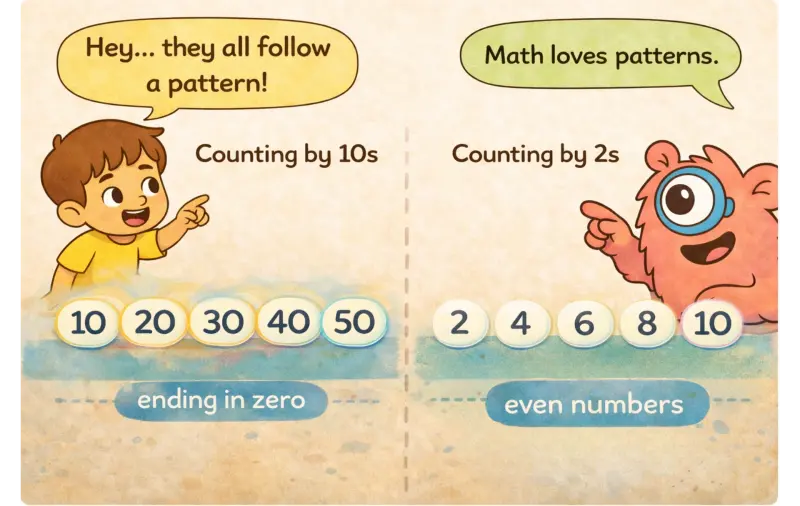
Research has consistently linked skip counting fluency to stronger arithmetic outcomes. A peer-reviewed study found that a skip-counting intervention of a few sessions produced remarkable improvements in elementary students' multiplication fluency - with participant reaching mastery on previously unsolvable fact sets.
It's the Bridge to Multiplication
This is the big one. Skip counting and multiplication are, at their core, the same idea expressed differently. When a child counts "3, 6, 9, 12," they are essentially solving 3×1, 3×2, 3×3, 3×4 - they just don't know it yet.
"Skip counting lays the groundwork for multiplication by helping kids think in equal intervals, visualize repeated groups, and build number sense in a way that feels natural."
Research on children’s mathematical development shows that skip counting can signal an important cognitive shift. Work by Jeffrey Wilkins and Caroline Ulrich highlights that progress in mathematics depends on children learning to construct composite units - seeing numbers as groups that can be iterated (like thinking of 5 as a unit that becomes 10, 15, 20…).
This part–whole view of number is the same idea behind number bonds, but without the composite units being repeated.
Skip counting is one way this shift becomes visible, as it reflects coordinating equal groups rather than counting by ones. This ability forms the foundation for multiplicative reasoning and supports later learning in fractions, proportional reasoning, and algebra. When this shift doesn’t fully develop, students often continue relying on additive strategies, which can make more advanced topics significantly harder to grasp.
This shift is exactly what helps children move from counting to understanding multiplication.
If you want to show your child this bridge directly, our free Times Table Explorer lays out each times table as both a skip-count sequence and a list of multiplication facts in one view. The 3× table reads as 3, 6, 9, 12... with the matching equations (3×1=3, 3×2=6, 3×3=9, 3×4=12) right there. It makes the 'same idea, expressed differently' point concrete in a single screen
For a deeper look at how this connection plays out in practice, our article on multiplication for dyscalculia walks through the whole journey from skip counting to arrays - it's a great read for any parent whose child is starting to make the leap to times tables.
See also think multiplication: a smarter way to learn division and multiplication and division strategies for 3rd graders.
It Supports Real-World Math Skills
Skip counting by 5s and 10s is directly useful for counting money. Skip counting by 5s also supports telling time on an analog clock. These practical applications mean that strong skip counting skills translate immediately to tasks children encounter every day - making it one of those rare mathematical skills that is both foundational and immediately useful.
The Research Case for Skip Counting
A study published in the International Journal of Special Education found that explicitly teaching skip counting significantly improved both the accuracy and speed of math facts in students with learning difficulties, highlighting it as an effective, teachable strategy rather than relying on memorisation alone.
Research published in Insights into Learning Disabilities applied the Count-Bys (skip counting) method with a student who was almost entirely unable to perform multiplications before the intervention. After just two weeks of practising skip counting across three fact sets, the student reached mastery and maintained those gains during a follow-up phase - showing that skip counting doesn't just teach facts temporarily, it consolidates them.
A peer-reviewed study found that integrating skip counting using visual number lines led to stronger number sense, improved recall of multiplication facts, and greater learner confidence in elementary school students. The researchers concluded that visual number lines reduce cognitive load by organising information into manageable segments - exactly the scaffolding children need when moving from counting to calculation.
A 2025 synthesis of several peer-reviewed studies found that when children are explicitly taught structured ways of counting - not just asked to repeat numbers - they show meaningful improvements in early math performance, with gains extending to skills like addition and subtraction. These findings show that good counting skills are the foundation for math, and skip counting is one powerful way to build them.
How to Practice Skip Counting at Home
The good news is that skip counting is one of the easiest math skills to practice naturally, without it feeling like homework. Here are some approaches that work well:
Use Movement
Have your child hop, clap, or stomp on the "skip" numbers and stay still (or whisper) for the in-between ones. For example, counting by 5s: stomp on 5, whisper 6, 7, 8, 9, stomp on 10. The physical rhythm makes the pattern stick. Research on multisensory learning consistently shows that engaging movement alongside number sequences improves retention - something we explore further in our article on multisensory math strategies.
Use Number Lines Visually
Draw a number line or a number path and have your child draw "jumps" of 5 or 10. Seeing the equal-sized gaps on a visual model helps children understand that skip counting isn't magic - it's repeated addition made visible.
Read more about number paths vs. number lines.
Make It Contextual
Count coins by 5s or 10s. Count chairs around the table by 2s. Count eggs in a carton by 3s. Real-world contexts give skip counting immediate meaning, which research shows improves comprehension and recall compared to abstract drills.
Use Songs and Rhythms
There's a reason skip counting songs have been a classroom staple for decades - they work. Rhythmic, auditory repetition helps children internalize sequences without it feeling like rote memorization. YouTube has plenty of skip counting songs for different intervals if you need inspiration.
Try Games and Apps
Games that incorporate skip counting - whether board games, card games, or apps - provide the repetition needed to build fluency without the boredom of worksheets. The key is varied practice: see it, hear it, say it, move to it.
Common Challenges (And How to Help)
Some children find skip counting tricky, and that's completely normal. A few common sticking points:
Starting from a number other than zero. Many children can count by 5s from 0 but struggle if you say "Start at 15 and count by 3s." Practice this by playing "start anywhere" games once the basic sequences feel solid.
Counting backwards. Backward skip counting is harder because it requires subtraction instead of addition. Start with forward skip counting and introduce backwards counting gradually - it's a different, slightly more advanced skill.
Mixing up sequences. A child who's just learning 3s might slip into 2s or 5s mid-sequence. This is normal. Visual tools like hundred charts - where you colour every third square - can help lock in the specific rhythm of each sequence.
If your child is struggling consistently despite practice, it may be worth reading about why skip counting can be a lifeline for children with dyscalculia, a math learning difficulty that affects around 3-6% of school-age children. Our parent's guide to what dyscalculia is also explains the signs and what helps.
See also our broader guide to neurodivergent math learning strategies.
FAQs:
What is skip counting in simple terms?
Skip counting means counting in equal jumps - for example, by 2s (2, 4, 6, 8…), by 5s (5, 10, 15, 20…), or by 10s (10, 20, 30…) - instead of counting every number one by one.
At what age should children start skip counting?
Most children start skip counting in kindergarten (around ages 5-6), beginning with 5s and 10s. Skip counting by 2s is usually introduced in first grade, with more complex intervals following in second grade and beyond. That said, informal introduction can start earlier if a child is comfortable with basic counting.
How does skip counting relate to multiplication?
Skip counting is essentially repeated addition - the same idea that underlies multiplication. When a child counts by 4s (4, 8, 12, 16…), they are generating the 4 times table. This connection means that a child who is fluent at skip counting has a significant head start on understanding multiplication conceptually, not just as memorized facts.
What order should skip counting be taught?
Educators generally recommend starting with 10s (easiest pattern), then 5s, then 2s. After those feel solid, children are ready for 3s, 4s, and then more complex intervals. Each new sequence builds on the number sense developed from the previous ones.
Is skip counting the same as counting by multiples?
Yes - skip counting produces the sequence of multiples for whatever number you're counting by. Counting by 6s gives you the multiples of 6: 6, 12, 18, 24… This is why fluency in skip counting is such a powerful preparation for the times tables.
What if my child can skip count but still struggles with multiplication?
Skip counting is a great starting point, but multiplication also requires understanding the concept of equal groups. If your child can chant the sequences but doesn't connect them to multiplication equations, try using arrays, number lines with labelled jumps, and concrete objects before moving to abstract facts.
References:
Grünke, M. (2016). Fostering Multiplication Fluency Skills Through Skip Counting. International Journal of Basic and Applied Science, 4(4), 1–6. ResearchGate full text
Akther, S. S., Powell, S. R., & Lariviere, D. O. (2025). Counting-Focused Intervention Effects for Students With Mathematics Difficulty: A Research Synthesis. Learning Disabilities Research & Practice, 40(3). doi:10.1177/09388982251321538
Medina, C. G. (2025). Enhancing Multiplication Skills of Learners Through Skip Counting on Visual Manipulatives. Cognizance Journal of Multidisciplinary Studies, 5(12), 58–68. Full text (PDF)
Ulrich, C., & Wilkins, J. L. M. (2017). Using written work to investigate stages in sixth-grade students' construction and coordination of units. International Journal of STEM Education, 4, 23. doi:10.1186/s40594-017-0085-0
DuVall, T. D., McLaughlin, T. F., & Cooke-Sederstrom, G. C. (2003). The differential effects of skip counting and previewing on accuracy and fluency of math facts with middle school children with learning disabilities. International Journal of Special Education, 18(1), 1–6. ResearchGate full text
Grünke, M., & Calder Stegemann, K. (2014). Using Count-Bys to promote multiplication fact acquisition for a student with mild cognitive delays: A case report. Insights into Learning Disabilities, 11(2), 117–128. ResearchGate full text