TLDR: Math centers split your class into small groups that rotate through different activities at the same time. You teach a targeted group at your table. The other stations run themselves. Below are 10 specific, low-prep activities that make that possible.
What are math centers?
Math centers - sometimes called math stations or math rotations - are a way of structuring your math block so that small groups of students work on different tasks simultaneously, rather than the whole class doing the same thing at the same time. Instead of 25 students doing the same thing, you split the class into groups of 4-6 and set up 3-5 stations around the room. Each station is self-contained - a game, a hands-on task, a writing prompt. Students work independently or in pairs, which frees you to pull a small group and teach to exactly what they need.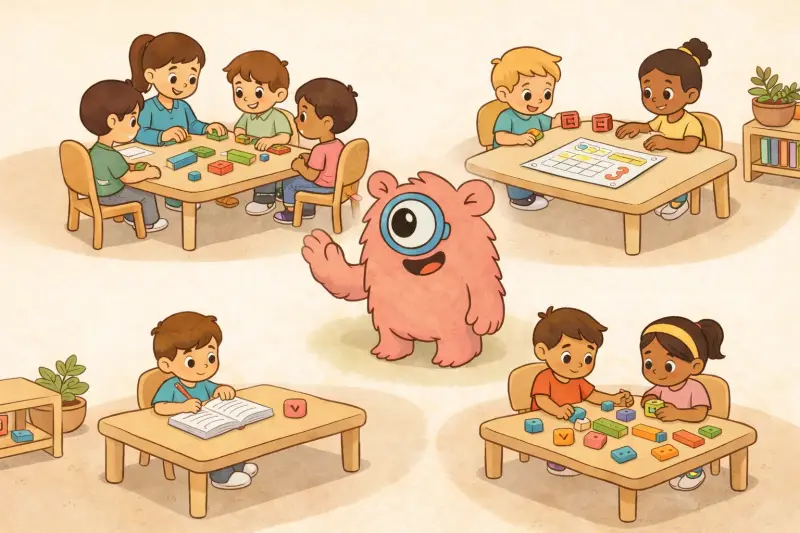
A typical 60-minute block looks like this:
The four station types
Why bother setting them up?
Whole-class instruction can only ever teach to one level at a time. Pitch it to the middle and the students who are behind get lost, while the students who are ahead get bored. Centers solve this by letting you differentiate through the activities themselves - and by giving you daily protected time at your small-group table, where you can actually move individual students forward.
The research backs this up. A meta-analysis found that students working in cooperative, small-group settings showed significantly better math achievement than those in traditional classrooms. And another study found that learning center models significantly outperformed direct instruction.
That said, centers only work when activities are clear enough for students to run independently. Vague stations create noise and off-task behavior - and then you can't teach your small group while managing the rest of the room. Every activity below is specific enough that a student can read the task card and start without asking you.
The 10 activities
💡 Starting out? Use 3 stations, not 10. Spend a full week on routines before introducing new content. Once students know how centers work, the learning takes care of itself.
1. Roll & race
Players: 2 Materials: 2 dice + number line or 100-chart Grades: K–5
Roll both dice, add the numbers, and circle that answer on a shared chart in your color. If the number is already circled, lose your turn. First to circle 10 numbers wins.
Grade adjustments:
K–1 - One die, add to a fixed number, use a 0-10 line
2–3 - Two dice, add or subtract
4–5 - Multiply instead of adding, use a 1–100 chart
2. Salute!
Players: 3 · Materials: 1 deck of cards (remove face cards, Ace = 1)
Grades: 1–5
One student is the caller. The other two each draw a card and press it face-out to their own forehead - they can see each other's card but not their own. The caller says the sum. Each player uses the sum and the visible card to figure out their own number. First to call it correctly wins both cards. Rotate the caller every 5 rounds.
Grades 4–5: Caller announces the product instead of the sum.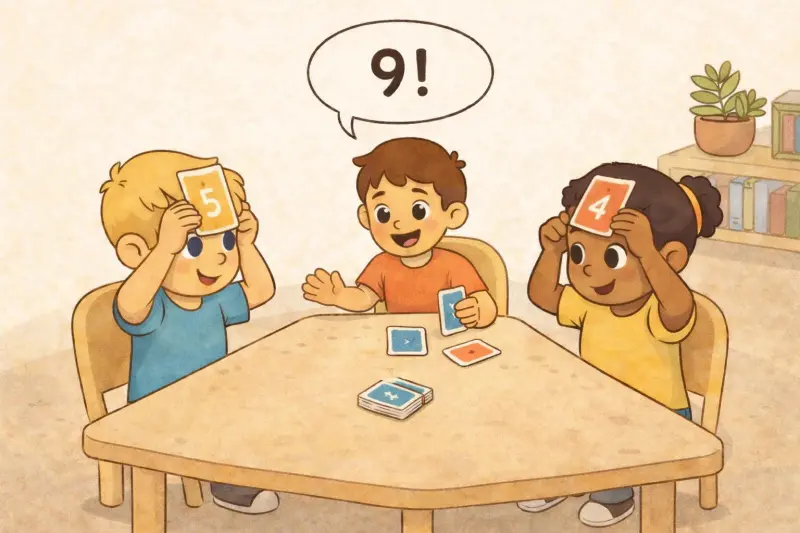
3. Number of the day
Players: Individual · Materials: Laminated mat + dry-erase markers
Grades: K–5
You write one number on the mat each morning. Students spend the rotation representing it in as many ways as they can.
What goes on the mat:
Ten frame
Tally marks
Mark on a number line
Expanded form
1 more / 1 less / 10 more / 10 less
Draw this many things
Write a word problem using this number
Teacher tip: Tie the number to your lesson. Students arrive at your small-group table having already worked with it - gives your instruction a running start.
4. Sorting mats
Players: Pairs · Materials: Printed cards + laminated sorting mat · Grades: 1–5
Students sort a pile of cards into labeled columns on a laminated mat, then explain their choices to a partner. Disagreements are the point - that's the math conversation you want happening while you're at your table.
Ideas by grade:
Grade 1 - Numbers 1–20: less than / equal to / more than 10
Grade 2 - Addition sums: even / odd
Grade 3 - Multiplication products: under 20 / 20–40 / over 40
Grade 4 - Fractions: less than / equal to / greater than ½
Grade 5 - 2D shapes by lines of symmetry: 0 / 1 / 2 / more
Open-ended version: Give students a blank mat. "Sort these any way you like. Be ready to explain your rule." Reveals more about thinking than any fixed sort.
5. Domino addition wall
Players: 1–2 · Materials: Double-six domino set · Grades: K–2
Draw dominoes from a pile, add both sides, and slide each new domino into the correct spot in a line from smallest sum to largest. Every placement requires comparison.
Early finisher challenges:
Find two dominoes with the same sum
Find a domino where one side is double the other
Find all the dominoes that equal 7
Optional: record every addition sentence in order on a sheet to bring back as evidence of work.
6. Place value dice
Players: 1–2 · Materials: 3–4 dice + paper · Grades: 2–5
Roll 3 dice. Write the three digits without assigning place values yet. Then arrange them to make the largest possible number, rearrange to make the smallest, write both in expanded form, and find the difference.
Grades 4-5: Use 5 dice and 5-digit numbers. Add: "Round to the nearest thousand."
Competitive version: Both players roll the same dice simultaneously. Each secretly arranges their digits, then both reveal at once. Bigger number scores a point. Play 6 rounds.
7. Fraction strips comparison
Players: Pairs · Materials: Paper fraction strips + recording sheet
Grades: 3–5
Students use paper strips folded into halves, thirds, fourths, sixths, and eighths to compare fractions side by side. They can see why ¾ is bigger than ⅔ instead of relying on an algorithm they might misremember.
Steps:
Each student gets strips: whole, ½, ⅓, ¼, ⅙, ⅛
Task card shows a pair of fractions to compare
Build each fraction by lining up pieces end to end
Record which is larger and write a sentence explaining why
Challenge: Arrange four fractions least to greatest using the strips, then transfer the order onto a number line.
8. Multiplication arrays on graph paper
Players: Individual · Materials: Graph paper + colored pencils · Grades: 3–5
Students pick a target number and draw every rectangle that can be made with exactly that many squares. For 12: a 1×12, a 2×6, a 3×4, and their reverses. They write the multiplication sentence inside each rectangle and list all factors at the bottom.
Good target numbers: 12, 16, 18, 24, 36
Bonus: The 3×4 rectangle showing 3×4=12 also shows 12÷3=4. Point this out every time - it's a free division lesson.
9. Math journal prompts
Players: Individual · Materials: Composition notebook + laminated prompt card · Grades: K–5 · Swap weekly
One laminated card, one prompt, students write for the duration of the rotation. This is the quietest center - and often the one that reveals the most about how students are actually thinking.
Prompts that work:
"Draw two different ways to solve 48 + 37. Which was easier for you, and why?"
"A student says ½ is always smaller than ¾. Is that always true? Explain with a drawing."
"Here's a wrong answer: 3 × 0 = 3. What mistake did this student make?"
"Which is closer to 500 - 487 or 512? Show your thinking two different ways."
Sentence starters to laminate and tape to the table: I think this because… / I notice that… / The tricky part was… / This is like…
How to use journals: Read 5–6 every couple of weeks. You'll catch misconceptions that never surface during lessons - especially from quiet students.
10. Word problem choice board
Players: Individual or pairs · Materials: Laminated 3×3 grid · Grades: 2–5 ·
A 3×3 grid of nine word problems. Students must complete the center square, then choose any two more from the remaining eight. Problems vary in difficulty but aren't labeled - students self-select based on confidence and interest.
How to build yours:
Mix one-step, two-step, and open-ended problems
Vary operations - use money, time, measurement, food, sports
Put a moderately challenging problem in the center (everyone does this one)
Corners slightly harder; edges slightly easier, don't label them
Mark 2–3 problems with ★ to indicate "draw a diagram or model required"
Nobody gets a different-colored worksheet. Nobody knows who's doing what. And everyone ends up with something they can contribute to wrap-up.
Bonus center: digital math games
If your classroom has iPads or Chromebooks, a digital center can be one of the easiest stations to run - and one of the most engaging for students.
The key is choosing tools where the gameplay is actually tied to the math, not just layered on top of it. Games like Monster Math are built around visual problem-solving and strategy-based learning rather than speed or timed drills - a strong fit for center rotations, especially for students who need a lower-pressure environment to build confidence.
How to use it as a center:
Assign 1–2 students per device
Use headphones to reduce noise
Set a specific skill or level range to play
Keep rotations aligned with what you're teaching that week
Teacher tip: Treat digital games like any other station - not a free-for-all. Clear expectations and a defined task make the difference between meaningful practice and screen time.
Want to expand your rotation without adding prep time? Many of the ideas in our low-prep math games guide translate directly into center activities - especially for fluency and partner work.
FAQs:
How many centers should I run at once?
Three to four is the sweet spot when starting out - groups of 5–6, one at your table, one at games, one at manipulatives, one writing. Once routines are solid, add a fifth.
How long should each rotation be?
15–20 minutes fits most 60-minute blocks. For richer tasks (activities 8 or 10), try 25-minute rotations with fewer stations. Rule of thumb: students should feel slightly pressed for time - engaged, not rushed or bored.
What if students finish early?
Build an extension into every station - a harder version on the back of the task card, or a challenge question at the bottom. Students should never have a reason to just sit and wait.
How do I stop it getting noisy and chaotic?
This almost always comes down to unclear routines or a mismatched activity - too easy leads to off-task behavior, too hard leads to frustration. Spend real time on transitions before worrying about the math. A visual timer visible to everyone helps significantly.
How do I assess what students learn at centers?
Your small-group table is your primary window - listen closely and ask questions in the moment. Math journals give you written evidence to review later. A quick "one person per group, tell me something you noticed" at wrap-up gives fast formative data without any grading.
References:
Capar, G., & Tarim, K. (2015). Efficacy of the cooperative learning method on mathematics achievement and attitude: A meta-analysis research. Educational Sciences: Theory and Practice, 15(2), 553–559. https://www.researchgate.net
Culleny, S. R. (2024). Mathematics learning centers – Not just for the elementary classroom. International Journal of Studies in Education and Science (IJSES), 5(3), 182–294. researchgate.net