
TL;DR
IXL is one of the most widely used K–12 practice platforms in the U.S., but it is also one of the most polarizing. On consumer review sites where users self-select to leave feedback, ratings are strikingly low — Trustpilot shows roughly 1.2/5 stars for ixl.com and 1.4/5 for the UK site, Sitejabber sits around 1.4/5 from ~680 reviews, and Common Sense Media parent ratings hover around 2/5. Meanwhile, the iOS app shows about 4.0 stars and the Android app around 4.3 stars from ~19,000 ratings, where a different (largely younger) population is rating.
The single biggest complaint, repeated thousands of times across platforms, is the SmartScore mechanic — particularly the "challenge zone" between 70 and 99 where one wrong answer can erase 7–20 points of progress. Parents and teachers describe children crying, refusing to use it, or developing math anxiety; this concern is amplified for kids with dyscalculia, ADHD, autism, or existing math anxiety, where peer-reviewed research suggests pressure-based, accuracy-driven practice can backfire.
IXL works reasonably well as targeted, standards-aligned practice for already-confident learners and for teachers who need analytics, but it is a poor first-line tool for K–3 neurodiverse learners. For that audience, research more strongly supports visual, conceptual, low-stakes practice over high-stakes drill-and-kill — and there are better-suited alternatives (Khan Academy Kids, Monster Math, Beast Academy, AdaptedMind, depending on age).
Why parents and teachers keep asking, "Is IXL worth it?"
If you teach K–3 — especially in a special education or inclusion setting — you have probably been handed an IXL login and told to "assign 20 minutes a day." If you're a parent, your child's teacher has probably mentioned IXL at conferences, or you've seen it pop up on homeschool curriculum lists. It's everywhere: IXL says it serves more than 17 million students and 1 million teachers, and the Android app alone has been downloaded over 5 million times.
But pull up the parent reviews and a different picture appears almost immediately. Comments like "she sat at the computer in tears,""my son refuses to do it," and "the SmartScore is cruel to kids who struggle" appear on virtually every review platform. At the same time, a smaller but real population of parents and teachers — especially of advanced learners and homeschoolers — describes IXL as a useful skill-builder.
This post is for K–3 teachers (especially those teaching neurodiverse learners) and parents who want a balanced, sourced answer to two questions:
What do real parents, teachers, and special educators actually say about IXL?
What does peer-reviewed research suggest about whether the design choices reviewers complain about — timed pressure, accuracy-driven scoring, drill-heavy practice — actually help or hurt young children, especially neurodiverse ones?
We'll cite reviews verbatim by platform, link to the underlying research where claims about learning are made, and end with a balanced "when IXL works / when it doesn't" framework.
What is IXL? A quick overview
IXL Learning is a subscription-based, web and app-based K–12 personalized practice platform offering more than 15,000 skills across math, English language arts, science, social studies, and Spanish. It is owned by IXL Learning, Inc., based in San Mateo, California — the same company that owns Quia, Education.com, Rosetta Stone, and Wyzant.
How it works
Students pick a skill (e.g., "Add fractions with unlike denominators"), then answer an unlimited stream of computer-generated problems. Each session is governed by an internal algorithm called the SmartScore, which moves from 0 to 100. Reaching 100 supposedly indicates mastery. Right answers earn points; wrong answers subtract more points than right answers add, especially in the upper "challenge zone."
Pricing (family plans, U.S., as of 2025)
According to IXL's family pricing page and corroborating coverage from Tech & Learning:
Age range
Pre-K through 12th grade for math and ELA; 2nd–8th for science and social studies.
Free trial
Family memberships have a 30-day money-back guarantee rather than a true free trial — you are charged immediately, and you must request a refund within 30 days. Schools get a 30-day classroom trial.
What parents and teachers love about IXL
It is important to start here, because IXL is not universally hated — and the positive reviews tend to come from a specific subset of users.
Praise theme 1: Comprehensive, standards-aligned skill coverage
Parents who use IXL as review or supplemental practice (not primary instruction) are often happy with the breadth. A parent on the Apple App Store wrote:
"My son has learned so much from doing IXL. He is in first grade but doing 2nd and 3rd grade work. It has helped me work with him on things I would not have thought to work on, on my own."
Common Sense Media's editorial review highlights "IXL is a comprehensive tool that provides thousands of math, language, social studies, science, and Spanish practice questions and modules" and notes that questions align with Common Core and state standards. A homeschooling parent reviewing IXL on the Monkey and Mom blog said, "IXL breaks every concept into microskills … there are 17,000+ skills across all subjects."
Praise theme 2: Teachers love the analytics and reports
This is the most consistent praise from educators, and it appears on essentially every platform. On EdSurge, Cory, an 8th-grade special education teacher from Michigan, wrote:
"IXL was great for skill breakdown and practice, easy to find standards based on common core."
A sentiment that recurs (somewhat ironically) across Common Sense Education teacher reviews is captured by one Trustpilot reviewer:
"Anybody who rates this app 5 stars is either lying or is a teacher who loves IXL for its only positive value: the analytics."
Praise theme 3: Some neurodiverse kids and their parents do find a use case
IXL's own special education page cites a parent named Doreen Sigman whose son with autism uses IXL: "I let my son choose whatever he wants to practice. The positive reinforcement and reports are great." A Common Sense Education review by an elementary teacher described "tremendous growth" in a special education context. These are real but should be read alongside the much larger volume of negative reports below.
Praise theme 4: Immediate feedback and adaptive difficulty
A 6th-grade student review on the Apple App Store:
"After using IXL, I really improved on my calculations on math and on different subjects … I also really liked to get awards so that always kept me up to doing lesson to lesson."
This is the use case where IXL most resembles its marketing: a motivated student who treats the badges and certificates as a positive challenge.
What parents and teachers complain about
Now the harder reading. The complaints below appear so consistently and across so many independent platforms that they cannot be dismissed as a vocal minority.
Aggregate ratings
The huge gap between the app store ratings (~4) and dedicated review platforms (1.1–2) is itself worth noting: the app stores prompt users while they are mid-task in a school-required app, while sites like Trustpilot, Sitejabber, and Common Sense Media attract users who actively seek out a review platform, which tends to skew negative across all products.
Complaint theme 1: The SmartScore is the universal villain
This is the single most-discussed feature in negative reviews — across every platform, every age group, every country.
A representative Trustpilot review captures the math:
"When you get a question correct at the start, you earn 10 points out of 100 … not too bad until you get to the 'challenge zone' (from 70-99) where you earn a MAX of 4 points and LOSE 7 points, which means a typo can set you back 5 whole minutes."
A 9th-grader on Trustpilot: "I'll have a 75% score and then I get one wrong and it drops to a 50 and I'd have to do it all over again."
"It's absolutely infuriating. My twelve-year-old daughter thinks it's awful. Especially the challenge mode. It is so unforgiving. Even if you get one question wrong you have to restart from the beginning. This is especially annoying when you are doing difficult alegerbra problems"
The Common Sense Media editorial board itself summarizes the parent reviews this way -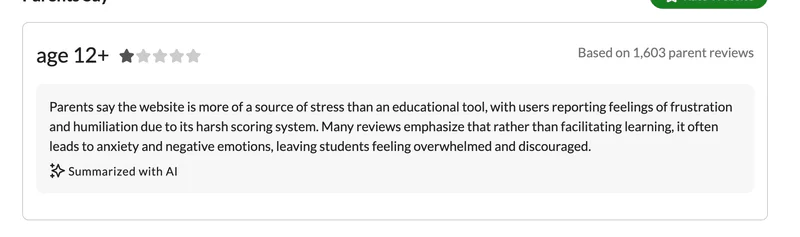
Complaint theme 2: It quizzes more than it teaches
"Not helpful. It only quizzes you. Doesn't show you how to do it. They make the kids learn by trial and error. Might work for simple topics, but not complex ones."
This pattern of "thin on instruction, heavy on assessment" is widely echoed across Trustpilot feedback for the math program in particular, and matches IXL's own description: it is a practice platform, not a curriculum. Problems arise when schools deploy it as if it were one.
Complaint theme 3: Marking correct answers wrong
A recurring frustration on the App Store, Trustpilot, and Sitejabber: "IXL constantly marks correct answers as 'incorrect,' leaving students confused and discouraged." Specific examples: punctuation errors (writing "1,000" when the system expects "1000"), formatting (writing "15" instead of "15.0"), or capitalization in ELA. For a child with dyscalculia, ADHD, or autism — who may already be working at the edge of working memory — this is not a small issue.
Complaint theme 4: Billing and cancellation
The BBB profile for IXL Learning lists a pattern of complaints around auto-renewal and refund difficulties, including instances where IXL "failed to respond" to disputes. Specific complaints include:
A parent who canceled and was immediately re-charged after a refund was issued.
Parents being charged in 2022 for a subscription they believed they had canceled in 2021.
Multiple unauthorized-charge reports cross-listed on PissedConsumer, Sitejabber, and Trustpilot.
IXL's Terms of Service make clear that subscriptions auto-renew until the user explicitly cancels, and that there is no automatic notification before a renewal charge. This is legal, but the friction is real and explains why "how do I cancel IXL?" is one of the most-Googled IXL questions.
Complaint theme 5: Time pressure and the "endless set"
A Trustpilot reviewer describes "11 hours and 16 minutes" spent on a single skill. A 6th-grader on Trustpilot:
"One time I was doing IXL and my 'SmartScore' was very low … It got to a point that I was physically and mentally exhausted, I was sweating and everything, it was horrible. (I'm also neurodivergent so it was way worse)..."
A parent on Sitejabber: "When he was on his 758th question, his computer died." Even allowing for adolescent hyperbole, the pattern is a child trapped in a long, unbounded session by the SmartScore mechanic.
Complaint theme 6: A federal lawsuit over student data
Separate from the SmartScore debate, in 2024 a class action complaint was filed against IXL Learning alleging that the company collects detailed student data through school contracts and uses it for purposes beyond providing services to schools. We mention this for completeness; the case is ongoing and the allegations have not been adjudicated, so we do not draw a conclusion. Parents and districts evaluating IXL should be aware of it.
The neurodiverse-learners section: what reviews from special ed teachers and parents actually say — and what the research says about why
This is the section most directly relevant to Monster Math's K–3 special education and neurodiverse audience, and it is where the IXL story is most concerning.
What special ed teachers and parents of neurodiverse kids report
Reviews from this group cluster around a few recurring issues:
Drops in SmartScore are devastating for children with low frustration tolerance. A Common Sense Media teacher: "I currently teach 8th graders … I give them 10 minutes of IXL, and 5 minutes of Pre-K, or Kindergarten skill sets as a brain break. Because the feeling of completing one is overwhelming … as a teacher, I know when something isn't right and it is difficult for my students. Which is why I don't overuse IXL."
Children with dyscalculia frequently hit the question-marking-wrong issue. Because they may format answers atypically (write 7 as a "P" shape, or insert extra spaces), "wrong" answers stack up faster than for typical peers.
Time pressure exacerbates ADHD-related working memory issues. Reviewers often describe their child "freezing" mid-set.
One IXL parent described their dyslexic and dyscalculic son's experience as "a review program, not instruction" — a characterization echoed even on a sponsored homeschool review for IXL. This use case (review only) appears to work for some neurodiverse children but is not how schools typically deploy the platform.
It is fair to note that IXL maintains a special education guide and explicitly markets multi-sensory question types, audio support, and adaptive pacing. Some special education teachers in the IXL Elite 100 testimonials do report large gains. But a balanced read of the wider review corpus suggests these are exceptions rather than the modal experience.
What peer-reviewed research says about why this design tends to backfire for neurodiverse K–3 learners
This is where review-platform sentiment lines up unusually well with what the research literature suggests. (For learning-science claims, we cite peer-reviewed sources only; reviewer sentiment alone is treated as evidence of experience, not pedagogical truth.)
1. Math anxiety in young children is real, measurable, and predictive of later achievement. Math anxiety can be detected as early as first grade and is consistently linked to lower performance — see the validated Math Anxiety Scale for Young Children in Harari, Vukovic, and Bailey's revised MASYC paper and the Early Elementary School AMAS. Brain-imaging work in 7-to-9-year-olds shows that math anxiety recruits amygdala (fear) circuitry in children at the same time it suppresses parietal regions used for arithmetic.
2. Anxiety hijacks the same working memory that math problem-solving requires.Ramirez, Gunderson, Levine, and Beilock (2013) showed in first- and second-graders that math anxiety was negatively associated with achievement specifically among children with higher working memory — the very children most likely to be punished by a "challenge zone" that rewards rapid, accurate streaks and punishes near-misses.
3. Adults' math anxiety is contagious to kids — including via "homework help" patterns IXL encourages.Beilock, Gunderson, Ramirez, and Levine (2010, PNAS) showed that when first- and second-grade female teachers (90%+ of early elementary teachers) had higher math anxiety, their female students ended the year with lower math achievement and stronger gender stereotypes. Maloney et al.'s 2015 Psychological Science paper extended the pattern to parents: math-anxious parents who frequently helped with math homework caused their first- and second-graders to learn less math and become more anxious. A platform that pushes kids to involve a stressed adult in long, escalating SmartScore battles is exactly the kind of structure these studies suggest can backfire.
4. For most neurodiverse learners, drill-and-game format can be a worse fit than plain practice. In a classic finding by Christensen and Gerber (1990), learning-disabled elementary students were disadvantaged by an arcade-style drill-and-practice format compared to plain drills — likely because the gamified context taxed selective attention. The lesson is not that games are bad, but that the wrong kind of gamification (timed competition, dramatic point swings, distracting flourishes) interferes with learning for kids who are already managing attentional load. IXL's SmartScore + awards + rapid penalty system fits that risky pattern.
5. Extrinsic rewards can erode intrinsic motivation, especially in children.Deci, Koestner, and Ryan's classic meta-analysis of 128 studies found that engagement-, completion-, and performance-contingent tangible rewards each significantly undermined intrinsic motivation, with effects especially strong for children. IXL's stickers, certificates, awards, and SmartScore are exactly the kind of performance-contingent rewards the meta-analysis flags.
6. Worked examples beat raw problem-solving for novice learners. The cognitive-load literature, summarized in Sweller's worked example research, consistently finds that for novices, studying worked examples is more efficient than solving problems by trial and error. This is precisely what reviewers mean when they say IXL "doesn't teach, it only quizzes."
7. Adaptive math programs can help — when designed well. This is important balance: meta-analyses of digital interventions for children with mathematical learning difficulties (Benavides-Varela et al., 2020) show a meaningful average effect size of about 0.55. A more recent meta-analysis of technology-based math fact practice (Burns et al., 2025) showed similar gains, with at-risk students benefiting too. So digital adaptive practice is not the problem; how a particular platform implements it is. A randomized study of the adaptive program Math Garden (Hilz et al., 2023, open-access in J. Intelligence) found gains in self-concept and subject-specific skill, illustrating that adaptive design can coexist with healthy affective outcomes.
8. Conceptual + procedural — not procedural alone — is what early math actually needs. The National Council of Teachers of Mathematics' position on procedural fluency and the cognitive-development literature (Rittle-Johnson and Schneider's review) converge: conceptual knowledge and procedural fluency reinforce each other. IXL is overwhelmingly procedural; for K–3 children — especially those with dyscalculia — building visual number sense and subitizing first is what the research recommends (more on Monster Math's blog).
9. Cognitive vs. emotional math problems "largely dissociate" — meaning a high-pressure platform punishes both groups in different ways.Devine, Hill, Carey, and Szűcs (2018) showed in a sample of 1,757 children that ~19% of dyscalculic kids were also math-anxious, but 77% of highly math-anxious kids had typical or above-average math ability. A platform that hits both groups with the same SmartScore mechanic is failing both: the dyscalculic child can't reliably climb the SmartScore, and the math-anxious-but-capable child experiences the climb as threat.
10. Encouragingly, well-designed digital math practice can reduce anxiety — but it has to be designed for that. A quasi-experimental study with first- and second-graders in Taiwan (Sun et al., open-access) found that 6 weeks of digital game-based math training reduced math anxiety, especially among those with the highest baseline anxiety. The point is not "tech is bad"; it's that low-stakes, scaffolded, visually grounded practice is what reduces anxiety, while high-stakes, accuracy-driven practice tends to increase it.
For more on these issues specifically in neurodiverse K–3 learners, see Monster Math's deeper guides on math anxiety in autism, ADHD, and dyscalculia, dyscalculia vs. math anxiety for K–3 teachers, and signs your child needs a different math approach (not more practice).
The SmartScore controversy, in detail
Because SmartScore comes up in literally every review thread, it deserves its own section.
How it works (in IXL's own description)
Per IXL's documentation, SmartScore is "a dynamic measure of progress towards mastery, rather than a percentage grade." It tracks skill level as students "tackle progressively more difficult" problems. Reaching 100 nominally indicates mastery. The algorithm weighs question difficulty, consistency, and number of recent correct answers.
How users describe it
The review corpus is unusually consistent on the actual behavior:
0 → 70 (the "comfort zone"): each correct answer is worth roughly 10 points, each wrong answer subtracts 1.
70 → 99 (the "challenge zone"): each correct answer is worth 1–4 points; each wrong answer subtracts 6–20 points, depending on streak and difficulty.
A Trustpilot review nicely sums up the cognitive consequence:
"You can be at a 98, make one small mistake, and suddenly you drop all the way down to like an 85 … It turns practice into stress instead of actual learning."
Why it lands as harshly as reviewers describe
The challenge-zone math has three properties that reliably trigger the cognitive and emotional patterns described in the research above:
Asymmetric loss/gain — kids feel the lost points more than the gained ones (a basic loss-aversion effect).
Visible regression — the bar moves backward, undoing visible effort. For kids with rejection-sensitive dysphoria (common in ADHD) or for kids with limited frustration tolerance (common across the autism spectrum), this is especially hard.
Unbounded session length — children cannot self-pace out: the only way to stop is to hit 100 or quit. For working-memory-limited learners, this often means hitting an emotional ceiling first.
IXL has written publicly that SmartScore is "not a grade" and is intended as a mastery indicator. In practice, schools use it as a grade, and kids treat it as one, and the platform's UI does not push back on that interpretation. This is a fair criticism whether or not you accept the broader anxiety arguments above.
Pricing and billing complaints
These are well-documented and worth flagging clearly.
What's actually charged
IXL charges immediately on sign-up; the 30-day "satisfaction guarantee" is a refund window, not a free trial.
Subscriptions auto-renew until canceled.
Refunds for annual memberships outside the 30-day window are generally not granted, per IXL's own response patterns on BBB and Revdex.
If you bought IXL through the Apple App Store or Google Play, IXL's Terms of Service explicitly state IXL is not responsible for billing — you must cancel through Apple/Google.
Common reported issues
From the BBB and PissedConsumer corpus:
Charges continuing after cancellation requests.
Refunds being issued and then reversed by an immediate re-charge.
Charges in the second year of an auto-renew that the customer believed they had canceled.
Difficulty getting customer service to act without a formal credit-card dispute.
Practical recommendation
If you sign up:
Do not buy a multi-year plan up front.
Set a calendar reminder 25 days after sign-up, before the satisfaction-guarantee window closes, to evaluate.
If you sign up through a school code, billing is generally handled by the school; you do not have a direct subscription.
If you sign up through Apple/Google, manage cancellations through those stores, not through IXL directly.
When IXL works well, and when it doesn't
A balanced summary, drawing on both the review corpus and the research above:
A decision rule for K–3 teachers and parents
If a child cries, refuses, or shuts down during IXL more than once a week, the platform is producing exactly the affective state that peer-reviewed research links to lower long-run math achievement. That is your signal to switch tools or use IXL only for short, optional review — not as the daily math driver.
Alternatives to IXL for K–3 (especially neurodiverse)
This post is a balanced review, not a sales pitch. But if IXL is a poor fit for your child or class, the most consistently recommended alternatives in the K–3 neurodiverse space are:
Khan Academy Kids — free, ad-free, calm pacing; strong fit for Pre-K and early elementary.
Monster Math — designed for K–3 with no timers and a focus on visual number sense and conceptual fluency rather than accuracy-driven scoring; built with ADHD, autism, and dyscalculia learners in mind. (Disclosure: Monster Math is the publisher of this blog — see our comparison of online math programs for neurodivergent kids for an honest side-by-side, including where it falls short.)
Beast Academy — for advanced elementary learners who are bored by drill.
AdaptedMind — broad K–6 coverage with gentler progress mechanics.
Time4Learning, DreamBox, Zearn — frequently cited by parents who left IXL specifically because of the SmartScore experience.
The best-fit alternative depends on the child's age, profile, and whether you need a curriculum or a supplement. One pattern to highlight: parents on Apple's App Store and Sitejabber repeatedly mention switching from IXL to either Prodigy, Time4Learning, or DreamBox after IXL caused their child distress.
FAQs
Is IXL worth it?
For confident, typically developing learners in upper elementary or middle school whose schools already license it, yes — for the analytics, standards alignment, and unlimited targeted practice. For K–3 students, neurodiverse learners, or any child who already shows math anxiety, probably not as a primary tool. A 30-day satisfaction-guarantee window lets families test cheaply if they're curious; just track the calendar.
Is IXL good for kids with dyscalculia?
Generally no, especially as a first-line tool. Dyscalculic learners tend to need explicit, multi-sensory, visual, conceptual instruction with a tolerance for slow progress — see the Devine et al. (2018) study and the dyscalculia literature summarized on Monster Math's blog. IXL's SmartScore mechanic punishes the slow, error-prone climb that is normal for dyscalculic kids. A small minority of parents do report success when IXL is used purely for review after a concept has been taught with another method.
Why does my child cry doing IXL?
The two most common reasons in the review corpus:
The SmartScore challenge zone — getting one wrong erases 5–20 points of visible progress, which can feel devastating to a child.
The "endless set" — children cannot self-pace out; they have to hit 100 or quit, which can mean hours on a single skill.
This is consistent with research showing that pressure-based, accuracy-driven practice elevates math anxiety, and that anxiety in turn impairs the working memory young children need to do math at all (Ramirez et al., 2013). If your child cries during IXL more than occasionally, it is worth pausing the platform.
Is IXL good for ADHD?
Mixed, leaning negative. Some ADHD students like the immediate feedback and clear progress bar. But the SmartScore loss-aversion mechanic, the unbounded session length, and the rejection-sensitivity many ADHD kids experience around visible failure mean the platform often produces emotional shutdown. If you do use IXL for an ADHD child, set a time limit, not a SmartScore target, and let them stop at the time limit regardless of where the bar is.
Is IXL good for kids on the autism spectrum?
It depends on the child. Some autistic children appreciate the predictability and structure (this is consistent with research showing some autistic children have lower math anxiety than peers). But for autistic children who struggle with unexpected change or loss of progress, the SmartScore drops can trigger significant distress. Time-bound sessions and clear "you can stop at the timer" rules help.
Why does the SmartScore drop so much?
By design. IXL has stated SmartScore is not a percentage but a dynamic mastery measure that requires sustained accuracy to climb the upper range. The asymmetric +1/–8 math in the challenge zone is intentional and is meant to ensure students don't reach 100 by guessing. The pedagogical intent is reasonable; the experiential cost for many young children, especially neurodiverse ones, is however, real.
How do I cancel IXL?
Family memberships purchased on ixl.com: Sign in, click your account menu (top right), and select Subscription details. There is a cancel option there. You can also email orders@ixl.com or call IXL support.
App Store (Apple) memberships: Cancel via Apple Settings > Apple ID > Subscriptions. IXL cannot cancel these for you.
Google Play memberships: Cancel via Google Play > Subscriptions.
30-day satisfaction guarantee: You must request a refund within 30 days of the original charge.
If you are charged after cancellation, file a written dispute; if IXL does not respond, the BBB record shows that disputes through the BBB or your card issuer often work.
Are there better alternatives for K–3 neurodiverse learners?
Yes — see the alternatives section above. The key features to look for: no timers, no harsh point-loss mechanics, visual-first instruction, and short bounded sessions. That set of features is what the peer-reviewed literature on math anxiety and neurodiverse math learning consistently supports.
Does IXL actually improve math achievement?
IXL cites internal research showing schools using IXL outperform schools that don't. Independent peer-reviewed evaluations specifically of IXL are scarce. The broader literature on adaptive practice tools shows modest positive effect sizes on average (Benavides-Varela et al., 2020; Burns et al., 2025), but the same literature notes that gains depend heavily on implementation, age group, and the affective response of the learner. For students who don't hate the tool, modest gains are plausible; for students who do hate it, gains are unlikely to materialize because they will avoid the tool whenever possible — and avoidance is one of the documented mechanisms by which math anxiety reduces math learning over time.
The bottom line
IXL is a sophisticated, broadly deployed practice platform with genuine strengths (curriculum coverage, analytics, immediate feedback) and a genuine, well-documented design problem: a SmartScore mechanic that, combined with unbounded session length, produces frequent distress in young and neurodiverse learners. The review corpus across Trustpilot, Sitejabber, Common Sense Media, and BBB is not a vocal-minority artifact; it is a remarkably consistent signal that the platform's affective design is misaligned with what peer-reviewed research suggests works for K–3 and especially for neurodiverse learners.
For K–3 special education teachers and parents of children with dyscalculia, ADHD, autism, or math anxiety, the practical takeaway is: don't use IXL as your daily math driver. Use it, if at all, as a teacher-controlled, time-bounded review tool after a concept has been taught well elsewhere — and watch for the affective signals (tears, refusal, shutdown) that mean the tool is doing more harm than good.
For administrators and district leaders, the question is harder: IXL solves a real workflow problem (analytics, standards alignment, scale) that is hard to replace at the district level. But the affective costs documented above are real and merit at least an opt-out path for students for whom the platform is producing distress.
Recommendations
For parents of K–3 neurodiverse children
Don't sign up before trying it. Sit with your child for a 20-minute IXL session before subscribing. Watch for tears, hand-flapping, withdrawal, or "I hate math" statements.
If you do subscribe, set a calendar reminder for day 25 to evaluate and cancel within the satisfaction-guarantee window.
Cap sessions by time, not by SmartScore. "10 minutes of IXL, then we stop, regardless of the bar" protects affective state.
Use IXL for review only, after concepts have been taught visually elsewhere — Khan Academy Kids, Monster Math, Beast Academy, or hands-on manipulatives.
Switch tools quickly if you see math anxiety rising. The opportunity cost of a bad month at age 6 is bigger than the dollar cost of switching subscriptions.
For K–3 classroom and special education teachers
Disable mandatory 100% SmartScore completion for IEP students if your district allows it. Time-based assignments are far safer.
Don't assign IXL as homework for neurodiverse students — Maloney et al.'s parent-anxiety research suggests math homework with anxious adults is a known harm pattern.
Use IXL primarily for the analytics, which most teachers agree are its real strength. Keep the student-facing exposure short and just enough for practice or evaluation.
Pair IXL with visual, conceptual instruction (number lines, ten frames, rekenreks, subitizing) — the pieces of math the platform doesn't really teach.
Tell parents what you're doing. A 5-minute conversation about how to use (and not use) IXL at home can prevent months of homework conflict.
Benchmarks that should change your decision
If your child or 3+ students in your class cry, refuse, or shut down during IXL more than once a week → switch tools or restrict use to teacher-led review only.
If your bill arrives and you didn't realize auto-renewal had triggered → cancel through your card issuer if IXL won't refund.
If your district is considering a multi-year IXL contract and has no opt-out for neurodiverse students → push for one before signing.
Caveats
Self-selection bias on review platforms. Trustpilot, Sitejabber, and Common Sense Media reviewers self-select to write reviews, which generally skews negative across all products. The 4.0-star App Store and 4.3-star Google Play averages reflect a different population (often students prompted in-app). Reality is between these poles.
Reviewer demographics. A meaningful share of negative IXL reviews are written by students themselves (often middle and high school), not by K–3 parents or teachers. Where we have quoted teacher and parent reviews above, we have tried to flag that. Student frustration is real evidence of affective state, but it is not pedagogical evidence.
IXL is not monolithic. The SmartScore behavior in 2026 may differ from a teacher's experience in 2018. IXL has updated explanations, added videos, and added a Real-Time Diagnostic that some teachers genuinely value.
Peer-reviewed studies of IXL specifically are scarce. Most learning-science citations in this post are about the design choices IXL has made (timed pressure, accuracy-driven scoring, drill-heavy practice, performance-contingent rewards), not about IXL itself. IXL's internal "schools that use IXL outperform schools that don't" claim is not independently peer-reviewed and should be treated cautiously.
The "challenge zone" math may have changed. Reviewer descriptions of point gains and losses are crowdsourced and may not reflect the precise current algorithm. The qualitative pattern (asymmetric, with bigger losses in the upper range) is consistent across years and platforms, but the specific numbers may not be exact.
The 2024 class action complaint over data collection is unresolved. We mention it because it is publicly filed; we draw no conclusion about its merits.
One author's biases worth declaring. This post is published by Monster Math, a competing K–3 math app for neurodiverse learners. We have tried to evidence every critical claim with independent reviews and peer-reviewed research, and to acknowledge IXL's real strengths (analytics, curriculum coverage, individual-success cases). Read accordingly.
References (peer-reviewed)
Beilock, S. L., Gunderson, E. A., Ramirez, G., & Levine, S. C. (2010). Female teachers' math anxiety affects girls' math achievement. Proceedings of the National Academy of Sciences, 107(5), 1860–1863. Open access: https://pmc.ncbi.nlm.nih.gov/articles/PMC2836676/
Benavides-Varela, S., Callegher, C. Z., Fagiolini, B., Leo, I., Altoè, G., & Lucangeli, D. (2020). Effectiveness of digital-based interventions for children with mathematical learning difficulties: A meta-analysis. Computers & Education, 157. https://www.sciencedirect.com/science/article/pii/S0360131520301512
Burns, M. K., Duesenberg-Marshall, M. D., Romero, M. E., Sussman-Dawson, K. J., & Singell, E. (2025). Meta-analysis of the effect of technology-based mathematical fact practice on mathematics outcomes. Journal of Special Education Technology. https://journals.sagepub.com/doi/10.1177/01626434241288199
Caviola, S., Toffalini, E., Giofrè, D., Ruiz, J. M., Szűcs, D., & Mammarella, I. C. (2020). The Early Elementary School Abbreviated Math Anxiety Scale (EES-AMAS): A new adapted version of the AMAS to measure math anxiety in young children. Frontiers in Psychology. Open access: https://www.ncbi.nlm.nih.gov/pmc/articles/PMC7253683/
Christensen, C. A., & Gerber, M. M. (1990). Effectiveness of computerized drill and practice games in teaching basic math facts. Exceptionality, 1(3), 149–165. https://www.tandfonline.com/doi/abs/10.1080/09362839009524751
Deci, E. L., Koestner, R., & Ryan, R. M. (1999). A meta-analytic review of experiments examining the effects of extrinsic rewards on intrinsic motivation. Psychological Bulletin, 125(6), 627–668. Open access: https://www.selfdeterminationtheory.org/SDT/documents/2001_DeciKoestnerRyan.pdf
Devine, A., Hill, F., Carey, E., & Szűcs, D. (2018). Cognitive and emotional math problems largely dissociate: Prevalence of developmental dyscalculia and mathematics anxiety. Journal of Educational Psychology, 110(3), 431–444. Open access: https://www.airipa.it/wp-content/uploads/2019/03/devine_etal2018-1.pdf
Harari, R. R., Vukovic, R. K., & Bailey, S. P. (2013). Mathematics anxiety in young children: An exploratory study. Journal of Experimental Education, 81(4), 538–555. Open access (revised MASYC): https://pmc.ncbi.nlm.nih.gov/articles/PMC4995220/
Hilz, A., Guill, K., Roloff, J., Sommerhoff, D., & Aldrup, K. (2023). How to continue? New approaches to investigating the effects of adaptive math learning programs on students' performance, self-concept, and anxiety. Journal of Intelligence, 11(6), 108. Open access: https://www.ncbi.nlm.nih.gov/pmc/articles/PMC10299571/
Kucian, K., et al. (2018). Neurostructural correlate of math anxiety in the brain of children. Open access: https://www.ncbi.nlm.nih.gov/pmc/articles/PMC6288142/
Maloney, E. A., Ramirez, G., Gunderson, E. A., Levine, S. C., & Beilock, S. L. (2015). Intergenerational effects of parents' math anxiety on children's math achievement and anxiety. Psychological Science, 26(9), 1480–1488. Open access: https://sites.temple.edu/cognitionlearning/files/2013/09/Maloney-et-al-in-press.pdf
Mammarella, I. C., Hill, F., Devine, A., Caviola, S., & Szűcs, D. (2015). Math anxiety and developmental dyscalculia: A study on working memory processes. Journal of Clinical and Experimental Neuropsychology, 37(8), 878–887. https://pubmed.ncbi.nlm.nih.gov/26313516/
Ramirez, G., Gunderson, E. A., Levine, S. C., & Beilock, S. L. (2013). Math anxiety, working memory, and math achievement in early elementary school. Journal of Cognition and Development, 14(2), 187–202. Open access (author copy): https://sites.temple.edu/cognitionlearning/files/2013/09/Ramirez-et-al-2013.pdf
Rittle-Johnson, B., & Schneider, M. (2015). Developing conceptual and procedural knowledge of mathematics. Oxford Handbook of Numerical Cognition. Open access (author copy): https://www.uni-trier.de/fileadmin/fb1/prof/PSY/PAE/Team/Schneider/RittleJohnsonSchneiderInPress.pdf
Sun, R., Soltész, F., Szűcs, D., et al. (2022). Evaluation of math anxiety and its remediation through a digital training program in mathematics for first and second graders. Brain and Behavior. Open access: https://www.ncbi.nlm.nih.gov/pmc/articles/PMC9120910/
Van Gog, T., Kester, L., & Paas, F. (2011). Effects of worked examples, example-problem, and problem-example pairs on novices' learning. Contemporary Educational Psychology, 36(3), 212–218. https://www.sciencedirect.com/science/article/abs/pii/S0361476X1000055X