TL;DR
Monster Math:
Designed intentionally for neurodivergent learners, with a focus on visual strategies, number sense, and low-pressure practice. Its game-based approach prioritizes understanding and confidence over speed or memorization.IXL:
Provides structured, standards-aligned practice and detailed skill tracking. Its accuracy-driven progression can feel discouraging for some neurodivergent learners, especially those with math anxiety or working-memory challenges.Prodigy:
Highly engaging for kids who enjoy fantasy worlds, characters, and game mechanics. The fast progression and competitive loops may increase pressure or anxiety for learners who are sensitive to speed and performance cues.Boddle:
Uses friendly characters, avatars, and playful visuals that can help younger children engage with math. Frequent animations and rewards may distract some neurodivergent learners from sustained math thinking.Khan Kids:
Offers calm pacing, friendly characters, and low-pressure activities that can feel reassuring for early learners. The content depth may be limited for older children who need more structured or advanced math practice.Beast Academy:
Emphasizes deep problem-solving and rich mathematical challenges, which can be a great fit for puzzle-loving or gifted learners. The worksheet-style format and cognitive demands may feel overwhelming for some neurodivergent kids.i-Ready:
Provides adaptive diagnostics and structured learning pathways that help identify skill gaps. The assessment-heavy, lesson-style experience can feel rigid or stressful for learners who benefit from play-based or low-pressure environments.AdaptedMind:
Combines guided instruction with some game-style elements and immediate feedback. Instructional pop-ups and remediation videos may interrupt flow for learners who learn best through continuous visual gameplay.
Searching for the best online math programs for neurodivergent kids can feel overwhelming. Many popular math apps promise engagement and results, but for children with ADHD, autism, dyscalculia, or learning differences, the details matter more than the brand name.
Timers, visual clutter, competitive pressure, and reward systems that work for some kids can completely backfire for others. This guide compares the most well-known online math programs - Prodigy, IXL, Boddle, Khan Academy Kids, Beast Academy, i-Ready, AdaptedMind and Monster Math - specifically through a neurodivergent-friendly lens.
If you’re a parent wondering which math programs for autistic students or math programs for kids with ADHD will actually feel doable (not draining), this article is for you.
What Neurodivergent Kids Need From Online Math Programs
Research consistently shows that neurodivergent learners are more sensitive to cognitive load, working memory demands, and emotional pressure during academic tasks. Studies on cognitive load theory explain that when instructional design overloads working memory, learning slows or stops altogether.
For many autistic and ADHD learners, math becomes harder not because of the math itself, but because of how it’s presented. Timers, cluttered screens, long problem sets, and forced speed can trigger stress responses that block learning, a pattern supported by research linking anxiety and executive function to math performance.
Neurodivergent-friendly math programs tend to share a few key traits:
Minimal or optional timers
Strong visual models (number lines, arrays, ten-frames)
Chunked challenges instead of long drills
Low-stakes feedback instead of public rankings
Rewards that support motivation without hijacking attention
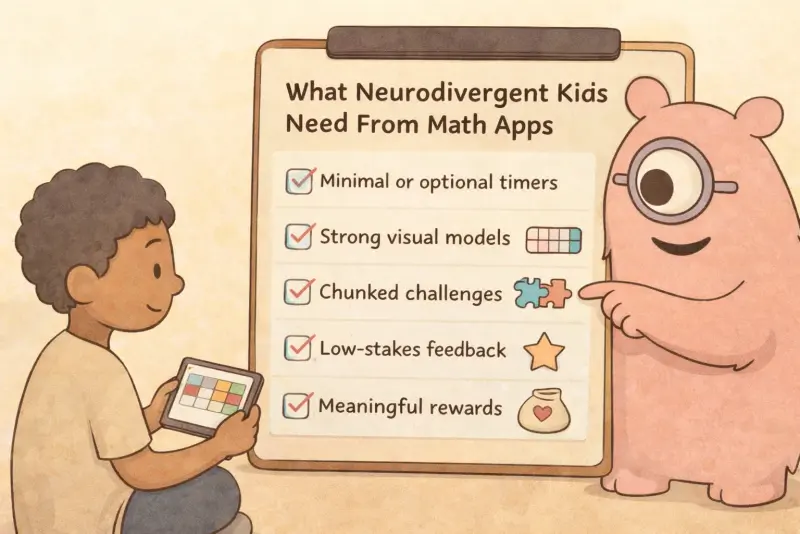
This is the lens we’ll use for each program below.
Program-by-Program Comparison (ND Lens)
Monster Math

Best for: Neurodivergent learners who need visual, pressure-free math practice.
Pros : Monster Math emphasizes visual strategies, number sense, and flexible thinking using concrete-representational-abstract progression - a progression that helps many learners build understanding from visuals to symbols.
Cons : If your top priority is a highly assessment-driven platform with extensive standards reporting and diagnostic placement built in, you may prefer pairing Monster Math with a school-style diagnostic tool.
There are no forced timers, no public leaderboards, and no penalties for thinking slowly. Visual tools like number lines and ten-frames reduce working memory load, aligning with findings that visual supports improve math outcomes for students with learning difficulties.
Prodigy
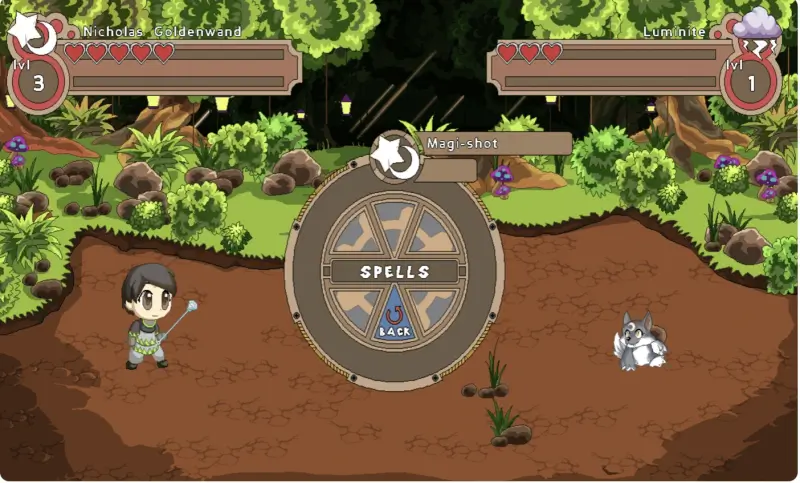
Best for: Kids who love fantasy games and external motivation.
Pros : Prodigy can be very motivating for kids who love game worlds, characters, and rewards. For some learners, that “fun-first” loop lowers resistance and makes it easier to start practicing.
Cons : Prodigy relies heavily on extrinsic rewards, competitive elements, and fast progression. While gamification can boost engagement, research suggests that excessive external rewards may reduce deep learning and intrinsic motivation over time. For children with ADHD or anxiety, frequent reward loops and pressure to keep moving forward can fragment focus and increase cognitive load.
If you want a deeper feature-by-feature breakdown, you can also read our detailed post on Prodigy.
If Prodigy's pace feels like too much, you can also explore other game-based Prodigy alternatives with calmer, lower-pressure designs.
IXL
Best for: Structured skill practice and standards alignment.
Pros : IXL is strong for targeted practice when you know exactly what skill your child needs (and when you want straightforward, standards-aligned questions). It can be a good fit for focused remediation and structured routines.
Cons : IXL uses an accuracy-driven progression system where mistakes can slow or reverse visible progress toward mastery. For some neurodivergent learners - especially those with working memory challenges or math anxiety - this emphasis on sustained accuracy can feel discouraging over time, since progress depends on longer streaks of correct answers rather than exploratory, game-based learning.
If you want a deeper feature-by-feature breakdown, you can also read our detailed post on IXL.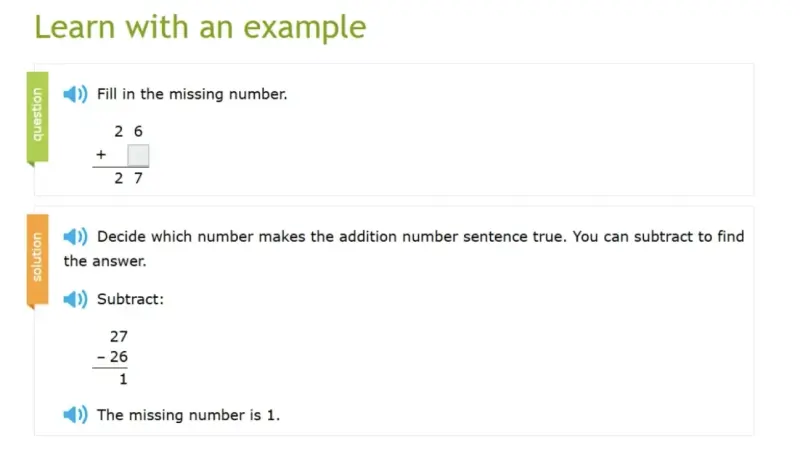
Boddle
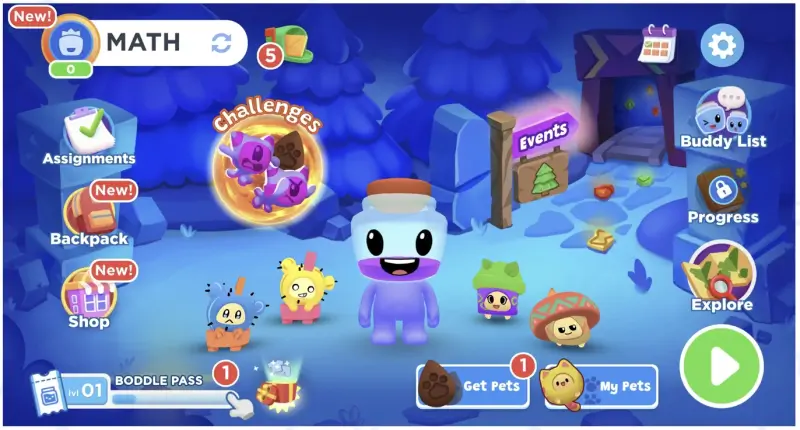
Best for: Early learners who enjoy friendly characters, avatar customization, and light gameplay mechanics.
Pros : Boddle can be a gentle entry point for younger children who need encouragement to begin math practice. The avatars and customization can boost buy-in, especially for kids who like playful, character-driven experiences.
Cons : While Boddle’s colorful visuals, playful sounds, and frequent rewards can be fun for some kids, these same elements may be overstimulating or distracting for neurodivergent learners who thrive with calmer pacing and focused instructional visuals. Some families find that attention shifts toward unlocking items rather than building math understanding.
If you want a deeper feature-by-feature breakdown, you can also read our detailed post on Boddle.
Khan Academy Kids

Best for: Preschool to early elementary learners.
Pros : Khan Kids uses calm pacing, friendly characters, and low-pressure activities. The absence of timers and competitive elements may help reduce math anxiety - a form of tension and apprehension that research shows is negatively linked to math performance and strategy use.
Cons : Limited depth for older elementary students who need structured math progression.
Beast Academy
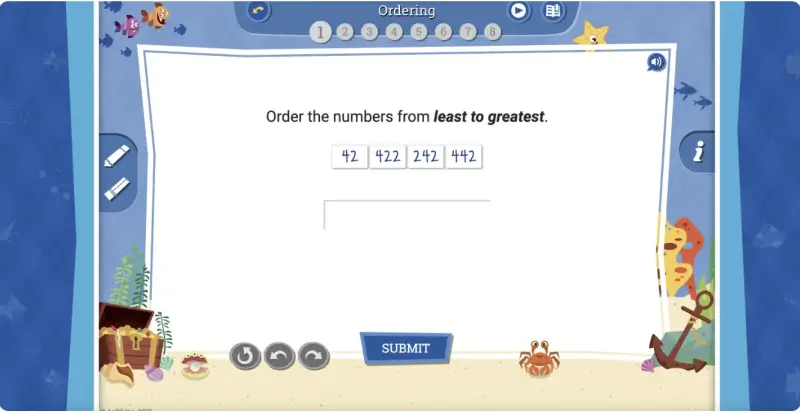
Best for: Learners who enjoy deep math challenges, rich problem sets, and curriculum that covers a broad range of elementary math topics.
Pros : Beast Academy is excellent for kids who enjoy puzzles, pattern-finding, and challenging math. It can be a great match for gifted learners who want deeper thinking beyond routine practice.
Cons : The experience can feel more worksheet-style than game-like, with videos and practice problems that resemble traditional school math. Some neurodivergent learners may find it cognitively demanding or harder to sustain without more interactive, visually embedded gameplay.
If you want a deeper feature-by-feature breakdown, you can also read our detailed post on Beast Academy.
i-Ready
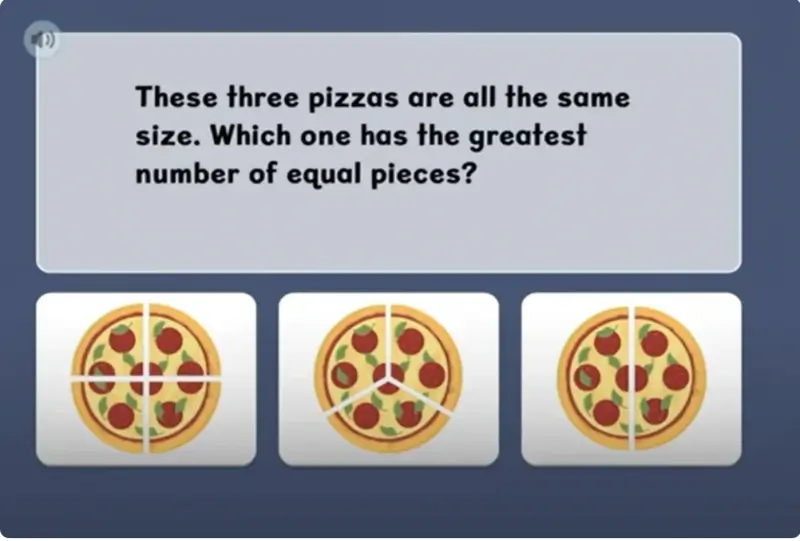
Best for: Comprehensive adaptive learning and detailed diagnostic insight.
Pros : i-Ready offers diagnostics, structured lesson pathways, and progress tracking that can help identify gaps and monitor growth over time - especially in school settings.
Cons : i-Ready can feel assessment-heavy and lesson-like. For neurodivergent learners who thrive with play-based motivation and low-pressure practice, the more formal structure may feel rigid or repetitive.
If you want a deeper feature-by-feature breakdown, you can also read our detailed post on i-Ready.
AdaptedMind

Best for: Learners who like a blend of game-style elements with corrective support.
Pros : AdaptedMind can work well for kids who benefit from guided practice and immediate corrective feedback. The structure can be reassuring for learners who like predictable routines.
Cons : Instructional pop-ups and remediation videos can interrupt the flow of practice. Some neurodivergent learners may do better with visuals and strategy cues embedded directly into gameplay rather than frequent instructional interruptions.
If you want a deeper feature-by-feature breakdown, you can also read our detailed post on AdaptedMind.
How to Choose the Right Program for Your Child
No single program is “best” for every neurodivergent child. When evaluating online math programs, ask:
Does this app reduce or increase pressure?
Are visuals supporting understanding or just decoration?
Can my child make mistakes safely?
Does progress feel motivating or stressful?
When choosing a program, it can also help to observe how your child feels during and after math time. Do they seem calmer, more confident, and willing to keep going - or frustrated, rushed, and avoidant? Neurodivergent kids often show you what works through their regulation and engagement. A program that looks rigorous on paper isn’t always the one that builds understanding or confidence, while a program that feels playful may actually support deeper learning by reducing cognitive and emotional load.
Quick Comparison Table (Neurodivergent Lens)
Final Thoughts
If your child has ADHD, is on the spectrum, or has Dyscalculia, we'd recommend Khan Academy kids for PreK ages, Monster Math for ages K-3 and Adapted Mind for higher grades. Ultimately, the “right” math program is the one that helps your child make progress without burning out. For many neurodivergent learners, that means prioritizing understanding over speed, concepts over memorization, and emotional safety over constant performance tracking, and the above recommendations do focus on that.
Online tools are just one part of the puzzle. For the bigger picture, see our overview of neurodivergent math learning strategies.
FAQs
Are online math programs good for autistic kids?
They can be, if designed with sensory load, pacing, and visual clarity in mind. Programs without timers and with strong visual scaffolds tend to work best.
Do online math programs help kids with ADHD?
Yes - especially when they reduce distractions and focus on short, meaningful challenges rather than long drills.
Is Monster Math good for dyscalculia?
Yes. Monster Math focuses on number sense and visual strategies, which research shows are particularly effective for learners with math-specific learning difficulties.
What is the best online math program for Neurodivergent kids?
There isn’t one single “best” program for every neurodivergent child, but the most effective online math programs tend to reduce pressure, limit unnecessary distractions, and use visual models to build understanding. Programs that allow kids to learn at their own pace - without timers, public rankings, or heavy drill - are often better suited for autistic children, kids with ADHD, and learners with dyscalculia.
References
Paas, F., & van Merriënboer, J. J. G. (2020). Methods to manage working memory load in the learning of complex tasks. Current Directions in Psychological Science. https://journals.sagepub.com/doi/10.1177/0963721420922183
Ashcraft, M. H., & Krause, J. A. (2007). Working memory, math performance, and math anxiety. Psychonomic Bulletin & Review. https://link.springer.com/article/10.3758/BF03194059
Deci, E. L., Koestner, R., & Ryan, R. M. (1999). A meta-analytic review of experiments examining the effects of extrinsic rewards on intrinsic motivation. Psychological Bulletin. https://depts.washington.edu/techdocs/papers/deciExtrinsicRewardsAndIntrinsicMotivation99.pdf
Ramirez, G., Chang, H., Maloney, E. A., Levine, S. C., & Beilock, S. L. (2016). On the relationship between math anxiety and math achievement in early elementary school. Journal of Experimental Child Psychology. https://bpb-us-w2.wpmucdn.com/voices.uchicago.edu/dist/5/1727/files/2019/04/Ramirezetal2015_MathAnxietyStrategies-1exeec6.pdf
Flores, M. M. (2009). Teaching algebra to students with learning disabilities using concrete–representational–abstract instruction. Learning Disabilities Research & Practice. https://files.eric.ed.gov/fulltext/EJ797683.pdf
Peltier, C., Vannest, K. J., Davis, J. L., & Brown, L. (2020). A meta-analysis of single-case research using mathematics manipulatives with students at risk or identified with a disability. Journal of Behavioral Education. https://files.eric.ed.gov/fulltext/EJ1250220.pdf