TL;DR: If a student is struggling with math, the problem is rarely effort - it's usually that they need a different approach. This article covers 10 strategies that are backed by real research, practical enough to use tomorrow, and effective across K-8 classrooms. From concrete manipulatives to spaced practice to peer-assisted learning, each strategy here has evidence behind it and a clear path to implementation.
Every classroom has students who just seem to hit a wall with math. They try, you reteach, but something does not click. The good news is that decades of research have identified specific, repeatable strategies that actually move the needle for struggling learners - and most of them do not require a specialist or a completely new curriculum.
Here are 10 math intervention strategies that the research consistently supports, and you can put them to work straight away.
1. Use concrete manipulatives before abstract symbols
Students who struggle with abstract number symbols often do much better when they can hold and move physical objects first. A large-scale meta-analysis reviewed 55 studies spanning kindergarten to college level and found consistent, significant benefits for manipulative-based instruction over abstract-symbol-only teaching - with especially strong effects on retention. The Concrete-Representational-Abstract (CRA) sequence formalises this: start with physical objects, move to drawings, then introduce symbols. Start with blocks, counters, or fraction tiles, and let students build the concept with their hands before they ever see a number sentence.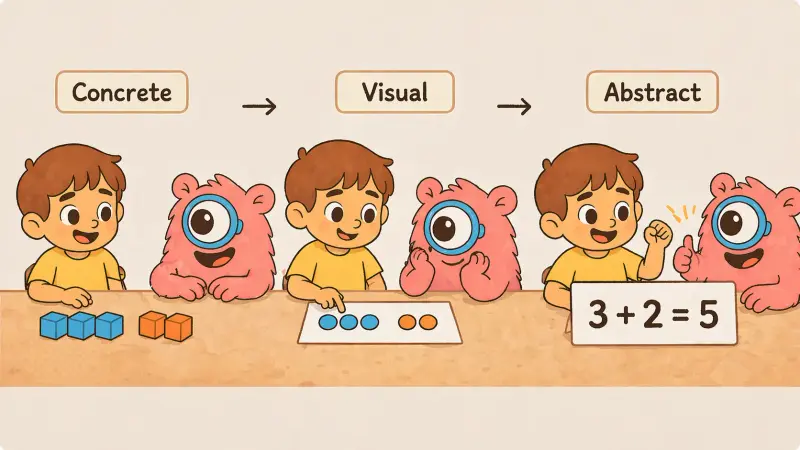
2. Explicitly teach problem-solving strategies
Struggling students often approach word problems by guessing at operations rather than thinking through structure. Schema-based instruction - teaching students to first identify what type of problem they are looking at, then apply the right solution strategy for that type - has a strong evidence base for students who find word problems most challenging. A review found that both schema-based and schema-broadening instruction consistently and significantly improved word-problem accuracy. Teach the structure of the problem, not just the computation.
3. Build fact fluency through spaced practice
Drilling the same facts repeatedly in one sitting is far less effective than spreading practice across multiple sessions. A classroom study compared massed and distributed practice on math fact fluency with third-grade students and found that distributing the same amount of practice time across shorter sessions throughout the day produced significantly higher fluency growth - with no extra instructional time required. Short daily sessions of 5-10 minutes beat one long weekly drill every time. This is also where well-designed math games for kids earn their place - when the gameplay naturally spaces and repeats facts, students practice without it feeling like repetition.
4. Use visual representations consistently
Number lines, bar models, and area diagrams are powerful thinking tools at every level of mathematics - and the research backs this up. A meta-analysisfound a strong, statistically significant effect on mathematics outcomes, with representations helping students build the mental models that make abstract operations accessible. The key is consistency - use the same representation across topics so students can transfer understanding rather than relearning a new visual each time.
Our free teacher tools give you projector-ready, interactive versions of the most common visual models - number lines, number bonds, place value charts, and multiplication arrays - all free with no signup, designed for whole-class use.
5. Provide immediate, specific feedback
Vague feedback like "try again" does little for a student who does not know what went wrong. A meta-analysis found that feedback is one of the highest-impact interventions available - but only when it conveys specific information. Feedback focused on the task and strategy, rather than on the student, consistently produces the strongest effects. Tell students exactly what they did, what went wrong, and what to try differently.
6. Teach students to monitor their own thinking
Metacognition - thinking about your own thinking - is a learnable skill that dramatically improves mathematical problem solving. A meta-analysisfound large, statistically significant effects of metacognitive instruction on mathematics achievement. Teaching students to self-monitor by asking "does this make sense?", checking their work against estimates, and verbalising their steps out loud is especially effective for students who make careless or impulsive errors. Think-alouds during small-group instruction are one of the most practical ways to model this.
7. Use peer-assisted learning strategically
Pairing students for structured practice - where one explains and the other responds - benefits both partners. A meta-analysis of 50 peer tutoring studies in mathematics found that 88% of programs produced positive effects on academic performance. The student doing the explaining consolidates their own understanding; the student listening gets a peer model rather than a teacher one, which is often easier to follow. This pairs naturally with math center rotations where partner stations give you time at your small-group table.
8. Increase opportunities to respond
In a typical classroom, a struggling student might answer one or two questions in a 45-minute lesson. That is nowhere near enough practice. A systematic review on teacher-directed opportunities to respond found consistent positive effects on both academic outcomes and behaviour when students were given more frequent chances to actively respond - verbally, in writing, or through gesture. Whiteboards, choral response, and turn-and-talk routines are simple tools that multiply response opportunities without adding planning time.
9. Address maths anxiety directly
For many struggling students, the barrier is not cognitive - it is emotional. Researchshows that anticipating a maths task activates the same neural regions associated with physical pain in high-anxiety individuals - and this same anxiety actively suppresses working memory during problem solving. Low-stakes practice environments, normalising mistakes as part of learning, and reducing timed pressure are all evidence-supported approaches to lowering anxiety. Games-based practice (physical or digital) works particularly well here because failure in a game feels fundamentally different from failure on a test.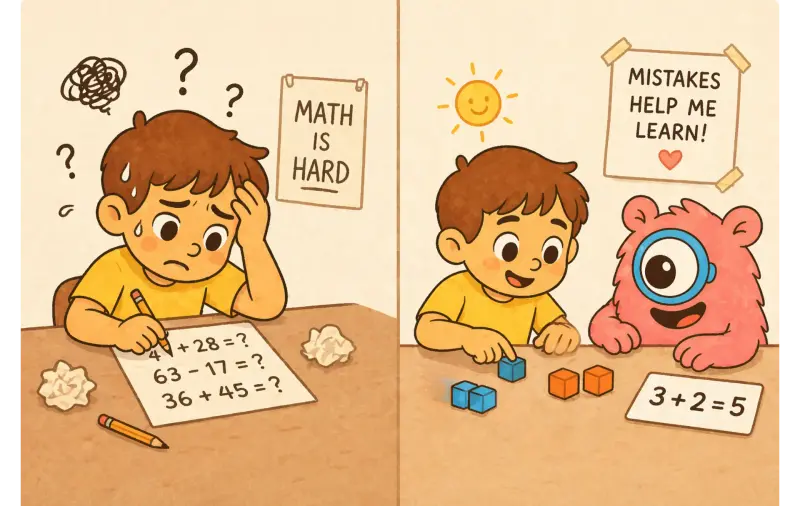
10. Use digital math games as a practice tool
Digital math games are not a replacement for instruction - but when chosen well, they are one of the most efficient tools available for reinforcing skills outside of direct teaching time. The research case for games in mathematics is strong: a systematic review of 57 studies found that 84% reported positive effects of game-based learning on students' motivation, engagement, and attitudes toward mathematics. The best games embed spaced practice, immediate corrective feedback, and low-stakes failure in a format that struggling students will actually engage with. Games like Monster Math take this further by making maths visual, embedding strategies directly into gameplay, and removing timed pressure entirely - so students practise more without the anxiety that holds them back.
Putting it all together
None of these strategies require a complete overhaul of how you teach. Most can be layered into what you already do - a bit more spaced practice here, a visual representation there, a structured peer pair during center time. The biggest shift is intentionality: choosing approaches based on evidence rather than habit, and watching closely enough to know when something is working.
Most struggling students have the ability - they just haven't yet found the approach that fits how their brain processes mathematical ideas. The strategies on this list are not a checklist to work through all at once. Pick one, try it consistently, and watch what changes.
FAQs:
What is the most effective math intervention strategy?
Explicit instruction combined with the CRA sequence tends to produce the strongest results for students who are significantly behind. Building in spaced practice and immediate feedback on top of that makes it even more effective - and all three are practical enough to implement in a classroom setting without specialist support.
How long should a math intervention session be?
20 to 30 minutes daily is the sweet spot supported by the research. Shorter than that and you lose momentum; longer and working memory fatigue sets in, especially for students who already find math effortful.
Can games count as math intervention?
Yes - when they are designed intentionally. Games that build in spaced practice, require strategic thinking, and give immediate feedback on errors hit several evidence-based levers at once. The key distinction is games where the math is the mechanic, not just the theme.
How do I know which strategy to use for which student?
Start with a simple error analysis - look at what kind of mistakes the student makes consistently. Procedural errors point toward more practice with CRA and explicit strategy instruction. Fluency gaps point toward spaced retrieval. Anxiety-driven avoidance points toward low-stakes practice environments and reducing timed pressure.
At what age should math intervention start?
The earlier the better. Gaps in number sense that appear in kindergarten tend to compound over time rather than close on their own. Early screening and targeted support in grades K–2 almost always produces better outcomes than waiting for students to fall further behind.
References:
Carbonneau, K. J., Marley, S. C., & Selig, J. P. (2013). A meta-analysis of the efficacy of teaching mathematics with concrete manipulatives. Journal of Educational Psychology, 105(2), 380–400. https://www.researchgate.net/publication/248701204_A_Meta-Analysis_of_the_Efficacy_of_Teaching_Mathematics_With_Concrete_Manipulatives
Powell, S. R. (2011). Solving word problems using schemas: A review of the literature. Learning Disabilities Research & Practice, 26(2), 94–108. Free full text via PMC
Schutte, G. M., Duhon, G. J., Solomon, B. G., Poncy, B. C., Moore, K., & Story, B. (2015). A comparative analysis of massed vs. distributed practice on basic math fact fluency growth rates. Journal of School Psychology, 53(2), 149–159. Free full text via ResearchGate
Sokolowski, A. (2018). The effects of using representations in elementary mathematics: Meta-analysis of research. IAFOR Journal of Education, 6(3), 129–152. Free full text via ERIC
Wisniewski, B., Zierer, K., & Hattie, J. (2020). The power of feedback revisited: A meta-analysis of educational feedback research. Frontiers in Psychology, 10, 3087. Free full text via PMC
Hidayat, R., Saad, M. R. M., & Wewe, M. (2025). A meta-analysis of the effect of metacognitive instruction on mathematics achievement. Cogent Education, 12(1). doi.org/10.1080/2331186X.2025.2517510
Alegre-Ansuategui, F., Moliner, L., Lorenzo, G., & Maroto, A. (2018). Peer tutoring and academic achievement in mathematics: A meta-analysis. Eurasia Journal of Mathematics, Science and Technology Education, 14(1), 337–354. Free full text via EJMSTE
MacSuga-Gage, A. S., & Simonsen, B. (2015). Examining the effects of teacher-directed opportunities to respond on student outcomes: A systematic review of the literature. Education and Treatment of Children, 38(2), 211–239. Free full text via ERIC
Lyons, I. M., & Beilock, S. L. (2012). When math hurts: Math anxiety predicts pain network activation in anticipation of doing math. PLoS ONE, 7(10), e48076. Free full text via PMC
Vankúš, P. (2021). Influence of game-based learning in mathematics education on students' affective domain: A systematic review. Mathematics, 9(9), 986. Free full text via MDPI