
TL;DR: Math resistance in neurodivergent children — the tears, the shutdowns, the "I can't do this!" — is rarely about laziness. It's usually a signal that something deeper is going on: anxiety overloading working memory, sensory overwhelm, demand avoidance, or a mismatch between how math is being taught and how your child's brain processes information. Research shows that math anxiety physically disrupts the cognitive resources children need to solve problems (Ashcraft, 2002), and that controlling parenting during math homework predicts lower achievement over time (Schaeffer et al., 2025). This guide helps you read your child's signals, know when gentle encouragement helps and when it's time to step back, and build a math environment rooted in safety, autonomy, and real understanding — not just compliance.
Why Your Child Isn't "Just Being Difficult"
You've set aside 15 minutes for math practice. The worksheet is ready. And then — the meltdown begins. Or maybe it's quieter than that. Maybe your child goes completely still, stares at the wall, or suddenly "needs to use the bathroom" for the third time.
If this sounds familiar, you're not alone. And if your child is neurodivergent — living with ADHD, autism, dyscalculia, or another learning difference — math resistance often looks different and runs deeper than it does for neurotypical kids.
Here's the thing that changes everything once you understand it: resistance is communication. Your child isn't choosing to be defiant. Their nervous system is telling them something important — and your response in that moment shapes not just tonight's math session, but their entire relationship with learning.
What's Really Happening When Your Child Resists Math
Math Anxiety Is a Working Memory Problem
When a child feels anxious about math, it doesn't just make them "nervous." Research by Ashcraft and colleagues has demonstrated that math anxiety functions like a secondary cognitive task, consuming the working memory resources that children need to actually solve the problem in front of them (Ashcraft & Krause, 2007). In other words, their brain is so busy processing fear that there's not enough mental bandwidth left for the math itself.
For neurodivergent children — who often already face challenges with working memory and executive function — this effect is amplified. A child with ADHD might be managing attention regulation and anxiety and the math problem simultaneously. That's a triple-task situation in a brain that's already juggling more than most.
The Avoidance Cycle
Research on math anxiety consistently reveals a damaging cycle: anxiety leads to avoidance, avoidance leads to less practice, less practice leads to lower competence, and lower competence feeds more anxiety (Ashcraft, 2002). Highly math-anxious individuals develop a strong tendency to avoid math altogether, which ultimately undercuts their competence and closes off future opportunities.
For neurodivergent kids, this cycle can accelerate quickly. A child with autism may develop rigid avoidance patterns that become deeply ingrained. A child with ADHD may use escape behaviours (suddenly needing a snack, complaining of stomachaches) without even being consciously aware they're doing it. Understanding this cycle is the first step toward breaking it.
Demand Avoidance: When "No" Means "I Can't Cope"
Some neurodivergent children — particularly those with a profile sometimes described as pathological demand avoidance (PDA) — experience everyday requests as overwhelming threats to their sense of autonomy. For these children, being told "it's time to do math" can trigger a fight-or-flight response that has nothing to do with the math itself.
This doesn't mean you never ask your child to do math. It means you learn to present it differently — with choices, with flexibility, and with respect for the very real distress the demand creates.
When to Push (Gently)
"Pushing" in this context doesn't mean forcing, bribing, or powering through tears. It means providing gentle, warm structure that helps your child move past the initial resistance toward the satisfaction of actually engaging with learning.
Here's when gentle encouragement is appropriate:
1. When the Resistance Is Mild and Momentary
If your child groans or says "I don't want to" but isn't visibly distressed — no tears, no physical tension, no shutdown — this is often the kind of low-level resistance that benefits from a warm nudge. Think of it as inertia, not distress.
Try saying:"I hear you — let's just look at the first one together and see what happens."
2. When Your Child Has Succeeded Before at This Level
If you know the task is within their capability (not their frustration zone), mild resistance may be more about habit than overwhelm. Children — especially those with ADHD — can struggle with task initiation even for activities they enjoy once they get started.
Try saying:"Remember last time, when you figured out the number-line problem? That was you. Let's see if today's is like that one."
3. When You Can Lower the Stakes First
Research on growth mindset interventions shows that students perform better when they believe struggle is part of learning, not evidence of failure (Yeager et al., 2019). Before gently encouraging your child to try, reframe the situation.
Try saying:"You don't have to get these right. We're just exercising your brain — mistakes are part of the workout."
4. When You Can Offer Genuine Choice
Self-determination theory, one of the most well-supported frameworks in motivational psychology, identifies autonomy as a core psychological need that drives intrinsic motivation (Bureau et al., 2022). Even small choices — "Do you want to start with addition or subtraction?" or "Tablet or whiteboard?" — give your child a sense of control that can transform resistance into willingness.
When to Pause
Pausing isn't giving up. It's a strategic, research-informed decision to protect your child's emotional relationship with math — which matters far more in the long run than any single practice session.
1. When You See Physiological Signs of Distress
Tears, rapid breathing, clenched fists, rocking, stimming that escalates — these are signs your child's nervous system has shifted into a stress response. At this point, no meaningful learning can take place because anxiety has already consumed the working memory resources needed for math (Ashcraft & Krause, 2007). Pushing through will only deepen the association between math and distress.
What to do: Name what you see calmly. "I can see your body is telling you this feels hard right now. Let's take a break." Then genuinely stop. No "but just try one more."
2. When Resistance Has Escalated to Shutdown or Meltdown
A child who has gone nonverbal, hidden under a table, or is having a full meltdown has moved past the point where any academic content can get through. For autistic children in particular, this may represent sensory or emotional overload that requires recovery time — not redirection.
3. When You Feel Your Own Frustration Rising
Here's something the research makes very clear: parents with higher math anxiety tend to adopt more controlling behaviours during homework, and this controlling approach predicts lower math achievement in their children a year later (Schaeffer et al., 2025). Your own stress is a valid signal to pause — not because you're failing, but because the way you show up during math time directly shapes your child's outcomes.
Taking a break when you're frustrated isn't weakness. It's modelling exactly the kind of emotional regulation you want your child to learn.
4. When the Same Task Has Caused Repeated Distress
If a particular type of problem or format consistently triggers resistance, the issue isn't willpower — it's fit. The task may be too abstract, too fast-paced, or relying on skills your child hasn't fully developed yet. Neurodivergent learners often need visual, multi-sensory, and strategy-based approaches rather than rote drill.
The Middle Path: Building a Math-Safe Home
The goal isn't to eliminate all discomfort — productive struggle is a real and valuable part of learning. The goal is to create conditions where your child can engage with that struggle without tipping into distress. Here's how.
Reframe What "Good at Math" Means
Research on intelligence mindsets has consistently shown that praising children for their strategies and effort, rather than their intelligence, builds greater resilience and desire for challenge (Mueller & Dweck, 1998; Kamins & Dweck, 1999). This is especially important for neurodivergent children, who may already carry a fixed belief about their abilities.
Instead of "You're so smart!" try "I noticed you tried a different strategy when the first one didn't work — that's what real mathematicians do."
And if your child says "I'm not a math person," add one powerful word: yet. Research suggests that framing current struggles as temporary and growth-oriented increases both persistence and confidence.
Support Autonomy, Not Just Compliance
The distinction between autonomy-supportive and controlling parenting behaviour is one of the strongest predictors of children's math outcomes. Studies show that autonomy-supportive parenting — offering rationale, acknowledging feelings, and providing choices — is linked to higher math achievement, while controlling approaches (hovering, taking over, expressing frustration) are linked to lower achievement over time (Schaeffer et al., 2025).
Autonomy support in practice looks like:
Offering choices within structure ("Which five problems do you want to try?")
Explaining why ("Practising these helps your brain build shortcuts so math gets easier over time")
Acknowledging feelings ("I know this feels frustrating — that's okay")
Stepping back when your child is working, rather than correcting every step
Keep Sessions Short and Predictable
For neurodivergent kids, predictability reduces anxiety and supports executive function. A consistent, brief routine — say, 10-15 minutes at the same time each day — is far more effective than longer, sporadic sessions. Use visual timers so your child can see the end point. Knowing "I only have to do this for 10 minutes" makes starting much more manageable.
Choose the Right Tools
Traditional worksheets and timed drills are among the fastest routes to math anxiety, particularly for neurodivergent learners. Research consistently links timed testing to heightened anxiety and reduced performance. Instead, look for tools that emphasise understanding over speed, use visual and game-based approaches, and adapt to your child's level without punishment for mistakes.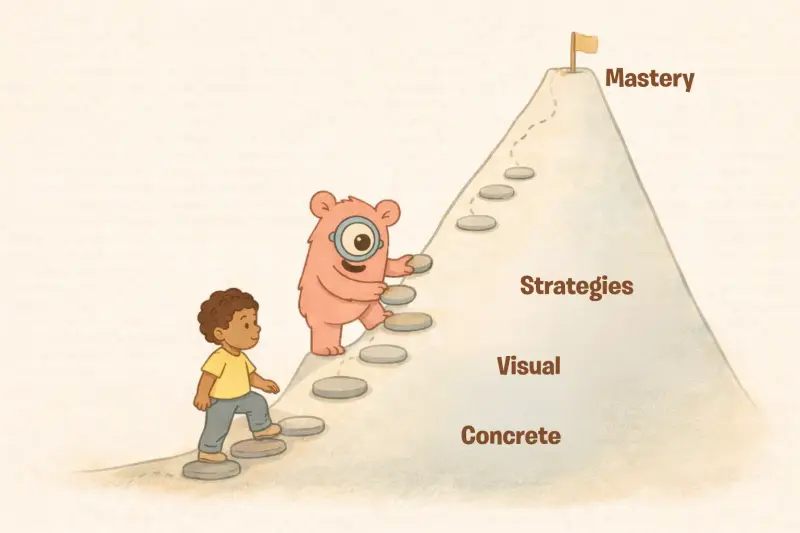
Apps like Monster Math are designed with exactly this in mind — no timers, no pressure, visual strategies that build number sense, and gameplay that makes practice feel like play rather than work.
Separate the Relationship from the Math
One of the most important things you can do is ensure that math time doesn't become a recurring conflict that damages your relationship with your child. If homework is consistently causing tears and arguments, something needs to change — and that something is usually the approach, not the child.
Consider whether someone else (a tutor, an older sibling, a co-parent) might be a less emotionally charged math partner. Or whether an app can take over the practice component, leaving your shared time free for connection rather than conflict.
A Quick Decision Framework
When your child resists math, run through this quick mental checklist:
Check the body first. Is your child showing signs of physiological distress (tears, tension, rapid breathing, shutdown)? If yes → pause. No learning is happening right now.
Check yourself. Are you calm, patient, and emotionally regulated? If not → pause. Your stress will escalate theirs.
Check the task. Is this within their ability range? Is it presented in a way that works for their brain? If not → adjust the task, not the child.
Check the environment. Is it noisy, visually cluttered, or unpredictable? Sensory factors matter enormously for neurodivergent learners → simplify the setting.
If none of the above apply — if your child is calm enough, the task is appropriate, and you're in a good headspace — then a gentle, choice-filled nudge is likely to help them get started.
FAQs
How do I know if my child has math anxiety or is just avoiding homework?
Math anxiety and homework avoidance can look identical on the surface. The key difference is the emotional and physiological response. A child with math anxiety may show physical signs of distress — stomach aches, tears, rapid breathing, or going completely still — specifically around math tasks. If the avoidance is specific to math (not reading, not art, just math), and if it's accompanied by distress rather than simple disinterest, math anxiety is likely playing a role. Research shows math anxiety disrupts working memory, making the subject feel genuinely harder — not just unpleasant (Ashcraft & Krause, 2007).
Is it okay to let my neurodivergent child skip math practice when they're upset?
Yes — sometimes skipping a session is the wisest move. When a child is in a state of emotional overload, pushing through teaches their brain that math equals distress. Over time, this deepens avoidance rather than building skills. The goal is consistency over time, not perfection every day. A short break followed by a return to practice in a calmer moment is far more productive than a tearful, forced session.
How can I tell the difference between productive struggle and harmful stress?
Productive struggle looks like effort mixed with engagement — your child is frustrated but still trying, still thinking, still in the game. Harmful stress looks like shutdown, escalation, or loss of executive function (suddenly unable to do things they normally can). If your child is still talking about the problem, even to complain, they're likely still in a zone where gentle support helps. If they've gone silent, rigid, or explosive, it's time to pause.
What if my child never wants to do math — should I just accept that?
Complete avoidance isn't the goal either. The research on the avoidance cycle shows that opting out entirely leads to skill gaps that make math even harder and more anxiety-provoking in the future (Ashcraft, 2002). The answer is to change the how, not eliminate the what. Find formats that reduce pressure — game-based apps, hands-on activities, real-world math in cooking or shopping — and build from there. Many neurodivergent children who resist worksheets will engage happily with math when it's presented through play and visual strategies.
My child is autistic and struggles with transitions. How do I start math time without triggering resistance?
Transition difficulty is one of the most common triggers for demand avoidance in autistic children. Use visual schedules so math time is predictable and expected. Give advance warnings ("In 5 minutes, we'll switch to math"). Offer a transition ritual — a specific song, a sensory break, or a "warm-up" activity that bridges the gap between what they're doing and math. Consistency and predictability are your greatest allies.
Does praising my child's effort really help, or is it just empty encouragement?
Process praise — praising strategy, effort, and persistence — is one of the most well-supported interventions in educational psychology. Research shows children who receive process-focused feedback develop greater resilience and willingness to take on challenges compared to children praised for being "smart" (Mueller & Dweck, 1998). But it needs to be genuine and specific. "I noticed you tried the number line when counting didn't work — that was really clever thinking" is meaningful. "Good job!" without specifics doesn't move the needle.
The Big Picture
Math resistance in neurodivergent children isn't a character flaw to be corrected. It's a signal to be decoded. Sometimes the signal says "I need a different approach." Sometimes it says "I need a break." And sometimes — with the right support, the right tools, and a safe emotional environment — it says "I just need a little help getting started."
Your job isn't to make math painless. It's to make it safe enough that your child is willing to try. And every time you respond to their resistance with curiosity instead of frustration, with flexibility instead of force, you're building something far more valuable than math fluency — you're building a child who believes they can learn.
References
Ashcraft, M. H. (2002). Math anxiety: Personal, educational, and cognitive consequences. Current Directions in Psychological Science, 11(5), 181–185. Full text PDF
Ashcraft, M. H., & Krause, J. A. (2007). Working memory, math performance, and math anxiety. Psychonomic Bulletin & Review, 14, 243–248. Full text PDF
Mueller, C. M., & Dweck, C. S. (1998). Praise for intelligence can undermine children's motivation and performance. Journal of Personality and Social Psychology, 75(1), 33–52. Full text PDF
Kamins, M. L., & Dweck, C. S. (1999). Person versus process praise and criticism: Implications for contingent self-worth and coping. Developmental Psychology, 35(3), 835–847. PubMed
Yeager, D. S., Hanselman, P., Walton, G. M., Murray, J. S., Crosnoe, R., Muller, C., … & Dweck, C. S. (2019). A national experiment reveals where a growth mindset improves achievement. Nature, 573, 364–369. Full text PDF
Schaeffer, M. W., Rozek, C. S., Berkowitz, T., Levine, S. C., & Beilock, S. L. (2025). Parent math anxiety and children's math success: The role of autonomy-supportive and controlling parenting behaviors. Contemporary Educational Psychology. Full text on ScienceDirect
Bureau, J. S., Howard, J. L., Chong, J. X. Y., & Guay, F. (2022). Pathways to student motivation: A meta-analysis of antecedents of autonomous and controlled motivations. Review of Educational Research, 92(1), 46–72. Full text on PMC
Joussemet, M., Landry, R., & Koestner, R. (2008). A self-determination theory perspective on parenting. Canadian Psychology, 49(3), 194–200. Full text PDF
Blackwell, L. S., Trzesniewski, K. H., & Dweck, C. S. (2007). Implicit theories of intelligence predict achievement across an adolescent transition: A longitudinal study and an intervention. Child Development, 78(1), 246–263. Full text PDF
Turner, J. C., Midgley, C., Meyer, D. K., Gheen, M., Anderman, E. M., Kang, Y., & Patrick, H. (2002). The classroom environment and students' reports of avoidance strategies in mathematics: A multimethod study. Journal of Educational Psychology, 94(1), 88–106. Full text PDF