TL;DR
Rote memorization often fails neurodivergent learners. This article explores why visualizing multiplication through arrays, number lines, and area models is essential for building true number sense in autistic and dyscalculic students. We cover the neuroscience behind visual math, how to choose the right model for your child, and how to scaffold learning from concrete objects to abstract equations.
For many parents of neurodivergent children, the "times tables" phase of elementary school is a source of immense anxiety. The traditional approach—rapid-fire verbal drills and timed tests—often relies heavily on working memory and verbal processing. For students with visual thinking strengths, such as many on the autism spectrum, or those with specific learning differences like dyscalculia, this approach doesn't just fail; it can actively dismantle their confidence.
However, mathematics is inherently visual. By shifting the focus from memorization to visualizing multiplication, we can tap into the neural strengths of neurodiverse learners, turning a source of frustration into a logic puzzle they can solve.
Why Visuals Work for Neurodivergent Students
The human brain processes mathematical information through multiple pathways. Research suggests that visual mathematics helps students build a deeper understanding of concepts rather than just memorizing rules. For autistic learners, who often possess strong visual-spatial reasoning skills, using math visuals bypasses the verbal bottleneck. Instead of hearing "three times four," they see a grid of three rows and four columns.
Similarly, for students with dyscalculia, the symbol "12" might feel abstract and meaningless. However, seeing a bar model that is clearly longer than a bar representing "4" provides the necessary context of magnitude. This aligns with the concept of "Dual Coding," where pairing a visual representation with a number strengthens the neural pathway for retrieval.
Essential Visual Models: Beyond the Flashcard
To effectively teach multiplication visualization, we need to move beyond decorative illustrations to models that show the structure of the math.
1. Arrays: The Gold Standard
An array is a set of objects arranged in rows and columns (e.g., a tray of muffins or a carton of eggs). This is often the most intuitive multiplication table visualization aid because it concretely demonstrates that 3 times 4 is the same total quantity as 4 times 3, reinforcing the commutative property without needing a verbal explanation.
Our free Multiplication Array Maker gives you the digital version of this: kids drag rows and columns to build any fact, and the dots always sit on a 10×10 grid so they see how each fact compares to its neighbors. The commutative property becomes obvious - build 3×4 and then 4×3, and kids see it's the same rectangle, just turned on its side.
2. Repeated Groups of Items
Repeated Groups are a second way to show multiplication. This is often the most practical multiplication table visualization aid because it concretely demonstrates what many word problems later ask (for e.g. 3 kids with 5 pencils each, how many total pencils).
3. Number Lines and Number Paths
While arrays show structure, lines show distance. Number paths and number lines are critical for connecting multiplication to repeated addition. Seeing three "jumps" of five on a number line helps a child understand that multiplication is simply an efficient way of counting forward. This visual representation is particularly helpful for skip counting strategies, which serve as a lifeline for dyscalculic learners who struggle to retrieve facts from memory. Our free Number Line Jumps Visualizer supports exactly this - it lets students take repeated equal-sized jumps (5s, 10s) on a clean number line, the foundation for connecting addition to multiplication.
4. Area Models
As students progress to multi-digit multiplication, arrays evolve into area models. Instead of counting individual dots, students visualize rectangular chunks. This is vital for decomposing difficult numbers (e.g., seeing 12 times 5 as a block of 10 times 5 plus a block of 2 times 5).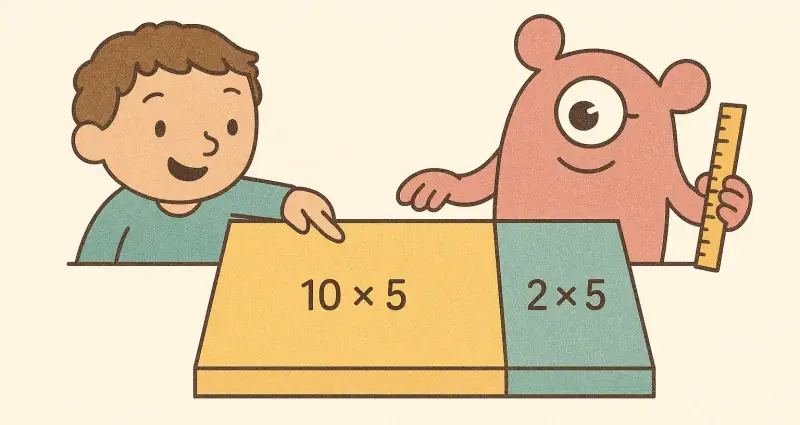
Choosing the Right Visual for Your Child
Not all dyscalculia multiplication visuals work for every child. The choice depends on their specific processing style:
For the Pattern Seeker: If your child lines up toys or notices geometric patterns, start with arrays. They will appreciate the symmetry and predictability.
For the Kinetic Learner: If your child needs movement, use number lines. The physical act of "jumping" a finger across the line adds a sensory component to the visualization.
For the Big Picture Thinker: Use area models to show how numbers fit together to form larger wholes, avoiding the overwhelm of counting tiny individual dots.
Once the child is familiar with one visual model, do share the same problem using different visual models - that helps strengthen their understanding of what multiplication really is. Just don't overburden them with multiple models in one go.
Step-by-Step Walkthrough: Concrete to Abstract
The most common mistake teachers and parents make is rushing to the abstract numbers (the flashcard) too quickly. Effective instruction follows the CRA (Concrete, Representational, Abstract) framework.
Concrete Phase: Put the pencil down. Use LEGO bricks, buttons, or counters to build physical arrays. Ask, "Can you build me 3 rows of 5?"
Representational Phase: Transition to visualizing multiplication on paper or a screen. This is where Monster Math excels. Our program uses concrete-to-visual scaffolding, ensuring that a child interacts with digital manipulatives—dragging and grouping virtual objects—before they ever face a bare equation.
Abstract Phase: Introduce the equation "3 X 5 = 15" alongside the visual. Eventually, the visual is faded, but the mental image remains.
By respecting this progression, we ensure that neurodivergent learners aren't just memorizing sounds; they are comprehending quantities.
If your child uses Monster Math to learn and practice multiplication, it already takes care of this progression from visualising to abstraction.
Frequently Asked Questions
My child counts every single dot in the array. Is that okay?
Yes, initially. This is the "counting all" stage. Gently guide them toward "counting on" or skip counting (counting by rows) to improve efficiency. Visualizing the rows as distinct groups helps this transition.
Do visuals prevent them from doing "mental math"?
No. Visuals are the foundation of mental math. Adults who are good at mental math often manipulate invisible arrays or number lines in their heads. We are simply making those invisible tools visible for the learner.
Are flashcards ever helpful?
Flashcards can be used for fluency practice after the concept is understood visually. However, look for cards that include a visual representation (like a small array) on the card itself to reinforce the connection.
References
Boaler, J., & Chen, L. (2016). Seeing as Understanding: The Importance of Visual Mathematics for our Brain and Learning
Butterworth, B. (2010). Foundational numerical capacities and the origins of dyscalculia.
Dehaene, S. (2011). The Number Sense: How the Mind Creates Mathematics.