
TL;DR: Timed math fact drills often backfire for children with ADHD, causing stress without improving long-term learning. A better approach is to use multi-sensory, strategic, and playful methods. Start with hands-on exploration (Concrete - Representational - Abstract sequence) to build true understanding before moving to symbols. Teach strategies (like using patterns, fact families, or skip-counting) instead of forcing rote memorization. Incorporate games and movement to keep their interest - research shows interactive learning can boost both focus and math performance. With these approaches, kids stay engaged, learn at their own pace, and gradually develop fluency in multiplication facts without anxiety.
Introduction
Teaching multiplication to an ADHD learner requires a different mindset than the old “drill-and-kill” approach. Many children with ADHD already struggle with basic math facts - they tend to retrieve math facts more slowly and rely on counting strategies longer than their peers. It’s not that they can’t learn their times tables; it’s that the traditional method of timed tests and flashcard drills clashes with how their brains work. In fact, forcing speed can trigger intense math anxiety, which only makes it harder for kids with ADHD to concentrate and recall facts under pressure. Many of these children also have working memory weaknesses - the mental scratchpad used to hold information - meaning they can easily get overwhelmed trying to remember multiple facts at once. It’s no surprise, then, that a lot of kids with ADHD absolutely dread flash cards and speed drills.
The good news is that there are proven, ADHD-friendly ways to teach multiplication that don’t involve one-minute timers or endless repetition. Below, we’ll explore why timed drills often backfire for ADHD brains and introduce three powerful strategies to replace them: using the CRA (Concrete - Representational - Abstract) sequence, explicitly teaching multiplication strategies (rather than pure memorization), and incorporating games, technology, and movement to make learning engaging. These approaches are backed by research and have been shown to improve both understanding and fact fluency for students with attention difficulties. Let’s dive in!
Why Timed Drills Backfire for ADHD Brains
Speed-focused drilling may seem like a quick way to instill math facts, but for a child with ADHD it can do more harm than good. One reason is the working memory load it creates. Children with ADHD often have impairments in working memory, which means they struggle to hold several pieces of information in mind at once. A traditional timed drill might present 20 or more problems to solve rapidly. For an ADHD brain, that’s an enormous cognitive load - they’re trying to recall facts while also racing against the clock. Instead of building fluency, the child may freeze up or resort to wild guessing. Research in educational psychology confirms that anxiety consumes mental resources needed for problem-solving; when children feel pressure, their brain’s capacity to retrieve information shrinks (math anxiety can sap working memory). In other words, the very act of timing a child can make it neurologically harder for them to recall the multiplication facts they do know!
Another issue is that kids with ADHD often develop negative associations with math through repeated drill failures. If every practice session turns into a stressful race they can’t win, their confidence plummets. They begin to see themselves as “bad at math” or think there’s something wrong with them. This is especially true because ADHD is frequently accompanied by high rates of math frustration - studies have found that students with ADHD are much more likely to experience math anxiety than their neurotypical peers. Timed drills only amplify this anxiety, creating a vicious cycle where stress further impairs performance, leading to more discouragement.
Importantly, memorization drills bypass understanding. Drills train children to spit out answers from memory, but they don’t ensure the child understands what “7 × 8” actually means or why it equals 56. Children with ADHD tend to thrive when they grasp concepts deeply (since it engages their interest), but rote drills give them no context or meaning - just rote repetition. As a result, many ADHD students simply tune out. Their brains crave novelty and stimulation; monotonous worksheets and flash cards provide the opposite, leaving the child understimulated and prone to distraction. Educators have noted that ADHD learners need approaches that are engaging and multisensory to maintain focus. Drills, unfortunately, are typically a single-sense (visual) repetitive task - a poor match for an easily bored brain that seeks variety.
Finally, consider that some children with ADHD rely on alternative strategies for math facts longer than other kids - and that’s not a bad thing. For instance, your child might quickly calculate 6 × 4 by thinking “6 × 2 = 12, and double that is 24.” This is a valid strategy showing they understand the math concept. Timed tests usually penalize such reasoning because it’s not as instantaneous as pure recall. But forcing immediate recall (before they’re ready) can discourage the use of logical strategies. It sends the message that “figuring it out” is wrong and only memorization matters, which is not true for building math skills. In fact, experts emphasize that accuracy, flexibility, and understanding are the keys to math fact fluency - speed comes as a natural by-product once those foundations are solid. Pushing speed too early is like demanding a toddler run before they’ve learned to walk.
In summary, timed drills often backfire because they stress the ADHD brain, overload working memory, and sap the joy and meaning from math. They can turn multiplication into a fear-inducing exercise rather than an exciting new skill to master. So if not drills, then what? Let’s look at three far more effective strategies for helping your child learn their multiplication facts.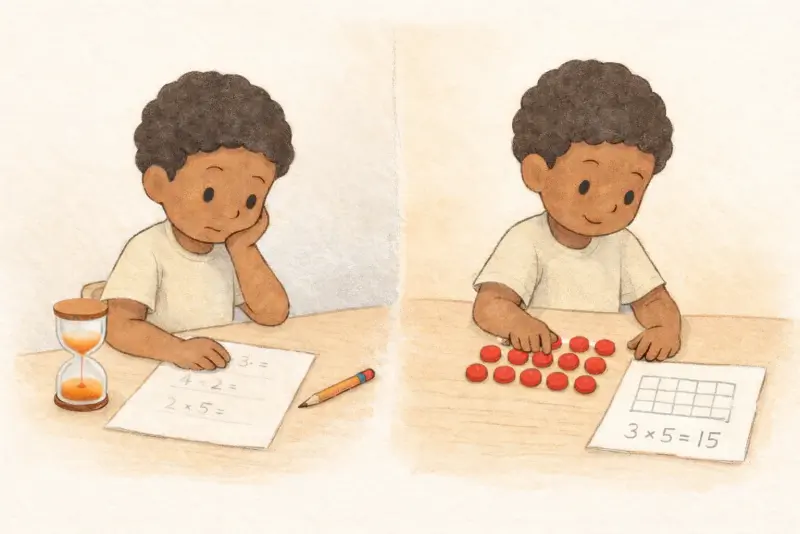
Hands-On Learning with the CRA Sequence
One of the most powerful methods for teaching math to any child - and especially a child with ADHD - is the Concrete - Representational - Abstract (CRA) sequence. In a nutshell, CRA is a three-step instructional approach that starts with tangible objects, then moves to visual pictures, and only then to numbers and symbols. This approach aligns perfectly with how neurodivergent kids learn because it builds understanding step by step, engaging multiple senses along the way. Research backs its effectiveness: using concrete and visual representations has been shown to significantly improve math performance for students with learning differences (multiple studies confirm that CRA-based instruction leads to better outcomes). Instead of memorizing 7 × 8 as an isolated fact, your child first sees and feels what 7 groups of 8 looks like, then draws it, and eventually connects it to “7 × 8 = 56.” This progression makes the learning sticky and meaningful.
How to apply CRA for multiplication? Start in the concrete stage by using real objects to represent multiplication problems. For example, if the task is 3 × 4, give your child 3 plates and a pile of counters (beans, blocks, coins - anything handy). Have them put 4 counters on each plate. Now they can physically count that 3 groups of 4 makes 12 total.
They might even arrange the counters into an array (a rectangle of 3 rows and 4 columns) and immediately see the structure of the multiplication fact. This hands-on play is not just fun - it’s teaching the concept of multiplication as grouping/repeated addition. Kids with ADHD often benefit from movement and touch in learning, and here they get both by handling objects. As one parent of an ADHD child put it, “We made multiplication into a game of making equal piles of snacks - suddenly it clicked!”
Next, move to the representational stage by replacing the objects with drawings or diagrams. Your child can draw the plates and dots instead of using the actual counters, or sketch an array with 3 rows of 4 stars. You can also introduce area models or bar models as visual representations.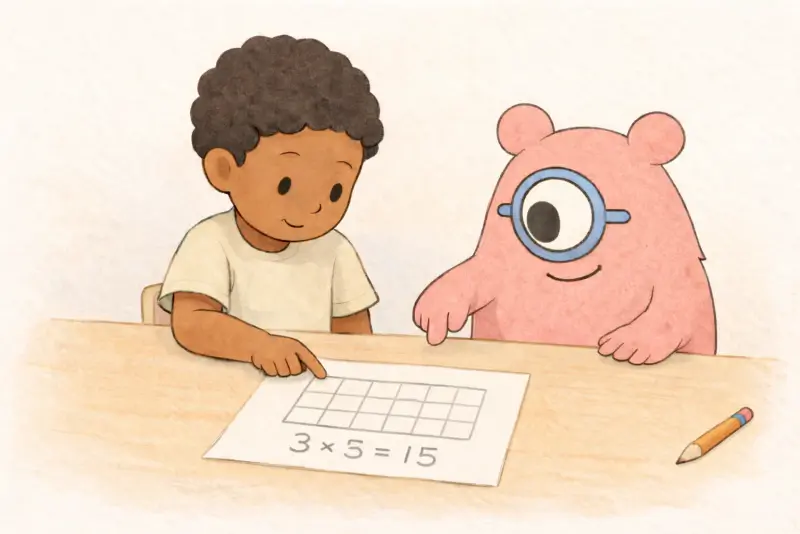
For instance, draw a 3 by 4 grid of squares and count them to show 12. At this stage, encourage your child to label their drawings (“4+4+4 = 12” under the picture) to connect addition and multiplication. There are also great visual tools like number lines (e.g. jump 3 steps of 4 on a number line) or color-coded charts. This representational step helps children bridge the gap between the physical world and abstract numbers. If your child has drawn out 3 × 4 in a picture, they’re far more likely to remember and understand that 3 × 4 = 12 later on, compared to just memorizing “3 times 4 is 12” by rote. It gives them a mental image to fall back on.
For ADHD learners who lose patience drawing arrays by hand - a 7×8 grid is 56 dots, which is a lot of pen strokes for a kid already low on executive function - our free Multiplication Array Maker does the representational stage on-screen. Set rows and columns, watch the rectangle form, and toggle on Skip count to see the running totals appear on each row. It preserves the visual learning the CRA stage needs without the friction of drawing.
Only after your child is comfortable with concrete and pictorial examples do you introduce the abstract symbols (numbers and × signs). Now you can show the equation 3 × 4 = 12 and say “See, this is the shorthand way to write the story of 3 groups of 4.” Because of the groundwork you laid, the symbols now have meaning. The child isn’t just recalling a fact; they truly get why it’s true. If they ever forget, they can re-draw the picture in their mind (or on paper) to derive the answer - that is powerful learning! Over time, with practice, they will need the drawings less and will recall that 3 × 4 is 12 more quickly. Fluency develops naturally once understanding is solid.
The CRA approach is especially helpful for ADHD kids because it breaks learning into manageable chunks and keeps them engaged. It’s multisensory (touching, seeing, speaking) and leverages their strengths. Children with ADHD often excel at visual-spatial reasoning, so seeing math in a visual or physical form taps into that asset. Also, moving manipulatives around can satisfy the need for activity - it turns “sit still and memorize” into an active exercise. One study noted that using systematic concrete-to-abstract teaching greatly helped students with attention and learning challenges master new math concepts. Parents can easily do CRA at home: use Lego bricks, beads, or even snacks like cereal pieces for the concrete stage. Draw pictures together for the representational stage (many kids love drawing their own groups or arrays). Make it colorful and fun. You don’t need fancy tools - creativity and a bit of patience go a long way. By following the CRA sequence, you’re essentially giving your child a strong conceptual foundation. When they truly understand multiplication, memorizing the facts becomes much easier because those facts “make sense” rather than being random numbers. In contrast to rote drills, CRA meets the child where they are developmentally and builds them up to mastery.
Teaching Strategies Instead of Rote Memorization
Beyond the general approach of CRA, it’s important to explicitly teach your child strategies for figuring out multiplication facts, rather than expecting instant recall of 100+ facts. Neurodivergent learners often do best when they have thinking tools in their toolbox. By showing your child patterns and strategies, you empower them to derive facts on their own, which is much more engaging (and effective) than drilling flashcards. Research suggests that children become truly fluent in math facts when they can use flexible strategies - not by rotely memorizing each fact in isolation. In fact, students with ADHD have been found to use less efficient strategies (like counting on fingers) more often and have difficulty switching strategies on their own. This indicates we should proactively teach them better strategies and give lots of practice using them, instead of just saying “memorize these.” Here are a few strategy-based techniques to consider:
Skip Counting: This is a fantastic entry point for learning multiples. If your child can count by 2s, 3s, 5s, etc., they can compute any multiplication for that number. Practice skip-counting with rhythm or songs (there are plenty of catchy multiplication songs out there). For example, chanting “5, 10, 15, 20...” helps them know 5 × 4 = 20 without direct memorization. Skip counting leverages auditory memory and pattern recognition, which can be easier for ADHD kids than memorizing random facts. Make it fun - march or jump while you count by 3s or 4s to release pent-up energy as well.
Use Known Facts to Derive Unknown Facts: Teach your child that they don’t actually need to memorize every single fact - they can use what they know to figure out what they don’t know. For instance, if they know 2 × 7 = 14, then 4 × 7 is just double that (28). If they know 5 × 6 = 30, then 6 × 6 is one more group of 6 (36). Show them how 9 × N is just (10 × N) minus N (e.g. 9×7 = 70 - 7 = 63). Show how 8 × N is (4 × N) doubled. These patterns drastically cut down the memory load. Your child starts to see a multiplication table as a connected web of facts rather than 100 individual facts. This not only helps them learn faster, it also appeals to logic - many ADHD kiddos love figuring out puzzles, so treating math facts like a puzzle to solve can hook their interest.
Fact Families and Turnarounds: Emphasize that multiplication has a lot of inherent shortcuts. For example, the commutative property means 3 × 8 is the same as 8 × 3; learn one and you know the other. Teach in pairs (“2 × 9 and 9 × 2 both equal 18”) so they immediately realize they got two facts for the price of one. Also, relate multiplication to division as “fact families.” If 4 × 6 = 24, then in that same family 6 × 4 = 24, 24 ÷ 6 = 4, and 24 ÷ 4 = 6. Learning facts in these related clusters is more efficient and shows how operations connect. Educators note that studying related facts together is often easier and more effective than memorizing isolated facts one by one. It reduces the number of pieces to remember, which is a big relief for a child with limited working memory.
Visual Patterns and Memory Aids: Multiplication is full of patterns that make facts easier to recall. Guide your child to notice them. For example, any time you multiply by 5, the product ends in 0 or 5 (great for quick checking). Multiplying by 9 produces a fun pattern: the digits of the answers add up to 9 (e.g. 9×4=36, and 3+6=9). Another pattern: 6 × an even number always ends in the same digit as that even number (6×4=24, 6×6=36, 6×8=48… the ones digits are 4,6,8). Playing “pattern detective” can transform fact practice from drudgery into a game. Some families draw multiplication charts together and color-code the patterns (like shading all multiples of 2, 5, etc. in different colors) - a great visual exercise that reinforces memory. For a no-prep digital version, our free Times Table Explorer lets kids tap any cell on a 10×10 chart to see the fact as dots, plus its commutative twin and skip-count sequence. Tap a square number and the entire diagonal of squares lights up - the kind of 'oh, the patterns!' moment that can hook an ADHD kid who'd lose interest halfway through coloring a paper chart
The goal with strategy instruction is to teach your child that math makes sense - it’s not just about memorizing arbitrary numbers. We want them to think, not just recall. This plays to the strengths of many kids with ADHD, who might struggle with rote memory but excel when they understand the “why” or can use reasoning. It also gives them a sense of control and confidence: if they forget a fact, they have ways to figure it out. Contrast this with drilling, where if you forget 7×8 under pressure, you’re just stuck and feel terrible about it. With strategies, an ADHD child might think “I don’t remember 7×8… oh, but 5×8 is 40 and 2×8 is 16, and 40+16 is 56!” That problem-solving process is a success experience - it rewards their effort and keeps them engaged.
When practicing, encourage your child to explain their thinking or the strategy they used (“How did you get 6×7?”). This reinforces their learning and also slows things down to a comfortable pace. You’ll likely find that as they use strategies repeatedly, certain facts do become automatic (they won’t forever calculate 6×7 from scratch - after using 5×7+7 a few times, they’ll just remember 42). In essence, you are building a robust network of knowledge in their brain, rather than a shaky house of cards built on rote memory. Over time, the strategies won’t slow them down - they’ll become second nature and support rapid recall. And even more importantly, your child will have developed *number sense* alongside fact fluency. This will serve them well beyond third-grade multiplication; it’s the foundation for higher math.
Make It Fun: Games, Technology, and Movement
Perhaps the most important piece of the puzzle is keeping your child engaged and motivated. Kids with ADHD have amazing capacity to focus when something captures their interest (hello, hyperfocus on video games!) - so why not harness that for multiplication? Turning math practice into play is not only more enjoyable, it’s supported by research as a highly effective approach. A recent study found that a well-designed gamified learning program significantly improved both attention and math performance in children with ADHD (children showed gains after 8 weeks of a math game intervention). Another systematic review concluded that educational games can substantially boost cognitive skills (like working memory and self-regulation) in kids with ADHD while reducing inattentive symptoms (serious games improved a range of ADHD outcomes). In plain terms: games make learning stickier and help ADHD brains stay on task.
So, what does this look like in practice? Here are some ideas to infuse multiplication learning with fun and movement:
Digital Math Games and Apps: Leverage your child’s love of screens for good! There are many math apps designed to practice multiplication in a playful way - often through quests, puzzles, or friendly competition. For example, apps like Prodigy or Reflex turn math facts into an adventure, and others like “Multifly” visualize multiplication as filling arrays. Our own roundup of 5 fun multiplication iPad games for ADHD kids showcases some great options. Many of these games provide instant feedback and reward progress, which is excellent for ADHD learners who respond well to immediate reinforcement. The key is to choose games that are pedagogically sound (they actually teach or reinforce strategies, not just drill in disguise) and that match your child’s interests. A child who loves adventure might enjoy an app where they battle monsters by solving multiplication problems, for instance. Limit play sessions to reasonable lengths so it doesn’t become overstimulating; 15 - 20 minutes of focused game practice can be more effective than an hour of rote drilling.
Physical and Board Games: Screen-free games can be just as effective and engaging. You can play multiplication bingo, where answers on the bingo card get covered when you solve a problem. Or try a card game: remove face cards from a deck, split the deck, and each player flips two cards - whoever multiplies them correctly first wins the round (this adds a slight speed element in a fun, low-stakes way). Dice games are great too: roll two dice (or one die twice) and have your child multiply the numbers - give points or a small reward for each correct answer. Even classic games like Times Table Hopscotch can work: write products in hopscotch boxes and as the child hops, they have to call out a multiplication fact that results in that number. The combination of movement and math is powerful for ADHD brains. It channels their energy and reinforces learning. Laughing and playing together also removes the tension that often surrounds math homework.
Incorporate Movement and Multi-Sensory Activities: Don’t be afraid to get creative and a little silly. Some families use a jumping jack multiplication routine - e.g., do jumping jacks while skip-counting by 3s. Or throw a ball back and forth, quizzing each other on times tables (the physical rhythm of catching and throwing can help some kids concentrate). For a tactile experience, let your child write multiplication facts in sand, shaving cream, or with chalk on the driveway - big muscle movement anchors the memory (plus it’s fun!). Research shows that physical activity can sharpen focus and executive function in children with ADHD, so integrating short movement breaks or kinesthetic learning can greatly improve their engagement. For example, you might set up four stations around the room, each with a different small activity (like a mini-puzzle or a stack of blocks) and a multiplication problem - the child moves station to station solving one problem at a time. This kind of rotation keeps them from feeling stuck in one place and makes practice feel more like an exciting mission than a drill.
Make It Social and Creative: Some kids are highly social, so involving family or friends can motivate them. Perhaps have a “multiplication fact of the day” that everyone in the family casually quizzes each other on (in a lighthearted way) throughout the day. Or work together on a creative project like a multiplication facts poster - your child can design one for the 7s or 8s with drawings or magazine cut-outs representing each fact (e.g., a picture of 3 cats and 4 cats for 3×4). This arts-and-crafts approach turns learning into a hands-on project and gives them a sense of accomplishment. Another idea is storytelling: create a silly story or word problem around a fact (e.g., “If 4 dragons each have 7 golden eggs, how many eggs in total?”). Acting out the story or drawing it can make the math come alive. The more you can connect multiplication to real-life contexts or a child’s personal interests (sports statistics, game scores, cooking measurements), the more meaningful and memorable it becomes.
The overarching principle is to keep things positive and low-pressure. Unlike timed drills, games and playful activities remove the fear of failure. Mistakes become part of the game (“oops, try again”) rather than a judgment. Many parents of ADHD kids find that when their child is having fun, their attention and retention skyrocket. You might notice your child voluntarily playing a math app or asking to do a quick quiz game after dinner - that’s a huge win! It means they are taking ownership of their learning and seeing math as something enjoyable or at least approachable. And if a particular game or method isn’t clicking, switch it up. Variety itself keeps an ADHD learner interested, so feel free to rotate through different apps, games, and activities. Every bit of practice helps reinforce the facts and the more modalities you use, the deeper the learning. By making multiplication practice fun, you’re also nurturing a growth mindset. Your child starts to feel, “I can get this, I just have to find the way that works for me.” That attitude is priceless and will carry them through challenges well beyond multiplication.
Conclusion
As a parent or teacher of a neurodivergent child, you have the opportunity to transform math from a source of anxiety into a journey of discovery. Ditching the timed drills doesn’t mean your child will never learn their multiplication facts - on the contrary, it means they’ll learn them more deeply, at their own pace, and with much less resistance. We’ve discussed how using the CRA progression, teaching clever strategies, and incorporating games and movement can open the door for your ADHD learner to truly grasp multiplication. These methods meet them where they are, leveraging their strengths (like creativity, curiosity, and energy) instead of punishing their challenges. Research and experience both affirm that when learning is engaging and multi-sensory, kids with ADHD thrive. They retain more, stay focused longer, and begin to develop confidence in their abilities!
FAQ
Q: Should I stop using flashcards and timed tests completely with my ADHD child?
A: If traditional flashcards and timed tests have been causing stress or frustration, it’s wise to put them aside for now. Research shows that timed drills can trigger anxiety without significantly improving recall for many kids. This doesn’t mean you must “ban” flashcards forever - but they should be reintroduced (if at all) in a low-pressure, game-like way once your child is more confident. For example, you might use flashcards cooperatively (solve together) or turn them into a memory matching game. The key is to remove the timer and high stakes. In general, prioritize strategies that build understanding and confidence first. Once your child knows some strategies and has had success with multiplication, they may actually enjoy using flashcards for a quick review, especially if you keep sessions very short. But if in doubt, there are plenty of other methods (like the ones described above) that are more effective and ADHD-friendly. In summary: *yes*, step away from the timed tests - your child won’t miss them, and their learning is likely to accelerate when you do.
Q: My child gets bored very easily. How can I keep them engaged in learning multiplication?
A: Variety and interactivity are your best friends here. Switch up the activities frequently - one day do a cooking project involving multiplication (e.g., doubling a recipe), another day play a math board game, another day use an app or watch a short educational video. Short bursts of practice work better than long sessions for an easily bored child. You might do 3 different 10-minute activities in a day rather than a single 30-minute drill. Incorporating your child’s interests can also hook their attention. If they love superheroes, frame word problems around superheroes (“Each superhero has 4 sidekicks…”). If they’re into Lego, use lego bricks to demonstrate facts. Movement is huge for engagement - try doing math outside with sidewalk chalk or have them answer a fact and then shoot a basketball, etc. Also consider a reward system for motivation: for example, a sticker chart or points that can be traded for a privilege when they practice multiplication without complaining or master a new set of facts. Kids with ADHD often respond well to immediate rewards because of their brain’s wiring. Even a high-five and enthusiastic “You did it!” after a practice session can reinforce their willingness to participate. The bottom line: keep things fresh, fun, and active. If you notice attention waning, it’s a sign to pivot to a new game or take a brain break. Over time, as they experience success and enjoyment, their tolerance for math will increase.
Q: How long will it take for my child to really know the multiplication facts?
A: It varies widely - and that’s okay. Neurodivergent children often follow a different timeline than the standard curriculum. Some might get the hang of multiplication in a few months with these methods; others may need consistent practice over a year or more to feel fluent with all facts 1 - 12. The important thing is steady progress. You might notice early on that they suddenly *own* a certain set of facts (say, the 2s, 5s, and 10s come quickly thanks to patterns), whereas 7s or 8s take longer. That’s completely normal. By using strategies, you’ll likely find that understanding comes quickly, but automaticity (quick recall) comes gradually. Keep in mind that even many adults don’t have all math facts instantly memorized - we often rely on quick mental calculation for the tougher ones, and that’s fine. Rather than focusing on a deadline (“must know all facts by X date”), focus on the trend: are they quicker or more accurate this month than last? If so, you’re on the right track. Celebrate that improvement. If progress has stalled, try introducing a new game or incentive to rekindle interest. Also, as your child’s general maturity and focus improve with age, you might see a leap in recall ability. In the meantime, ensure they aren’t held back in other math areas due to fact fluency - allow tools like multiplication charts or tables for multi-digit multiplication or division problems so they can continue learning higher concepts while the facts are still solidifying. Trust the process and be patient. With your support and the strategies in this article, your child will get there in their own time.
Q: What if my child has memorized some facts but still makes careless mistakes?
A: Careless mistakes are common among kids with ADHD due to impulsivity or momentary lapses in attention. It doesn’t necessarily mean they don’t know the facts. To help with this, continue practicing in ways that strengthen focus. One idea is to have them *double-check* answers through a different method - for example, after giving an answer, they could quickly add to verify (like check 6×7 by adding 7 six times) or use the approximate magnitude (“6×7 is 42, does that number sound reasonable?”). Teaching little self-monitoring habits can cut down errors. Another tip: encourage them to pause a second before answering - a brief moment to think, “Is that right?” can catch many mistakes. When reviewing work, instead of pointing out errors immediately, ask them to spot anything that “doesn’t look right” - this builds their error-checking skills. Sometimes careless errors happen more when they’re working on paper; if so, try oral practice or vice versa to see if format affects accuracy. If they are racing (common in ADHD), emphasize quality over speed - perhaps set up a game where accuracy earns points, not just speed. Finally, make sure they’re not overly fatigued; frequent short breaks can help maintain attention and reduce slip-ups. Remember to stay patient and encouraging - when mistakes occur, treat them as a learning opportunity (“Oops, I see you said 7×7=48. Let’s figure out what happened there.”) rather than a failure. With supportive strategies, those careless errors should diminish over time.
References
Ganor-Stern, D., & Steinhorn, O. (2018). ADHD and math - The differential effect on calculation and estimation.
Boaler, J. (2014). Research suggests that timed tests cause math anxiety.
Martinussen, R., Hayden, J., Hogg-Johnson, S., & Tannock, R. (2005). A meta-analysis of working memory impairments in children with attention-deficit/hyperactivity disorder.
Finell, J., Sammallahti, E., Korhonen, J., Eklöf, H., & Jonsson, B. (2022). Working memory and its mediating role on the relationship of math anxiety and math performance: A meta-analysis.
Flores, M. M., Hinton, V. M., & Strozier, S. D. (2014). Teaching subtraction and multiplication with regrouping using the concrete-representational-abstract (CRA) sequence and strategic instruction model (SIM).
Doulou, A., Pergantis, P., Drigas, A., & Skianis, C. (2025). Managing ADHD symptoms in children through the use of various technology-driven serious games: A systematic review.
Dai, J., Wufue, A., & Zhang, H. (2025). Effectiveness of a gamified educational application on attention and academic performance in children with ADHD: An 8-week randomized controlled trial.