TL;DR:
Dyscalculia affects roughly 3-6% of children and often occurs in students with normal or high intelligence.
Bright or verbal children can mask math difficulties through language skills and compensatory strategies.
Schools often rely on general academic performance rather than specific numerical assessments.
This mismatch delays identification, sometimes until middle school or later.
Early recognition and concept-based math instruction can significantly improve outcomes.
“But they’re so smart.”
That’s often the first reaction teachers and parents have when a child struggles with math but excels in conversation, storytelling, or reading. The child explains ideas beautifully, asks thoughtful questions, and may even perform well in most subjects. Yet when it comes to numbers, something just doesn’t click.
For many families, this mismatch creates confusion. If a child is bright, articulate, and curious, how can math be such a struggle?
The answer may lie in dyscalculia, a specific learning disability that affects a child’s ability to understand numbers and mathematical relationships. And in bright or highly verbal children, dyscalculia often goes unnoticed for years.
Research shows that developmental dyscalculia is a specific learning disability affecting number processing that occurs despite normal intelligence and adequate educational opportunities.
Yet many of these children are never identified early. Let’s explore why.
What Dyscalculia Actually Is (and Isn’t)
Dyscalculia is a neurological learning disability that affects a child’s ability to process numbers, understand quantities, and perform arithmetic. Children with dyscalculia may struggle with number sense, place value, estimation, or recalling basic math facts.
Importantly, dyscalculia is not caused by low intelligence. Many students with dyscalculia perform well in other academic areas such as reading, language, or reasoning, because the difficulty is specific to numerical processing rather than overall cognitive ability. Research examining mathematical learning disabilities, describe it as a domain-specific learning difficulty that can occur in individuals with otherwise typical intellectual functioning.
This is why dyscalculia can be particularly difficult to identify in children who are otherwise strong learners.
Children with dyscalculia often struggle with number sense, magnitude comparison, and understanding how numbers relate to one another - foundational skills explored in approaches to building number sense in kids with dyscalculia, where learning focuses on helping children see how numbers break apart, combine, and represent quantities.
The “Bright Kid” Paradox
One of the biggest misconceptions about learning disabilities is that they only affect struggling students.
But research on twice-exceptional learners (students who are both gifted and have a learning disability) shows that cognitive strengths can actually hide learning differences. Since identification often relies on discrepancies between IQ and academic achievement, many students are overlooked when their strengths compensate for their weaknesses.
This creates what educators sometimes call the “bright kid paradox.”
A child may:
Speak fluently and explain ideas well
Read above grade level
Understand stories, science, and social studies easily
But still struggle deeply with numbers
Because the child appears capable overall, adults may assume the math struggles are due to effort, attention, or motivation rather than a learning difference.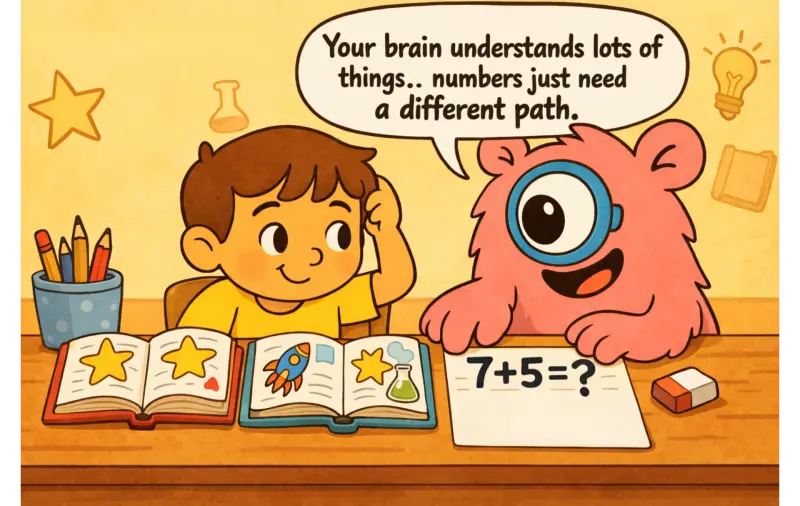
Why Verbal Skills Can Mask Math Difficulties
Strong language skills are one of the biggest reasons dyscalculia can go unnoticed.
Verbal children often develop clever ways to compensate for weaknesses in number processing. For example, they might:
Memorize procedures without understanding the concepts
Use verbal reasoning to guess answers
Rely heavily on counting strategies
Use storytelling to remember steps
These strategies can temporarily hide underlying numerical difficulties.
However, as math becomes more abstract in later grades, these workarounds stop working.
At that point, the gap between the child’s verbal intelligence and math performance becomes more visible.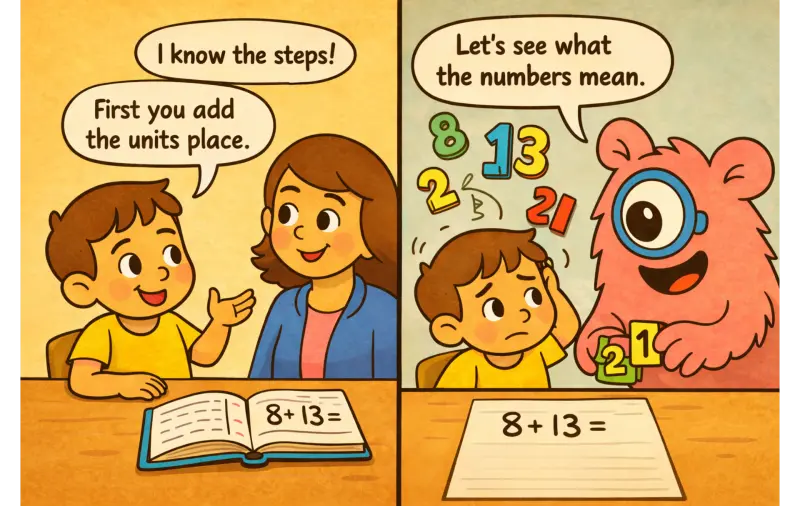
Schools Often Look for the Wrong Signals
Many school identification systems focus on general academic performance rather than specific cognitive processes related to math.
This approach can miss dyscalculia because children with the condition may perform adequately on basic classroom tasks.
Research on mathematical learning disabilities highlights that dyscalculia involves deficits in number processing, working memory, and executive functions related to numerical tasks. For example, a meta-analysis examining cognitive profiles found significant weaknesses in working memory and processing speed in students with mathematical learning disabilities.
But these weaknesses may not appear in everyday classroom assessments.
Instead, teachers may see:
Incomplete homework
Slow calculation speed
Frequent mistakes in arithmetic
Difficulty explaining how answers were reached
Without understanding the underlying cognitive differences, these behaviors can easily be misinterpreted.
The “Good in Everything Else” Effect
Another reason dyscalculia is missed is that strong performance in other subjects can create misleading expectations.
Teachers may think:
“They’re doing great in reading.”
“They write amazing essays.”
“They participate thoughtfully in discussions.”
So when math problems arise, the assumption often becomes:
“They just need more practice.”
But dyscalculia is not a practice problem. It is a difference in how the brain processes numerical information.
Research shows that mathematical learning difficulties are linked to challenges in numerical magnitude processing and executive functions. Studies using number comparison tasks demonstrate how these systems interact during math learning, suggesting that the difficulty is not simply memorizing math facts but developing a deeper understanding of numbers.
Delayed Identification Creates Long-Term Effects
When dyscalculia goes unnoticed in early grades, the consequences often build slowly.
Children may begin to experience:
Growing math anxiety
Avoidance of math tasks
Lower confidence in school
Increasing gaps in foundational concepts
Research examining emotional factors in dyscalculia has found that students with the condition often experience higher levels of mathematics anxiety and executive function challenges compared to peers.
What Early Signs Might Look Like
Even bright and verbal children with dyscalculia often show subtle early indicators.
Parents and teachers may notice:
Difficulty estimating quantities
Trouble remembering basic math facts
Confusion with place value
Reliance on counting for simple problems
Difficulty understanding number magnitude
What Actually Helps
The encouraging news is that children with dyscalculia can thrive when math instruction is aligned with how their brains learn.
Research suggests that effective support often includes:
Visual representations of numbers
Concrete manipulatives
Strategy-based math instruction
Reduced reliance on timed drills
Conceptual understanding before memorization
These approaches help build number sense rather than forcing students to rely purely on memory.
When learning becomes visual and conceptual, many children who previously struggled with math begin to experience meaningful progress.
Conclusion
If your child is bright, curious, and articulate - but consistently struggles with math - it’s worth looking deeper.
The difficulty may not be effort, motivation or intelligence.
Sometimes the real issue is simply that the child’s brain processes numbers differently.
When we recognize that difference early, we can finally give children the tools they need to understand math in ways that actually make sense to them.
FAQs
Can a smart child have dyscalculia?
Yes. Dyscalculia frequently occurs in children with average or above-average intelligence. Research consistently shows that math learning disabilities can exist even when overall cognitive ability is strong.
Why is dyscalculia often missed in school?
Bright or verbal children may compensate using language skills, memory, or reasoning strategies. Because they perform well in other subjects, teachers may not initially suspect a learning disability.
At what age can dyscalculia be identified?
Signs of dyscalculia can appear in early elementary school, particularly when children begin learning number sense, place value, and basic arithmetic.
Does dyscalculia affect intelligence?
No. Dyscalculia specifically affects mathematical processing and does not reflect a child’s intelligence or overall learning potential.
References
Butterworth, B., Varma, S., & Laurillard, D. (2011). Dyscalculia: From Brain to Education. Science, 332(6033), 1049–1053.
https://scispace.com/pdf/dyscalculia-from-brain-to-education 1sxi3bx8au.pdfSzűcs, D. (2013). Developmental dyscalculia: Fresh perspectives.
https://www.sciencedirect.com/science/article/pii/S2211949313000185
Beckmann, E., & Minnaert, A. (2018). Non-cognitive Characteristics of Gifted Students With Learning Disabilities: An In-depth Systematic Review.Frontiers in Psychology, 9, 504.
https://pmc.ncbi.nlm.nih.gov/articles/PMC5919977/Kivirähk-Koor, T., & Kiive, E. (2025). Differences in Cognitive and Mathematical Skills of Students with a Mathematical Learning Disability and Those with Low Achievement in Mathematics: A Systematic Literature Review.Education Sciences, 15(3), 361.
https://www.mdpi.com/2227-7102/15/3/361
Wilkey, E. D., Pollack, C., & Price, G. R. (2020). Dyscalculia and Typical Math Achievement Are Associated With Individual Differences in Number-Specific Executive Function.Child Development, 91(2), 596–619.
https://pmc.ncbi.nlm.nih.gov/articles/PMC8183686/
Lievore, R., Monaldi, M., Viggiano, M. P., & Lanfranchi, S. (2025). Children with and without dyscalculia: How mathematics anxiety and executive functions affect mental calculation performance. Journal of Experimental Child Psychology, 249, 106078.
https://www.sciencedirect.com/science/article/pii/S104160802500069X