TL;DR
Fractions are especially challenging for children with dyscalculia and autism because they place heavy demands on language processing, working memory, and abstract reasoning. Research consistently shows that visual and tactile fraction instruction — using fraction bars, area models, number lines, and hands-on manipulation — significantly improves understanding, retention, and transfer. This article explains why fractions are uniquely difficult for dyscalculic and autistic learners and how parents and teachers can teach fractions effectively by starting with concrete and visual representations before introducing symbols.
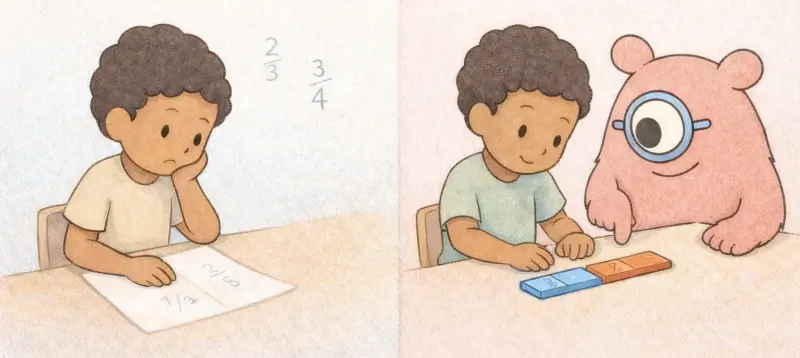
Fractions are often described as the point where “math gets hard.” For neurodivergent learners — particularly children with dyscalculia or autism — fractions can feel not just hard, but incomprehensible. Parents may notice that their child can count, add, or even multiply, yet completely unravels when introduced to ideas like ⅔, ¾, or equivalent fractions.
Research shows that fraction learning places intense demands on magnitude processing, language comprehension, working memory, and abstraction — the very areas most impacted in dyscalculia and autism. The good news is that decades of cognitive and educational research point to a clear solution: fractions must be taught visually and tactilely first.
Why Fractions Are Especially Hard for Dyscalculic and Autistic Learners
1. Fraction Symbols Are Abstract and Counterintuitive
Unlike whole numbers, fractions do not represent a single countable quantity. A symbol like ¾ encodes a relationship between two quantities, not a standalone magnitude. Research shows that many children fail to develop accurate mental representations of fraction magnitude and have systematic misconceptions.
For children with dyscalculia, who already struggle with numerical magnitude processing, this relational structure is particularly difficult to grasp. Studies on developmental dyscalculia highlight impairments in representing numerical quantity, which directly impacts fraction understanding.
2. Language Load Is Extremely High
Fractions rely heavily on linguistic constructs such as numerator, denominator, out of, over, part, and whole. For autistic learners, who often experience challenges with receptive language, semantic ambiguity, or figurative phrasing, this language density creates an additional barrier.
Dyscalculia research demonstrates that language-heavy math instruction disproportionately disadvantages students with language and working memory differences — even when conceptual understanding could otherwise develop.
3. Working Memory Gets Overloaded
To interpret a fraction symbol, a child must simultaneously hold the whole in mind, track the part being considered, and compare magnitudes — all while decoding symbolic notation. Studies show that children with math learning disabilities have reduced working memory capacity for numerical tasks, making symbolic fraction instruction particularly difficult for them.
What the Research Says Works: Visual and Tactile Fraction Instruction
Concrete and Visual Models Are Not “Supports” — They Are the Instruction
A robust body of research demonstrates that students learn fractions more effectively when instruction begins with concrete and visual representations, rather than symbols. Research shows that conceptual understanding is strongest when learners interact with physical or visual models before transitioning to abstract notation.
This aligns with the Concrete–Representational–Abstract (CRA) instructional framework, which has strong empirical support for students with learning disabilities. You can explore how this framework supports neurodivergent learners in more depth in our guide on the CRA method in math learning.
Why Visual Models Reduce Cognitive Load
Visual fraction models externalize information that would otherwise need to be held in working memory. According to Sweller’s cognitive load theory, learning improves when mental effort is reduced for non-essential processing.
For autistic and dyscalculic learners, fraction bars, area models, and number lines transform fractions from linguistic-symbolic puzzles into spatial relationships that can be seen, compared, and manipulated.
Visual and Tactile Fraction Models That Work Best
Area Models (Circles and Rectangles)
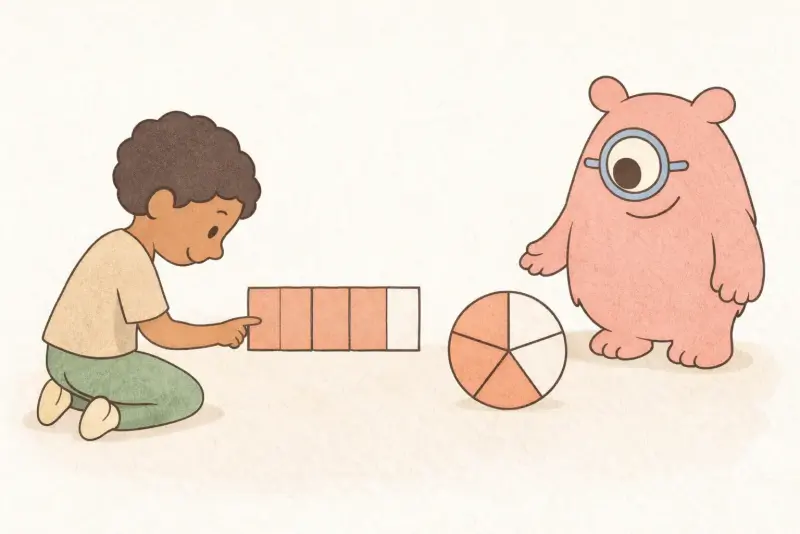
Area models help children connect fractions to partitioning and fairness, and to relate fractions as parts of whole. For autistic learners who prefer visual symmetry and structure, evenly partitioned shapes reduce ambiguity and support predictability.
Fraction Bars and Strips
Fraction bars allow children to see that two one-fourths cover the same length as one-half. They are flexible and can be used in a wide variety of problems.
Number Lines
Ability to point out fractions correctly on the number line is one of the strongest predictors of long-term fraction understanding. Number lines differ from the previous models in some important ways - for example, the number line does not have any visual separation between consequetive units - and is hence continuous.
What to Avoid (Even If It’s Common)
- Timed fraction drills, which increase anxiety without improving understanding
- Teaching rules (e.g., “cross-multiply”) before conceptual models
- Language-only explanations without visual grounding
- Worksheets that jump straight to symbols
For children with dyscalculia and autism, these approaches often reinforce confusion rather than clarity.
Connecting This to Game-Based Learning
Digital math games that embed fraction concepts within visual, interactive environments can offer the same cognitive benefits as physical manipulatives — when designed correctly. Calm pacing, no timers, and strong visual scaffolding are essential. You can see how these principles are applied in fraction-friendly math games in our article on math games that support dyscalculic learners.
FAQs
At what age should dyscalculic or autistic children start fractions?
Research suggests that fraction concepts can begin informally as early as ages 5–7 using visual and sharing-based activities, long before symbolic notation is introduced.
Should I avoid fraction symbols entirely?
No — but symbols should come after visual and tactile understanding is solid. Symbols should label understanding, not replace it.
Are manipulatives enough on their own?
Manipulatives are most effective when paired with guided discussion and gradual transition to drawings and symbols, consistent with CRA research.
References
- Siegler, R. S., Thompson, C. A., & Schneider, M. (2011).An integrated theory of whole number and fractions development.Cognitive Psychology.
- Butterworth, B. (2010). Dyscalculia: From brain to education. Science.
- Fuchs, L. S., et al. (2013). Effects of fraction instruction on at-risk learners. Psychological Science.
- Mazzocco, M. M. M., Feigenson, L., & Halberda, J. (2011). Impaired acuity of the approximate number system. Cognition.
- Fyfe, E. R., et al. (2015). Benefits of Concreteness fading for children's mathematics instruction. Elsevier.