
TL;DR: Children with ADHD often experience weaknesses in working memory and sustained attention, which makes the multi-step, place-value-heavy parts of arithmetic (carrying, borrowing, regrouping, aligning digits) especially difficult. The fix is not “more drilling” - it’s targeted place-value instruction that reduces cognitive load: concrete representations (base-ten blocks), explicit regrouping, external memory supports, and clean visual layouts.
Why place value becomes a bottleneck - especially for ADHD brains
When parents say, “My child knows the facts, but multi-digit math falls apart,” they’re usually describing a place-value breakdown.
Place value is the rule that in a number like 507, the 5 means five hundreds, the 0 means zero tens, and the 7 means seven ones. That sounds simple - but in practice, place value is a system your child has to keep stable in their head while they:
align digits into columns
choose the correct operation and step order
hold partial answers in mind
regroup (carry/borrow) across columns
inhibit distractions and irrelevant strategies
That stack of steps is exactly where ADHD learners often struggle: not because they are not trying, but because attention and working memory are under constant load.
Place value is not a “nice-to-have” - it’s the operating system of arithmetic
Multi-digit arithmetic is basically a place-value machine.
Addition and subtraction: regrouping across ones, tens, hundreds
Multiplication: place shifts, partial products, carrying
Division: place-based estimation and repeated regrouping
Fractions/decimals: moving across place-value units (tenths, hundredths)
In research, number-line estimation is often used as a window into children’s understanding of numerical structure. Importantly, the ability to estimate accurately on a number line requires a strong grasp of the place-value structure of numerals, and this accuracy is associated with arithmetic development. One study notes that making accurate number-line estimates - which depends on understanding place-value structure - is essential for arithmetic development and is correlated with arithmetic performance.
So if place value is shaky, the entire arithmetic tower becomes fragile.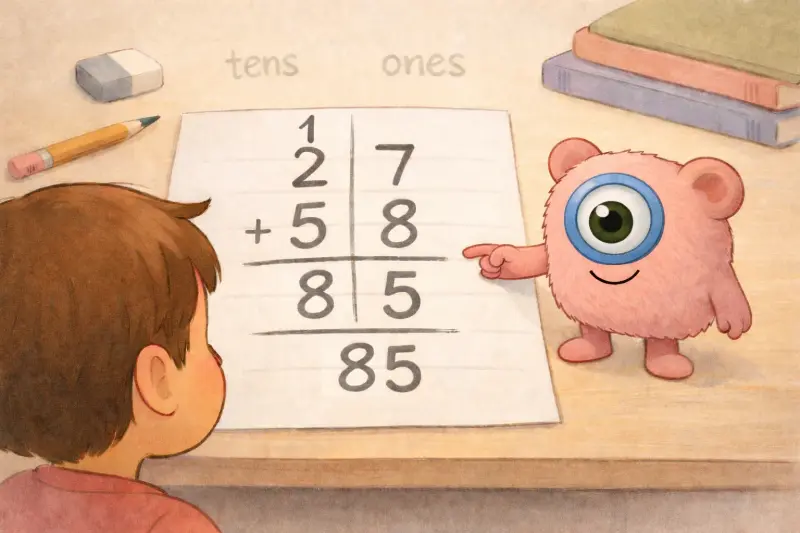
What ADHD changes: attention + working memory + sequencing
Many kids with ADHD can understand quantity and can often estimate “more vs less” just fine. In fact, research suggests math difficulties in ADHD are unlikely to originate from an impaired visual number sense - meaning the basic ability to perceive numerosity may be intact even when symbolic math performance is weaker.
Where ADHD tends to hit hardest is in the executive demands of multi-digit math:
Working memory (holding steps and partial results)
Updating (carrying a 1, then remembering to add it)
Inhibition (not writing the answer in the correct column)
Sustained attention (staying with the procedure through multiple steps)
A study modeling working memory and math skills found that the three working/short-term memory components (phonological loop, visuospatial sketchpad, central executive) all significantly contribute to children’s math skills, jointly explaining a large portion of variance in math achievement. Teacher-reported inattentive ADHD symptoms also contributed to predicting math skills.
That’s why place value becomes the “real bottleneck”: it is where arithmetic becomes procedural, multi-step, and memory-heavy.
The “carry/borrow” problem: the research signal that points directly at place value
If you want a simple test of place-value load, look at what happens when a problem requires regrouping.
Example:
23 + 45 (no carry)
27 + 58 (carry is required)
When regrouping is required, the student must:
add ones
notice that the sum crosses 10
record the ones digit
carry/regroup 1 ten
shift attention to tens and include the carried ten
That’s a lot of updating and place-value coordination.
A study on third graders with mathematics difficulties examined whether place-value processing problems generalize to arithmetic and found an increased carry effect (slower responses and higher error rates) specifically when addition required carryover. In other words: the moment place-value computation becomes necessary, performance drops disproportionately.
Separately, work comparing dyscalculia and ADHD symptoms shows that children with ADHD symptoms can display selective difficulties in calculation (including subtraction) alongside working memory and processing speed differences, which fits the day-to-day pattern families describe: the hardest problems are the ones where you must hold and move place-value information across steps.
What this looks like at home (and why it gets mislabeled as “careless”)
Place-value errors can look like “sloppy mistakes,” but many are predictable signs of cognitive overload:
writing 47 + 28 as 4+2 and 7+8 but misaligning columns
forgetting to add the carried 1
borrowing from the wrong column (when subtracting)
writing the answer in the tens place instead of ones
skipping a step because the brain “jumps ahead”
This is why ADHD math struggles often show up as inconsistent performance: the child can do it sometimes (when cognitive load is lower) and fall apart other times (when tired, distracted, or rushed).
If you want a practical checklist for catching these errors without shame, Monster Math’s post on 6 Ways to Catch “Careless” Math Mistakes in ADHD Learners includes classroom-friendly layout and checking strategies.
The fix: make place value visible, external, and low-load
Here are evidence-aligned strategies that target place value while respecting ADHD brains.
1) Use concrete models before symbols (and don’t rush this)
Base-ten blocks, bundling sticks, place-value disks, bead strings - anything that physically represents:
10 ones = 1 ten
10 tens = 1 hundred
You can also use visual videos on Youtube to help kids understand what the place values mean, before they start using carry overs or borrows.
Our free Place Value Exploder does this digitally - kids can watch a number like 47 'explode' into 4 tens and 7 ones, and toggle between digit cards and base-ten (Dienes) blocks to see the same idea two ways.
Concrete regrouping matters because it turns “carrying” into a visible action: swap 10 ones for 1 ten.
Try this script:
“We don’t ‘carry a 1’. We regroup ten ones into one ten.”
That language teaches place value, not just a procedure.
2) Externalize working memory
When working memory is the bottleneck, you reduce the need to hold steps in mind.
Write the carry digit big and clear above the tens column
Use a place-value chart with labeled columns (Hundreds | Tens | Ones)
Encourage kids to jot “mini-notes” (e.g., “carry 1”)
Use scratch space intentionally (not as messy overflow)
This works because multi-digit arithmetic requires keeping interim results in working memory and updating them.
3) Make columns visually bulletproof
If digit alignment is unstable, place value collapses.
Use squared paper (each digit in a box)
Highlight the ones column lightly
Draw a vertical place-value frame
Keep problems one per line with lots of spacing
Monster Math’s post on How to Adapt Math Worksheets for ADHD and Autistic Learners goes deeper on reducing visual noise, improving alignment, and lowering overwhelm.
4) Teach regrouping as a concept, not a trick
Many kids memorize “carry the 1” without understanding what it means - and that causes even more difficulties for ADHD learners.
Instead:
name the units out loud: “7 ones + 8 ones = 15 ones”
show the regroup: “15 ones is 1 ten and 5 ones”
physically move the ten into the tens column (blocks or drawings)
This reduces errors because the student is tracking meaning, not just steps.
5) Short, high-quality practice beats long worksheets
ADHD brains fatigue quickly on repetitive procedures. Instead of 30 problems, do:
6 to 10 carefully chosen problems
mixed difficulty (some with carry, some without)
one clear strategy goal (“Today we practice regrouping with blocks”)
immediate feedback
The aim is automaticity with understanding, not grind.
6) Be careful with working-memory training claims
There is research exploring working-memory training for ADHD, and reviews note reports of transfer effects to academic skills including math in some studies. But overall effects vary across programs and outcomes, and training should be treated as a supplement - not a replacement for explicit place-value instruction.
A practical rule: teach place value directly first, and use memory/focus supports as secondary helpers.
Quick “place value check” for parents and teachers
If you’re not sure whether place value is the bottleneck, try these quick probes:
Expanded form: Can they match 300 + 40 + 5 to 345?
Regrouping meaning: Can they explain why 15 ones becomes 1 ten + 5 ones?
Number line: Can they place 73 on a 0-100 line reasonably?
Compare numbers: Do they reliably know that 402 is greater than 390?
Error pattern: Are mistakes mostly happening on carry/borrow problems, compared to problems that don't involve carry/borrow (even with multiple digits?
If multiple are weak, place value is likely the “real” target.
FAQs (Parents and Teachers)
What exactly is place value?
Place value is the idea that a digit’s value depends on its position. In 642, the 6 represents 600, the 4 represents 40, and the 2 represents 2.
Why does ADHD make place value harder than basic facts?
Multi-digit problems require sustained attention, working memory, and sequencing. Research links arithmetic performance to working memory and attentional resources because multi-step computation requires holding interim results, updating them, and shifting attention between digits and places.
My child understands place value orally, but makes mistakes on paper. Why?
This is common. The paper version adds visual alignment, writing, and step tracking - extra load on attention and working memory. Visual supports (boxes, frames, spacing) and externalizing carries/borrows often reduce errors quickly.
Is it “careless mistakes” or a real learning issue?
Often it is cognitive load, not carelessness. Many children with ADHD show intact basic number sense but weaker performance on symbolic, multi-step math tasks. If errors cluster around regrouping and alignment, place value is a strong suspect.
What accommodations help in school?
Common supports include:
squared paper or place-value templates
fewer problems with higher quality feedback
extra time
allowing scratch work and step notes
breaking multi-step problems into parts
These align with reducing working-memory and attention load in the task.
Bottom line
Place value is where arithmetic stops being “counting” and starts being a structured, multi-step system. That system is demanding for any child - and especially for ADHD learners whose attention and working memory are already running at capacity.
When you teach place value as a visible structure (not a memorized trick), and you design practice to lower cognitive load, place value stops being a bottleneck - and starts becoming a confidence builder.
References
Qi, Y., Chen, Y., Yang, X., & Hao, Y. (2022). How does working memory matter in young children’s arithmetic skills: The mediating role of basic number processing. Current Psychology (advance online publication), 1–13. https://pmc.ncbi.nlm.nih.gov/articles/PMC8956146/
Gaye, F., Groves, N. B., Chan, E. S. M., Cole, A. M., Jaisle, E. M., Soto, E. F., & Kofler, M. J. (2024). Working Memory and Math Skills in Children with and without ADHD. Neuropsychology, 38(1), 1–16. https://pmc.ncbi.nlm.nih.gov/articles/PMC10842998/
Ganor-Stern, D., & Steinhorn, O. (2018). ADHD and math - The differential effect on calculation and estimation. Acta Psychologica, 188, 55–64. https://www.sciencedirect.com/science/article/abs/pii/S0001691817305565
Lambert, K., & Moeller, K. (2019). Place-value computation in children with mathematics difficulties. Journal of Experimental Child Psychology, 178, 214–225. https://pubmed.ncbi.nlm.nih.gov/30390494/
Kuhn, J.-T., Ise, E., Raddatz, J., Schwenk, C., & Dobel, C. (2016). Basic numerical processing, calculation, and working memory in children with dyscalculia and/or ADHD symptoms. Zeitschrift für Kinder- und Jugendpsychiatrie und Psychotherapie, 44(5), 365–375. https://pubmed.ncbi.nlm.nih.gov/27356678/
Anobile, G., Bartoli, M., Masi, G., Tacchi, A., & Tinelli, F. (2022). Math difficulties in attention deficit hyperactivity disorder do not originate from the visual number sense. Frontiers in Human Neuroscience, 16, 949391. https://pmc.ncbi.nlm.nih.gov/articles/PMC9649814/
Al-Saad, M. S. H., Al-Jabri, B. A., & Almarzouki, A. F. (2021). A review of working memory training in the management of attention deficit hyperactivity disorder. Frontiers in Behavioral Neuroscience, 15, 686873. https://www.frontiersin.org/journals/behavioral-neuroscience/articles/10.3389/fnbeh.2021.686873/full