TL;DR
Many traditional math worksheets overload attention, working memory, and visual processing.
ADHD and autistic learners often understand the math, but the worksheet format creates barriers.
Small changes - chunking, white space, visuals, checklists, and scaffolds - can noticeably improve engagement and accuracy.
You don’t need brand-new curriculum. You need better worksheet design.
Why So Many Math Worksheets Backfire
If math worksheets regularly lead to avoidance, meltdowns, tears, or shutdowns, it’s tempting to assume the child “doesn’t like math” or “needs more practice.” But often, the worksheet itself is the problem.
While we are not big fan of worksheets at Monster Math, it is true that some worksheets are much better than others.
Traditional worksheets place heavy demands on working memory and attention. When students spend mental energy scanning dense pages and holding directions in mind, there’s less capacity left for actual math learning - exactly what cognitive load research warns about. (This matters a lot for learners who already have limited working-memory “space.”)
In practical terms, a typical worksheet asks students to:
Remember the instructions (and keep remembering them)
Visually scan a crowded page without losing their place
Decide where to start and when they’re “done”
Monitor accuracy independently
That’s before they even solve the math.
For ADHD learners, task initiation and sustained attention are common sticking points. For autistic learners, visual clutter and unpredictable layouts can increase cognitive and emotional load - especially when the page is busy or unclear. This is why many math worksheets for ADHD students and math activities for special needs students fail: not because the math is too hard, but because the format is inaccessible.
The Core Principle: Reduce Load Without Reducing Learning
A “worksheet makeover” keeps the math goal the same, but removes the extra obstacles. The guiding idea is simple:
Reduce extraneous load (layout, ambiguity, clutter) so students can spend energy on the math.
This is directly aligned with Sweller’s cognitive load theory work, which shows learning improves when unnecessary processing demands are minimized.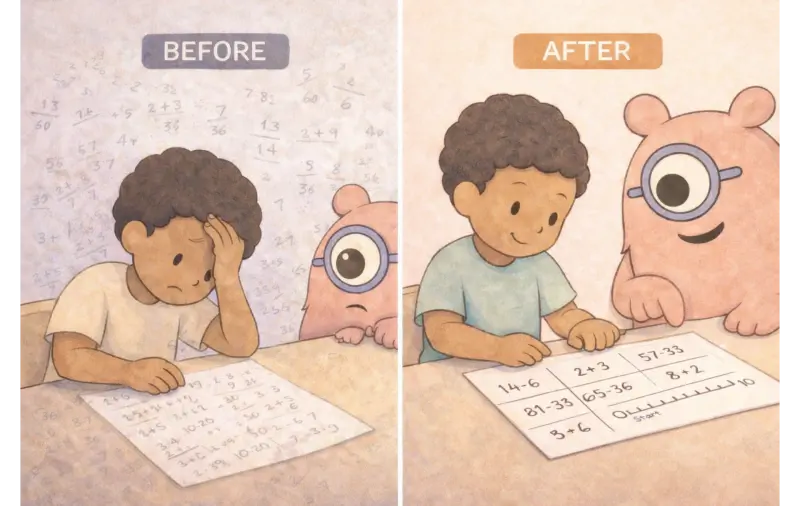
Makeovers You Can Apply Today
Below are concrete, copy-pasteable makeover moves. You can use them on almost any worksheet - computation, word problems, or mixed review.
Worksheet Makeover #1: Reduce Visual Overload
Before: 20-40 problems per page, tight spacing, small fonts, decorative borders/clip art, weak visual hierarchy.
After: 6–10 problems per page, larger spacing, one consistent font, clean alignment.
Why it helps: research reviews show atypical visual perception and attention patterns can affect how autistic learners process cluttered visual information. And for ADHD learners, dense pages increase “lose-my-place” errors and skipping.
Fast fix: Put a thick line after every 3–4 problems. Even if you can’t reformat the whole worksheet, that single visual divider helps.
Worksheet Makeover #2: Chunk the Work (and Make the Chunk Size Visible)
Before: A full page labeled “Solve.”
After:
Part A (3 problems): Solve, then check
Pause (30 seconds): stretch / breathe / drink water
Part B (3 problems): Solve, then check
Why it helps: Research observing classroom practice found that teachers often adapt their instructions for students with ADHD by breaking tasks into smaller, more manageable chunks, describing it as a way to help learners process information step by step rather than all at once.
Fast fix: If the worksheet has 20 problems, don’t assign “20.” Assign “5 now, 5 later.” Same learning target, less overwhelm.
Worksheet Makeover #3: Add Visual Models as “Optional Supports,” Not Decorations
Before: “14 − 6 = ____” with nothing else.
After: Add one small visual model beside each item (or beside each set): a number line jump, ten-frame, dot card, or bar model.
Why it helps: visuals reduce working-memory load by making relationships visible. That’s the whole point of external representations in math learning - and it fits the cognitive load idea of offloading unnecessary mental juggling.
Worksheet Makeover #4: Replace “Show Your Work” With Strategy Prompts
Before: “Show your work.”
After (choose 1–2 prompts):
Draw a quick model (ten-frame / dots)
Use a number line jump
Break apart one number
Write an equation that matches your model
Why it helps: explicit prompts reduce ambiguity and improve planning - especially for students who struggle to decide “what counts as work.” This also reduces stress-related freezing because expectations are visible, not implied.
Worksheet Makeover #5: Build in Self-Monitoring Checklists
Before: Student completes work and turns it in with no guidance on checking.
After: Add a tiny checklist at the bottom (or after each chunk):
I answered every problem in this box
I checked using a model or inverse operation
If stuck, I starred it and moved on
Why it helps: self-management approaches (including self-monitoring) are commonly used to improve regulation and independence for ADHD and autism-related needs. Evidence reviews show classroom interventions can reduce off-task behavior in ADHD and structured systems can increase engagement for autistic learners.
Fast fix: Put “STAR IT" + "SKIP IT” on the page. This gives permission to keep momentum without melting down.
Worksheet Makeover #6: Scaffold Before Independent Practice (Work Examples + Fading)
Before: Independent practice appears immediately after instruction.
After:
1 worked example with annotations
2 problems with a hint box
3-6 independent problems
Why it helps: worked examples are a classic cognitive load strategy - students learn the structure of the problem without getting overloaded by “what do I do first?” (Again, tied to cognitive load effects.)
Worksheet Makeover #7: Add a Visual “Work System” Header (TEACCH-Inspired)
This is one of the highest-impact changes for autistic learners (and honestly, it helps ADHD learners too).
Before: A worksheet with no clear workflow.
After: A 3-part header at the top:
1) What am I doing? (e.g., “Subtract within 20 using a number line”)
2) How much? (e.g., “Complete 2 boxes (6 problems total)”)
3) What happens when I’m done? (e.g., “Show teacher / choose a break card”)
Why it helps: structured work systems are associated with increases in engagement and task completion, with decreases in problem behaviors in young children with disabilities.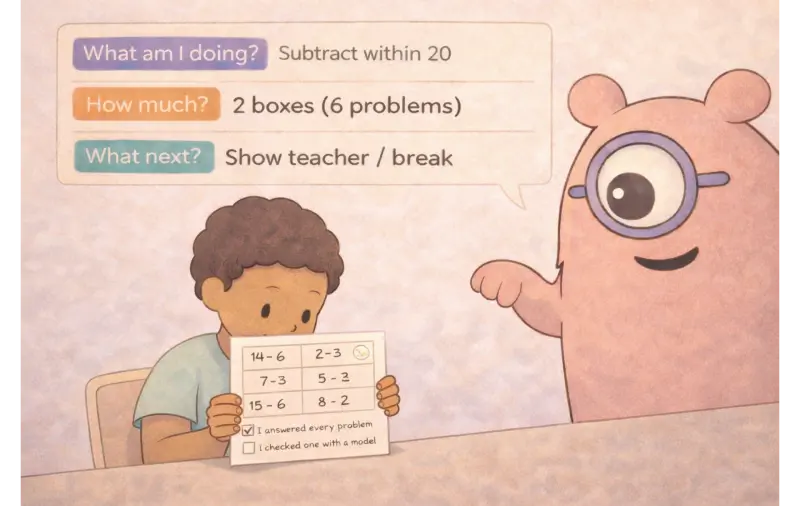
Worksheet Makeover #8: Simplify Language Load in Word Problems (Without “Dumbing It Down”)
Word problems often become reading tests plus anxiety tests.
Before: A paragraph-long story problem with multiple sentences, irrelevant details, and no workspace.
After:
Bold the question sentence.
Underline the numbers.
Add a “What I know / What I need” box.
Add one visual (bar model or quick sketch space).
This kind of structured breakdown mirrors the metacognitive math routines that help students plan, monitor, and reflect while solving word problems, instead of guessing what to do first
Example (After format):
Question: How many stickers does Mia have now?
Numbers: Mia has 7 stickers. She gets 5 more.
Plan: □ draw □ number line □ equation
Workspace: ______________________
Why it helps: reducing extraneous load (irrelevant text + unclear structure) aligns with the same learning principles described in cognitive load research. You’re keeping the math reasoning, but removing the layout traps.
Worksheet Makeover #9: Use “Cover Boxes” or Progressive Reveal
Before: The whole page is visible at once.
After: Add a note: “Cover the next box until you finish this one.” Or design the worksheet with one box per half-page.
Why it helps: progressive reveal reduces distraction and visual overwhelm. It also supports on-task behavior by narrowing attention to the current unit of work - similar in spirit to structured, self-managed classroom supports used with ADHD and autism.
Worksheet Makeover #10: Add a Micro-Choice
Choice doesn’t have to mean “choose any activity.” It can be micro-choice:
“Pick Box A or Box B first.”
“Use a number line or ten-frame.”
“Do odds or evens.”
Why it helps: micro-choice increases agency without changing the learning target. For many ADHD learners, agency reduces resistance; for many autistic learners, predictable options reduce anxiety.
Quick “Worksheet Makeover” Checklist
Less per page: 6–10 problems is often enough.
Chunk clearly: boxes, dividers, mini-finish lines.
Visual model present: number line / ten-frame / bar model.
Strategy prompts: replace “show work” with choices.
Self-monitoring: checkboxes + “star and skip.”
Structured header: what / how much / what next.
Word problem supports: bold question + plan box.
Progressive reveal: cover boxes or one section at a time.
Where Monster Math Fits (When Worksheets Still Aren’t Enough)
Sometimes, even a beautifully adapted worksheet still feels like a worksheet. That’s when it helps to rotate in game-like practice that keeps the same skills but reduces pressure.
If you want alternatives that still build real math understanding, our roundup on online math program for neurodivergent kids explains what to look for (and what to avoid) when choosing digital practice.
Final Thought
If a worksheet consistently causes distress, avoidance, or shutdown, we need to do something different.
When we adapt math worksheets for ADHD students and autistic learners, we allow kids to spend their mental energy on thinking - not just surviving the page.
FAQs
Do adapted worksheets lower academic expectations?
No. The goal is to remove barriers (layout, ambiguity, clutter) while keeping the same math. This is an access change, not a rigor change.
What are the highest-impact edits if I only have 5 minutes?
Do these two first: (1) reduce the number of problems assigned, and (2) add big chunk dividers with a mini finish line. Then add a checklist if you can.
Are visual schedules or activity schedules helpful for ADHD?
Yes - research reviews suggest visual activity schedules can reduce problem behaviors and support routines for children with ADHD. A worksheet header that clearly shows what/ how much/ what next is basically a mini visual schedule.
How do I know if it’s the worksheet design or the math skill itself?
A quick test: read the first problem aloud, cover the rest of the page, and offer a visual model. If performance improves immediately, design was a major factor.
References
Sweller, J. (1988). Cognitive Load During Problem Solving: Effects on Learning. Cognitive Science.
Gaastra, G. F., Groen, Y., Tucha, L., & Tucha, O. (2016). The Effects of Classroom Interventions on Off-Task and Disruptive Classroom Behavior in Children with Symptoms of ADHD: A Meta-Analytic Review. PLOS ONE.
Chung, S., & Son, J. W. (2020). Visual Perception in Autism Spectrum Disorder: A Review of Neuroimaging Studies. Frontiers in Human Neuroscience.
Thomas, N., & colleagues. (2022). The Efficacy of Visual Activity Schedule Intervention in Reducing Problem Behaviors in Children with ADHD: A Systematic Review. Frontiers in Psychiatry.
McDougal, E., Tai, C., Stewart, T. M., Booth, J. N., & Rhodes, S. M. (2022). Understanding and Supporting Attention Deficit Hyperactivity Disorder (ADHD) in the Primary School Classroom: Perspectives of Children with ADHD and Their Teachers. Journal of Autism and Developmental Disorders.