
TL;DR: Rote memorization of multiplication tables often fails for children with dyscalculia due to working memory deficits. Using the CRA Framework (Concrete, Representational, Abstract) can help. Start with physical objects, move to visual arrays, and end with symbols. Replace "times tables" drilling with dyscalculia math games and logic-based strategies like skip counting on number lines.
If you have watched your third grader stare at a flashcard while practicing multiplication, panic rising in their eyes, you are not alone. For neurotypical children, multiplication is often a memory task. For children with dyscalculia, it can feel like trying to hold water in a sieve.
The traditional approach—"memorize 7 x 8 = 56"—relies heavily on verbal working memory. However, research by Dr. David Geary indicates that children with mathematical learning disabilities often have specific deficits in working memory that make retrieving arithmetic facts from long-term memory unreliable. When we force rote memorization, we aren't teaching math; we are highlighting a deficit.
The good news? There is a better way. By leveraging a scaffolded path known as the Concrete-Representational-Abstract (CRA) sequence, we can bypass the memory bottleneck and build genuine number sense.
(Related: Read our guide on The Early Signs of Dyscalculia in Primary School)
Why "Just Memorize It" Doesn't Work
To understand the solution, we must understand the barrier. Dyscalculia is not just "being bad at math"; it is a neurodevelopmental condition that affects the ability to acquire arithmetic skills. Neuroimaging studies suggest that dyscalculia involves structural and functional differences in the intraparietal sulcus, the area of the brain responsible for processing numerical magnitude.
When a child with dyscalculia sees "5 x 3", they may not intuitively grasp that this represents "five groups of three." Without that conceptual anchor, the numbers are just abstract nonsense symbols. This is why our approach must shift from memorization to visualization.
Phase 1: Concrete Strategies (The "Touch" Phase)
The foundation of dyscalculia-friendly multiplication lies in the Concrete phase. Before a child writes a number, they must hold the quantity. This utilizes the parietal lobe's spatial processing capabilities to support the weaker verbal memory areas. Following activities can help -
1. Bead Strings and Groups
Use a 100-bead string (organized in groups of 10 colors). Ask your child to show you "3 groups of 5." They physically slide 5 beads, then another 5, then another 5. This provides tactile feedback that multiplication is essentially repeated addition, a critical concept often missed in standard multiplication strategies for 3rd grade curriculums.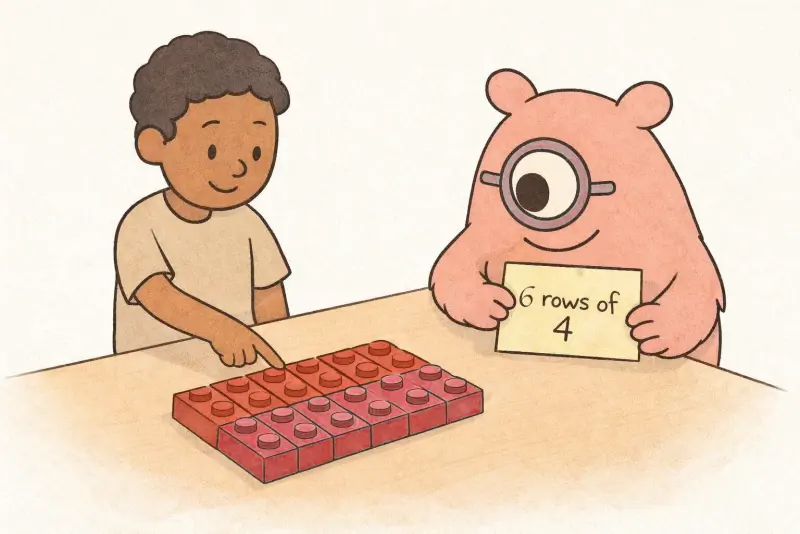
2. LEGO Arrays
LEGO bricks are the ultimate dyscalculia tool. A 2x4 brick isn't just a toy; it is a physical manifestation of "2 times 4 equals 8."
The Activity: Give your child a handful of bricks. Ask them to find a "3 by 2" brick. Have them count the studs.
The Connection: This builds the geometric model of multiplication (Area Model), which is essential for understanding algebra later on.
Phase 2: Representational Strategies (The "See" Phase)
Once the child understands the physical grouping, we move to drawing. This bridges the gap between the physical world and abstract numbers. These activities can help in this phase -
1. Circles and Stars
This is a classic activity advocated by math educator Marilyn Burns, highly effective for neurodivergent learners.
How to Play:
Roll a die. Draw that many circles on a page.
Roll the die again. Draw that many stars inside each circle.
Write the equation: "3 circles with 4 stars is 12 stars." (Avoid using 'x' initially; use natural language).
2. Visual Skip Counting
Skip counting is the bridge to multiplication. Many dyscalculia games focus on rhythm and auditory patterns (counting by 2s, 5s, 10s).
However, ensure this is visual. Use a number line and have the child draw "jumps" of 5. Seeing the distance helps them understand that 5 x 4 is simply four jumps of five. This grounds the abstract fact in spatial reality.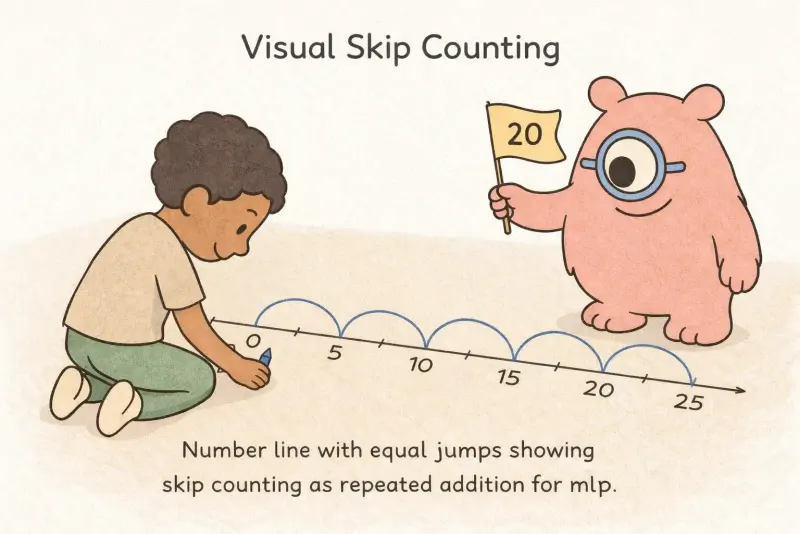
If drawing dozens of stars or marking number-line jumps gets tedious - which it often does for dyscalculic kids who struggle with motor planning on top of math - our free Multiplication Array Maker does Phase 2 digitally. Set the rows and columns to build any fact, toggle on Skip count to see the running totals (5, 10, 15, 20) appear on each row, and the array renders on a persistent 10×10 grid so kids see how each fact compares in size.
Phase 3: Abstract (The "Symbol" Phase)
Only after the child has mastered the physical and visual do we introduce the flashcards or the abstract equations. But even here, we use logic, not rote memory.
Teach "benchmark" facts. If a child knows 2 x 5 = 10 and 5 x 5 = 25, they can figure out surrounding numbers.
"I don't know 6 x 5, but I know 5 x 5 is 25, so I just add one more 5."
This encourages derived fact strategies, which studies show are a significant predictor of later arithmetic fluency.
Top Dyscalculia Math Games for Home
Gamification reduces anxiety, which is critical since math anxiety effectively lowers working memory capacity. Here are two low-prep dyscalculia games:
1. Multiplication War (with a Twist)
A variation of the classic card game.
The Rules: Two players flip a card. The first to say the product wins? NO. That penalizes slow processing speed.
The Dyscalculia Twist: Flip two cards each. Each player builds the array with tokens or beans. The player with the correct area (product) wins the hand. If both get it right, the cards return to the deck.
This reinforces magnitude over speed.
2. Array Hunt
Go around the house finding arrays. An egg carton (2x6), a window pane (2x2), a muffin tin (3x4). Take photos and write the equation on the photo. If taking digital photos on a smartphone, just use the edit photos tool to write the equation on the photo.
This generalizes the skill to the real world.
(Related: 5 Ways to Reduce Math Anxiety in Neurodivergent Kids)
Frequently Asked Questions
How do you teach multiplication to a child with dyscalculia?
Avoid rote memorization. Use the CRA (Concrete, Representational, Abstract) approach. Start with manipulatives like blocks or beads to show groups, move to drawing arrays, and finally use logic-based strategies for abstract equations.
Are multiplication tables necessary for dyscalculia?
Conceptual understanding is more important than speed. While knowing tables helps, many adults with dyscalculia succeed by using derived facts (e.g., knowing 10x and halving it for 5x) rather than rote retrieval.
What are the best math tools for dyscalculia?
Multisensory tools are best. Cuisenaire rods, base-10 blocks, Numicon shapes, and graph paper for aligning calculations are highly effective. Math games like Monster Math also help.
References
Geary, David. (1993). Mathematical disabilities: Cognitive, neuropsychological, and genetic components.
Nicolas Molko, Arnaud Cachia, Denis Rivière, Jean-François Mangin, Marie Bruandet, Denis Le Bihan, Laurent Cohen, Stanislas Dehaene. Functional and Structural Alterations of the Intraparietal Sulcus in a Developmental Dyscalculia of Genetic Origin.
Dowker A (2014). Young children's use of derived fact strategies for addition and subtraction.