TL;DR: Reading a clock and judging how much time has passed are two different skills, and both take more scaffolding for neurodivergent kids than the usual "look at the clock and explain it" approach gives them. Here's a concrete way to teach both, plus what to do when it's not clicking.
Ask parents which math skill blindsided them and "telling time" comes up almost as often as fractions. Time is one of the only math concepts a child can't touch or stack - you can hand a child ten blocks to build "ten," but you can't hand them a minute. For neurodivergent learners, that abstractness runs into working memory, sequencing, and attention all at once, which is exactly why the usual approach of just explaining the clock face once tends to fall flat.
Two Different Skills, Not One
Clock-reading is a decoding skill: matching two hands on a dial to a number. Elapsed time is a different thing entirely - judging or calculating a duration, with no dial to read at all. They need different teaching approaches.
Clock-reading is hard on its own terms: two hands moving at different speeds, and the same numbers meaning something different depending on which hand points at them. When researchers tested 290 third graders, children at risk for dyscalculia scored less than half as many correct answers on a clock-reading test as their typically-achieving classmates.
Elapsed time adds a layer on top. For ADHD, kids judged duration about as accurately as their peers when timing something as it happened, but overestimated by close to a minute when asked to judge it afterward, without warning.
For dyscalculia, the difficulty appears to be quite specific. Adults with dyscalculia estimated everyday durations and compared clock times just as accurately as controls, but were significantly less accurate when calculating elapsed time - for example, working out what time it will be 2 hours and 50 minutes from now. Rather than a general problem with understanding time, the findings point to a specific difficulty with time calculations, suggesting that targeted visual supports may be especially helpful.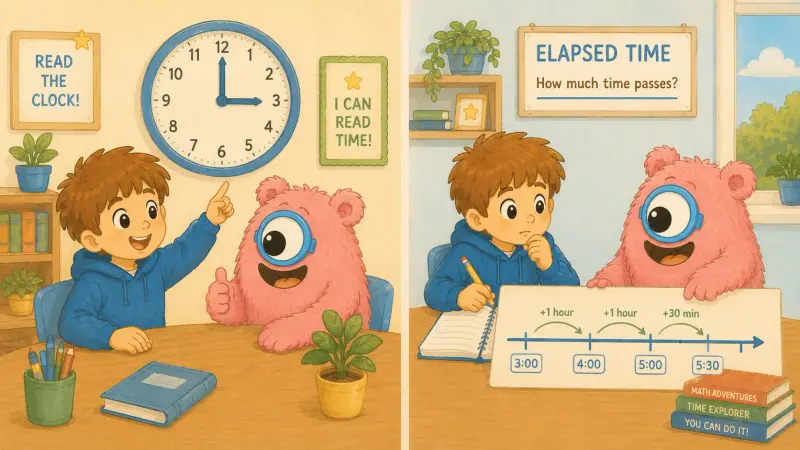
Teaching Clock Reading: A Sequence That Works
Skip the worksheet stack and start with explicit, hands-on instruction. Research has shown that a carefully sequenced, mastery-based teaching approach can help children with learning disabilities acquire clock-reading skills successfully. The progression below follows the same principle: build one foundational skill at a time before introducing the next, so each new concept has something solid to build on
Which hand is which, out loud, before anything else. This is where almost every stuck child is actually stuck, even when the real problem looks like something else later on. Draw a blank clock with both hands extended slightly past the numbers (one bigger than the other), so the length difference is obvious rather than subtle. Point to each hand and ask, "Which one's the minute hand?" - resist the urge to just tell them; let them answer, get it wrong, and correct with the visual in front of them. Do this daily, thirty seconds at a time, until the answer comes without a pause. That "without a pause" part is the actual milestone - a child who has to stop and think about which hand is which will burn all their attention on that one step and have nothing left over for reading the actual time, which is what makes later stages feel like they're "not working" when really this first one was never solid.
Count around the face by fives, completely separate from clock-reading. Point to each number in turn and count out loud: "0, 5, 10, 15, 20…" all the way around. This looks unrelated to telling time, which is exactly why it gets skipped, but it's the single skill that makes five-minute and one-minute reading possible later - a child who can't fluently skip-count by fives will be doing that arithmetic for the first time at the same moment they're also trying to read a clock, which is too much at once. Practice this on its own, away from any clock talk, until it's automatic in both directions (forward and, eventually, backward from 60).
Whole hours first, and use a real clock, not a printed one. "It's 3 o'clock" is the easiest case: the minute hand sits exactly on 12 and the hour hand sits exactly on a number, with nothing to interpret in between. Practice this against an actual clock on the wall or desk, at real moments during the day, rather than only on worksheets - tying it to lived moments ("it's 3 o'clock, time to go") gives the fact somewhere to live in memory beyond an abstract exercise. Move on once your child can read whole hours confidently without counting anything - this stage should feel almost too easy before you leave it, which is the point.
Five-minute intervals next, then one-minute - as two separate stages, not one. Five-minute reading is really just the skip-counting from step two, applied to a clock face: "the minute hand is on the 4, so that's 20." Give this its own few days of short, oral-first practice before introducing one-minute precision, which asks a child to count on by ones from the nearest five-minute mark ("the hand's just past the 4 - that's 20, 21, 22") and is a meaningfully harder ask. Cramming all three stages - hour, five-minute, one-minute - into a single lesson is the most common way this sequence gets rushed, and it's exactly what turns a child who's genuinely progressing into one who looks like they've plateaued.
Visual Strategies That Actually Work
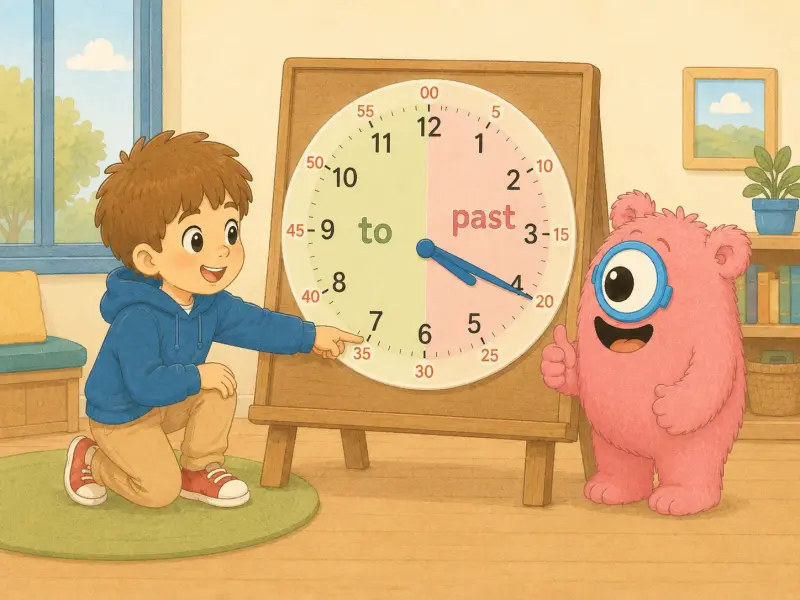
Color-code the clock face. Split the clock face into two halves based on how the minute hand reads. Color the right half (from 12 down to 6) in one color and label it "past" - that side is where the minute hand shows "past the hour." Color the left half (from 6 up to 12) in a second color and label it "to" - that side is where the minute hand shows "to the next hour." Then, next to each hour number, add its minute value ("5" next to the 1, "10" next to the 2, and so on) in a third color. Now "20 past 4" becomes a spatial pattern the child can see: the minute hand is on the 4, which sits in the "past" half, and the "20" label right next to it names the minutes directly. No multiplication or decoding required.
Use a shrinking-wedge timer, not a digital countdown, for anything happening live. A colored wedge that visibly shrinks turns "10 minutes left" into a shape a child can watch change - which plays to the in-the-moment timing kids with ADHD tend to already do well. One caution: use it to make session length visible, not to add pressure to solving the problem itself - a timer counting down while a child works on the actual clock-reading task can raise stress rather than lower it.
Build elapsed time on an open number line before a clock face. Instead of subtracting 10:20 from 2:45, mark the start time on the left and jump forward in friendly chunks: "up to 11:00 is 40 minutes, then 3 whole hours to 2:00, then 45 more minutes to 2:45." Add the jumps. This is the same concrete-to-abstract bridge that works for place value, and it matches how kids naturally think about time - in landmarks, not subtraction.
Anchor time to your child's own routine. "Homework starts when the big hand reaches the six" holds up better than "homework starts at 4:30." Our guide to time management for math homework goes deeper on building routines like this around a visual schedule.
Practicing Time in Everyday Moments
Practice sticks when it shows up during the day, not just on worksheets. Baking is a natural fit: set a visual timer for the cookies and ask "what time will they come out?" while you both watch the clock. Travel works too - pick a departure time, count forward to arrival on an open number line, then check against the actual trip. Even screen time becomes a mini-lesson when a child sets their own timer and predicts when it'll go off.
When It's Not Clicking
Confusing the hour and minute hand, over and over: go back to step one of the clock-reading sequence and drop everything else until it's solid - every later step depends on it.
Meltdowns at transition time: the timer needs to start earlier, not run faster. Show the wedge the moment there's meaningfully less time left, not right at the one-minute mark.
Elapsed-time word problems still don't land, even though your child estimates everyday durations fine: that split is normal and well documented - go back to the number line rather than assuming a general "time sense" problem.
Start Wherever Your Child Actually Is
The goal here isn't fluent analog reading by any particular age - it's a child who can reason about time: plan for what's next, wait for the timer, catch a bus. A child confusing the hour and minute hand in third grade isn't behind in any permanent sense; they're at an earlier stage of a skill that develops for every kid, just on a different timeline. Plenty of neurodivergent adults rely on digital clocks and phone alarms for life, and that's a completely fine place to land - reading an analog face is a bonus skill, not the finish line.
FAQs
What age should a child be able to tell time?
Most curricula introduce whole hours in first grade, then half-hours and quarter-hours, then five-minute and one-minute intervals across second and third grade. It's normal for neurodivergent learners to need longer at each stage.
Is difficulty telling time a sign of dyscalculia?
It can be one indicator among several, not a diagnosis on its own. Clock-reading ability has been shown to moderately predict overall math achievement, so persistent difficulty alongside other math struggles is worth mentioning to a teacher.
Why does my child with ADHD struggle more with "how long was that" than with a timer running?
Research backs up exactly that split - judging duration in the moment tends to hold up fine, while judging it afterward, from memory, is where the gap shows up. Lean on visual timers for live tracking, and treat after-the-fact guessing as a skill worth practicing separately.
My child can estimate how long things take but still can't do elapsed-time math problems - why?
That's a documented split in dyscalculia specifically: everyday time estimation and clock comparison can be intact while the calculation step - working out what time it'll be after a given interval - lags behind. Treat it as a number-line calculation skill to build, not a general sense-of-time problem.
Should I still teach analog clocks if my child mostly sees digital ones?
Yes - reading "7:58" correctly doesn't require understanding it means "almost 8:00." Analog clocks make the passage of time visible in a way digits alone don't.
References
Mutlu, Y., & Korkmaz, E. (2020). Investigating Clock Reading Skills of Third Graders With and Without Dyscalculia Risk. International Online Journal of Primary Education, 9(1), 97-110. https://files.eric.ed.gov/fulltext/EJ1258500.pdf
Walg, M., & Prior, H. (2021). Prospective and Retrospective Verbal Time Estimation in Children with ADHD. Advances in Cognitive Psychology, 17(3), 212-221. https://pmc.ncbi.nlm.nih.gov/articles/PMC10697718/
Cappelletti, M., Freeman, E. D., & Butterworth, B. L. (2011). Time Processing in Dyscalculia. Frontiers in Psychology, 2, 364. https://doi.org/10.3389/fpsyg.2011.00364
Wieber, A. E., Evoy, K., McLaughlin, T. F., Derby, K. M., Kellogg, E., Williams, R. L., Peterson, S. M., & Rinaldi, L. (2017). The Effects of a Modified Direct Instruction Procedure on Time Telling for a Third Grade Student With Learning Disabilities. Learning Disabilities: A Contemporary Journal, 15(2), 239-248. https://files.eric.ed.gov/fulltext/EJ1160663.pdf