How to Teach Place Value with Base-Ten Blocks: Step-by-Step Visual Guide
TL;DR: Place value is the organizing idea behind every multi-digit number - the same digit, 3, means something completely different in 347, 37, and 3. Base-ten blocks make this invisible positional value visible. This guide explains what place value is, why it is harder to teach than it appears, how visual models support neurodivergent learners in particular, and how to teach the full progression step by step using our free Place Value Exploder.
Ask a child to read "347" aloud and they almost certainly can. Ask what the 3 means, and most will say "three." That is the problem. The 3 in 347 does not mean three - it means three hundred. The same digit, placed one column to the left, is worth ten times as much. That invisible, positional system is precisely what trips up so many children in the early years of school.
The difficulties start early and compound quickly. A child who reads the "6" in 65 as simply six (not sixty) will make sense of neither addition with regrouping nor subtraction with borrowing. They are not being careless - they are missing a conceptual layer that written numerals simply do not convey on their own. Base-ten blocks exist to make that layer visible.
What Is Place Value?
Place value is the principle that a digit's meaning depends on its position, not just its face. In our base-ten system, each position is worth ten times the position to its right: ones (1), tens (10), hundreds (100), thousands (1,000), and so on. The number 347 is three hundreds, four tens, and seven ones - not three, four, and seven arranged side by side.
This positional system is efficient but cognitively demanding. Children must hold two things in mind at once: the digit itself (its face value) and the column it occupies (its place value). Written numerals hide this entirely - the 3, 4, and 7 in 347 look identical in size and style, yet they represent quantities differing by factors of ten. Base-ten blocks, also called Dienes blocks, give each position a distinct physical form: a small cube for ones, a rod of ten cubes for tens, a flat plate of one hundred cubes for hundreds. The size differences are not decorative - they reflect the actual magnitude differences between the positions, making the invisible system visible.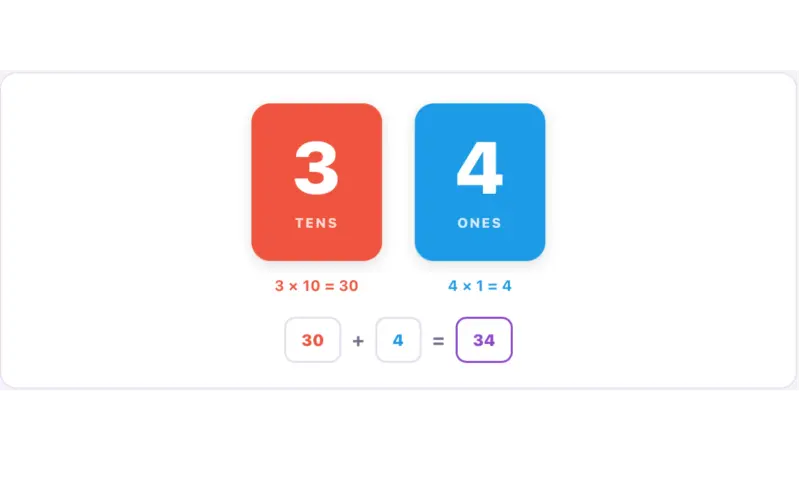
Why Place Value Understanding Is Hard - and Matters
Decades of research have documented a consistent misconception: many young children read the digits in a multi-digit number by face value alone, with limited understanding of the quantities those digits represent. In a landmark digit-correspondence study, Ross found that when children were asked what the individual digits in a two-digit numeral actually represented, no second-graders in her sample demonstrated the most advanced level of place-value understanding, and only about half of the fifth-graders did. Her findings suggest that children can often identify tens and ones columns correctly while still struggling to interpret a digit as representing groups of ten rather than individual objects.
Place value matters because:
Regrouping ("carrying" in addition, "borrowing" in subtraction) is literally a physical exchange: 10 ones for 1 ten, or 1 hundred for 10 tens. Without a visual picture of that exchange, the procedure is magic rather than mathematics.
(The part–whole thinking behind this exchange is the same idea as number bonds.)
Estimation depends on reading the most significant digits correctly - which requires knowing what each position is worth.
Decimals extend the same positional logic to the right of the ones place. Students who do not genuinely grasp integer place value are almost always confused by decimal place value too.
Multi-digit multiplication and division require students to track which column each partial product belongs to - impossible without place-value fluency.
This gap between procedure and understanding is well documented. In Adding It Up, the National Research Council argues that mathematical proficiency requires both procedural fluency and conceptual understanding, noting that students can learn to carry out multidigit algorithms without fully understanding the quantities and relationships those procedures represent. Place-value understanding is therefore not a one-time skill but a foundational idea that develops over time. Building that understanding requires experiences and representations that make the structure of the base-ten number system visible and meaningful to learners.
Teaching Place Value with the Free Exploder
The fastest way to build genuine place-value understanding is to make positional value visible rather than described. Our free Place Value Exploder does three things a written number on the board cannot: it shows a number breaking apart into its place values, it lets students switch between a symbolic view and a concrete-blocks view, and it displays expanded form - the equation that names exactly what each digit is worth. Here is what each teaching move looks like, followed by a step-by-step lesson you can run straight from the tool.
"The Explode": Watching a Number Come Apart
When a student types in a number and hits Explode, the number visibly separates into hundreds, tens, and ones - each place value pulled into its own labeled column. Before the explode, students see a compact symbol: 247. After it, they see 2 flat hundreds-squares, 4 tens-rods, and 7 unit cubes arranged side by side. The key insight becomes inescapable: those three digits are not equal. The ones digit and the hundreds digit look identical on paper; here, the hundreds flat is visibly a hundred times larger than the ones cube. The size difference is the lesson.
Digit Cards and Dienes Blocks: Two Views of the Same Value
The Exploder offers two representations of the same number. In Digit Cards mode, each place-value column shows a colored card - the digit in large type with the column label (Hundreds, Tens, Ones) below it. In Dienes Blocks mode, the same value appears as physical blocks: the 4 in the tens column becomes four orange rods, each composed of ten unit squares. Toggling between views makes the abstract-to-concrete connection explicit - the symbol "4" and four rods describe exactly the same quantity. This is the representational bridge that the Concrete–Representational–Abstract (CRA) approach recommends building deliberately, rather than assuming students make it on their own.
A Step-by-Step Lesson Sequence
You can run the entire place-value progression with nothing but a projector and the Exploder. Each step maps directly to a feature in the tool.
Start with a familiar 2-digit number. Enter 34 and hit Explode. Ask: "What does the 3 mean?" Let students answer before the display updates. Stay in Digit Cards mode so the column labels (Tens, Ones) are prominent.
Make it concrete. Switch to Dienes Blocks view. Count the rods together: "One ten, two tens, three tens - that is thirty. And four ones makes thirty-four." The rods are the most direct proof that the 3 is not three objects.
(Counting the tens rods this way is also skip counting by 10s.)
Read the expanded form. Point to the equation bar: 3 × 10 = 30, 4 × 1 = 4, total = 34. Ask: "If we have three rods and each rod is worth ten, what is three rods worth?" This connects the physical blocks to multiplication vocabulary early.
Move to a 3-digit number. Enter 247. Before hitting Explode, ask students to predict: how many flats? How many rods? How many cubes? The prediction step forces active thinking rather than passive watching.
Introduce zero as a placeholder. Enter 305. The tens column is empty. Ask: "What goes in the tens position? Can we skip it?" Students who have been misreading 305 as "thirty-five" will see immediately why the empty column matters.
Fade the visual support. Cover the blocks; show only the digit cards. Then cover the digit cards; show only the written numeral. A student who can describe each digit's value without the visual scaffold has built genuine place-value understanding.
Open the Place Value Exploder and try it with your next lesson.
Place Value and Neurodivergent Learners
For children with dyscalculia, abstract positional notation is particularly hard to hold in mind - the face values feel interchangeable because written symbols give no visual cue to their magnitude. Dienes blocks break that abstraction: a flat square and a thin rod look nothing alike, in a way that "3" and "4" on paper do not. Research consistently recommends concrete-to-representational instruction for students with mathematics learning difficulties, and place value is one of the topics where that visual foundation most obviously matters. A child who has touched a hundreds flat and felt how much larger it is than a ones cube has a physical memory to anchor the concept.
For children with ADHD, regrouping errors often arise not from misunderstanding the concept but from losing track of the exchange mid-procedure. The Exploder externalizes the column structure - students can see the column they are working in rather than holding the whole layout in working memory. The reduced working-memory load that visual representations provide maps directly to every carrying and borrowing situation they will encounter.
For autistic learners, who often respond well to predictable, structured visual systems, the Exploder offers exactly that consistency: ones always in the same column, always the same color, always the same block shape. The visual grammar is stable and rule-governed, which makes the positional system learnable rather than arbitrary - matching the kind of explicit, structured instruction that works best for many autistic students.
FAQs:
What are Dienes blocks?
Dienes blocks (also called base-ten blocks or multibase arithmetic blocks) are physical or digital manipulatives that represent place value concretely: a small cube for ones, a rod of ten cubes for tens, and a flat square of one hundred cubes for hundreds. Named after mathematician Zoltán Pál Diénes, they are specifically designed so that the size of each block reflects the actual magnitude it represents.At what grade is place value taught?
Two-digit place value (tens and ones) is typically introduced in Grade 1. Three-digit numbers (hundreds, tens, ones) arrive in Grade 2. Students continue to extend place-value understanding through Grade 3 and beyond, applying it to regrouping, larger numbers, and eventually decimals.How does understanding place value help with addition and subtraction?
Regrouping is a physical exchange: 10 ones cubes trade for 1 tens rod, or 1 tens rod trades back for 10 ones. Students who understand why that exchange is valid - because both sides represent the same amount - make far fewer regrouping errors and can self-correct when an answer looks unreasonable.What is expanded form?
Expanded form writes a number as the sum of each digit's actual value: 347 = 300 + 40 + 7, or equivalently 3 × 100 + 4 × 10 + 7 × 1. It makes explicit what positional notation hides - that each digit carries a different weight depending on its column.
References:
Ross, S. H. (1989). Parts, wholes, and place value: A developmental view. Arithmetic Teacher, 36(6), 47–51. https://deniseflicknumeracy.wordpress.com/wp-content/uploads/2012/09/full-access-parts-wholes-and-place-value-a-developmental-view.pdf
National Research Council. (2001). Adding It Up: Helping Children Learn Mathematics. National Academy Press. Retrieved from https://www.nationalacademies.org/read/9822/chapter/7