TL;DR:Math "I can" statements are kid-friendly versions of grade-level math standards, written from the student's point of view ("I can add two-digit numbers" instead of "Students will add within 100"). They make learning goals visible, support self-assessment, and are linked in peer-reviewed research to higher math achievement when used as part of formative assessment. Below you'll find what they are, why they work, and ready-to-use examples for every elementary grade from kindergarten through 5th grade.
What are math "I can" statements?
An "I can" statement is a learning goal rewritten in the first person, in language a child can actually understand. Take a typical Common Core standard like "CCSS.MATH.CONTENT.2.NBT.B.5: Fluently add and subtract within 100 using strategies based on place value, properties of operations, and/or the relationship between addition and subtraction." A second grader's eyes will glaze over before they hit the comma. Rewrite it as "I can add and subtract numbers up to 100 using place value" - and the child knows what they're working on.
That tiny shift, from teacher-facing standard to student-facing target, is doing real cognitive work. It tells children three things at once: what they're learning, why this lesson matters, and what "got it" looks like. Decades of classroom research by Paul Black and Dylan Wiliam show that when students can answer "what am I trying to learn?" their progress speeds up substantially, because feedback finally has somewhere to land.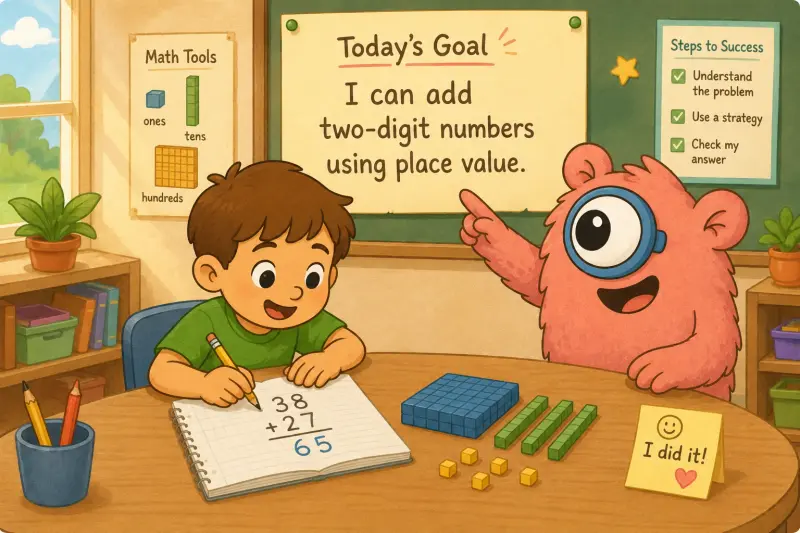
Why "I can" statements actually move the needle in elementary math
The case for "I can" statements in elementary math classrooms goes well beyond intuition. In a critical review of research on student self-assessment, Heidi Andrade concluded that when children get clear criteria and time to check their own work, both achievement and self-regulation improve - especially when self-assessment is treated as a learning tool rather than a grading shortcut.
The math-specific evidence is stronger still. A 2025 meta-analysis found that metacognitive instruction - teaching kids to plan, monitor, and reflect on their own thinking - produces a large effect on math achievement. "I can" statements are one of the simplest entry points into that kind of instruction.
How to use "I can" statements without it feeling like extra work
The most common mistake is treating "I can" statements like decorative wall art. Posting them and never referring to them is roughly as useful as a fire extinguisher locked in a closet. Here's a simple rhythm that keeps the goal alive throughout the lesson without adding planning time:
Open with it. Read the day's statement aloud. Ask a student to put it in their own words.
Refer back mid-lesson. "Are we still working on the goal? Where are we?"
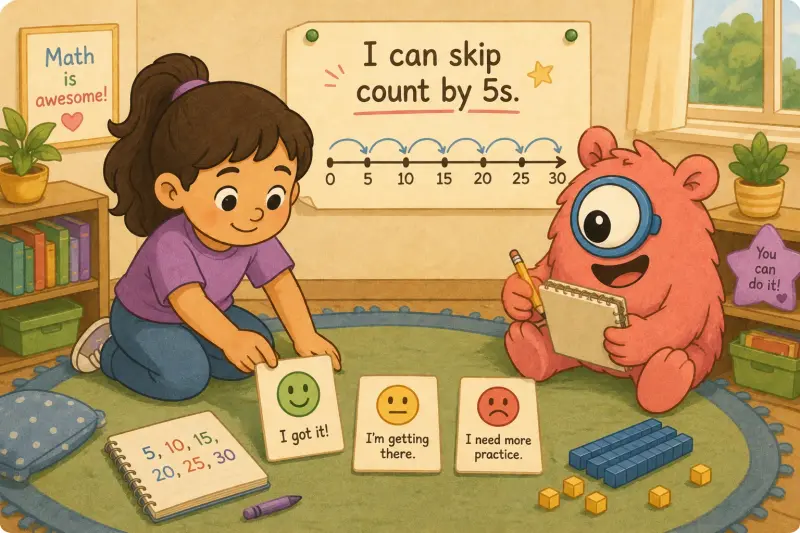
Close with a self-check. A thumbs up / sideways / down at the end gives both you and the child real information.
Pair with one success criterion. "I'll know I can do this when I solve three problems without using my fingers."
Math "I can" statements by grade
The lists below are grouped by Common Core domain to mirror how the standards themselves are organized. They are the high-leverage statements most elementary teachers reach for first.
Kindergarten "I can" statements
Kindergarten math is mostly about counting, cardinality, and getting comfortable with small numbers as quantities.
Counting & Cardinality
I can count to 100 by ones and by tens.
I can count forward starting at any number.
I can write numbers from 0 to 20.
I can count objects to tell how many there are.
I can compare two groups and tell which has more, less, or the same.
I can compare two written numbers between 1 and 10.
Operations & Algebraic Thinking
I can solve addition and subtraction word problems within 10 using objects or drawings.
I can take apart numbers less than or equal to 10 in more than one way (5 = 2 + 3, 5 = 4 + 1).
I can find the number that is added to 1–9 to make 10.
I can add and subtract within 5.
Number & Operations in Base Ten
I can put together and take apart numbers from 11 to 19 by naming the tens and ones.
Measurement & Data
I can tell how an object can be measured (length, weight).
I can sort objects into categories and count how many are in each category.
Geometry
I can describe where shapes are using words like above, below, beside, and behind.
I can name shapes like circles, squares, triangles, and rectangles, no matter their size or position.
I can tell the difference between two-dimensional and three-dimensional shapes.
I can use simple shapes to make bigger shapes.
1st grade "I can" statements
First grade is when addition and subtraction within 20 become the headline event, and place value starts to make sense.
Operations & Algebraic Thinking
I can solve addition and subtraction word problems within 20.
I can solve word problems that add three whole numbers up to 20.
I can use an addition fact to help me answer a subtraction problem.
I can add and subtract facts within 20.
I know what an equal sign means.
I can find the missing number in an addition or subtraction problem.
Number & Operations in Base Ten
I can count to 120 starting at any number.
I can tell how many tens and how many ones are in a number.
I can compare two-digit numbers using <, =, and >.
I can find 10 more or 10 less in my head.
I can subtract multiples of 10 under 100 and explain what I did.
Measurement & Data
I can put three objects in order from longest to shortest.
I can tell the length of an object using whole numbers.
I can tell and write time in hours and half-hours using a clock.
I can organize and answer questions about data.
Geometry
I can name, build, and draw shapes.
I can put 2-D and 3-D shapes together to make new shapes.
I can divide shapes into equal parts.
2nd grade "I can" statements
Second grade pushes fluency within 100 and lays the foundation for multiplication through arrays. This is also the grade where math anxiety often surfaces, which is why building math resilience in elementary school matters so much here.
Operations & Algebraic Thinking
I can use strategies to solve addition and subtraction word problems within 100.
I know my addition and subtraction facts from memory.
I can group objects to tell if a number is odd or even.
I can use repeated addition to help me understand multiplication (arrays).
Number & Operations in Base Ten
I can understand and use hundreds, tens, and ones.
I can count to 1,000 and skip count by 1s, 5s, 10s, and 100s.
I can read and write numbers to 1,000 in different ways.
I can compare three-digit numbers using <, =, and >.
I can add and subtract numbers within 100.
I can add and subtract two three-digit numbers.
I can add or subtract 10 or 100 in my head.
Measurement & Data
I can use different tools to measure objects.
I can estimate the lengths of objects.
I can use addition and subtraction to solve measurement problems.
I can tell time to the nearest five minutes and understand a.m. and p.m.
I can solve word problems involving dollars and cents.
I can make a line plot, picture graph, or bar graph.
Geometry
I can name and draw shapes (triangles, quadrilaterals, pentagons, hexagons, cubes).
I can divide shapes into equal parts and use fractions to describe them.
3rd grade "I can" statements
Third grade is the multiplication-and-division year. It's also when fractions enter the picture as numbers on a number line.
Operations & Algebraic Thinking
I can understand multiplication by thinking about equal groups of objects.
I can understand division as sharing a group into equal smaller groups.
I can solve multiplication and division word problems within 100.
I can find the missing number in a multiplication or division equation.
I can use the commutative, associative, and distributive properties of multiplication.
I can use what I know about multiplication to solve a division problem.
I can fluently multiply and divide within 100.
I can know my multiplication facts up to 10 × 10 from memory by the end of the year.
I can solve two-step word problems using all four operations and check that my answers are reasonable.
I can find patterns in addition and multiplication tables and explain them.
Number & Operations in Base Ten
I can round whole numbers to the nearest 10 or 100.
I can fluently add and subtract within 1,000.
I can multiply one-digit whole numbers by multiples of 10 (e.g., 9 × 80).
Number & Operations - Fractions
I can show that a fraction is an equal part of a whole.
I can understand a fraction as a number on a number line.
I can recognize and generate simple equivalent fractions.
I can compare two fractions with the same numerator or the same denominator.
I can show whole numbers as fractions (such as 3 = 3/1).
Measurement & Data
I can tell and write time to the nearest minute and solve problems about time intervals.
I can measure liquid volumes and masses using grams, kilograms, and liters.
I can create and read picture graphs and bar graphs.
I can make a line plot using measurements to the nearest whole, half, or quarter unit.
I can find the area of a rectangle by tiling or by multiplying the side lengths.
I can solve real-world problems involving the perimeter of polygons.
Geometry
I can classify shapes by their attributes (such as recognizing rhombuses, rectangles, and squares as quadrilaterals).
I can divide shapes into parts with equal areas and write each part as a unit fraction.
4th grade "I can" statements
Fourth grade is where multi-digit arithmetic gets serious and fractions become operations, not just objects.
Operations & Algebraic Thinking
I can multiply or divide to solve word problems by using drawings or equations.
I can solve multi-step word problems with whole numbers using all four operations.
I can check whether my answers are reasonable using estimation, mental math, and rounding.
I can find all factor pairs and multiples for a number from 1 to 100.
I can tell whether a whole number up to 100 is prime or composite.
I can create and extend number or shape patterns that follow a given rule.
Number & Operations in Base Ten
I can read, write, and compare large whole numbers in numerals, words, and expanded form.
I can round large whole numbers to any place.
I can add and subtract large numbers using the standard algorithm.
I can multiply a multi-digit number by a one-digit number using place value.
I can find whole-number quotients with up to four-digit dividends and one-digit divisors.
Number & Operations - Fractions
I can recognize and generate equivalent fractions.
I can compare two fractions with different numerators and denominators.
I can add and subtract fractions and mixed numbers with the same denominator.
I can multiply a fraction by a whole number.
I can use decimals to show fractions with denominators of 10 and 100.
I can compare two decimals to hundredths.
Measurement & Data
I can convert measurements from a larger unit to a smaller unit within the same system.
I can solve word problems involving area and perimeter of rectangles.
I can make a line plot to display measurements involving fractions.
I can recognize angles and understand how they are measured.
I can measure angles in whole-number degrees using a protractor.
Geometry
I can identify and draw points, lines, line segments, rays, angles, and parallel and perpendicular lines.
I can classify two-dimensional shapes by their properties.
I can recognize and draw lines of symmetry.
5th grade "I can" statements
Fifth grade closes out elementary math by extending fractions, decimals, and the coordinate plane - the on-ramp to middle school.
Operations & Algebraic Thinking
I can use parentheses and brackets in expressions and follow the order of operations.
I can write numerical expressions from words.
I can form ordered pairs from number patterns and graph them on a coordinate plane.
Number & Operations in Base Ten
I can explain how the value of a digit changes based on its place.
I can read, write, and compare decimals to the thousandths.
I can round decimals to any place.
I can multiply multi-digit whole numbers using the standard algorithm.
I can divide four-digit dividends by two-digit divisors.
I can add, subtract, multiply, and divide decimals to the hundredths.
Number & Operations - Fractions
I can add and subtract fractions and mixed numbers with unlike denominators.
I can solve word problems involving fractions.
I can multiply a fraction or whole number by a fraction.
I can divide a unit fraction by a whole number, or a whole number by a unit fraction.
Measurement & Data
I can convert measurements within the same measurement system.
I can make a line plot to display fractional data.
I can understand volume and measure it by counting unit cubes.
I can find the volume of a rectangular prism by counting unit cubes or using a formula.
Geometry
I can plot points on the coordinate plane to solve real-world problems.
I can understand and use the x-axis, y-axis, and origin to describe a location on the coordinate plane.
I can classify two-dimensional shapes based on their properties and understand that some shapes belong to more than one category (for example, all squares are rectangles).
Tying it all together with the rest of your math block
"I can" statements are at their best when they share a classroom with the rest of your math toolkit. They give purpose to fluency practice, structure to small-group work, and a target for self-reflection. Many teachers anchor each station in their math center rotation to a specific "I can" so kids know which goal that station is working toward. The same logic applies at home: parents who pin the week's "I can" to the fridge and ask "which one are you closest to?" are doing what the research recommends.
The bottom line
Math "I can" statements are a small move with an outsized payoff. They take a dense academic standard and hand it back to the child as a goal they can see, name, and check off. The evidence keeps pointing in the same direction: when students know what they're learning and can monitor their own progress, they learn more. Pick the grade-level list above, start with one statement a day, and let the kids do the rest.
FAQs
What is the difference between an "I can" statement and a learning objective?
A learning objective is written for the teacher; an "I can" statement is written for the student. Same goal, different audience.
Are math "I can" statements aligned to Common Core?
Most published "I can" statement sets - including the ones above - are direct rewrites of the Common Core State Standards, organized by the same domains teachers see in their curriculum. If your state uses different standards (Texas TEKS, Virginia SOLs, etc.), the structure works the same way; you rewrite from your state's standards.
How many "I can" statements should I focus on at once?
One per lesson is plenty. Two if they're tightly related. The point is focus, not coverage.
Do "I can" statements actually improve test scores?
Indirectly, yes. They're a tool for formative assessment, and the evidence linking formative assessment to achievement is large and consistent. Gains come from how the statements are used (daily reference, self-check, feedback) rather than the statements themselves.
At what grade should I start using "I can" statements?
Kindergarten works fine, as long as the statements are short and you read them aloud. Even five-year-olds can answer "what are we learning today?" once they've heard the language a few times.
References
Andrade, H. L. (2019). A Critical Review of Research on Student Self-Assessment. Frontiers in Education, 4, 87. https://www.frontiersin.org/journals/education/articles/10.3389/feduc.2019.00087/full
Black, P., & Wiliam, D. (1998). Assessment and Classroom Learning. Assessment in Education: Principles, Policy & Practice, 5(1), 7–74. https://www.gla.ac.uk/t4/learningandteaching/files/PGCTHE/BlackandWiliam1998.pdf
Hidayat, R., et al. (2025). A meta-analysis of the effect of metacognitive instruction on mathematics achievement. Cogent Education, 12(1). https://www.tandfonline.com/doi/full/10.1080/2331186X.2025.2517510