TL;DR: The right math games turn elementary classrooms into places where kids actually want to do math. A meta-analysis on digital game-based STEM education found that students using learning games outperformed peers in traditional instruction, and broader systematic reviews on game-based math learning show consistent gains in achievement and attitude. Below: five classroom-ready math games (board, dice, card, bingo, digital), the research behind each, and how to run them without burning hours on prep.
Why math games belong in your elementary classroom
If you've ever watched a third grader light up when you pull out a deck of cards instead of a worksheet, you already know the secret: games lower the stakes and raise the engagement. A systematic review on math learning games in K-12 settings found that well-designed games consistently support both learning outcomes and student motivation. Games give kids repeated, low-pressure exposure to numbers and make struggle feel like part of the play. Here are five worth a permanent spot in your rotation.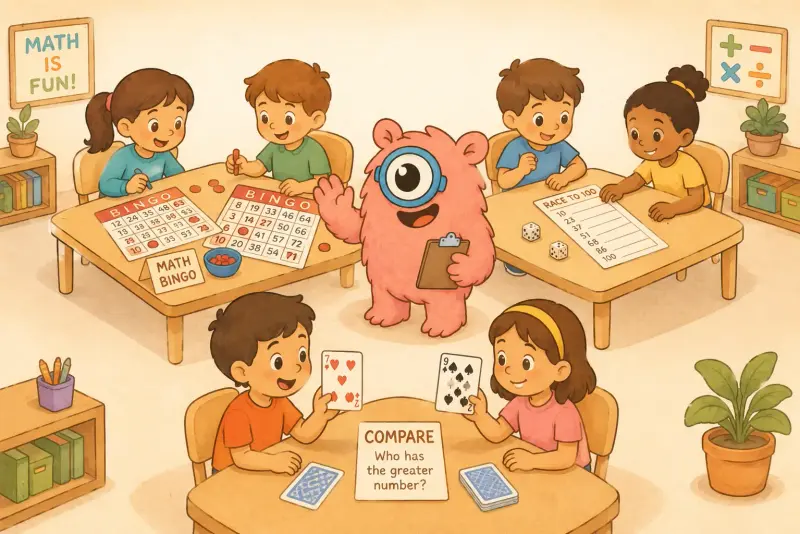
1. The Linear Number Board Game (Grades K-1)
This one looks deceptively simple: a strip of 10 numbered squares, a token, and a spinner or die. Kids take turns moving along the path, saying each number out loud as they pass. The research behind it is some of the strongest in early math.
In a classic Carnegie Mellon study, Siegler and Ramani found that roughly one hour of playing a linear number board game produced large gains in preschoolers' numerical magnitude comparison, number line estimation, counting, and numeral identification, with effects holding nine weeks later. Kids who played a color-based version (no numbers) showed none of those gains.
How to run it: Draw a 1-to-10 strip on cardstock. Pair students up with a die and tokens. On every move, the child says the name of every square they pass (a move from 3 to 7 sounds like "four, five, six, seven"). First token to the end wins. For Grade 1, extend to 1-20 or 1-100.
Skills covered: Counting in sequence, one-to-one correspondence, numeral recognition, number-line/magnitude understanding, cardinality, comparing numbers
Common core modules: K.CC.A.1, K.CC.A.2, K.CC.B.4, K.CC.C.6, K.CC.C.7
Why it works: The board acts as a physical number line, giving kids a spatial sense of magnitude that flashcards can't match.
2. Race to 100 (Dice Game, Grades 1-3)
Race to 100 works on almost every level at once: addition fluency, mental math, and place value. Each player rolls two dice, adds the numbers, and adds that sum to a running total. First to 100 wins.
A 2024 study reported that primary teachers commonly use non-digital math games such as dice, card, and board games, and generally view them as effective for supporting fluency, understanding, problem-solving, and reasoning.
How to run it: Pairs share two dice and one recording sheet. Each turn: roll, add, write the new total. Wrong addition? Partner gets to challenge politely. Differentiate by adding a third die or switching to multiplication for Grade 3.
Skills covered: Addition fluency within 100, mental math, place value (tens and ones), two-digit addition, cumulative/running totals, multiplication facts (Grade 3 variant)
Common core modules: 1.OA.C.6, 1.NBT.B.2, 2.OA.B.2, 2.NBT.B.5, 3.OA.C.7
Why it works: The running total forces repeated mental addition without it ever feeling like drill.
3. Compare (Card Game, Grades K-3)
Compare is the math version of War. Two players, one deck of cards (face cards removed or assigned values). Each flips the top card. Higher card wins both. Tied? Flip again.
Advanced version - both players flip two cards. And then depending on the skill you want them to practice, they either have to add both the cards, or find the difference or even multiply them and then compare, to determine who is the winner.
It looks simple, but card games can support real mathematical learning. A study on a classroom fraction card game found that students developed stronger understanding of fraction magnitudes and fraction addition through repeated game-based practice and visual reasoning.
How to run it: Two-player pairs. Add variants as kids master comparison: in Addition Compare, each player flips two cards and the higher sum wins. In Subtraction Compare, the larger difference wins. In Multiplication Compare, the larger product wins.
Skills covered: Number recognition, magnitude comparison, greater than / less than, addition fluency (Addition Compare variant), subtraction fluency (Subtraction Compare variant), number sense, multiplication fluency.
Common core modules: K.CC.C.6, K.CC.C.7, 1.OA.C.6, 2.OA.B.2
Why it works: Kids get hundreds of magnitude comparisons per session, building the kind of number sense worksheets can't reach. (For more low-prep ideas, see our guide to 10 low-prep math games using everyday items.) Note that this is also not a competition on who gets the answer first, both are incentivised to individually calculate and confirm that the answer is correct!
4. Math Bingo (Grades 2-5)
Every kid knows Bingo. Swap called numbers for math problems and you have an instant fluency tool. Each square holds an answer; the caller reads out problems like "8 x 7" or "45 - 18"; kids mark the matching answer.
The classroom research is unusually clean. A quasi-experimental study compared Grade 3 pupils taught with Bingo strategy against a control group taught conventionally; the Bingo group's mean posttest score was 14.07 versus 6.61 for the control. The authors recommend Bingo as a regular primary math strategy.
How to run it: Generate two or three card sets per skill (multiplication facts, two-digit subtraction, fraction equivalents). Laminate so kids can mark with dry-erase. Five-in-a-row wins. Rotate caller duties so students practice reading problems aloud.
Skills covered: Whatever skill the teacher chooses to put on the cards. Common variations include addition/subtraction within 20 or 100, multiplication and division facts, fraction equivalence, decimal recognition, place value, and rounding. The underlying cognitive demand (fact retrieval, mental computation, pattern recognition) stays consistent across versions.
Common core modules: 2.OA.B.2, 2.NBT.B.5, 3.OA.C.7, 3.NF.A.3, 4.NF.A.1
Why it works: Bingo combines pattern recognition with fact retrieval, and the social element keeps engagement high even on tough topics.
5. Adaptive Digital Math Games (Grades K-8)
Digital games have a mixed reputation, but the well-designed ones earn their place. A 2023 study evaluating an adaptive game-based math app with nearly 1,000 kindergarten and first-grade students found significant learning gains for students using the program, with greater in-game skill mastery strongly associated with higher gains on external math assessments.
The key word is adaptive. Generic flash-card apps don't move the needle much. What works are games that adjust difficulty, embed visual representations, and treat math as a puzzle rather than a quiz.
How to run it: Use digital math games as one station in a rotation, not the whole math block. Fifteen to twenty minutes per session, three or four times a week, with clear expectations about what counts as on-task play.
Skills covered: Varies by app - typically covers number sense, counting, addition/subtraction fluency, place value, multiplication foundations, problem-solving, and visual/spatial representations of math.
Common core modules: K.CC, K.OA.A.1–5, 1.OA.C.6, 1.NBT.B.2–3, 2.OA.B.2, 2.NBT.A.1–4, 3.OA.A.1–4, 3.OA.C.7
Why it works: Adaptive difficulty means each child gets problems at their personal learning edge, which is hard to engineer with whole-class instruction. For more on building game rotations, see our guide to 10 engaging math center activities for elementary classrooms.
How to make math games actually work in your classroom
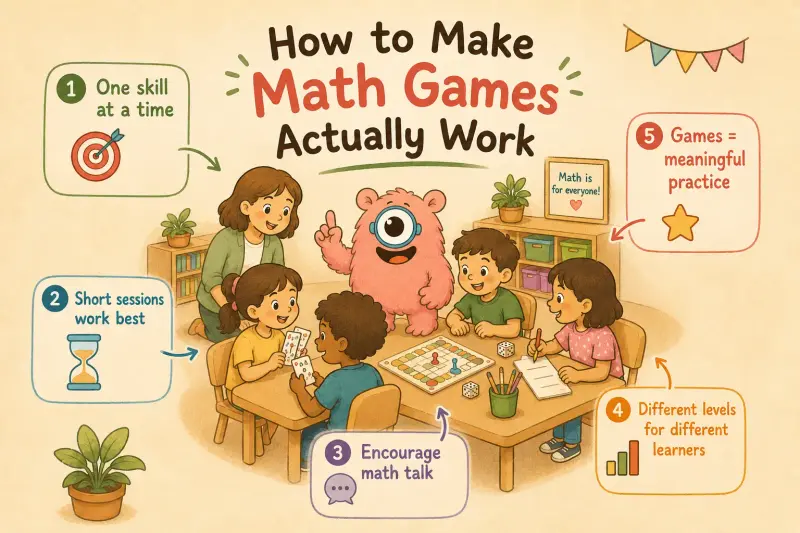
A few things separate games that build math from games that just fill time:
Tie each game to one specific skill. "Multiplication facts 2-5" beats "math facts" every time.
Keep sessions short. Fifteen to twenty minutes hits the sweet spot for engagement and retention.
Build math talk in. Ask kids to explain their move, or have partners check each other's work.
Differentiate by difficulty, not by who gets to play. Every kid should be in a game at their level.
Treat games as practice, not entertainment. Set expectations the same way you would for any other math task.
The takeaway
Used well, math games become a primary tool for building fluency, number sense, and a positive math identity, not a Friday-afternoon treat. Start with one game per week. Pick the skill, set the time, run it consistently. The research is on your side, and so are your students.
FAQs
How often should I use math games in an elementary classroom?
Most primary teachers in published surveys use math games at least once a week, and many use them daily as warm-ups or center activities. Short, frequent sessions (15-20 minutes) work better than long, occasional ones.
Do math games actually improve test scores?
The Wang et al. (2022) meta-analysis reported a moderate, statistically significant positive effect on math and STEM achievement compared with traditional instruction. Effects vary by game design, dosage, and integration.
What ages benefit most from math games?
Research suggests early elementary (K-3) sees some of the largest gains, especially for number sense, magnitude comparison, and fact fluency. Older students benefit too, particularly when games target reasoning and problem-solving.
Can math games help students with math anxiety or learning differences?
Game-based learning is well-documented to improve student motivation, attitude, and confidence in math. For kids with dyscalculia or math anxiety, low-pressure, hands-on games can be especially helpful (more in our guide to 8 tactile math games for dyscalculic learners).
References
Pan, Y., Ke, F., & Xu, X. (2022). A systematic review of the role of learning games in fostering mathematics education in K-12 settings. Educational Research Review, 36, 100448. https://par.nsf.gov/servlets/purl/10325947
Hui, H. B., & Mahmud, M. S. (2023). Influence of game-based learning in mathematics education on the students' cognitive and affective domain: A systematic review. Frontiers in Psychology, 14, 1105806. https://pmc.ncbi.nlm.nih.gov/articles/PMC10086333/
Siegler, R. S., & Ramani, G. B. (2009). Playing linear number board games - but not circular ones - improves low-income preschoolers' numerical understanding. Journal of Educational Psychology, 101(3), 545–560. https://www.cmu.edu/dietrich/psychology/cs/research-teaching/docs/SieglerBoardGamesCDPerp2009.pdf
Wang, L.-H., Chen, B., Hwang, G.-J., Guan, J.-Q., & Wang, Y.-Q. (2022). Effects of digital game-based STEM education on students' learning achievement: A meta-analysis. International Journal of STEM Education, 9, 26. https://stemeducationjournal.springeropen.com/articles/10.1186/s40594-022-00344-0
Debrenti, E. (2024). Game-Based Learning experiences in primary mathematics education. Frontiers in Education, 9, 1331312. https://www.frontiersin.org/journals/education/articles/10.3389/feduc.2024.1331312/full
Zhao, J., Nokkaew, A., & Laosinchai, P. (2019). Constructing Grade 3 Students’ Understanding of Fractions by Using a Fraction Card Game.
https://www.researchgate.net/publication/338248070_Constructing_Grade_3_Students%27_Understanding_of_Fractions_by_Using_a_Fraction_Card_GameTella, A., & Fatoki, F. M. (2021). Effect of Bingo Game Instructional Strategy on Pupils' Achievement in Mathematics in Public Primary Schools in Oyo State, Nigeria. Journal of the International Society for Teacher Education, 25(1), 21–34. https://files.eric.ed.gov/fulltext/EJ1305569.pdf
Bang, H. J., Li, L., & Flynn, K. (2023). Efficacy of an Adaptive Game-Based Math Learning App to Support Personalized Learning and Improve Early Elementary School Students’ Learning. Early Childhood Education Journal, 51, 717-732
https://link.springer.com/article/10.1007/s10643-022-01332-3