TL;DR: If worksheets cause meltdowns, shutdowns, or avoidance, it’s often not “math refusal” - it’s sensory overload plus working-memory overload. Sensory-friendly math games use movement, deep pressure, fidgets, and tactile play to teach real math ideas like number sense, fractions, and fact strategies in a way that feels regulating and doable.
Why Worksheets Often Backfire
Worksheets combine a bunch of hard things at once: sitting still, tolerating visual clutter, fine-motor writing, filtering noise, and holding steps in working memory. For many autistic kids, that’s a perfect storm.
Research shows sensory processing differences are common in autism, and when the sensory system is overloaded, the brain shifts into coping mode rather than learning mode. In fact the paper hypothises (though doesn't conclusively prove) that the sensory differences could be the primary feature disorder that cause other disorders such as language delay and difficulty with reading emotion from faces.
Math is especially vulnerable because it depends heavily on working memory and visual-spatial reasoning - and studies in autism show that working memory relates to math performance, while fine motor skills are linked to visuospatial working memory, highlighting why sensory-motor pathways can matter for math learning.
The good news: you don’t need to “make kids tolerate worksheets.” You can teach the same math ideas through sensory-friendly pathways that support regulation.
For many autistic learners, tapping into personal interests can be just as powerful as sensory supports, because motivation and emotional safety play a huge role in engagement - especially when math connects to topics a child already loves. Interest-based approaches to math learning can reduce resistance and increase persistence, particularly when math activities are built around a child’s natural fascinations and strengths.
Movement Math: Number Sense You Can Feel
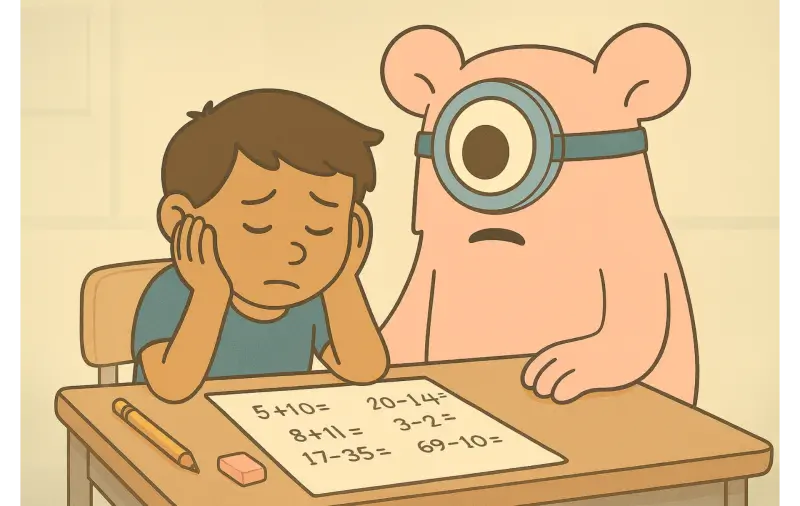
Movement isn’t “off-task” for many autistic kids - it’s how the nervous system stays organized. And movement-based math is incredible for number sense, because it turns numbers into positions, distances, and actions.
There’s evidence that motor activity can support attention and cognitive control (including in neurodivergent profiles), which is why allowing movement can sometimes improve focus rather than reduce it.
Game 1: Floor Number Line Missions
Use tape or foam tiles to create a floor number line. Give “missions” instead of worksheets:
- Counting on: “Start at 6. Jump forward 3. Where did you land?”
- Counting back: “Start at 12. Step back 5.”
- Near-doubles: “Stand on 7. Show me 7+7, then 7+8 by adding one more step.”
This builds magnitude and distance intuitions that are at the heart of number sense.
Game 2: “Walk the Tens” for Place Value
Make a “tens lane” and a “ones lane” on the floor. Call out a number (like 34):
- Walk 3 steps in the tens lane
- Walk 4 small steps in the ones lane
Now you’ve taught place value without writing a single digit. If your child likes props, use a jump rope for the tens lane boundary or hula hoops as “ten zones.”
Deep Pressure and Heavy Work: Fractions and Quantity Without Stress
Many autistic kids seek deep pressure (squeezing, pushing, compression) because it can feel organizing and calming. Research on deep pressure in autism shows benefits can be immediate for some individuals, but responses vary - the key is to observe and individualize.
Game 3: Playdough Fractions (Deep Pressure + Concept)
Roll a thick “pizza” of playdough (or therapy putty for stronger resistance). Then:
- Cut into 2 equal parts: “Two halves”
- Cut into 4 equal parts: “Four quarters”
- Combine two quarters: “Two quarters is the same as one half”
This ties proprioceptive input (squeezing/rolling) to fraction meaning: equal parts, equivalence, and composing/decomposing. The math goal isn’t memorizing “1/2 = 2/4,” it’s understanding it.
Game 4: Weighted “Compare and Order”
Use small weighted beanbags labeled with numbers. Ask:
- “Find the heaviest number” (largest)
- “Put these in order from smallest to largest”
- “Make two piles that add to 10”
It’s a hands-on, sensory-friendly way to practice comparison, ordering, and composing tens - core number sense skills - without visual overload.
Fidgets as Math Tools: Fact Strategies Without Timers
Fidgets get a bad reputation, but for many autistic kids they help regulate arousal and attention. Instead of fighting fidgets, turn them into math tools - especially for fact strategies (make-10, doubles, decomposing). Research on cognition and performance suggests movement can support working memory and persistence in some learners, which is why strategy practice often goes better when the body is allowed to move.
Game 5: Pop-It “Make 10” Lab
Use a pop-it with rows of 5 or 10. Say, “We’re doing make-10 science.” Then:
- Pop 7 bubbles acknowledge “7”
- Ask, “How many more pops to reach 10?”
- Pop the remaining 3 and say, “7 and 3 make 10”
Now add a twist: “If 7+3 makes 10, what does 17+3 make?” (It becomes 20.) You just taught a fact strategy and place value connection.
Game 6: “Doubles +1” with a Fidget Spinner
Write small number cards (6, 7, 8). Spin the spinner; wherever it lands:
- Say the double (7+7)
- Then add one more (7+8) and explain “double + 1”
The spinner keeps engagement high; the strategy keeps the math meaningful.
This kind of strategy-based practice focuses on understanding rather than speed, supporting multisensory, low-stress fact work that many autistic learners respond to well.
Tactile Bins: Autism-Friendly Sensory Math Activities
Tactile bins are one of the easiest math sensory activities to set up because you can adjust texture, noise, and difficulty. Use rice, dry beans, kinetic sand, water beads (if safe for your child), or even shredded paper. The goal is to pair tactile exploration with a very specific math idea.
Game 7: Number Hunt (Counting + One-to-One Correspondence)
Hide number cards (1–20) in the bin. When your child finds a number, they build it with counters (pom-poms, mini erasers, pebbles):
- Find “8” → place 8 counters into a tray
- Count out loud while placing, one counter per count
This is hands-on math activities for autistic students at its best: tactile input + one-to-one mapping + steady rhythm.
Game 8: Compare Piles (More/Less + Magnitude)
Make two piles of objects from the bin. Ask:
- “Which pile has more?”
- “How do you know?”
- “Can you make them equal?”
Then introduce language: more, less, equal, difference. This is foundational number sense without a worksheet.
How to Bridge Sensory Play to “Real Math” on Paper
This part matters, because sensory-friendly doesn’t mean you avoid abstraction forever - it means you learn abstraction through understanding.
A well-supported approach is the Concrete-Representational-Abstract (CRA) progression: first manipulate objects (concrete), then draw what you did (representational), then use symbols (abstract). Research shows that the CRA sequence fosters connections between physical materials, visual models, and symbolic math, supporting conceptual understanding for learners with autism through integrated concrete, representational, and abstract stages.
Here’s the bridge in practice:
- Concrete: Build 7+3 with a pop-it
- Representational: Draw 7 dots and 3 dots (or a ten-frame)
- Abstract: Write 7+3=10
When a child melts down on paper, it’s often because we skipped the middle. Representational drawing is the “soft landing” between sensory play and symbols.
Reducing Math Anxiety: Regulation Comes First
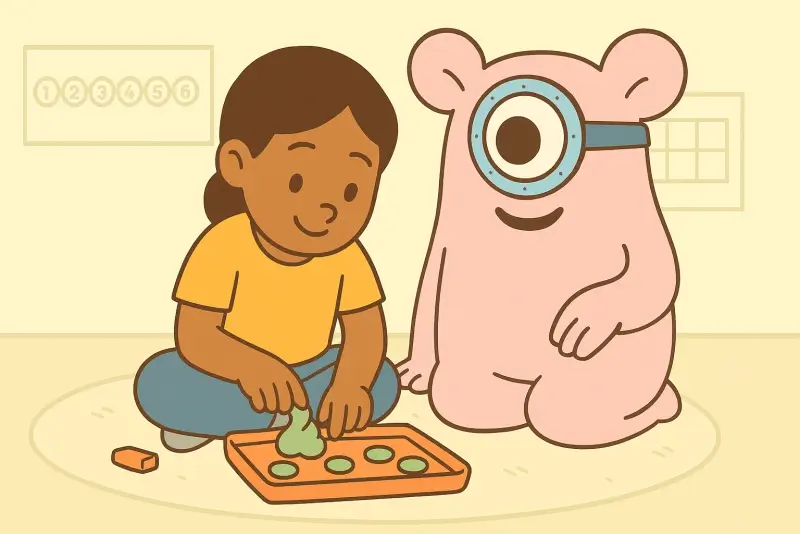
If your child has a history of worksheets going badly, they may develop math anxiety - and anxiety changes performance. Research indicates math anxiety is related to math difficulties and includes emotion-related components that can interfere with working memory and performance.
This is why sensory-friendly math helps twice: it teaches math, and it prevents the nervous system from pairing math with threat.
Quick practical rule: if you see stress signals (avoidance, agitation, shutdown), switch from “more problems” to “more regulation.” A 2-minute heavy-work break, a tight bear hug (if wanted), or a push-the-wall reset can save the learning session.
Final Thought
Autistic kids don’t hate math. They hate overload. Sensory math activities autism-friendly by design make math calmer, more concrete, and more successful - which is exactly how learning starts.
FAQs
Are sensory math activities “real math”?
Yes. They teach the same concepts - just through channels that support regulation and reduce cognitive load.
What if my child hates messy textures?
Sensory-friendly means individualized. Use dry bins (pom-poms, foam numbers), smooth bins (silk scarves), or no-bin options like magnetic tiles and pop-its.
Can I use real products?
Absolutely. Pop-its, kinetic sand, therapy putty, wobble cushions, resistance bands, and weighted lap pads can all be useful - the key is pairing them with a math idea, not using them as random add-ons.
References
- Marco, E. J., Hinkley, L. B. N., Hill, S. S., & Nagarajan, S. S. (2011). Sensory Processing in Autism: A Review of Neurophysiologic Findings. Pediatric Research. https://pmc.ncbi.nlm.nih.gov/articles/PMC3086654/
- Chen, C., Chang, C., & Wu, M. (2019). Academic heterogeneity in children with autism spectrum disorder: Associations with working memory and academic achievement. Journal of Autism and Developmental Disorders. https://pmc.ncbi.nlm.nih.gov/articles/PMC6483392/
- Tsujishita S, Nakashima D, Akizuki K, Takeuchi K. (2025). Relationship between visuospatial working memory and fine and gross motor skills in children with developmental disabilities. Journal of Physical Therapy Science. https://pmc.ncbi.nlm.nih.gov/articles/PMC11787861/
- Piek, J. P., et al. (2018). (Study on activity/fidgeting and attention regulation). Scientific Reports. https://www.nature.com/articles/s41598-018-21529-0
- Bestbier, L., & Williams, T. I. (2017). The Immediate Effects of Deep Pressure on Young People with Autism and Severe Intellectual Difficulties. Psychiatry Journal. https://pmc.ncbi.nlm.nih.gov/articles/PMC5612681/
- Goñi-Cervera, J., Polo-Blanco, I., Tregón, N., & Bruno, A. (2024). The concrete–representational–abstract sequence for the acquisition of the cardinal principle in preschool children with autism. (Open access PDF). https://zaguan.unizar.es/record/135359/files/texto_completo.pdf
- Cohen, L. D., et al. (2021). Math anxiety is related to math difficulties and composed of multiple components. Frontiers in Psychology. https://pmc.ncbi.nlm.nih.gov/articles/PMC8699086/