
TL;DR: Kids with ADHD can absolutely thrive in math, when the classroom isn’t working against their brains. Traditional instruction often overwhelmsworking memory, splits attention, and creates too much cognitive load. Research shows that when math is presented with visual supports, reduced cognitive load, structured routines, and explicit, predictable instruction, ADHD learners not only perform better, they feel more confident.
This guide breaks down 25 high-impact, research-backed math accommodations that you can incorporate into an IEP or 504 plan.
Why ADHD makes math feel harder than it looks.
Children with ADHD frequently demonstrate deficits in multiple domains of math skills - not because children lack ability or intelligence, but because math taps directly into the cognitive systems where ADHD creates the most friction. Children with ADHD often experience challenges across working memory, multi-step problem solving, attention switching, inhibition, and math fluency, and when these pressures stack together, even simple math tasks can feel overwhelming.
Research on working memory and math performance shows that children with ADHD perform weaker on tasks requiring simultaneous attention and calculation because their cognitive resources get overloaded more quickly leading to neurocognitive vulnerabilities in working short term memory.
The good news though - targeted accommodations make a measurable difference, because they directly address the specific cognitive processes that makes math harder for children with ADHD. Instead of asking the child to “try harder,” accommodations reshape the learning environment so the student can access math with the brain that they have and not the brain the curriculum assumes.
One of the biggest breakthroughs in ADHD and math research is the understanding that many difficulties stem from working memory overload. Accommodations help reduce extraneous cognitive load, which is the mental effort wasted on poor instructional design rather than on the math itself. Another way accommodations help is by externalizing executive function components. For many ADHD learners, tasks fail because students lose track of what to do next. Tools such as checklists, worked examples, number lines, or manipulatives take internal processes like planning, sequencing, self-monitoring and make them visible and manageable.
Below are the most effective, research grounded math accommodations grouped into the five domains educators use when designing IEP supports.
25 ADHD-Friendly Math Accommodations That Actually Help
Presentation Accommodations (How information is shown)
These help reduce cognitive overload and support students’ ability to see and understand math.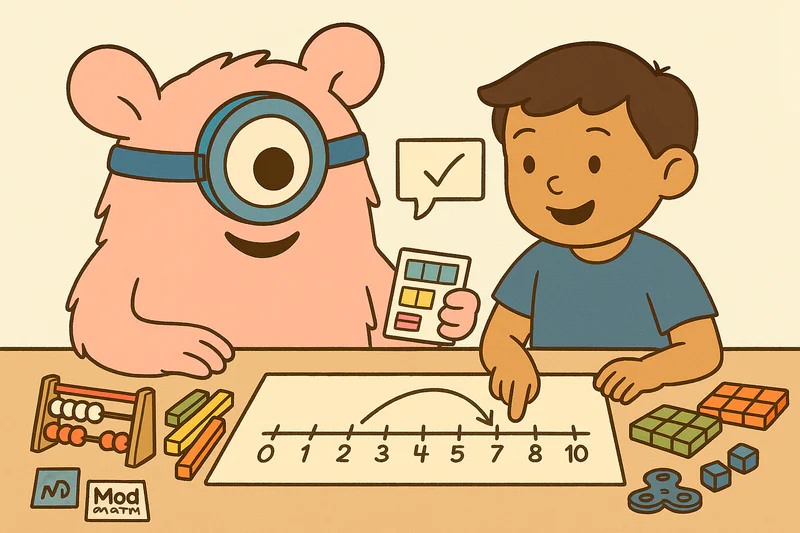
1. Use visual models for every new concept
Ten-frames, number lines, bar models, and arrays reduce working memory demands by making the math visible instead of purely mental. Visual models are especially effective because concrete and representational stages strengthen concept understanding and automaticity in learners with math difficulties.
Example 1: When teaching 8 + 6, the teacher uses a ten-frame. They show 8 dots, then add 2 more to fill the frame, then the remaining 4 in the next frame. The student can see that 8 + 2 + 4 = 14 instead of holding all of that in their head.
Example 2: For a word problem about distance, the teacher uses an open number line and draws jumps of 10, then jumps of 1, so the student can track each step visually instead of mentally juggling all the steps at once.
2. Provide step-by-step instructions (not big blocks of text)
Instead of handing an ADHD learner a wall of text or a long list of mixed problems, break the task into small, visible steps so their brain only has to focus on one thing at a time. This reduces working memory load, makes the path through the problem clearer, and gives the student more chances to feel, “Okay, I can do this.”
Example:
Original word problem:
“Sam had 28 stickers. He bought 17 more stickers at the store. Then he gave 9 stickers to his friend. How many stickers does Sam have now?”
Chunked version:
Step 1: “First, find out how many stickers Sam has after he buys more.” Only show: 28 + 17 = ?
Step 2: “Now take away the stickers he gave his friend.” Only show: [answer from Step 1] − 9 = ?
Step 3: “So how many stickers does Sam have now?” The student never has to hold all parts of the problem in mind at once.
3. Highlight keywords in word problems
Students with ADHD often struggle to filter out irrelevant details and hold onto the pieces of information that actually matter.
Example (without highlighting):
“Lily baked 24 cookies for the school fair. She gave 8 cookies to her friend Maya and then packed the rest into boxes of 4. How many boxes did she fill?”
Example (with highlighting):
Lily baked 24 cookies for the school fair. She gave8 cookiesaway to her friend Maya, and then packed the rest into boxes of 4. How many boxes did she fill?
Pro tip:
Some teachers use color coding, yellow for quantities, blue for action words, green for the final question to build consistency across the year.
4. Offer math reference sheets or strategy cards
Math reference sheets and strategy cards act as external memory supports, giving students quick access to strategies they may forget when overwhelmed. For kids with ADHD, who often struggle with working memory and recall, these tools reduce cognitive load and help them approach problems more strategically.
Example strategy cards might include:
Number-line strategies: “Count on,” “Jump by 10s,” “Bridge to 10” with a mini picture of an open number line.
Addition strategies: “Make a 10” (e.g., 8 + 6 → 8 + 2 + 4), “Doubles and near-doubles” (6+6, 6+7) with little dot images.
Multiplication strategies: Arrays, skip-counting, “double and halve” (8 × 6 → (4 × 6) × 2) with simple diagrams.
Fraction models: Bars showing 1/2, 1/3, 3/4; a small table of common equivalent fractions.
When a student sees 36 + 17, instead of guessing, they look at their card: “Break apart by place value.” The card shows example of break-apart visually. They can also use pencil and paper to replicate it for the current problem - that way the strategy is visible, so working memory doesn’t have to carry the full load.
5. Pre-teach vocabulary with icons or visuals
Math is full of abstract terms like sum, difference, factor, multiple, quotient, regroup and for students with ADHD, unfamiliar vocabulary can become a hidden barrier. Pre-teaching key words with simple icons or visuals reduces processing load during instruction and gives students a fast mental shortcut.
Example vocabulary table:
Sum: answer to an addition problem - visual: ➕ or two blocks joining.
Difference: answer to a subtraction problem - visual: ➖ or blocks being taken away.
Factor: numbers multiplied together - visual: two groups of dots forming an array.
Regroup: trading ones for tens - visual: 10 single cubes turning into 1 rod.
Before a unit on word problems, the teacher introduces the words and visuals. Later, when students see “find the difference,” they already know that means subtraction and can focus on the math, not decoding the language.
6. Show the student worked examples before asking them to solve independently
Worked examples reduce unnecessary cognitive load especially powerful for ADHD students who can get lost in the steps. Instead of asking them to problem-solve from scratch, you first show a fully solved example with each step clearly labeled.
Example:
The teacher shows how to solve 47 − 19:
Step 1: “We can’t do 7 − 9, so we regroup from the tens.”
Step 2: Cross out 4 tens, replace with 3; change 7 ones to 17 ones.
Step 3: 17 − 9 = 8; 3 − 1 = 2; answer is 28.
Next, the student gets a similar problem (e.g., 52 − 18) and follows the same clearly modeled pattern. The worked example acts as a roadmap they can copy and adapt.
7. Reduce the number of problems but keep the rigor
A smaller set of items, each carefully chosen, leads to better-quality work and less frustration. For ADHD students, fewer problems mean reduced fatigue and more chances to fully apply strategies without shutting down.
Example: Instead of assigning 30 mixed problems, the teacher chooses 8–10 that target the key skill (e.g., regrouping or multi-step word problems), and allows the student to show deeper thinking on each. They might ask the student to solve and then explain their strategy for 3 of them, rather than racing through a long page.
Environment Accommodations (Where and how math is learned)
8. Provide a quiet or semi-private workspace during math tasks
Environmental distractions significantly affect task persistence for ADHD learners. A quieter or semi-private area helps them focus on the math instead of constantly fighting background noise and movement.
Example: During independent math time or tests, the student is allowed to sit at a back table, a study carrel, or a side desk away from high-traffic areas. They still have access to the teacher but are shielded from most distractions.
9. Allow noise-cancelling headphones or soft background noise
For some ADHD students, completely silent rooms are just as distracting as noisy ones. Allowing noise-cancelling headphones or low-level background sounds (like soft instrumental music) can support attentional regulation without isolating the student.
Example: A student wears over-ear headphones during worksheet time and listens to gentle, lyric-free music. This helps them tune out classroom chatter and stay with the task longer.
10. Prefer seating close to the teacher or away from distractions
Strategic seating supports attention and reduces off-task behavior. Being closer to the teacher makes it easier to get quick clarifications and keeps subtle cues (like a hand on the desk or a nod) within view.
Example: The student sits in the front row or at a side table near the teacher’s main board. They are away from windows, doors, or talkative peers, which reduces the chance of visual and social distractions pulling their attention away from math.
11. Let students use physical manipulatives even in upper grades
Manipulatives reduce cognitive burden for learners with attention and working memory weaknesses.
Example: A 4th grader uses base-ten blocks to model 342 − 178, physically trading a hundred for tens and tens for ones. A 6th grader uses fraction tiles to compare 2/3 and 3/5 instead of doing only symbolic procedures on paper.
12. Build predictable math routines
A consistent routine such as “warm-up → mini-lesson → guided practice → independent practice → exit” - helps ADHD learners anticipate what’s next, reducing anxiety and decision fatigue.
Example: Every math block begins with a 5-minute warm-up on the board, followed by a short teacher demonstration, then partner work with models, and finally individual practice. The routine is posted on the wall in picture form so students can track where they are in the sequence.
Response Accommodations (How students show what they know)
13. Allow oral responses for math reasoning
Students with ADHD often know the math but get lost in the writing. Allowing them to explain thinking out loud lets you see their understanding without the barrier of handwriting, spelling, or slow written expression.
Example: Instead of requiring a written paragraph explaining how they solved a fraction problem, the teacher asks, “Can you walk me through your thinking?” The student points to their drawing and talks through each step while the teacher records key phrases or checks a rubric.
14. Let students explain thinking using visuals or manipulatives
Many ADHD learners are strong verbal or spatial thinkers. Letting them use drawings, number lines, or manipulatives to demonstrate understanding makes it easier for them to communicate their reasoning.
Example: For a problem like 3 × 7, a student draws an array or uses counters arranged in 3 rows of 7 instead of writing a sentence. For a fraction addition problem, the student shows shaded fraction circles to explain why 1/4 + 1/4 = 1/2.
15. Provide graph paper or digital grid lines
Organization can be a major challenge for students with ADHD. Graph paper or digital grid lines help them keep numbers aligned in columns, reducing errors that have nothing to do with understanding.
Example: A student uses graph paper for multi-digit multiplication so each digit in the problem and answer has its own box. This prevents misalignment like writing the tens digit under the ones column.
16. Offer alternative formats for showing work
Not every student needs to show work the same way. Some ADHD learners do better drawing, circling, or verbally explaining than writing long sequences of steps.
Example:
Instead of writing out “23 − 7 = 16” in three lines of work, the student circles “23” on a number line and then makes 7 jumps back to 16.
For a word problem, the student draws a bar model and labels the parts rather than writing sentences.
17. Allow the use of math apps that support conceptual understanding
Research on digital supports for math indicates that interactive, scaffolded tools improve accuracy and mental number-line representation when aligned with good pedagogy (study link). Apps that use clear visuals, gradual steps, and low-distraction design can be especially supportive for ADHD learners.
Example: A student practices addition using a math app that shows an animated number line and lets them drag jumps to represent +3 or +4. Each step is visible, and feedback is immediate. Another app uses ten-frames and arrays for multiplication so the student can see the structure of the fact before memorizing it.
Monster Math can support this step, especially because visual models and stepwise scaffolds reduce extraneous load for ADHD learners and turn practice into game-based, bite-sized challenges instead of long, stressful worksheets.
Timing & Scheduling Accommodations (When and how long students work)
18. Extra time for multi-step tasks or assessments
ADHD students often need more time to shift attention between steps, recover from distractions, or re-read directions. Extra time helps them show what they actually know rather than how fast they can work under pressure.
Example: On a math test with multi-step word problems, the student receives 50% extra time or is allowed to finish during a second session later in the day.
19. Break long tasks into short, timed chunks (“micro-sprints”)
Instead of one long 40-minute stretch of work, breaking tasks into shorter “micro-sprints” makes it easier for ADHD learners to stay engaged and reduces working memory stress.
Example: The teacher says, “We’ll do just the first 4 problems for 8 minutes. Then we’ll check in, take a short stretch break, and do the next 3.” The assignment is the same, but the structure makes it feel more manageable.
20. Provide movement breaks before and during math activities
Physical activity primes attention and working memory for students with ADHD. Short, structured movement breaks can improve focus when it’s time to work on math.
Example: Before a challenging problem set, the class does a 2-minute “math jog” where they march in place and count by 2s or 5s. Midway through the lesson, students stand up for 30 seconds of stretching or a quick “jump to the answer” number-line game on the floor.
21. Let students start assessments early or complete them in sessions
For some ADHD learners, the start of class is when focus is strongest. Allowing them to begin a test early, or to complete it across two shorter sessions, reduces pressure and aligns better with their attention patterns.
Example: The student comes in 10 minutes before math and begins the test in a quiet space, then finishes with the class. Another student completes half the test on Monday and the other half on Tuesday to avoid fatigue and shutdown.
22. Flexible deadlines for long tasks
Long-term projects or multi-page assignments can feel overwhelming, leading some ADHD learners to procrastinate or give up. Flexible deadlines, combined with interim checkpoints, help them move forward without feeling doomed by a single missed day.
Example: For a multi-step math project (like a “design your own store” budgeting activity), the teacher sets mini-deadlines for each part and allows a 1–2 day grace period as long as the student is making progress and checking in.
Executive Function Accommodations (Memory, organization, planning)
23. Use checklists for multi-step math tasks
Executive function research shows that externalizing steps greatly improves performance for ADHD students. Checklists take internal processes planning, sequencing, self-monitoring and put them on paper.
Example: A long division checklist posted on the desk:
Divide
Multiply
Subtract
Bring down
Repeat or stop
The student points to each step as they go. For word problems, a checklist might say: 1) Read, 2) Underline question, 3) Circle key numbers, 4) Decide operation, 5) Solve, 6) Check.
24. Provide guided notes or partially completed examples
Guided notes and partially completed examples reduce the executive load during instruction so the student can focus on understanding the concept instead of copying everything down.
Example: Instead of giving students a blank page to copy from the board, the teacher hands out a worksheet with key parts already printed and some blanks for students to fill in. For instance, the steps of the area formula are written out, and students only fill in the specific numbers for each example.
25. Teach and reinforce explicit math strategies
Strategies like “make a 10,” “use a number line,” and “draw a model” reduce reliance on fragile working memory systems. Explicitly teaching these strategies and practicing when to use them gives ADHD learners a toolbox they can reach for when they feel stuck.
Example: When working on 9 + 7, the teacher says, “Let’s use the make a 10 strategy: 9 + 7 → 9 + 1 + 6 → 10 + 6 = 16.” The strategy is named, modeled, and practiced across many problems so it becomes automatic.
Conclusion
Supporting an ADHD learner in math isn’t about lowering expectations, it’s about removing barriers that were never meant to be part of learning in the first place. When we use targeted accommodations, we’re not giving shortcuts; we’re giving students access. Visual models, step-by-step scaffolds, structured environments, flexible timing, and executive function supports all work together to reduce cognitive overload and let a child’s true mathematical thinking emerge.
FAQs
1. Do ADHD students need different math instruction or just accommodations?
They often need both, explicit instruction + supports that reduce cognitive overload.
2. Are extra time and reduced work enough?
No. Research shows that ADHD math struggles are often tied to working memory, meaning kids need visuals, structure, and scaffolding, not just more time.
3. Should parents request these accommodations in a 504 or IEP?
Yes. All 25 accommodations in this guide can be requested by parents, but you might have to work with the teacher and special ed teams to arrive at the final list appropriate for your child.
4. Do math apps help ADHD students?
When apps use clear visuals, stepwise scaffolds, and low-distraction design, studies show improved number-line understanding and calculation accuracy.
5. What’s one accommodation that helps instantly?
A number line or visual model for all operations. It reduces working memory load immediately.