TL;DR
Struggling with math doesn’t automatically mean a child isn’t “ready.”
Math readiness depends on working memory, number sense, language development, and emotional safety.
Research shows math anxiety and early negative experiences can impact long-term performance.
Evidence-based instruction (visual models, strategy flexibility, reduced cognitive overload) improves outcomes.
Sometimes it’s not the child who needs to “catch up” - it’s the method that needs to adapt.
“Maybe my child just isn’t ready for math yet.”
If you’ve ever said that quietly to yourself after homework tears, blank stares, or a sudden “I hate math,” you’re not alone.
But here’s a gentler question to consider:
What if your child isn’t the problem?
What if the math - or the way it’s being taught - isn’t developmentally ready for them?
This isn’t about lowering expectations. It’s about understanding how children’s brains develop, how math skills actually form, and why timing and instruction matter more than most of us realize.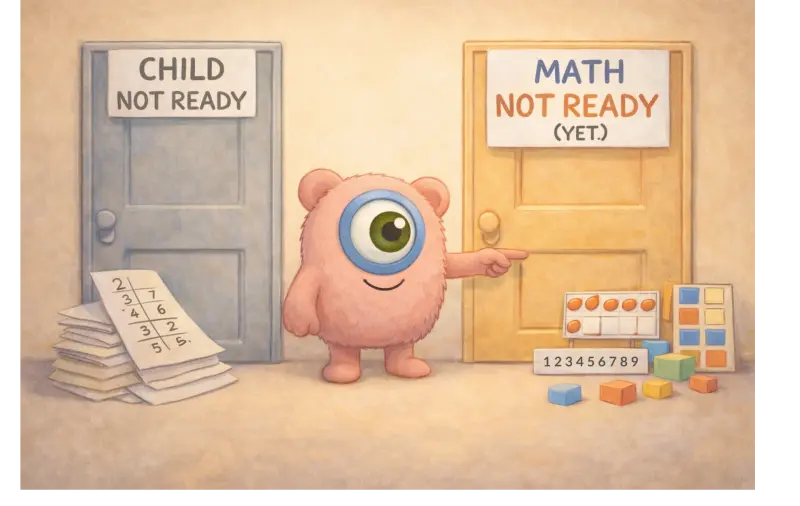
What Does “Ready for Math” Even Mean?
When we talk about math readiness, we often imagine memorizing numbers, writing neatly, or finishing worksheets independently.
But cognitive science paints a much more nuanced picture.
Early mathematical development depends heavily on number sense - the intuitive ability to discriminate quantities without counting. A longitudinal research found that infants’ early number sense predicts later formal math achievement, even after accounting for general intelligence and vocabulary.
In other words, math success isn’t built on speed. It’s built on conceptual foundations.
In particular, working memory plays a key role in how children approach and solve mathematical problems. Peer-reviewed research found that children with stronger working memory capacity tend to perform better on arithmetic tasks, especially those involving multi-step reasoning and complex calculations. This suggests that the ability to hold and manipulate numbers in mind - not just how fast a child writes - contributes significantly to math achievement.
So if your child forgets steps midway through a problem, that may not be carelessness. It may be cognitive load.
The Hidden Role of Working Memory and Cognitive Load
Math is uniquely demanding because it stacks processes on top of each other.
A child solving 27 + 18 in their mind isn’t just adding. They’re:
Holding numbers in memory
Applying place value rules
Managing regrouping steps
Monitoring accuracy
If working memory is overloaded, errors happen - even when understanding is present.
Research in educational psychology, including foundational work in Cognitive Load Theory, shows that reducing unnecessary demands on working memory improves learning outcomes. When instruction emphasizes visual supports, and chunking, students retain more.
This is especially important for children with ADHD or executive functioning differences, where working memory demands can quietly derail understanding - particularly in the way working memory challenges affect math performance in ADHD.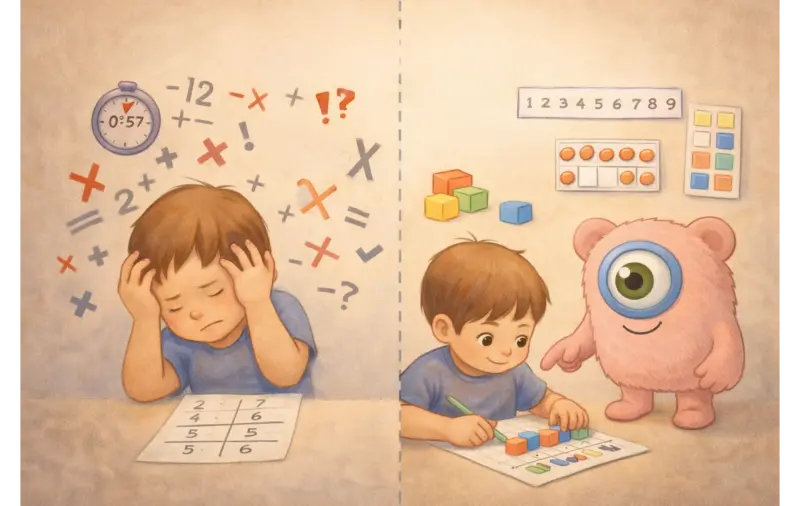
Math Anxiety Starts Earlier Than You Think
Many parents assume math anxiety develops in middle school. But research suggests it can emerge much earlier. A longitudinal study of first-grade students found that even young children experience measurable math anxiety, with concerns about difficulty and failure appearing at the very start of formal schooling. The study also showed that higher levels of math anxiety were associated with lower math performance, indicating that anxiety can begin shaping achievement far earlier than many families expect.
When children repeatedly experience confusion or public correction, their brain begins associating math with threat. And once anxiety enters the picture, working memory shrinks even further.
This creates a painful loop:
Struggle → Anxiety → Reduced Working Memory → More Struggle
That doesn’t mean a child isn’t capable. It means the environment may not feel safe enough for learning yet.
Developmental Readiness vs. Rigid Pacing
Most school systems follow pacing guides. Skills are introduced according to grade-level standards.
But children’s developmental trajectories don’t always align perfectly with curriculum calendars.
Research in developmental psychology suggests that mathematical reasoning develops most effectively when students move step-by-step from concrete experiences to visual representations and finally to abstract symbols - a progression known as the Concrete-Representational-Abstract (CRA) framework. In one experimental study, students who were taught using this structured CRA sequence - beginning with hands-on manipulatives, then drawings, and only later symbolic notation - showed significantly stronger math achievement compared to those taught through traditional methods. The findings reinforce the idea that conceptual understanding deepens when children build meaning before being asked to operate purely at the symbolic level.
If math instruction jumps too quickly to symbols and timed drills before conceptual foundations are solid, some children appear “not ready.”
But readiness may simply require more concrete experiences.
Is It Dyscalculia - Or Instructional Mismatch?
About 3–7% of children are estimated to have developmental dyscalculia, a specific learning difficulty affecting numerical processing.
However, many more children struggle with math due to instructional mismatch, anxiety, or working memory challenges - not a formal disability.
If you suspect a learning difference, it’s important to consult a professional.
But before concluding your child “isn’t ready,” it’s worth asking:
Have they had enough visual modeling?
Are they allowed multiple strategies?
Is fluency being demanded before understanding?
What Research Says Actually Helps
Evidence-based math instruction tends to share common elements:
Explicit strategy instruction
Visual representations (number lines, ten-frames, area models)
Opportunities for verbal reasoning
Reduced emphasis on timed performance
A meta-analysis and systematic review of math instruction found that interventions involving explicit and systematic instruction - where concepts are clearly explained, practiced, and scaffolded - tend to produce larger improvements in student math performance compared with less structured approaches.
Teaching that meets children where they are - instead of where a pacing guide expects them to be - leads to stronger learning.
How to Tell If It’s the Math (Not Your Child)
Here are signs that instruction may not be developmentally aligned:
Your child understands concepts when using manipulatives but struggles on paper.
They can explain reasoning verbally but freeze during timed drills.
Errors increase under pressure.
Confidence drops quickly after small mistakes.
These aren’t signs of inability. They’re signals about instructional fit.
What You Can Do as a Parent
You don’t need to redesign the curriculum. Small shifts make a big difference:
Slow down and ask, “How did you think about that?” instead of “Is it correct?”
Encourage drawing models.
Normalize mistakes as part of learning.
Remove time pressure during practice.
Most importantly, protect your child’s identity.
A child who believes “I’m bad at math” often disengages long before actual ability plateaus.
Maybe It’s Not About Readiness
Sometimes children don’t need to mature more. They need instruction that matches where they already are. They need space to build understanding before speed. They need math experiences that reduce cognitive overload and increase confidence.
And when that shift happens, something beautiful often follows:
The same child who once froze during worksheets begins explaining strategies at the dinner table. Not because they suddenly became “ready.”
But because the math finally was.
FAQs
How do I know if my child is truly not ready for math?
True developmental delay is rare. More often, difficulty stems from working memory load, anxiety, or instructional pacing. A formal evaluation can clarify if dyscalculia is present.
Can math anxiety cause poor performance?
Yes. Peer-reviewed research shows math anxiety reduces working memory capacity, directly impacting problem-solving performance.
Should I delay introducing math concepts?
Rather than delaying entirely, focus on concrete experiences and conceptual understanding before emphasizing speed or memorization.
Is struggling in early math a predictor of future failure?
Not necessarily. Early number sense predicts later performance, but targeted intervention and supportive instruction significantly improve trajectories.
References:
Starr, A., Libertus, M. E., & Brannon, E. M. (2013). Number sense in infancy predicts mathematical abilities in childhood. Proceedings of the National Academy of Sciences, 110(45), 18116–18120. https://www.pnas.org/doi/10.1073/pnas.1302751110
Śmigasiewicz, K., Grabner, R. H., & Szűcs, D. (2023). Working memory capacity is related to arithmetic performance: Evidence from children and adolescents. Brains, 13(1), 22. https://www.mdpi.com/2076-3425/13/1/22
Sweller, J. (1998). Cognitive load during problem solving: Effects on learning. Cognitive Science, 12(2), 257–285. https://onlinelibrary.wiley.com/doi/epdf/10.1207/s15516709cog1202_4
Szczygieł, M., & Pieronkiewicz, M. (2021). Exploring the nature of math anxiety in young children: Intensity, prevalence, and reasons. Journal of Education and Learning, 10(4). Retrieved from https://www.researchgate.net/publication/349238285_Exploring_the_nature_of_math_anxiety_in_young_children_Intensity_prevalence_reasons
Enhancing student performance in mathematics through the concrete-representational-abstract (CRA) instructional sequence. (2025). International Journal of Scientific Research and Applications, IJSRA-2025-0887. Retrieved from https://journalijsra.com/sites/default/files/fulltext_pdf/IJSRA-2025-0887.pdf
Svane, L. J., Zieffler, A., & Fatehi, N. (2023). Systematic review of systematic and explicit mathematics instruction: Features and outcomes. Frontiers in Education, 8:1229849. https://www.frontiersin.org/journals/education/articles/10.3389/feduc.2023.1229849/full