TL;DR: Motivating a child with ADHD is about working smarter with how their brain processes reward and effort. Here's what the research says works:
Deliver rewards immediately after the behaviour - delayed praise rarely sticks.
Use token economies and point systems rather than punishments.
Break tasks into short, winnable chunks with frequent feedback.
Incorporate movement - aerobic exercise genuinely improves focus and impulse control.
Lean into their interests; intrinsic motivation is powerful when you find the right hook.
Pair visual timers and routines with warm, specific praise.
If you're the parent of a child with ADHD, you've probably had this experience: your kid is completely absorbed in a video game or a Lego set for hours, but the moment homework appears, it's like someone flipped a switch. Focus evaporates. Resistance kicks in. And you're left wondering - is my child choosing not to try?
The short answer is no. And understanding why is the key to everything.
What looks like a motivation issue in ADHD is often a difference in how rewards are processed. The ADHD brain has altered dopamine pathways, which means it craves immediate, high-interest feedback and struggles with tasks that offer delayed or abstract payoffs. Once you understand this, the strategies stop feeling like tricks - they start feeling like the right tools for the job.
Why Motivation Works Differently in the ADHD Brain
ADHD involves neurally-based motivational systems that, as research shows, respond poorly to the kinds of contingencies that typically work for neurotypical children. Specifically, children with ADHD are less responsive to inconsistent, delayed, and weak reinforcement, and less sensitive to cues of punishment or non-reward compared to their peers.
What this means practically: a gold star promised for Friday doesn't move the needle. A sticker right now might. The time horizon is genuinely shorter, and this is a neurological reality, more than a character flaw.
There's also something called "hyperfocus" - that paradoxical ability to lock in completely on things they find intrinsically interesting. It reveals that motivation can be accessed under the right conditions. The job is to understand what creates that intrinsic motivation and build bridges from there to the tasks that need to happen.
Research found that children with ADHD prefer small, immediate rewards over larger delayed ones, and are more influenced by the most recent reinforcement they received than by their overall reinforcement history. This insight can guide how we design motivation in a way that actually works.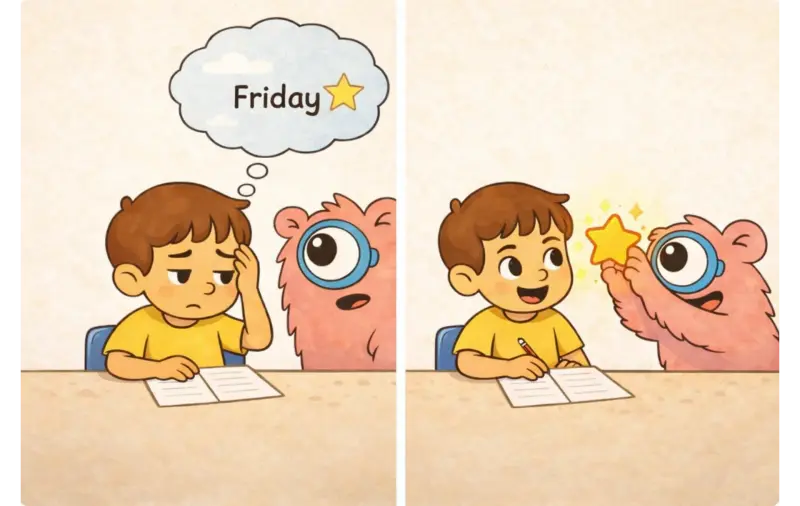
1. Use Reward Systems That Are Fast, Frequent, and Specific
One of the most proven ways to motivate children with ADHD is behavioural parent training, built around immediate positive reinforcement.
Token economy systems - where children earn points or tokens for specific behaviours and exchange them for rewards they've chosen - have a strong research track record. A study found that combining cognitive behavioural therapy with token-economy techniques led to meaningful improvements in inattention, impulsivity, and hyperactivity in children with ADHD.
Key things to get right with any reward system:
Be specific. "Good job today" is too vague. "You sat at your desk and finished three maths problems - that's exactly what we were practising, well done!" is the kind of feedback that lands.
Keep rewards immediate. For younger children especially, "you can earn screen time this weekend" is too far away to motivate action right now. A small reward after the task - a sticker, five minutes of a preferred activity, a small privilege - is far more effective.
Let them choose the reward. Autonomy matters. When a child picks the reward, they're more invested in earning it.
Practical tip: Try a "motivation menu" - a small card with 5-6 rewards your child has chosen themselves, ranging from small (10 extra minutes of playtime) to bigger (choosing what's for dinner). After a task, let them pick from the menu.
2. Break Tasks Into Micro-Goals
One of the clearest patterns in ADHD is that large, open-ended tasks - a full homework worksheet, a long chapter, a multi-step project - trigger avoidance and overwhelm almost immediately. The task looks like a mountain, and the summit feels too far away to bother climbing.
The fix is to make the mountain disappear. Break any task into the smallest possible units that still feel meaningful. Instead of "do your homework," it becomes "write one sentence," "solve the first two problems," "read this one paragraph." Each micro-completion earns immediate acknowledgement.
This approach works because it creates a constant stream of small wins - and for the ADHD brain, those small wins are genuinely motivating. The dopamine hit from finishing something, even something tiny, is real.
A helpful tool here is a visual timer - but only when used as a guide, not a deadline. Research shows that children with ADHD often struggle with time perception - sometimes referred to as “time blindness” - with studies finding consistent differences in how they estimate and track time. A visible countdown can make time feel more concrete and give the task a clear shape. Used gently, it helps reduce uncertainty. Used as a race, it can create pressure and make things harder.
If you're looking for more practical ways to reduce friction around focus, we've put together 7 ADHD-friendly focus hacks that actually work for kids - many of which pair well with the strategies above.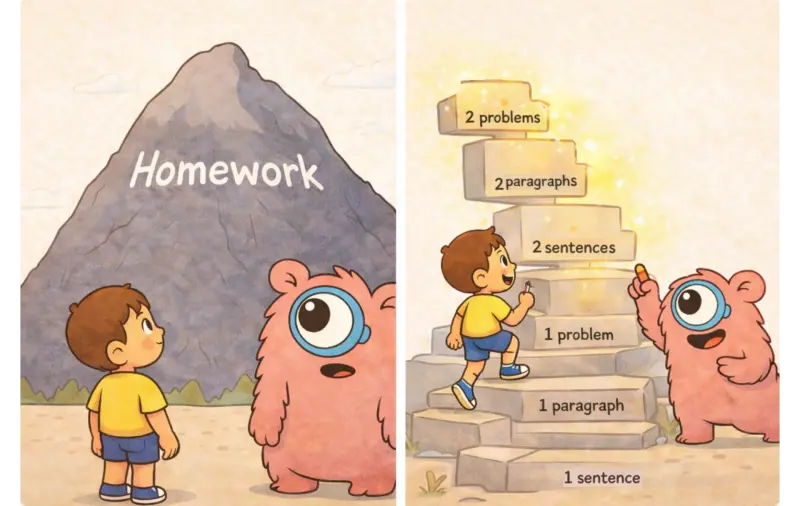
3. Move the Body to Unlock the Brain
Here's something that consistently surprises parents: apart from physical activity being good for your ADHD child's body - it's one of the most effective ways to improve their focus, impulse control, and motivation for learning.
A meta-analysis confirmed that both acute and chronic physical exercise are beneficial to ADHD symptoms, executive function, and motor abilities in children. Exercise increases dopamine, serotonin, and brain-derived neurotrophic factor (BDNF) - the same neurotransmitters targeted by ADHD medications.
A separate meta-analysis found that aerobic exercise significantly improved executive function in children with ADHD, with moderate-to-large effect sizes for inhibitory control, cognitive flexibility, and working memory.
This has a very practical implication: a 10–20 minute movement break before homework or learning time can meaningfully improve your child's ability to engage with it. A bike ride, a dance break, jumping on a trampoline, or even just running around the garden can prime the brain for the cognitive work ahead.
4. Tap Into Their Interests (Seriously)
ADHD research on motivation points to differences in how the brain processes reward. Brain imaging studies have found reduced activity in the dopamine reward pathway, which is linked to motivation and attention. This helps explain why some tasks are harder to engage with, especially when they don’t feel immediately interesting or rewarding. In practice, this means that tapping into what a child already finds engaging can be a powerful way to support learning.
This is the logic behind gamified learning platforms - and it's also the logic you can apply at home. If your child loves superheroes, make maths problems about superheroes. If they're obsessed with Minecraft, use Minecraft as a framework for measuring, counting, and problem-solving. The content of the interest becomes a scaffold for the skill you're trying to build.
Don't underestimate how powerful it is to give your child agency in what they're learning and how. When kids with ADHD feel like they have ownership over a task, engagement goes up noticeably.
If math is where the resistance shows up most, it's worth reading how ADHD creativity can actually become an asset in math problem solving.
5. Praise Effort, Not Outcome
How you praise matters as much as whether you praise. Research in developmental psychology finds that ability praise - "you're so smart" -can actually trigger helpless responses in children after failure, including less persistence, more negative self-talk, and worse performance on subsequent tasks. Effort praise, by contrast - "you worked really hard on that" - leads children to associate success with something they can control, which builds resilience and keeps motivation intact after setbacks. For children with ADHD, who encounter failure more frequently than their peers, this distinction is the difference between a child who tries again and one who quietly stops trying.
When a child with ADHD hears "you're so smart" and then fails, it feels shattering - because failure disproves the identity. But when they hear "you worked really hard," they have something actionable: they can always try harder. The effort is within their control; the outcome isn't always.
The effort is within their control; the outcome isn't always.
Specific, warm, effort-focused praise - delivered immediately after a desired behaviour - is one of the lowest-cost, highest-impact tools available to parents and teachers.
6. Build Consistent Routines (And Make Them Visual)
ADHD brains struggle with transitions, unpredictability, and the cognitive overhead of deciding what comes next. A consistent routine removes that overhead. When a child always does homework after a 15-minute snack break, the brain stops having to negotiate it - it just happens.
Make routines visual wherever possible. A simple printed checklist on the wall, a picture-based schedule for younger children, or a whiteboard with today's plan can dramatically reduce friction. The child can see what's expected, track their own progress, and feel the small satisfaction of crossing things off.
Behavioural parent training research consistently shows that structured techniques - such as clear instructions, routines, and reinforcement - can improve compliance and reduce ADHD-related difficulties at home and school.
7. Rethink Punishment - It Rarely Works for ADHD
This one is worth saying clearly: punishment and criticism are consistently less effective for children with ADHD than for neurotypical children. This means that the primary driver of behaviour change should be positive reinforcement, not negative consequence.
The reason comes back to neurobiology. Punishment requires a child to connect a current consequence to a past action. For children with ADHD, working memory differences make this connection unreliable. The lesson doesn't stick the way you'd hope, but the stress and shame do - and both make motivation worse.
When mild consequences are needed, they work best when they're immediate, clearly linked to the specific behaviour, and brief. The goal should always be to create an opportunity to try again, not to punish repeated failure.
When to Seek More Support
These strategies are powerful, but they're not everything. If your child's motivation difficulties are significantly affecting their learning, relationships, or self-esteem, it's worth talking to a paediatrician or psychologist who specialises in ADHD. Evidence-based interventions like behavioural parent training, cognitive behavioural therapy, and - where clinically appropriate - medication, all have strong research support and can be combined with the home strategies above.
A large systematic review found that a wide range of treatments - including both pharmacological and psychosocial approaches - can improve outcomes for children with ADHD.
You don't have to figure this out entirely on your own.
FAQs
Why does my ADHD child seem motivated for games but not for schoolwork?
This is one of the most common questions parents ask - and it makes complete sense. Video games and other high-interest activities offer constant, immediate feedback and escalating challenge. Schoolwork typically doesn't. The ADHD brain's reward circuitry responds best to immediate payoff, so the gap in motivation is a reflection of which environment is set up to engage that reward system. The goal is to bring some of those same game-like qualities (immediate feedback, visible progress, clear goals) into learning contexts.
How do reward systems actually work for ADHD kids?
The most effective reward systems for children with ADHD are immediate (delivered right after the behaviour), consistent (applied every time the target behaviour occurs), and chosen by the child themselves. Token economies - where children earn points or tokens and exchange them for preferred rewards - have strong research backing. The key is to start with very frequent reinforcement and fade it gradually as the behaviour becomes more established.
Is it okay to use screen time as a reward for an ADHD child?
Screen time can be an effective motivator when it's framed as a contingent reward (earned after completing a task) rather than a default activity. The key is clarity and consistency: "After 20 minutes of reading, you get 20 minutes of screen time." What to avoid is using screen time to manage distress or as an indefinite activity, which can make transitions away from it harder. The type of screen activity also matters - passive watching is different from interactive, educational games.
How much exercise does an ADHD child need to see benefits?
Research suggests that even short, acute bouts of moderate aerobic exercise - as little as 20 minutes - can improve attention and impulse control in children with ADHD for the hours that follow. For sustained benefits, consistent moderate-intensity aerobic activity several times a week (60-90 minutes total per session, 2-3 times weekly) has been shown to produce the strongest effects on executive function. But practically, any movement is better than none - especially right before tasks that require focus.
My child with ADHD gives up the moment something gets hard. What can I do?
This is often a sign that the task is pitched at the wrong difficulty level, or that the child has experienced enough failure with similar tasks that avoidance has become a coping strategy. The most helpful interventions are to break the task into much smaller steps (so early wins are guaranteed), praise effort explicitly and warmly, and reduce time pressure wherever possible. Building a track record of success - even on tiny tasks - genuinely rebuilds willingness to try.
At what age do these motivation strategies start to work?
Behavioural strategies and reward systems are effective from preschool age onwards, though the specific implementation needs to be developmentally appropriate. Very young children (ages 3-5) do best with immediate, tangible rewards and very short task windows. Older children can handle slightly delayed rewards and more complex token economies. Adolescents often respond better when they're involved in designing the system themselves - autonomy and buy-in matter more as children get older.
References:
Pfiffner, L. J., & DuPaul, G. J. (2014). Behavior Management for School Aged Children with ADHD. PMC / Child and Adolescent Psychiatric Clinics of North America. https://pmc.ncbi.nlm.nih.gov/articles/PMC4167345/
Van der Oord, S., & Tripp, G. (2020). How to Improve Behavioral Parent and Teacher Training for Children with ADHD: Integrating Empirical Research on Learning and Motivation. Clinical Child and Family Psychology Review. PMC.https://pmc.ncbi.nlm.nih.gov/articles/PMC7585566/
Morsink, S. et al. (2022). Studying Motivation in ADHD: The Role of Internal Motives and the Relevance of Self Determination Theory. Frontiers in Psychology. PMC. https://pmc.ncbi.nlm.nih.gov/articles/PMC9066661/
Coelho, L. F., Barbosa, D. L. F., Rizzutti, S., Muszkat, M., Bueno, O. F. A., & Miranda, M. C. (2015). Use of Cognitive Behavioral Therapy and Token Economy to Alleviate Dysfunctional Behavior in Children with Attention-Deficit Hyperactivity Disorder. Frontiers in Psychiatry, 6, 167. https://pmc.ncbi.nlm.nih.gov/articles/PMC4659172/
Chan, Y. S., Jang, J. T., & Ho, C. S. (2022). Effects of physical exercise on children with attention deficit hyperactivity disorder. Biomedical Journal. PMC. https://pmc.ncbi.nlm.nih.gov/articles/PMC9250090/
Zhu, F. et al. (2023). Comparative effectiveness of various physical exercise interventions on executive functions and related symptoms in children and adolescents with ADHD. Frontiers in Public Health. https://doi.org/10.3389/fpubh.2023.1133727
Peterson, B. S. et al. (2024). Treatments for ADHD in Children and Adolescents: A Systematic Review. Pediatrics.https://doi.org/10.1542/peds.2024-065787
Ptacek, R. et al. (2019). Time perception in attention deficit hyperactivity disorder: A review. Frontiers in Psychology. https://doi.org/10.3389/fpsyg.2019.00867
Xing, S., Gao, X., Jiang, Y., Archer, M., & Liu, Q. (2018). Effects of Ability and Effort Praise on Children's Failure Attribution, Self-Handicapping, and Performance. Frontiers in Psychology, 9, 1883. https://pmc.ncbi.nlm.nih.gov/articles/PMC6176062/
Volkow, N. D., Wang, G-J., Newcorn, J. H., Kollins, S. H., Wigal, T. L., Telang, F., Fowler, J. S., Goldstein, R. Z., Klein, N., Logan, J., Wong, C., & Swanson, J. M. (2011). Motivation deficit in ADHD is associated with dysfunction of the dopamine reward pathway. Molecular Psychiatry, 16(11), 1147–1154. https://pmc.ncbi.nlm.nih.gov/articles/PMC3010326/