
TL;DR: Dyslexia and dyscalculia are both classified under Specific Learning Disorder in the DSM-5, but they affect different academic domains and require different instructional approaches.
Dyslexia primarily affects word reading, decoding, spelling, and reading fluency. It is strongly associated with difficulties in phonological processing.
Dyscalculia primarily affects mathematical learning, including number sense, quantity understanding, math fact retrieval, calculation, and mathematical reasoning.
While the two conditions can co-occur, they also frequently occur independently.
Accurate identification is essential, because effective intervention for dyslexia (structured literacy instruction) differs from effective intervention for dyscalculia (explicit, visual, number-sense-focused math instruction).
Both conditions can affect a child’s academic progress, confidence, and emotional well-being but with early identification and targeted support, outcomes can improve significantly.
If your child struggles in school, the first question many parents ask is:
“Is this a reading issue… or a math issue?”
Sometimes the answer is obvious.
Sometimes it isn’t.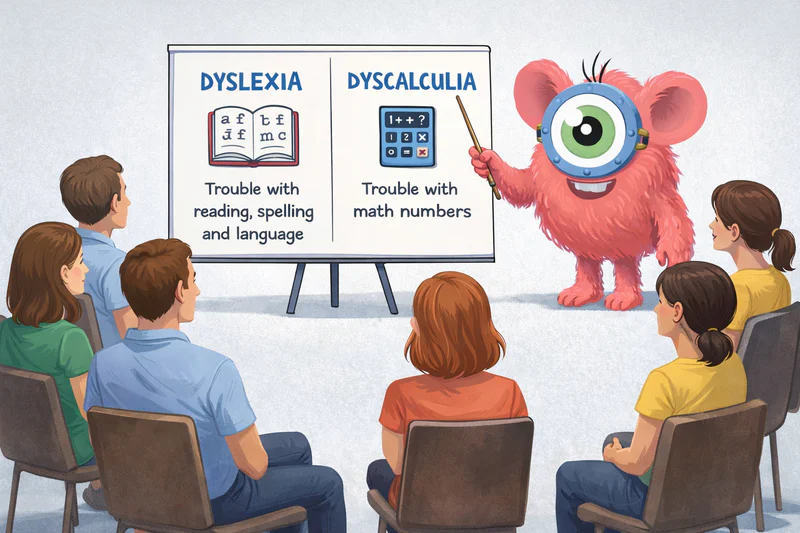
Dyslexia and dyscalculia are both classified under Specific Learning Disorder in the DSM-5, but they affect different cognitive systems and require different types of support. Dyslexia and dyscalculia are developmental disorders in the areas of reading and mathematics. Both can make it hard to learn math. It’s possible to have both, but they’re very different.
Understanding the difference is essential because the right intervention depends on identifying the right difficulty.
What Is Dyslexia?
Dyslexia is a neuro developmental learning disability that primarily affects accurate / fluent word recognition, decoding, and spelling.
Dyslexia is mainly defined as the low end of a normal distribution of word reading ability. It represents a disorder within the language system and more specifically within a particular subcomponent of that system i.e. phonological processing. It is not caused by low intelligence or lack of motivation. Neuroimaging studies consistently show under activation in posterior reading systems during decoding tasks, making phonological deficits the most consistent cognitive markers of dyslexia. The prevalence of dyslexia in global population is at least 10% with significant number of students with dyslexia going undiagnosed and their symptoms unaddressed.
In practical terms, you may notice:
Slow, effortful reading.
Difficulty sounding out unfamiliar words.
Inconsistent spelling.
Avoidance of reading aloud.
Strong verbal reasoning despite weak written output.
Dyslexia is not a reflection of intelligence. Many children with dyslexia have average or above-average cognitive ability.
What Is Dyscalculia?
Dyscalculia is a learning disability that affects mathematical learning and number processing.
It's a specific neurodevelopmental disorder characterized by persistent difficulties in mastering number sense, number facts, calculation, or mathematical reasoning, despite normal intelligence and adequate educational opportunities. The World Health Organization describes dyscalculia as a specific impairment in arithmetical skills that cannot be explained by general intellectual disability or grossly inadequate schooling. The prevalence of dyscalculia in the general population ranges from approximately 2.5% to 7%
In practical terms, you may notice:
Persistent reliance on finger counting.
Confusion about which numbers are larger.
Difficulty remembering basic math facts.
Trouble with place value (12 vs 21).
Strong reading skills but ongoing math struggles.
Again, this is not about intelligence. It is about how the brain processes numerical information.
Why Parents Confuse Dyscalculia and Dyslexia
Both disorders can look similar emotionally:
- Homework avoidance.
- Anxiety.
- Low academic confidence.
- Falling behind peers.
- Some symptoms can be confusing - a child with Dyslexia might struggle with word problems in Math, even if they don't have Dyscalculia.
There is also a substantial overlap between reading and arithmetic disabilities. Interpretation of studies of Reading or Math disabilities suggest that they co-occur in 30 – 70% of individuals with either disorder, a phenomenon known as comorbidity.
Shared cognitive contributors include:
- Working memory limitations.
- Processing speed differences.
- Executive function challenges.
Can a Child Have Both?
Yes. Some children show weaknesses in both reading and mathematics, though the underlying causes may differ.
This is why careful evaluation matters. A child who struggles in both subjects may not simply “need more practice.” They may need targeted intervention in both domains.
Signs to Watch For

Learning Impact caused by dyslexia and dyscalculia
Academic Impact of Dyslexia
Slower reading affects all subjects.
Written assignments may not reflect true understanding.
Fatigue from reading-heavy work.
Reduced confidence in academic identity.
Academic Impact of Dyscalculia
Math fact fluency develops slowly.
Multi-step problems overwhelm working memory.
Word problems become doubly difficult.
Timed tests increase anxiety.
Social and Emotional Impact
Both dyslexia and dyscalculia affect more than grades. Children may experience:
- Academic shame.
- Anxiety or school avoidance.
- Social comparison distress.
- Reduced academic self-esteem
Long-term outcomes improve significantly when difficulties are identified early and addressed with supportive instruction.
Why Differentiation Matters for Intervention
Interventions for dyslexia focus on:
- Explicit phonics instruction.
- Structured literacy approaches.
- Repeated decoding practice.
Interventions for dyscalculia focus on:
- Concrete - Representational - Abstract progression.
- Visual number lines.
- Strategy based fact fluency.
- Building number sense before memorization.
Treating dyscalculia with repetitive timed drills can increase math anxiety without strengthening understanding, a pattern we discuss in our article on math accommodations for struggling learners and in our guide on choosing the right math curriculum for children with dyscalculia.
Assistive Technology That Can Help
For Dyslexia
-Text-to-speech tools.
-Audiobooks.
-Speech-to-text writing support.
Meta-analyses show read-aloud tools improve comprehension outcomes for students with reading disabilities (Wood et al., 2017).
For Dyscalculia
- Digital tools with visual math models.
- Interactive number-line practice.
- Strategy-based math fluency programs.
- Calculator use when reasoning (not computation) is the target.
School Accommodations that can help
Dyslexia Accommodations
- Extended time on reading-heavy tasks.
- Audiobook access.
- Reduced spelling penalties.
- Oral response options.
Dyscalculia Accommodations
- Extended time on math tests.
- Reduced emphasis on timed drills.
- Visual reference sheets.
- Calculator for higher-level reasoning tasks.
- Chunked problem sets.
What Parents Can Do at Home
You do not need to replicate school at home.
Instead: For Dyslexia
- Read aloud regularly.
- Use audiobooks.
- Practice decoding in short, structured sessions.
- Praise strategy and persistence.
For Dyscalculia
- Use everyday math (cooking, shopping, estimating)
- Use visual tools like number lines
- Focus on strategies instead of timed drills
- Reduce pressure during practice
Key Takeaways
Dyslexia affects reading and decoding.
Dyscalculia affects number sense and mathematical processing.
They may occur separately or together.
Intervention must match the specific learning profile.
Emotional well-being is as important as academic progress.
Early identification leads to better outcomes.
Frequently Asked Questions
Is dyscalculia just being bad at math?
No. Dyscalculia is a neurodevelopmental learning disability involving number processing difficulties, not lack of effort.Is dyslexia just reversing letters?
No. Letter reversals can occur in many young children. Dyslexia primarily affects decoding and word recognition.Can intervention really help?
Yes. Early, explicit instruction significantly improves outcomes in both reading and math disabilities.Will my child grow out of it?
Learning disabilities do not simply disappear, but appropriate support dramatically improves skills and confidence.Should I request an evaluation?
If concerns persist despite quality instruction, formal evaluation is recommended.Is dyscalculia just math anxiety?
No. Anxiety may develop, but dyscalculia involves measurable differences in numerical magnitude processing.Can dyslexia cause math problems?
Yes, it can, particularly in word problems, especially because of the difficulty in comprehending the language in the word problems.Are both neurodevelopmental?
Yes. Both are classified as Specific Learning Disorders in DSM-5.What age can you identify them?
Warning signs typically appear in early elementary school when decoding and number sense should consolidate.
References
Shaywitz, S. E., & Shaywitz, B. A. (2005). Dyslexia (Specific Reading Disability). Biological Psychiatry, 57(11), 1301–1309. https://doi.org/10.1016/j.biopsych.2005.01.043
Willcutt, E. G., Petrill, S. A., Wu, S., Boada, R., DeFries, J. C., Olson, R. K., & Pennington, B. F. (2013). Comorbidity Between Reading Disability and Math Disability: Concurrent Psychopathology, Functional Impairment, and Neuropsychological Functioning. Journal of Learning Disabilities, 46(6), 500–516. PMCID: PMC3749272. Available from https://pmc.ncbi.nlm.nih.gov/articles/PMC3749272/
Sunil, A. B., Banerjee, A., Divya, M., Rathod, H. K., Patel, J., & Gupta, M. (2023). Dyslexia: An invisible disability or different ability. Industrial Psychiatry Journal, 32(Suppl 1), S72–S75. PMCID: PMC10871397. Available from https://pmc.ncbi.nlm.nih.gov/articles/PMC10871397/
Snowling, M. J., Hulme, C., & Nation, K. (2020). Defining and understanding dyslexia: past, present and future. Oxford Review of Education, 46(4), 501–513. doi:10.1080/03054985.2020.1765756. PubMed PMID: 32939103. Available from https://pubmed.ncbi.nlm.nih.gov/32939103/
Dowker, A. (2020). Arithmetic in developmental cognitive disabilities. Research in Developmental Disabilities, 107, Article 103778. https://doi.org/10.1016/j.ridd.2020.103778. Available from https://www.sciencedirect.com/science/article/abs/pii/S0891422220302109