
TL;DR: Your child is still expected to know their addition facts by heart, just by the end of second grade rather than first. Until then, the homework asks them to show strategies like "making ten," because the standards most US schools follow require it and because there's some evidence that how a child solves simple sums in first grade is linked to how math goes later. You don't need to learn a whole new system to help. Ask your child to teach you their way.
The worksheet says 8 + 6. You know that's 14. But the page doesn't want 14. It wants your child to fill in two ten frames, move two dots across, and write a number sentence showing how they "made a ten." Your child is frustrated, you're not sure what the teacher is after, and the way you'd do it, by simply knowing the answer, apparently doesn't count.
Most parents of first graders hit this moment at some point. Once you can read what the page is asking for, helping gets a lot easier, and the arguments at the kitchen table get a lot shorter.
What first grade math homework is actually asking for
Forty-one states and the District of Columbia have adopted the Common Core State Standards, which cover math and English. Some states have renamed or revised theirs since, so check your state education department's website for the exact wording where you live. The Common Core first grade standard for addition and subtraction asks children to add and subtract within 20 while becoming fluent within 10, using strategies such as counting on and making ten. The standard names the strategies it wants, with examples, and those examples are what end up on your child's worksheets.
A ten frame is a grid of two rows of five boxes, and it makes "how many more do I need to get to ten?" something your child can see. A number bond is a small diagram that shows one number split into two parts, like 6 split into 2 and 4. Our post on what number bonds are and why schools teach them goes into those in more detail. A number line shows the same moves as jumps.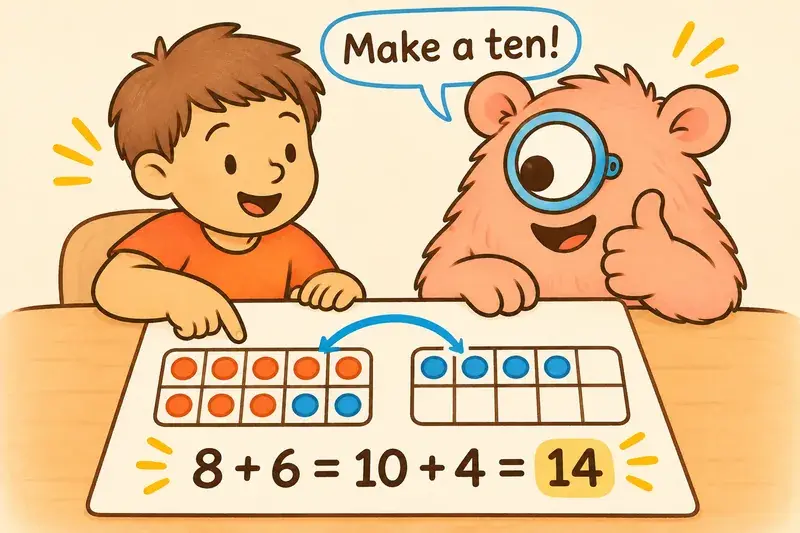
Memorizing math facts is still the goal
The standards haven't dropped memorization. By the end of second grade, children are expected to know from memory all sums of two one-digit numbers. The strategies are how children get there.
Practice still matters along the way, too. In a randomized trial with 648 first graders at risk for math difficulty, children tutored in number knowledge learned more arithmetic than untutored classmates, and those whose short practice segments were fast-paced gained the most on arithmetic. That tutoring ran three times a week for 16 weeks, with most of each session spent on understanding numbers and five minutes on practice. Understanding and quick recall were taught side by side.
The column method you learned, with carrying and borrowing, comes later. The standards don't expect children to add and subtract multi-digit numbers fluently using the standard algorithm until fourth grade, though many classes start it in second or third. Until then, it's usually easier on your child to stick with the method the class is using.
Why schools teach strategies before the shortcuts
Every child starts out counting, often on their fingers, and that's a normal stage. What schools are trying to avoid is a child who is still counting one by one at the end of first grade, because that tends to show up again later.
When researchers followed 61 Danish first graders to fourth grade, the way a child solved simple addition in first grade was the single strongest predictor of their math achievement three years later. It told the researchers something a standardized math test taken at the same time didn't. That's a small study in three schools.
A larger US study points the same way. Among 177 children followed from kindergarten to fifth grade, first graders who could break numbers apart to solve harder addition problems scored higher in math in every later grade, even after accounting for intelligence, working memory and processing speed. That edge narrowed over the years, while knowing some basic facts by heart in first grade mattered more with each grade. The children all came from one school district, and those with incomplete data were left out.
Both studies show a link. Neither proves that teaching strategies causes later success. But they fit what teachers see: children who can use what they know to work out what they don't tend to keep moving forward.
Making ten earns its place because our number system is built in tens. A child who sees 8 + 6 as 10 + 4 is using the same idea they'll later need for 38 + 5, and later still for 380 + 50. Counting on fingers doesn't stretch that far.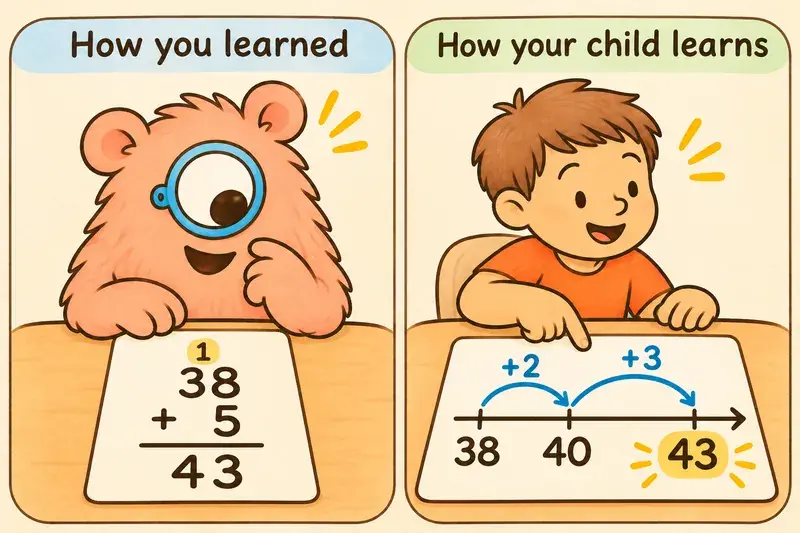
The pictures have research behind them too. The What Works Clearinghouse, part of the US Department of Education, reviewed intervention research for elementary students who struggle with math and found strong evidence for using a well-chosen set of concrete and visual representations, such as blocks, drawings and number lines, based on 28 studies. That guide is about children who find math hard, including those with attention and working-memory difficulties, so it applies to many neurodivergent kids. It isn't a verdict on every classroom method.
Why homework time can go sideways
Parents matter a great deal here, in both directions. In a study of 438 first and second graders, children of math-anxious parents learned less math over the school year and ended it more anxious about math, but only when those parents helped with homework often. When anxious parents helped less often, the link disappeared.
The researchers suggested one possible reason. Math-anxious parents might insist on the methods they learned long ago when the classroom teaches different ones, leaving the child confused. That was an idea they raised, not something they tested, but most parents of first graders will recognize the scene.
Keep helping, but use the classroom's method and stay calm about it.
Try this tonight: let your child teach you
Pick one problem from tonight's homework that your child can mostly do already. Hand over the pencil and say, "Show me how your teacher wants you to do this one. I learned it a different way, and I want to see yours." Now your child is the one explaining, and you're the one learning.
As they explain, ask one question and only one: "How did you know?" Don't correct anything yet. You're listening for the strategy, and their answer will usually fall into one of these.
They count from one every time. "One, two, three... fourteen." This is counting all, and it's common early in first grade. Our guide to counting on and when children should stop counting from one covers the next step.
They start at the bigger number and count up. "Eight... nine, ten, eleven, twelve, thirteen, fourteen." That's counting on, a real step forward.
They make a ten. "Eight needs two to make ten, and then there are four more, so fourteen." This is exactly what the worksheet is after.
They just know it. "It's fourteen. I know it." That's recall, which is the long-term goal. Ask how they'd show it anyway, since the teacher is checking the thinking as well as the answer.
Try it across a few evenings with different problems before drawing any conclusions. One tired evening after a long school day tells you very little.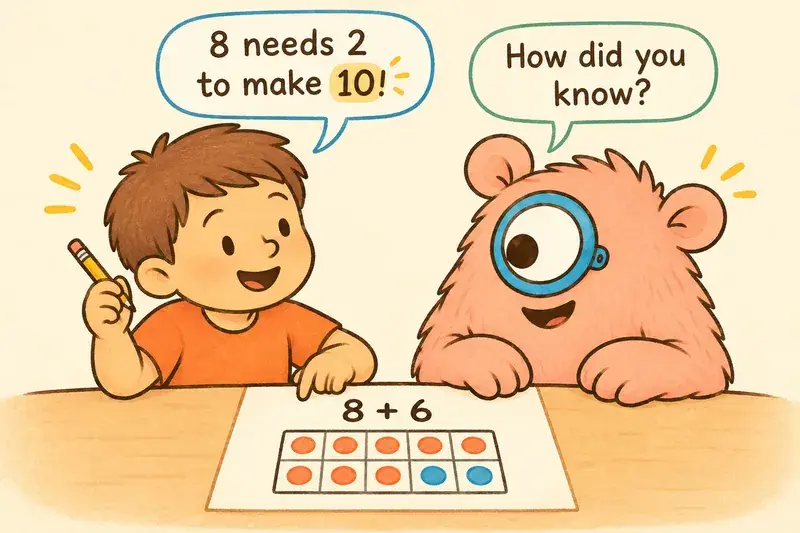
What helps
Learn the one strategy on tonight's page, not the whole system. Look for the strategy name in the directions ("make a ten," "use a number bond," "count on") and find it in the table above. Then use the same words your child's teacher uses. Matching the vocabulary does more for your child than any explanation you could give in your own terms.
Make a ten frame out of an egg carton. Cut a dozen-egg carton down to ten cups, two rows of five. Drop in seven raisins and ask, "How many more to fill it?" Then let your child eat their way back down. This builds the pairs that make ten, which the whole making-ten strategy depends on, in about two minutes and with no worksheet in sight.
Keep fact practice short and friendly. Once a strategy makes sense to your child, a few minutes of quick recall helps it stick. Card and dice games do this well, and our list of math games for 1st graders who hate worksheets has a dozen that need nothing more than a deck of cards or a pair of dice.
Ask the teacher one specific question. Many schools send home a parent guide to the strategies. If yours hasn't, send a short note: "Which strategies is the class working on this month, and how would you like them shown on homework?" One email can save weeks of crossed wires.
Keep your own tone even. If a problem stumps you, say so: "I'm not sure how your teacher wants this one. Let's put a star next to it and ask." That's the same calm attitude toward being stuck that you'd like your child to have.
When it's more than a different method
Sometimes the homework is hard because of the method. Sometimes it's hard because the number sense underneath hasn't settled yet. Moving beyond counting is a core first grade goal, and researchers note that many children, especially those who find math hard, struggle to learn these non-counting strategies, so some struggle here is expected.
Research on children who were later identified with a math learning disability points to what to watch. In a US study that tracked 306 children from kindergarten to third grade, the children with a math learning disability had weaker number sense in first grade and correctly recalled fewer addition facts than typical achievers. A follow-up with the same research group found that second graders with a math learning disability made at least 2.5 times more counting errors than their classmates. Those groups were small (17 and 15 children), so treat this as a guide to what to notice.
Going by that research, it's worth raising with the teacher if, in the second half of first grade, your child still counts every object from one for small sums like 3 + 2, often loses count and lands on the wrong answer, or can't tell you which of two numbers like 7 and 12 is bigger. The timing and the examples are our reading of the studies, which didn't test a checklist like this one, and none of these signs is a diagnosis. Ask what the school sees in class and whether a number sense screening would help.
Where to start this week
Tonight, pick one homework problem and ask your child to teach you how they do it. Later this week, ask the teacher which strategies the class is working on. The homework will still look unfamiliar, but you won't be guessing at what it wants.
FAQs
Why doesn't my child's teacher want them to just memorize math facts?
They do, eventually. Under the Common Core standards, children are expected to know all sums of two one-digit numbers from memory by the end of second grade. First grade focuses on strategies like making ten, which give children a reliable way to work out facts they haven't memorized yet and help those facts stick.
What does "make a ten" mean in first grade math?
Making ten means breaking one number apart so the other number becomes 10, then adding what's left. For 8 + 6, a child takes 2 from the 6 to turn the 8 into 10, then adds the remaining 4 to get 14. It works because our number system is built in tens, and adding something to 10 is easier than adding something to any other number. The same idea carries on into adding bigger numbers later.
Should I teach my first grader to carry and borrow?
It's usually better to wait. The Common Core standards don't expect children to be fluent with the standard column method for multi-digit addition and subtraction until fourth grade, though many classes introduce it in second or third. Teaching it early can give your child two methods to juggle and answers that don't show the thinking their teacher is asking for.
What is a ten frame?
A ten frame is a grid of two rows of five boxes used to show numbers up to 10 with dots or counters. It lets children see at a glance how many there are and how many more are needed to make 10. You can make one at home from an egg carton cut down to ten cups.
Why does my child have to show their work on easy problems?
The teacher is checking which strategy your child uses, not only whether the answer is right. How children solve simple addition in first grade matters: in a small Danish study that followed 61 children, first grade addition strategy use was the strongest single predictor of math achievement three years later. A US study of 177 children found that first graders who could break numbers apart to add scored higher in math in every later grade. Neither study proves cause, but together they're part of why teachers look at the method.
How can I help with math homework if I don't understand the method?
Ask your child to teach you their way, ask the teacher which strategies the class is using, and keep the mood calm. One study of first and second graders found that parents' math anxiety was linked with children learning less math only when those parents helped with homework often, so how you help matters as much as how much you help.
References
Common Core State Standards Initiative. (2010). Common Core State Standards for Mathematics: Grade 1, Operations & Algebraic Thinking. National Governors Association Center for Best Practices & Council of Chief State School Officers. https://www.thecorestandards.org/Math/Content/1/OA/
Common Core State Standards Initiative. (2010). Common Core State Standards for Mathematics: Grade 2, Operations & Algebraic Thinking. National Governors Association Center for Best Practices & Council of Chief State School Officers. https://www.thecorestandards.org/Math/Content/2/OA/
Common Core State Standards Initiative. (2010). Common Core State Standards for Mathematics: Grade 4, Number & Operations in Base Ten. National Governors Association Center for Best Practices & Council of Chief State School Officers. https://www.thecorestandards.org/Math/Content/4/NBT/
Common Core State Standards Initiative. (n.d.). Standards in your state. National Governors Association Center for Best Practices & Council of Chief State School Officers. https://www.thecorestandards.org/standards-in-your-state/
Fuchs, L. S., Geary, D. C., Compton, D. L., Fuchs, D., Schatschneider, C., Hamlett, C. L., DeSelms, J., Seethaler, P. M., Wilson, J., Craddock, C. F., Bryant, J. D., Luther, K., & Changas, P. (2013). Effects of first-grade number knowledge tutoring with contrasting forms of practice. Journal of Educational Psychology, 105(1), 58–77. Open access: https://pmc.ncbi.nlm.nih.gov/articles/PMC3779611/ (DOI: 10.1037/a0030127)
Fuchs, L. S., Newman-Gonchar, R., Schumacher, R., Dougherty, B., Bucka, N., Karp, K. S., Woodward, J., Clarke, B., Jordan, N. C., Gersten, R., Jayanthi, M., Keating, B., & Morgan, S. (2021). Assisting students struggling with mathematics: Intervention in the elementary grades (WWC 2021006). National Center for Education Evaluation and Regional Assistance, Institute of Education Sciences, U.S. Department of Education. https://ies.ed.gov/ncee/WWC/Docs/PracticeGuide/WWC2021006-Math-PG.pdf
Geary, D. C. (2011). Cognitive predictors of achievement growth in mathematics: A 5-year longitudinal study. Developmental Psychology, 47(6), 1539–1552. Open access: https://pmc.ncbi.nlm.nih.gov/articles/PMC3210883/ (DOI: 10.1037/a0025510)
Geary, D. C., Bailey, D. H., Littlefield, A., Wood, P., Hoard, M. K., & Nugent, L. (2009). First-grade predictors of mathematical learning disability: A latent class trajectory analysis. Cognitive Development, 24(4), 411–429. Open access: https://pmc.ncbi.nlm.nih.gov/articles/PMC2813681/ (DOI: 10.1016/j.cogdev.2009.10.001)
Geary, D. C., Hoard, M. K., & Bailey, D. H. (2012). Fact retrieval deficits in low achieving children and children with mathematical learning disability. Journal of Learning Disabilities, 45(4), 291–307. Open access: https://pmc.ncbi.nlm.nih.gov/articles/PMC3163113/ (DOI: 10.1177/0022219410392046)
Leuenberger, D., Moser Opitz, E., & Gloor, N. (2024). Assessment of computation competence and non-count strategy use in addition and subtraction in Grade 1. Journal of Numerical Cognition, 10, Article e12633. https://doi.org/10.5964/jnc.12633
Maloney, E. A., Ramirez, G., Gunderson, E. A., Levine, S. C., & Beilock, S. L. (2015). Intergenerational effects of parents' math anxiety on children's math achievement and anxiety. Psychological Science, 26(9), 1480–1488. Author copy: https://sites.temple.edu/cognitionlearning/files/2013/09/Maloney-et-al-in-press.pdf (DOI: 10.1177/0956797615592630)
Sunde, P. B., De Smedt, B., Verschaffel, L., & Sunde, P. (2024). Grade one single-digit addition strategies as predictors of grade four achievement in mathematics. European Journal of Psychology of Education, 39, 2083–2103. https://doi.org/10.1007/s10212-023-00761-x