TL;DR: Working memory is the small amount of information your child can hold in mind while doing something with it. It's about four things at once, and math eats it faster than almost anything else. You can't really train it bigger, but you can lower what a task demands.
If you've been told your child has a working memory difficulty, or you've read it on an assessment report and nodded without quite knowing what it meant, this is the plain version.
It's also probably the single most useful thing to understand about why math goes wrong for some children, because so much of math involves keeping one thing in your head while you work on another.
What it actually is
Working memory is the ability to hold information in your head and use it at the same time.
The "working" part is what matters. It isn't a storage cupboard where things sit until you need them. It's more like a small desk you work on. You can lay a few things out, move them around and combine them, but the desk is small, and anything you put down to pick something else up tends to slide off the edge.
Here's what that looks like in a classroom. A teacher says: "Turn to page 42, do questions one to five, and write the date at the top." That's three instructions. By the time your child has found page 42, there's a decent chance the other two have gone. Not because they weren't listening, but because the desk only had room for one.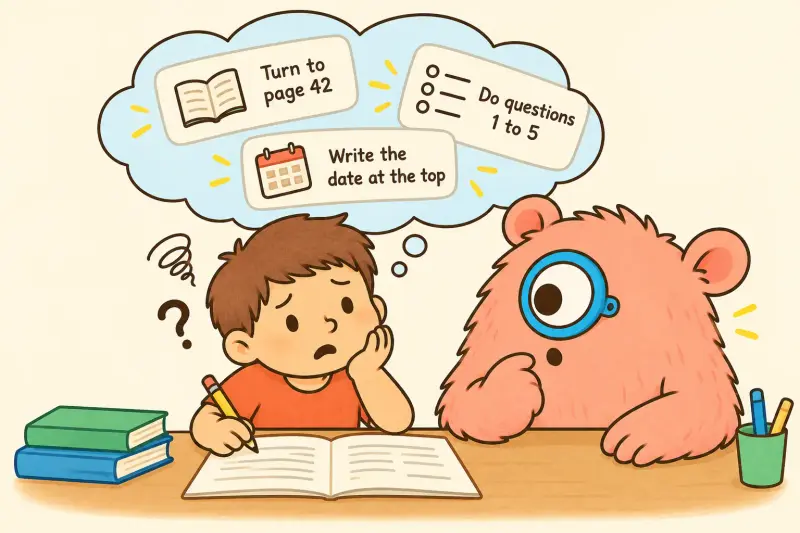
It helps to separate three things that all get called "memory."
Long-term memory is everything stored away: their teacher's name, the words to a song, what happened at their birthday party.
Short-term memory is holding something briefly, exactly as it arrived. Repeating a phone number straight back to you.
Working memory is holding it and doing something to it. Repeating that phone number backwards, or adding up the digits. The information has to stay put while your child works on it, and that's a much harder job than simply keeping it there.
Researchers describe it as the ability to store and manipulate information for brief periods. That second part matters in math, where children often need to remember numbers while using them to work through a problem.
Working memory also comes in two flavours. There's a verbal side, which holds words and numbers - the part your child uses to keep "17 minus 9" in mind while they work it out. And a visual side, which holds pictures and positions, like where they are on a number line or which column they're partway through. Math tends to use both at once, which is part of why it's so demanding.
Two last things worth knowing. Working memory clears quickly, which is why an interruption genuinely loses the information rather than just delaying it. And it's quite separate from having a good memory in the everyday sense. A child who can recall every detail of a film they saw a year ago can still have real working memory difficulties. One tells you very little about the other.
It's smaller than you'd think
You've probably heard that people can hold seven things in mind at once. That number comes from a 1956 paper by George Miller, and it's been repeated ever since. A later review reconsidered the whole question and pointed out that Miller meant it more as a rough estimate and a rhetorical device than as a real capacity limit.
In the same review, psychologist Nelson Cowan argued that the limit is closer to four chunks of information on average, particularly when we can't use memory tricks to remember more.
Four chunks. That's roughly what an adult can hold in mind at once under certain conditions. Children generally have less capacity, and it develops gradually as they grow.
Though "four chunks" needs unpacking, because what counts as one chunk isn't fixed.
A phone number has ten digits, but most adults hold it as three pieces: the area code, then two groups. Three chunks rather than ten. Grouping information like that is what makes it manageable.
The same applies to math, and this is where it becomes useful. For a child who knows straight away that 8 + 7 is 15, that's one thing taking up one slot. For a child who has to count up from 8, it's a whole string of things, and every one of them is sitting on a desk with room for four.
Which is why two children can do the same worksheet and have completely different experiences of it. Not because one is cleverer, but because one of them is spending their whole capacity on the parts the other isn't even thinking about.
Why math is so demanding
Here's something a lot of parents recognize. Your child can tell you exactly how regrouping works. Ask them to explain it and they will. Then they sit down with a page of subtraction and get half of it wrong.
That's not usually a gap in understanding. They just aren't able to hold the information long enough to process that problem.
Think about what a child does when they work out 47 − 19 on paper.
They have to notice that 7 minus 9 won't work. Remember that trading is allowed. Do the trade. Hold onto the fact that the 4 has become a 3 while they work out 17 minus 9. Write the 8. Then come back and finish the tens column, remembering what they changed.
That's four or five things being held and updated, in sequence, in a child whose capacity is smaller than yours. One slip and the answer is wrong, even though they understood every individual step.
Our guide to explaining regrouping in subtraction goes into how to spot which part broke.
The same thing happens with multi-step word problems, mental arithmetic, and anything where a child has to remember the question while working out the answer.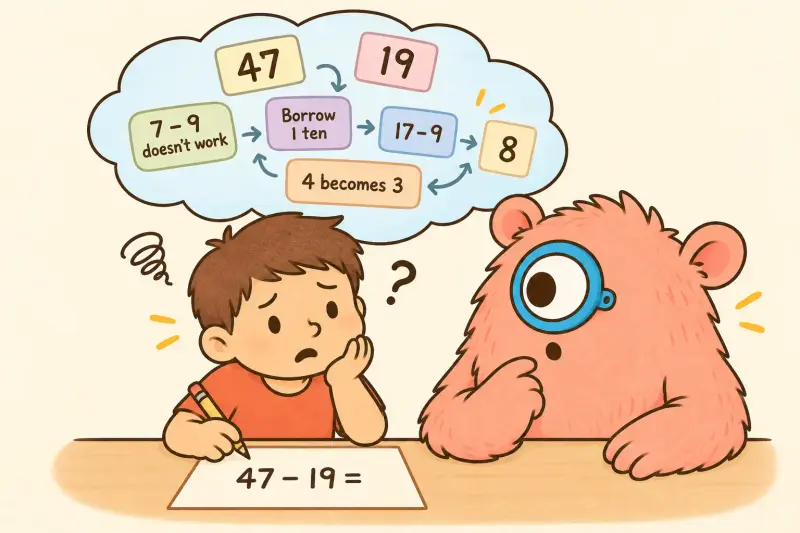
How it differs by child
The pattern isn't the same across conditions.
ADHD gives the clearest picture. In a sample of 172 children aged 8 to 13, 75% to 81% showed impairment in working memory, while their verbal short-term memory was intact. That's exactly the split described earlier: they could hold information perfectly well, but not hold it and work on it at the same time.
Autism shows a broader difficulty. A meta-analysis of 34 studies found lower working memory scores than in typically developing children on both the verbal and the visual side, rather than in just one of them.
Dyscalculia is the least settled of the three. A review of 46 studies covering 8,506 children found working memory implicated, but a sizeable number of those studies found no difference at all.
One thing worth adding about math difficulties specifically. Working memory is rarely the only thing that comes out weak in these children - processing speed and other skills often do too. So it's genuinely hard to tell whether poor working memory causes the math difficulty, results from it, or just tends to show up alongside it.
Can working memory be trained?
If working memory matters this much for math, it's natural to wonder whether you can build it up. So this is worth looking at properly.
The biggest review of this looked at 87 studies. Children who did the training did get better at working memory tasks. But when researchers checked their math, there was no real improvement. Same for reading.
The researchers also found no clear evidence that children who made bigger gains in working memory made bigger gains in math.
So the training makes children better at the training, and not much else.
That's not the same as saying nothing helps. You can't make the holding space bigger, but you can make the math ask less of it. That's what the next section is about, and it's where the real gains are.
What helps instead
If you can't make the jug bigger, pour less into it. That's the whole strategy, and it works.
The researchers behind that developmental disorders study put it directly: supporting a child means breaking down tasks into smaller components, simplifying the information to be remembered, and using long-term memory to assist recall.
In practice, for math:
Let them write things down. Anything on paper is something they no longer have to hold. Scratch space isn't a crutch, it's offloading.
Keep reference material visible. A times table chart or a number line on the desk frees up the capacity that recalling those facts would have used.
Fewer problems on the page. Not less work - less to track at once.
One instruction at a time. "Get your book out, turn to page six and do the first three" is three things. Said separately, it's one thing three times.
Let them re-read. A child who has to remember the word problem while solving it is doing two jobs. One of them is unnecessary.
Our guide to math accommodations for ADHD has more of these, several of which are really working memory supports wearing a different name.
The useful thing to take away
Working memory isn't about how clever your child is, and it isn't fixed by trying harder. It's a capacity limit, it's small in everyone, and it's smaller in some children than others.
What you can change is how much a task asks of it. A child who writes their steps down, keeps their reference charts out and gets one instruction at a time is working with the same capacity as before, but spending far less of it on things that didn't need remembering.
FAQs
What is working memory in simple terms?
It's the ability to hold information in mind while doing something with it. Remembering a phone number is short-term memory; remembering it while adding up the digits is working memory. The modern estimate is that adults can hold about four pieces of information at once, and children fewer.
What's the difference between working memory and short-term memory?
Short-term memory is storage alone. Working memory is storage plus manipulation, which is why a child can have a good memory for films, names and events while still having a significant working memory difficulty. They're different systems.
How does working memory affect math?
Heavily, because so much of math involves holding one result while working out the next. Subtraction with regrouping, multi-step word problems and mental arithmetic all require a child to keep several things in mind at once. A child can understand the method perfectly and still get wrong answers when the holding runs out.
Can working memory be improved with training?
Not in a way that transfers. Studies of working memory training in children find meaningful improvement on tasks resembling the training itself, but little or no effect on academic achievement including math, particularly in better-designed studies with active control groups. Reducing what a task demands works better than trying to expand capacity.
Do children with ADHD have working memory problems?
Often, and with a specific pattern. One study of children with developmental disorders found those with ADHD scored within age-expected levels on short-term memory while showing a pervasive working memory deficit across both verbal and visuospatial domains, with more than half falling in the deficit range.
How can I help a child with poor working memory?
Lower the load rather than trying to raise the capacity. Let them write steps down, keep reference charts visible, give one instruction at a time, reduce the number of problems per page, and let them re-read the question as often as they need.
References
Agostini, F., Zoccolotti, P., & Casagrande, M. (2022). Domain-general cognitive skills in children with mathematical difficulties and dyscalculia: A systematic review of the literature. Brain Sciences, 12(2), 239. https://www.mdpi.com/2076-3425/12/2/239
Alloway, T. P., Rajendran, G., & Archibald, L. M. D. (2009). Working memory in children with developmental disorders. Journal of Learning Disabilities, 42(4), 372–382. https://strathprints.strath.ac.uk/8128/6/strathprints008128.pdf
Cowan, N. (2001). The magical number 4 in short-term memory: A reconsideration of mental storage capacity. Behavioral and Brain Sciences, 24(1), 87–114. https://memory.psych.missouri.edu/assets/doc/articles/2001/cowan-bbs-2001.pdf
Habib, A., Harris, L., Pollick, F., & Melville, C. (2019). A meta-analysis of working memory in individuals with autism spectrum disorders. PLOS ONE, 14(4), e0216198. https://journals.plos.org/plosone/article?id=10.1371/journal.pone.0216198
Kofler, M. J., Singh, L. J., Soto, E. F., Chan, E. S. M., Miller, C. E., Harmon, S. L., & Spiegel, J. A. (2020). Working memory and short-term memory deficits in ADHD: A bifactor modeling approach. Neuropsychology, 34(6), 686–698. https://psy.fsu.edu/clc/Publications/nihms-1596588.pdf
Melby-Lervåg, M., Redick, T. S., & Hulme, C. (2016). Working memory training does not improve performance on measures of intelligence or other measures of "far transfer": Evidence from a meta-analytic review. Perspectives on Psychological Science, 11(4), 512–534. https://discovery.ucl.ac.uk/id/eprint/10120081/1/1745691616635612.pdf