TL;DR: Place value is the idea that a digit's position in a number decides how much it is worth. In 34, the 3 means three tens (30); in 43, the same 3 means three ones. Our number system groups everything in tens — ones, tens, hundreds, thousands — and zero holds empty places open. Children build this understanding gradually between kindergarten and 3rd grade, and research shows it strongly predicts how well they handle multi-digit arithmetic later. This guide explains what place value is, the key terms you'll see on homework, how the skill develops grade by grade, and which mistakes are normal versus worth a closer look.
Looking for hands-on activities? Our step-by-step guide on how to teach place value to a 6-year-old using household items walks you through a five-day routine with straws and rubber bands. This article focuses on the what and why.
What Is Place Value, Exactly?
Place value is the rule that gives each digit a value based on where it sits. Reading from right to left, the places are ones, tens, hundreds, thousands, and so on — and each place is worth ten times the place to its right.
In 34, the 3 is in the tens place (worth 30) and the 4 is in the ones place (worth 4).
In 43, the 3 is worth just 3, and the 4 is worth 40.
Same digits, different numbers - only the position changed. Researchers describe the system the same way: a small set of symbols (0–9) combined with a positional "grammar," so that a written number like 532 stands for 5 hundreds, 3 tens and 2 ones.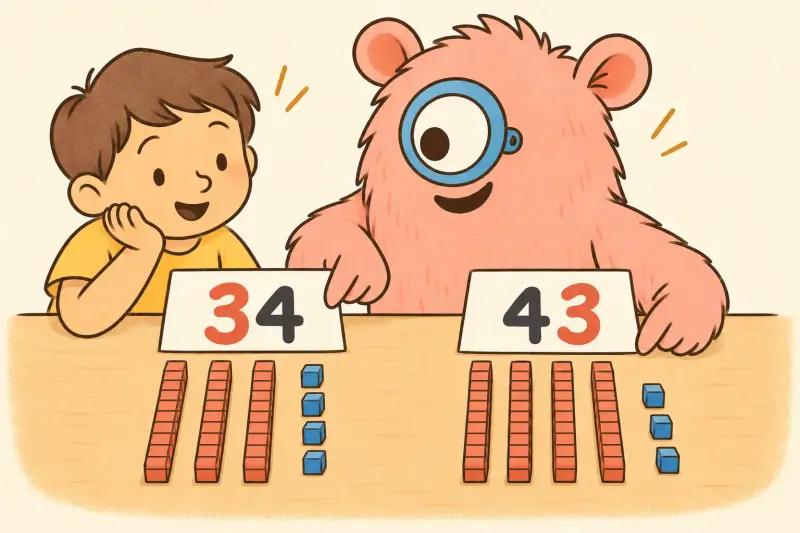
Place Value Words You'll See on Homework
A lot of parent confusion comes from vocabulary rather than the math itself. Here are the terms that show up most in K–3 worksheets.
Place value vs. face value. The face value of a digit is simply the digit itself. The place value is what it's worth in its position. In 572, the 7 has a face value of 7 but a place value of 70.
Expanded form. Writing a number as the sum of its place values: 572 = 500 + 70 + 2. Expanded form makes the hidden structure of a number visible, which is why teachers lean on it so heavily in 1st and 2nd grade.
Standard form. The ordinary way of writing a number: 572.
Unit form. Describing a number by its units: 5 hundreds, 7 tens, 2 ones. You'll often hear this called "saying it the math way."
Regrouping. Trading ten of one unit for one of the next (ten ones for one ten, or the reverse). This is what "carrying" and "borrowing" really are, and it's where place value gets put to work — see our explainer on addition and subtraction with regrouping.
Why Zero Is the Unsung Hero of Place Value
Zero does a special job in our number system: it holds a place open when there's nothing there. Without it, 5, 50, and 500 would look identical.
This is also where many children stumble. A child who reads 105 as "fifteen," or who writes "one hundred five" as 1005, hasn't yet grasped that the 0 is doing work by keeping the tens place empty. Numbers with zeros in the middle (like 105, 307, or 1,040) are some of the most useful ones to practice for exactly this reason.
Why Does Place Value Matter So Much?
Place value sits underneath almost everything in elementary math: comparing numbers, counting on by tens, rounding, lining up columns, and adding or subtracting with regrouping. Without it, multi-digit arithmetic becomes a list of rules with no meaning.
The research is consistent on this point. In a longitudinal study, children's place-value understanding in 1st grade predicted their addition performance in 3rd grade, particularly on problems that required carrying. Another study found that kindergartners' base-ten knowledge predicted their arithmetic accuracy both at the time and two years later. And in a large study of Hong Kong children, the ability to count collections strategically in groups was the strongest of 15 early predictors of math achievement at the end of 2nd grade.
A caveat: these studies show that early place-value understanding predicts later success. That's a strong signal of how foundational the skill is, but it doesn't prove place value alone causes later outcomes - other skills develop alongside it.
How Place Value Develops from Kindergarten to 3rd Grade
Place-value understanding grows in layers, and it starts earlier than most parents expect. Children often have a rough, informal sense of how multi-digit numbers work well before they're formally taught, and researchers have found this approximate knowledge comes first, with precise understanding of the rules following later.
Kindergarten: "Ten and some more"
The main work in kindergarten is counting and number sense, but place value begins with the teen numbers - seeing 14 as "ten and four more." Even preschoolers show partial knowledge: when asked to write "six hundred forty-two," many 4- to 6-year-olds wrote strings like 600402, capturing the parts they heard without yet knowing the compact way to write them.
1st Grade: Tens and ones
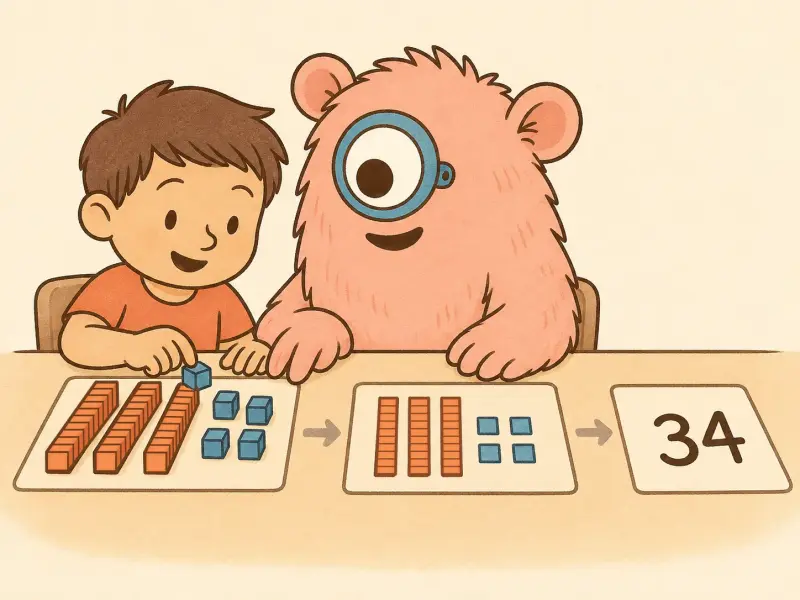
First grade is where place value becomes an explicit topic. Children learn that ten ones can be treated as a single "ten" (a leap called unitizing), and they read, write, and compare numbers up to 100. For a closer look at what this leap involves for a six-year-old, see our household-items guide.
2nd Grade: Hundreds and expanded form
Second graders extend the system to 1,000. They learn that 100 is ten tens, write numbers in expanded form, skip-count by 10s and 100s, and compare three-digit numbers digit by digit. Research with 2nd and 3rd graders shows that place-value understanding explains much of the difference between children in how accurately they write numbers — which is why number-writing errors often point back to place value.
3rd Grade: Using place value as a tool
By 3rd grade, place value becomes something children use rather than something they learn about: rounding to the nearest 10 or 100, adding and subtracting within 1,000 with regrouping, and reasoning about mental math ("47 + 30 is 7 tens and 7 ones"). It also lays the groundwork for decimals in later grades, where the same "ten times" pattern continues to the right of the ones place.
A note on timing: these grade bands describe a typical progression, not a deadline. Children — especially neurodiverse children — move through these ideas at different paces.
Common Place-Value Mistakes (and What They Tell You)
Many place-value errors are signs of understanding under construction. Here's what the most common ones usually mean:
Writing "forty-two" as 402. The child writes each part they hear and joins them together. This is a very common stage, the same pattern researchers saw in young children writing three-digit numbers.
Reading 105 as "fifteen" or writing 1005 for "one hundred five." A signal that the role of zero as a placeholder hasn't clicked yet.
Thinking 29 is bigger than 31 "because 9 is big." The child is comparing the ones digits instead of starting from the largest place.
Struggling with "10 more" or "10 less." If a child counts on ten ones to get from 47 to 57 rather than just changing the tens digit, they're still treating numbers as long counts rather than tens and ones.
Reversing digits (writing 51 for fifteen). Partly a language effect, and much more common in some languages than others — more on that below.
Why Language Makes Place Value Easier or Harder
The number words a child speaks shape how visible place value is. In Chinese, Japanese, and Korean, number names follow the base-ten structure directly, and in a cross-national study, first graders speaking these languages were more likely to represent numbers as tens and ones than peers speaking English, French, or Swedish.
Some languages go further in the other direction. German says 25 as "five-and-twenty," and in a study of German-speaking first graders, around half of their number-writing errors were digit-order reversals. If your family speaks more than one language at home, or your child learns numbers in a language with inverted number words, occasional reversals are especially understandable.
Place Value and Neurodiverse Learners
Place value is abstract, and abstraction is often where children with dyscalculia, ADHD, or other learning differences need more time. Studies of children with math difficulties find that place-value knowledge is one of the areas where they differ most from typically achieving peers, alongside quick recall of number facts. (That study was with Chinese-speaking children, and researchers don't agree on a single "core deficit" behind math difficulties, so treat this as one piece of the picture.)
A few principles help:
Stay concrete longer. A meta-analysis of 55 studies found small-to-moderate benefits from teaching math with physical objects, with results depending on how the materials were used. Our guide to the concrete–representational–abstract (CRA) approach explains how to move from objects to pictures to symbols.
One place at a time. Secure tens and ones before introducing hundreds.
Check the foundations. Place value rests on counting and number sense; if those are shaky, start there.
Signs Your Child May Need Extra Support
Occasional mistakes are normal. It's worth talking to a teacher or specialist if, well past the expected grade, your child consistently:
Can't say what each digit in a two-digit number is worth;
Still writes numbers like 402 for "forty-two" after 1st grade;
Can't find 10 more or 10 less without counting by ones by the end of 2nd grade;
Struggles to line up digits or regroup in 3rd-grade addition and subtraction;
Finds many areas of math hard, not just place value.
Our article on signs your child may have dyscalculia covers what to look for and when to ask for an assessment.
Where Games Fit In
Place value rewards frequent, low-pressure practice, and games are well suited to that. Simple number board games have a strong research record: playing a linear number board game for about an hour improved low-income preschoolers' number knowledge, and the gains were still there nine weeks later. Those studies measured general number understanding rather than place value specifically, but the principle — short, repeated, playful exposure — carries over. Game-based apps built for neurodiverse learners, like Monster Math, aim to offer that kind of repetition with visual models and no penalty for getting it wrong.
Frequently Asked Questions
What is place value in simple terms?
Place value means a digit's worth depends on its position. In 34 the 3 is worth 30; in 43 it's worth 3.
What is the difference between place value and face value?
Face value is the digit itself; place value is what the digit is worth in its position. In 572, the 7 has a face value of 7 and a place value of 70.
What are the ones, tens, and hundreds places?
Reading right to left, the first digit is ones, the second is tens, and the third is hundreds. Each place is worth ten times the one to its right.
What is expanded form in place value?
Expanded form writes a number as the sum of each digit's value: 348 = 300 + 40 + 8. It's a common 1st- and 2nd-grade tool for showing how a number is built.
Why is zero important in place value?
Zero holds a place when there's nothing in it. It's what makes 5, 50, and 500 different numbers. Children often find numbers like 105 or 407 tricky for exactly this reason.
What grade do kids learn place value?
Foundations start in kindergarten with teen numbers, tens and ones are taught in 1st grade, hundreds in 2nd grade, and by 3rd grade children use place value to round and to add and subtract with regrouping.
My child mixes up place value — should I worry about dyscalculia?
Occasional mistakes are normal. Persistent difficulty across many areas of math, well past the expected grade, is worth raising with a teacher or specialist.
Does place value really matter for later math?
Yes. Longitudinal research shows early place-value understanding predicts later arithmetic performance, especially on problems that involve carrying.
The Bottom Line
Place value — the idea that where a digit sits determines what it's worth — is one of the most important things your child learns in early elementary school. Knowing the vocabulary, watching for the telltale mistakes, and giving the concept time to settle will help you support your child through K–3 and beyond.
References
Bower, C. A., Mix, K. S., Yuan, L., & Smith, L. B. (2022). A network analysis of children's emerging place-value concepts. Psychological Science, 33(7), 1112–1127. https://www.colorado.edu/lab/del/media/96
Byrge, L., Smith, L. B., & Mix, K. S. (2014). Beginnings of place value: How preschoolers write three-digit numbers. Child Development, 85(2), 437–443. https://pmc.ncbi.nlm.nih.gov/articles/PMC4445456
Carbonneau, K. J., Marley, S. C., & Selig, J. P. (2013). A meta-analysis of the efficacy of teaching mathematics with concrete manipulatives. Journal of Educational Psychology, 105(2), 380–400. https://doi.org/10.1037/a0031084
Chan, W. W. L., & Ho, C. S.-H. (2010). The cognitive profile of Chinese children with mathematics difficulties. Journal of Experimental Child Psychology, 107(3), 260–279. https://doi.org/10.1016/j.jecp.2010.04.016
Chan, W. W. L., Au, T. K., & Tang, J. (2014). Strategic counting: A novel assessment of place-value understanding. Learning and Instruction, 29, 78–94. https://doi.org/10.1016/j.learninstruc.2013.09.001
Herzog, M., & Fritz, A. (2022). Place value understanding explains individual differences in writing numbers in second and third graders but goes beyond. Frontiers in Education, 6, 642153. https://doi.org/10.3389/feduc.2021.642153
Laski, E. V., Schiffman, J., Shen, C., & Vasilyeva, M. (2016). Kindergartners' base-10 knowledge predicts arithmetic accuracy concurrently and longitudinally. Learning and Individual Differences, 50, 234–239. https://stem.utah.gov/wp-content/uploads/2022/09/Kindergartners-base-10-knowledge-predicts-arithmetic-accuracy.pdf
Miura, I. T., Okamoto, Y., Kim, C. C., Steere, M., & Fayol, M. (1993). First graders' cognitive representation of number and understanding of place value: Cross-national comparisons—France, Japan, Korea, Sweden, and the United States. Journal of Educational Psychology, 85(1), 24–30. https://doi.org/10.1037/0022-0663.85.1.24
Moeller, K., Pixner, S., Zuber, J., Kaufmann, L., & Nuerk, H.-C. (2011). Early place-value understanding as a precursor for later arithmetic performance—A longitudinal study on numerical development. Research in Developmental Disabilities, 32(5), 1837–1851. https://doi.org/10.1016/j.ridd.2011.03.012
Ramani, G. B., & Siegler, R. S. (2008). Promoting broad and stable improvements in low-income children's numerical knowledge through playing number board games. Child Development, 79(2), 375–394. https://doi.org/10.1111/j.1467-8624.2007.01131.x
Siegler, R. S., & Ramani, G. B. (2009). Playing linear number board games—but not circular ones—improves low-income preschoolers' numerical understanding. Journal of Educational Psychology, 101(3), 545–560. https://siegler.tc.columbia.edu/wp-content/uploads/2019/02/sieg-ram09.pdf
Zuber, J., Pixner, S., Moeller, K., & Nuerk, H.-C. (2009). On the language specificity of basic number processing: Transcoding in a language with inversion and its relation to working memory capacity. Journal of Experimental Child Psychology, 102(1), 60–77. https://doi.org/10.1016/j.jecp.2008.04.003