
TL;DR: Number sense is a child's intuitive, flexible understanding of numbers - what quantities mean, how big or small they are, how they relate to one another, and how they change when you add, subtract, or split them. It shows up as skills like instantly "seeing" three dots without counting (subitizing), counting accurately, knowing which number is bigger, and placing numbers on a mental number line. Decades of peer-reviewed research show that strong early number sense is one of the best predictors of later math achievement - and the good news is that everyday games and conversations at home can strengthen it.
What Is Number Sense? A Clear Definition
Number sense is the intuitive understanding of numbers, their magnitudes (how big or small they are), the relationships between them, and how they are affected by operations like adding and subtracting. A child with good number sense doesn't just recite "1, 2, 3" - they feel that 8 is a lot more than 3, that 6 is one less than 7, and that 5 can be split into 4 and 1.
Researchers often describe number sense as having two layers. The first is an innate, approximate sense of quantity that even babies and animals share. In an influential review, cognitive scientists proposed that humans rely on two core systems of number - one for representing large, approximate quantities and one for precisely tracking a few individual objects - that together account for our basic "number sense."
The approximate layer is often called the approximate number system (ANS): a rough, wordless intuition for "more" versus "fewer."
The second layer is symbolic number knowledge — the learned system of counting words and written numerals (1, 2, 3) that children build through experience. Mature number sense is really the bridge between these two: connecting the gut feeling of quantity to the exact symbols we use in school math.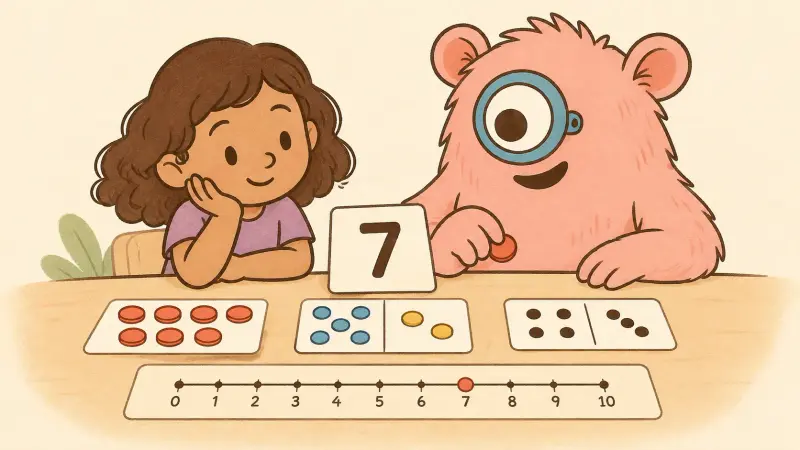
The Building Blocks of Number Sense
Research on early numeracy consistently points to a handful of components that make up number sense in kids. Here are the ones parents will see most in kindergarten through third grade.
Subitizing
Subitizing is instantly recognizing how many items are in a small group — up to about four — without counting. When your child glances at a die and says "four," that's subitizing. It's one of the earliest number skills to appear and is closely tied to later math.
We go deep on this in our guide to what subitizing is.
Counting and cardinality
Counting is more than reciting numbers. True counting means understanding one-to-one correspondence (one number word per object) and cardinality - that the last number you say tells you how many there are in all.
Magnitude comparison
This is knowing which of two numbers is bigger or smaller. Being able to quickly judge that 7 is more than 4 is a reliable early indicator of math development; researchers have identified magnitude comparison as one of the valid markers for spotting kindergartners who may need extra support.
Number relationships and part-whole thinking
Strong number sense includes seeing that numbers are made of other numbers — that 7 is 5 and 2, or 6 and 1. This "part-whole" understanding is the foundation for flexible addition and subtraction, and it's why many schools now teach number bonds before formal arithmetic.
The number line and estimation
Children gradually build a mental "number line" and learn to place numbers on it. As they gain experience, their estimates shift from a squished, logarithmic pattern to an accurate, linear one — a window into their numerical understanding.
Flexible thinking with numbers
Finally, number sense means using numbers flexibly — estimating, spotting patterns, and choosing efficient strategies rather than counting everything one by one.
Why Number Sense Matters: What the Research Says
Here's the headline finding parents should know: early number sense strongly predicts later math achievement.
In a large longitudinal study, researchers found that kindergarten number competence predicted the rate of growth in math achievement all the way through the end of third grade. An earlier study from the same team was even more striking: tracking 277 children, they found that number sense performance in kindergarten, together with its growth, accounted for 66 percent of the variance in first-grade math achievement — and number sense at the start of kindergarten already correlated with end-of-first-grade math at r = 0.70.
The importance of early math reaches beyond math class. A landmark analysis of six longitudinal data sets found that school-entry math skills were the single strongest predictor of later academic achievement, ahead of early reading and attention (average effect sizes of roughly .34 for math, .17 for reading, and .10 for attention). Worth stressing: these are predictive correlations from population studies, not a guarantee about any individual child.
The approximate number system matters too. One study reported that individual differences in this nonverbal number acuity correlate with children's math achievement, and a later study found that preschoolers' ANS precision predicted their school math performance years later. These links are real but modest — a sharp ANS helps, it isn't destiny.
Finally, how accurately children place numbers on a number line is tied to broader math skill. A meta-analysis found that, averaged over 263 effect sizes from 10,576 participants aged 4 to 14, number-line estimation correlated with mathematical competence at r = .443 (95% CI .406–.480) — a medium-strength, remarkably stable relationship.
Number Sense and Neurodiverse Learners
It's worth looking carefully at what research says about number sense across different profiles.
Dyscalculia. The clearest connection is with dyscalculia, a specific math learning difficulty. In a classic study, children with dyscalculia showed impaired performance on basic number-processing tasks despite high-average IQ, vocabulary, and working memory — pointing to a core weakness in number sense itself. If persistent math struggles worry you, our parent's guide to dyscalculia explains the signs in more detail.
ADHD. Children with ADHD often struggle with math, but the reasons appear more tied to attention and working memory than to a broken number sense. One study found no clear evidence that math difficulties in children with ADHD originate from an impaired visual number sense, suggesting the underlying numerosity system may be largely intact.
Autism. The picture for autistic children is genuinely mixed, so be wary of sweeping claims in either direction. A study of 4- and 5-year-olds with autism spectrum disorder found largely similar early numerical competencies compared with peers, with only marginal weaknesses in subitizing and counting. By contrast, a study of older, cognitively able autistic children found they performed worse on number-estimation tasks and directly challenged "the widespread belief that mathematical skills are generally enhanced in autism." Both studies stress that autistic children vary widely, and neither supports a one-size-fits-all rule — number sense should be assessed individually.
(For apps that could help kids with autism, see our roundup of the best math apps for autistic kids.)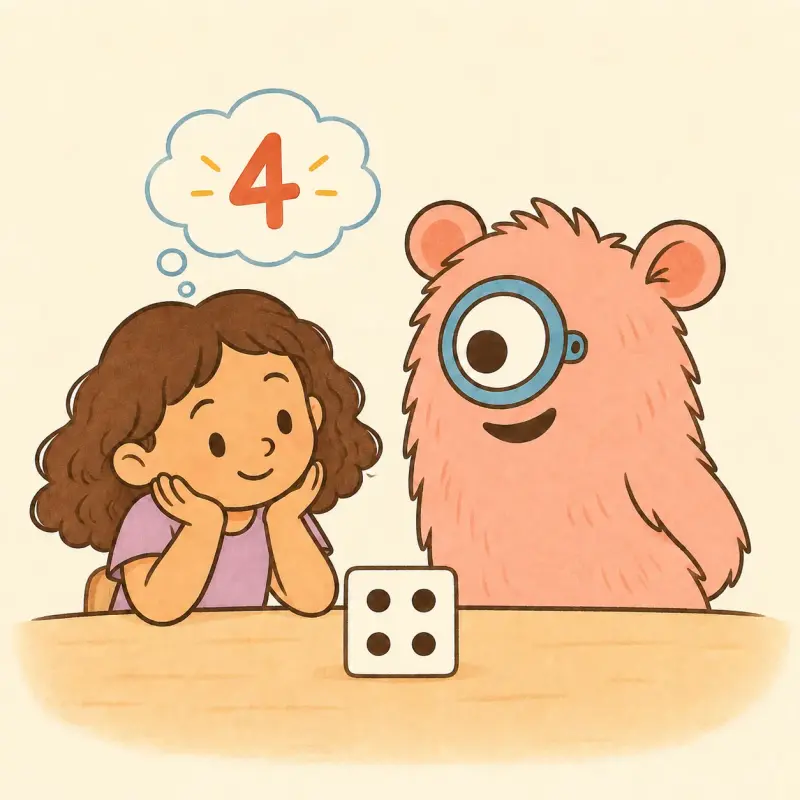
How to Build Number Sense at Home
You don't need flashcards or worksheets. Some of the most effective, research-backed ways to build number sense look a lot like play.
1. Play linear number board games
This is one of the best-supported activities. In experimental studies, having preschoolers play a simple linear (left-to-right) number board game — think Chutes and Ladders with numbered squares — improved their magnitude comparison, number-line estimation, counting, and numeral identification, with gains that held up weeks later. Notably, a linear board worked better than a circular one, because it maps directly onto the mental number line.
2. Practice subitizing with dots, dice, and fingers
Flash small groups of dots, fingers, or dominoes and ask "how many?" before your child can count. This trains the instant recognition at the heart of number sense. Our subitizing guide has seven quick activities you can try tonight.
3. Talk numbers in everyday routines
"Number talk" matters. In a study following families over about 7.5 hours of recorded interaction, parents used anywhere from 4 to 257 number words, and that variation predicted children's later number knowledge even after controlling for overall talk and socioeconomic status — with talk about larger sets (4–10 objects) being especially valuable. Count the stairs, compare quantities at snack time, and ask "how many more do we need?"
4. Play estimation and comparison games
Ask "Which pile has more?" or "About how many grapes are in the bowl?" Estimation exercises the approximate number system and strengthens the mental number line.
5. Use number lines and games that reward flexible thinking
Games that reward mental math and flexible number strategies — including well-designed math games and apps — can make practice feel like play. For screen-free ideas, see our guide to gamifying math at home.
A note on game-based learning: a meta-analysis of 24 studies found that math video games produced a small, marginally significant improvement over traditional instruction (d = 0.13), with effect sizes varying widely in both size and direction. In other words, good games are a helpful supplement - not a magic bullet - and quality and how they're used both matter.
Signs Your Child May Be Struggling With Number Sense
Every child develops at their own pace, and occasional mistakes are normal. But it's worth paying closer attention if, well past the typical age, your child consistently:
Counts every item one by one and can't instantly recognize small groups of 2–4 dots
Struggles to say which of two small numbers is bigger
Has trouble connecting the numeral "4" to four objects
Relies on finger-counting for simple facts like 5 + 3 into second or third grade
Seems confused about where numbers fall on a number line
These are possible signs worth watching — not a diagnosis. If the patterns persist across months despite support, it's reasonable to talk with your child's teacher, and, if concerns continue, to ask about an evaluation by a school psychologist or learning specialist. Early support helps.
Where Monster Math Fits In
Monster Math is a game-based math app designed for K–3 learners, including neurodiverse kids, that turns practice with counting, comparing, and number relationships into play. Think of it as one tool among many — the everyday games and number talk above are just as important, and cost nothing.
FAQs About Number Sense
What is number sense in simple terms?
Number sense is a child's intuitive feel for numbers: understanding how big quantities are, how numbers relate to each other, and how they change when you add or take away. It's the "common sense" of math that everything else builds on.
At what age does number sense develop?
The roots of number sense appear in infancy as an approximate sense of quantity. Symbolic number sense - counting, comparing, and subitizing with numerals - develops rapidly between ages 3 and 7, which is why kindergarten through grade 3 is such a critical window.
What is the difference between number sense and counting?
Counting is one component of number sense. A child can recite numbers without truly understanding them. Number sense is the deeper, flexible understanding of what those numbers mean and how they relate to one another.
Can number sense be taught, or is it innate?
Both. The approximate "gut feeling" for quantity is partly innate, but the rich, symbolic number sense that supports school math is largely learned - and can be strengthened through games, number talk, and practice.
How can I tell if my child has poor number sense?
Watch for persistent difficulty recognizing small quantities without counting, comparing which number is bigger, or connecting numerals to amounts, well past when peers have mastered them. Ongoing struggles are worth discussing with a teacher or specialist.
What is subitizing and why does it matter?
Subitizing is instantly recognizing a small quantity (up to about four) without counting. It's one of the earliest and most important building blocks of number sense and predicts later math success.
References
Feigenson, L., Dehaene, S., & Spelke, E. (2004). Core systems of number. Trends in Cognitive Sciences, 8(7), 307–314. https://www.harvardlds.org/wp-content/uploads/2017/01/feigenson2004-1.pdf
Jordan, N. C., Kaplan, D., Ramineni, C., & Locuniak, M. N. (2009). Early math matters: Kindergarten number competence and later mathematics outcomes. Developmental Psychology, 45(3), 850–867. https://pmc.ncbi.nlm.nih.gov/articles/PMC2782699/
Jordan, N. C., Kaplan, D., Locuniak, M. N., & Ramineni, C. (2007). Predicting first-grade math achievement from developmental number sense trajectories. Learning Disabilities Research & Practice, 22(1), 36–46. https://www1.udel.edu/cmp2/jordan_LDRP2007.pdf
Duncan, G. J., Dowsett, C. J., Claessens, A., Magnuson, K., Huston, A. C., Klebanov, P., … Japel, C. (2007). School readiness and later achievement. Developmental Psychology, 43(6), 1428–1446. https://www.apa.org/pubs/journals/releases/dev-4361428.pdf
Gersten, R., Jordan, N. C., & Flojo, J. R. (2005). Early identification and interventions for students with mathematics difficulties. Journal of Learning Disabilities, 38(4), 293–304. https://doi.org/10.1177/00222194050380040301
Halberda, J., Mazzocco, M. M. M., & Feigenson, L. (2008). Individual differences in non-verbal number acuity correlate with maths achievement. Nature, 455(7213), 665–668. https://doi.org/10.1038/nature07246
Mazzocco, M. M. M., Feigenson, L., & Halberda, J. (2011). Preschoolers' precision of the approximate number system predicts later school mathematics performance. PLoS ONE, 6(9), e23749. https://journals.plos.org/plosone/article?id=10.1371/journal.pone.0023749
Schneider, M., Merz, S., Stricker, J., De Smedt, B., Torbeyns, J., Verschaffel, L., & Luwel, K. (2018). Associations of number line estimation with mathematical competence: A meta-analysis. Child Development, 89(5), 1467–1484. https://siegler.tc.columbia.edu/wp-content/uploads/2019/12/4027Reading-Schneider-etal-2018.pdf
Siegler, R. S., & Booth, J. L. (2004). Development of numerical estimation in young children. Child Development, 75(2), 428–444. http://www.cs.cmu.edu/afs/cs/Web/People/jlbooth/sieglerbooth-cd04.pdf
Siegler, R. S., & Ramani, G. B. (2009). Playing linear number board games — but not circular ones — improves low-income preschoolers' numerical understanding. Journal of Educational Psychology, 101(3), 545–560. https://siegler.tc.columbia.edu/wp-content/uploads/2019/02/sieg-ram09.pdf
Landerl, K., Bevan, A., & Butterworth, B. (2004). Developmental dyscalculia and basic numerical capacities: A study of 8–9-year-old students. Cognition, 93(2), 99–125. https://doi.org/10.1016/j.cognition.2003.11.004
Levine, S. C., Suriyakham, L. W., Rowe, M. L., Huttenlocher, J., & Gunderson, E. A. (2010). What counts in the development of young children's number knowledge? Developmental Psychology, 46(5), 1309–1319. https://www.salzburgglobal.org/fileadmin/userupload/Documents/2010-2019/2015/Session558/Levineetal2010WhatCountsintheDevelopmentofYoungChildrens.pdf
Gunderson, E. A., & Levine, S. C. (2011). Some types of parent number talk count more than others: Relations between parents' input and children's cardinal-number knowledge. Developmental Science, 14(5), 1021–1032. https://pmc.ncbi.nlm.nih.gov/articles/PMC3177161
Tokac, U., Novak, E., & Thompson, C. G. (2019). Effects of game-based learning on students' mathematics achievement: A meta-analysis. Journal of Computer Assisted Learning, 35(3), 407–420. https://doi.org/10.1111/jcal.12347
Titeca, D., Roeyers, H., & Desoete, A. (2017). Early numerical competencies in 4- and 5-year-old children with autism spectrum disorder. Focus on Autism and Other Developmental Disabilities, 32(4), 279–292. https://biblio.ugent.be/publication/5855817
Aagten-Murphy, D., Attucci, C., Daniel, N., Klaric, E., Burr, D., & Pellicano, E. (2015). Numerical estimation in children with autism. Autism Research, 8(6), 668–681. https://www.pisavisionlab.org/wp-content/uploads/2019/12/2015_numericalEstimationInChildren.pdf