TL;DR: Executive function is the set of mental skills you use when you can't just run on autopilot. There are three core parts: holding information in mind, stopping yourself doing the obvious thing, and switching between rules. Subjects like math lean on all three at once, which is often what makes the difficulty visible.
Most parents meet the phrase "Executive Function" in an assessment report, or from a teacher trying to explain why a perfectly capable child keeps not finishing their work. It tends to land as jargon for "being organized," which is a shame, because the real thing is both more specific and more useful than that.
It's also the idea underneath a lot of what gets labelled as laziness, carelessness or not trying hard enough. So it's worth understanding properly.
What executive function actually means
The definition researchers keep coming back to is Adele Diamond's, and it's more specific than you'd expect. Executive functions, she writes, are -
Note that last part. You don't need executive function to walk to the kitchen, or recite the alphabet, or answer "what's two plus two" if your child has known it since they were five. Those things run by themselves. You need it in the moment when the easy, automatic answer happens to be the wrong one, and something has to step in and stop it before it comes out.
Which is also why it wears out. Diamond is quite blunt about this:
If you've ever watched your child sail through the first few problems on a page and then struggle somewhere around the fourth, executive function demands may be part of the explanation. Keeping information in mind, resisting distractions, and checking each step takes effort. As a task continues, fatigue or competing demands can make those skills harder to use consistently.
The three parts it's made of
There's broad agreement among researchers about what executive function is built from. Diamond's review puts it plainly:
Working memory is the ability to hold information in your head while you're doing something with it. Not just storing it, but keeping it available while you work. When a child is doing 47 minus 19, they have to remember that the 4 became a 3 while they're busy working out 17 minus 9, and then come back and use that.
Our guide to what working memory is and how it affects math goes through this one in proper detail, because it's the component that causes the most trouble in math specifically.
Inhibition is the ability to not do the first thing that springs to mind. In math, that's the child who sees two numbers on the page and adds them, because adding is what you usually do with two numbers, before anyone has read what the question was actually asking for. It's also what's behind reading a problem all the way to the end instead of starting to solve it halfway through. It covers attention as well as behavior, so the same skill is doing double duty: it's what lets a child tune out the conversation happening in the next room, and it's what lets them sit on an answer they feel certain about long enough to check it.
Cognitive flexibility is the ability to change track. A worksheet that goes from addition to subtraction halfway down is asking for exactly this, and a child who's short on it will carry the old rule across and keep adding without noticing. It's also what lets them abandon an approach that isn't working and try a different one, rather than doing the same thing more slowly and more carefully until everyone is upset.
One thing worth noticing in that list. Planning and problem solving aren't on it. They're built on top of the three, which is why a child can look disorganized or scattered when what's actually going on is one layer further down, in a component nobody's thought to look at.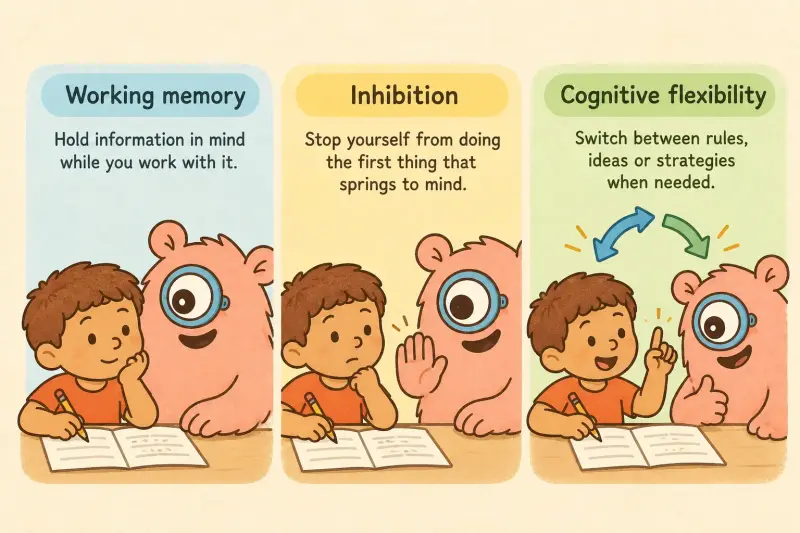
The three don't work separately
Listing them as three things is slightly misleading. In practice they lean on each other constantly, which is why a child often turns out to have trouble with more than one of them.
Diamond describes the dependency running in both directions. Working memory supports inhibitory control, because you have to hold your goal in mind in order to know what's relevant and what needs stopping. A child who has lost track of what the question was asking can't inhibit the wrong answer, for the simple reason that they no longer have anything to measure it against.
And it runs back the other way too. Inhibitory control supports working memory, because keeping your mind on what you want to focus on means holding off distractions, both the ones in the room and the ones in your head. The example Diamond gives is one most adults recognize instantly: that moment when you reach the bottom of a page and realize you've taken in none of it. Your eyes carried on. Your attention went somewhere else, and nothing stuck.
This is worth knowing when you're reading an assessment. If a report flags one component, it's rarely the only thing involved, and the piece that scores lowest on a test isn't always where the trouble actually starts. A child who can't hold onto instructions might have a working memory difficulty. They might equally be losing those instructions to a distraction they couldn't shut out.
Why it matters so much for math
Math has a habit of asking for all three at once, which is often what makes an executive function difficulty visible. A single multi-step problem wants you to hold numbers in mind, resist the operation that looks obvious, and switch rules partway through.
The research backs that up across a large body of evidence. Pooling 305 studies covering 64,167 elementary-school children, researchers found that the relationships with math stayed significant throughout elementary school with working memory showing a consistently moderate association with math, reading and oral language.
For math in particular, the same researchers found very little change in how executive function related to math skills across the elementary years. This isn't a window that slams shut at seven. Executive function keeps mattering for math right through the elementary years, not only in the earliest grades.
What it looks like when it's hard
Executive function difficulties aren't a diagnosis in themselves. They turn up across a number of different diagnoses, and they don't look quite the same in each one.
In a study of 172 children aged eight to thirteen, 81 of whom had ADHD, researchers estimated that 75% to 81% of the children with ADHD had working memory impairments, while their verbal short-term memory was largely intact. These children could hold onto spoken information perfectly well. What they struggled with was holding it while simultaneously doing something to it, which is the harder job and the one math constantly asks for.
At the kitchen table this tends to look like a child who can explain the method back to you correctly and still gets the answers wrong. Or one who does the first problem carefully and the sixth one apparently at random. Or who sits in front of a worksheet they're entirely capable of doing and cannot seem to begin.
It's very easy to read all of that as a motivation problem, partly because it looks exactly like one from the outside. But treating it that way tends to make things worse, because you end up applying pressure to a child who is already working harder than their classmates to produce less.
What actually helps
Most of what helps runs on the same principle: take the load off the child's head and put it somewhere outside it. If executive function is limited and effortful, then the useful move is arranging things so that less of it is needed. These are common classroom and home strategies rather than tested interventions, but they follow from how executive function works.
Get it onto paper. Anything written down is something your child no longer has to hold. Working shown step by step, formulas jotted in the margin before they start, the question underlined. This isn't a crutch and it isn't cheating - getting it out of their head and onto the page leaves room for the thinking itself.
Shrink what's visible. Twenty problems on a page isn't just twenty problems of work, it's twenty problems' worth of decisions about where to start and how much is left. Covering everything but the next two changes how hard the page feels without changing the work in it at all.
Put the steps outside the child. A short checklist taped to the desk does the job that internal self-monitoring can't do reliably yet. Circle the numbers and the sign, show the working, check the answer makes sense. Three steps they can see beats three steps they're supposed to remember.
Expect the later problems to be harder than the earlier ones. Using executive function takes effort, and sustaining that effort across a long task is harder than bringing it to a short one. Which means how your child does at the end of a worksheet may tell you less about what they can do than how they did at the start. Shorter sessions and planned breaks tend to suit children who find this difficult.
If you want the specific versions of these, broken down by which component is giving trouble, our post on executive function routines that help ADHD kids finish math problems goes through them one at a time.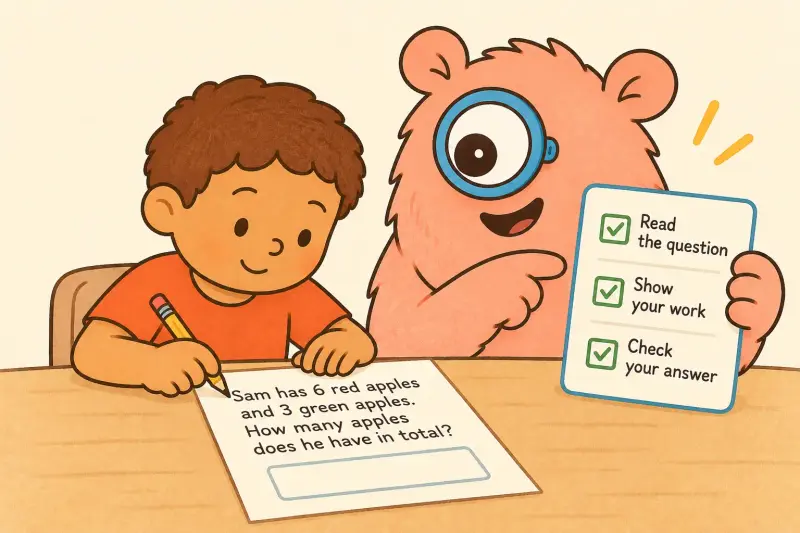
A more useful way to think about it
The most useful shift here is to stop treating executive function as something about your child's character and start treating it as a skill with a cost attached. It's what lets them override autopilot in the moments when autopilot would get things wrong. And in a child, the whole system is still years from finished.
That changes what you ask when something goes wrong. Your child was almost certainly trying. The more useful thing to work out is which of the three was being demanded at that moment, and how much had already been asked of them before they got there.
FAQs
What are the three executive functions?
Inhibition, which is stopping an automatic response; working memory, which is holding information in mind while using it; and cognitive flexibility, which is switching between rules or approaches. Higher-order abilities like planning, reasoning and problem solving are built on top of these three rather than sitting alongside them, which is why difficulties with planning often trace back to one of the core three.
Is executive dysfunction the same thing as ADHD?
No. Executive function difficulties are common in ADHD, but they also appear in autism, in learning disabilities, and in children with no diagnosis at all. ADHD is a diagnosis with specific criteria; executive function is a set of skills that can be weak for a number of different reasons.
How does executive function affect math?
Math asks for all three components at once, often within a single problem: holding numbers in mind while manipulating them, resisting the operation that looks obvious, and switching between rules. A meta-analysis of 305 studies covering more than 64,000 elementary children found executive function related to math achievement throughout the elementary years, with working memory showing the most consistent association of the three.
Can executive function be improved?
Executive function develops naturally through childhood and adolescence, and practical supports can help children manage tasks that place heavy demands on it. Training programs that try to expand working-memory capacity have a weaker record: a meta-analysis covering 87 publications found that working-memory training improved performance on similar memory tasks but showed no convincing transfer to arithmetic or reading. For everyday learning, a useful approach is to reduce the mental load of a task rather than relying on memory training to improve academic performance.
Why can my child focus on video games but not on math homework?
Because the two are structured very differently. A game keeps the goal visible, tells you immediately whether what you just did worked, and holds the state of play for you, so your child never has to carry it around in their head. Homework asks them to set their own steps, remember the instructions, and keep going with no feedback at all until someone marks it.
That isn't to say games are undemanding. Plenty require serious planning, memory and flexible thinking. The difference is how much support the activity gives those skills from outside, and how motivating it feels to keep going when it gets hard.
At what age does executive function develop?
Later than most people assume. These skills continue developing through childhood and adolescence, so a seven-year-old who can't yet plan a multi-step task independently is not unusual. Research on elementary-age children found the relationship between executive function and math skills stayed fairly stable across those years rather than peaking early, which means it's worth continuing to support rather than treating as a stage your child should have passed.
References
Diamond, A. (2013). Executive functions. Annual Review of Psychology, 64, 135–168. https://www.devcogneuro.com/Publications/ExecutiveFunctions2013.pdf
Spiegel, J. A., Goodrich, J. M., Morris, B. M., Osborne, C. M., & Lonigan, C. J. (2021). Relations between executive functions and academic outcomes in elementary school children: A meta-analysis. Psychological Bulletin, 147(4), 329–351. https://pmc.ncbi.nlm.nih.gov/articles/PMC8238326/
Kofler, M. J., Singh, L. J., Soto, E. F., Chan, E. S. M., Miller, C. E., Harmon, S. L., & Spiegel, J. A. (2020). Working memory and short-term memory deficits in ADHD: A bifactor modeling approach. Neuropsychology, 34(6), 686–698. https://psy.fsu.edu/clc/Publications/nihms-1596588.pdf
Melby-Lervåg, M., Redick, T. S., & Hulme, C. (2016). Working memory training does not improve performance on measures of intelligence or other measures of "far transfer": Evidence from a meta-analytic review. Perspectives on Psychological Science, 11(4), 512–534. https://pmc.ncbi.nlm.nih.gov/articles/PMC4968033/