
TL;DR
Counting on is an addition strategy where a child starts from one number and counts up the rest: for 5 + 3, they say "5… 6, 7, 8" instead of counting "1, 2, 3, 4, 5, 6, 7, 8."
Research shows children usually make this shift in kindergarten to first grade, but they mix old and new strategies for months. Counting from 1 sometimes, even in first grade, is normal.
Finger counting is a healthy stepping stone, not a bad habit, for 5- to 7-year-olds.
You can build counting on at home in 10 minutes a day with board games, dice and number lines, especially if you have your child count from the space they're on rather than from 1.
If your child is still counting everything from 1 by the end of first grade, despite regular practice, it's worth a calm conversation with their teacher.
Most children move from counting from 1 ("counting all") to counting on somewhere between the end of kindergarten and the middle of first grade, and it is completely normal for a 6-year-old to still count from 1 some of the time. What matters is not the exact date, but whether your child is gradually reaching for faster strategies as the year goes on.
What is counting on?
Counting on is an addition strategy in which a child holds the first number in their head and counts forward from it to find the total. For 6 + 3, a child who counts on says "six… seven, eight, nine," often tapping or raising three fingers to keep track.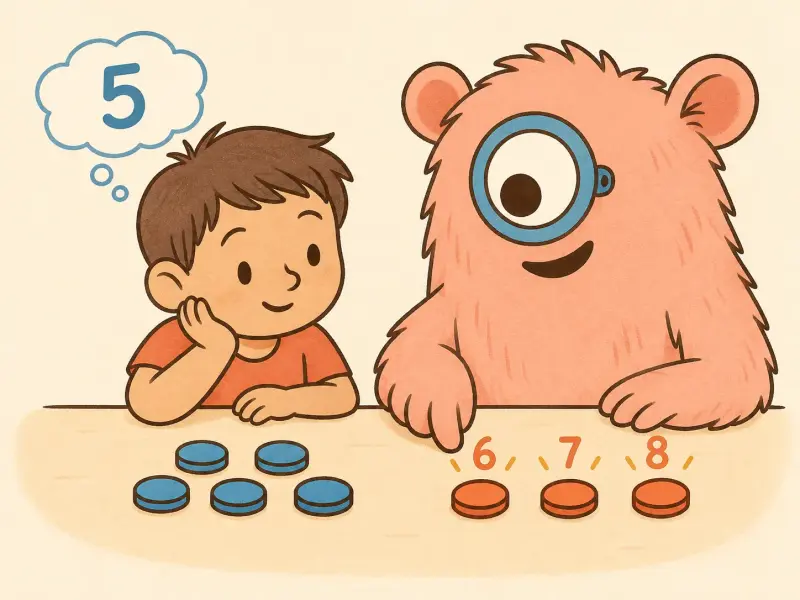
Counting all is the earlier strategy in which a child counts every object from 1, including the ones they've already counted. For 6 + 3, they'd count out six fingers, then three more, then count all of them: "1, 2, 3, 4, 5, 6, 7, 8, 9."
Both get the right answer. But counting on is faster, makes fewer errors with bigger numbers, and shows something important about your child's thinking: they trust that "6" already means six things, so they don't need to count them again.
Counting all vs counting on: the stages of first grade addition strategies
Researchers have studied how children learn to add for more than 40 years. In a classic three-year study that followed 88 children from grade 1 to grade 3, children solved addition problems with their own modelling and counting strategies, which were gradually replaced by more sophisticated counting strategies, often before they had been formally taught them.
Here's the typical progression, from earliest to most efficient:
One of the most useful findings for parents comes from psychologist Robert Siegler. When he asked young children how they solved each problem, he found that most children reported using at least three different approaches rather than one strategy all the time. This idea, often called "overlapping waves," means your child won't flip a switch from counting all to counting on. Older and newer strategies overlap for a while, and children tend to fall back on the older, safer one when a problem feels hard or when they're tired.
Stages 4 and 5 matter too. A study of 139 Austrian first graders found that children who used derived-fact strategies on a problem by mid–first grade were more likely to simply know that fact by the end of the year than children who were still counting on. In other words, counting on is a bridge to fact fluency, not the final destination.
(You can read this in detail in Math Fact Fluency: But What Exactly Is It?)
When should my child stop counting from 1?
There's no single birthday, but research gives us a reasonable window:
Important caveat: These are rough patterns from research groups, mostly middle-income children in the US and Europe. Individual children vary a lot. Language, schooling, how much number play a child has had, attention and learning differences all affect timing. Treat this table as a guide to the general direction, not a checklist your child must hit by a certain date.
For the wider picture, see our 1st Grade Math Milestones: A Parent's Checklist.
Some of the most relevant timing evidence:
A study of 136 children aged 3½ to 6 found that although many children can count sets by age 4, it is not until about 5½–6 years that they understand that adding 1 to a set means counting up one number. That "next number" understanding is a key ingredient of counting on, so it makes sense that counting on tends to click around the start of first grade.
In a classic study of 73 first graders, 28 children already counted on while 45 still counted all, which shows how normal it is for a single first-grade class to contain both.
Why does my child count from 1 every time?
If your child counts from 1 every time, it's usually not stubbornness. Counting on depends on several smaller skills that have to come together. The same study of first graders identified three subskills behind counting on:
Counting up from any number. Can your child start at 7 and say "8, 9, 10" without going back to 1?
Seeing the first number as both a total and a starting point. Understanding that "5" means a group of five things and is the place to start counting.
Starting the second count at the next number. Saying "6, 7, 8" for 5 + 3, rather than "5, 6, 7" (a very common mix-up).
The researchers found these skills built up in a predictable order. Most of the children who counted all were missing one or more of them. Encouragingly, 7 of 8 first graders who were taught the missing subskills in a single short session began counting on, compared with 1 of 8 who weren't taught (a small study, but a promising one).
Underneath all of this is cardinality: the understanding that the last number you say when counting tells you how many there are. A child who isn't yet sure that "5" is the whole group will feel they need to recount it. That's exactly why counting from 1 feels safer to them.
Is it normal for a 6-year-old to count on fingers?
Yes. Finger counting is normal, and helpful, for 5- to 7-year-olds.
A US study following children from kindergarten through second grade concluded that finger use is most adaptive when children are first learning number combinations, but this benefit lessens over time. Children's accuracy rose steadily while their finger use naturally declined.
A 2025 study from the University of Lausanne followed 192 children from age 4½ to 7½ across seven testing points. It found that virtually all children used their fingers at some point, and most children who no longer used their fingers by age 6½ were in fact ex-finger users, who showed higher arithmetic performance than both current finger users and children who had never used their fingers. The authors describe finger counting as "a developmental scaffold toward efficient mental arithmetic."
So rather than banning fingers, help your child use them more cleverly. Moving from raising all the fingers for both numbers (counting all) to holding one number in their head and raising fingers only for the second (counting on) is real progress.
For more on moving from concrete counting to mental math, see Bridging the Gap: Helping Neurodivergent Learners Transition from Counting to Abstract Math.
How to teach counting on at home: play-based activities
Some of the best evidence for building counting on comes from a surprisingly simple source: board games.
In Siegler and Ramani's 2008 study, preschoolers from low-income families played a simple 1–10 linear number board game for just four 15-minute sessions, and the game eliminated the differences in numerical estimation between them and their more advantaged peers. Playing the same game with colours instead of numbers did not have this effect.
In a follow-up study, the benefits of playing the number game were broad and, as Laski and Siegler later summarised, "endured for at least 2 months", covering counting, numeral identification and comparing numbers. Laski and Siegler also note that the game has helped children from middle-income as well as low-income families.
The key ingredient appears to be how children count. When kindergartners playing a 0–100 board game counted on from the number of the space they were on, their number line estimates, numeral identification and count-on skill improved, while counting from 1 "led to considerably less learning", according to Laski and Siegler (2014).
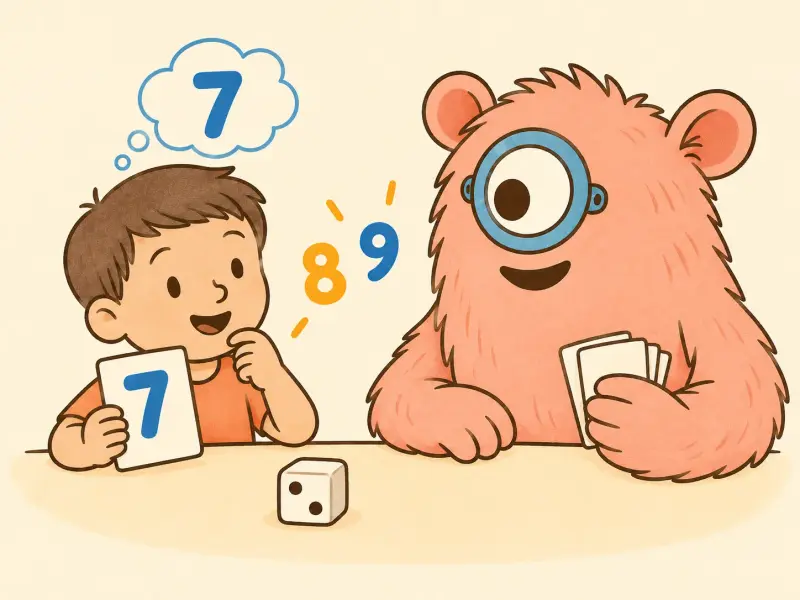
That last finding gives parents a powerful, free tip. When your child rolls a 3 while on space 5, have them say "6, 7, 8," not "1, 2, 3."
At-home counting on games
Tips that make these work:
Keep it short and playful. Several 5–10 minute sessions a week beat one long one.
Model it out loud. "Hmm, I'll put 7 in my head… 8, 9, 10!" Children copy what they hear.
Don't take the fingers away. Encourage your child to raise fingers only for the second number.
Praise the strategy, not just the answer. "I love how you started at 5 instead of 1!"
Looking for more ideas? Our list of 12 Math Games for 1st Grade Kids Who Hate Worksheets has plenty of low-prep options, and What Is Number Sense? A K-3 Parents' Guide explains the wider foundations that counting on builds on.
When should I talk to my child's teacher?
Most children who still count from 1 in early first grade are simply on their way. Consider a friendly, low-key chat with the teacher if, by the second half of first grade and despite regular practice, your child:
still counts every addition problem from 1, even small ones like 2 + 1;
can't say what number comes after a given number (e.g. "after 8?") without starting again from 1;
often loses track when counting small sets, or can't tell which of two numbers is bigger without counting both;
shows little change over several months, or is becoming anxious or upset about math.
Research on children with mathematical learning disabilities shows why early, patient support matters. In one study of first, third and fifth graders, children with a math learning disability used finger counting more often and made more counting errors than their peers, and the authors linked this to working memory and gaps in counting knowledge. A widely cited review estimates that between 5% and 8% of school-age children have memory or cognitive differences that interfere with learning math. Typically developing children tend to shift from heavy finger counting toward verbal counting and recall between first and second grade, while children with math learning disabilities often keep relying on finger counting for longer.
A note for families of neurodivergent learners: Children with ADHD, autism, dyslexia, dyscalculia or working memory differences often take a longer, less direct path through these stages. Slower doesn't mean stuck. Targeted practice can help. In one kindergarten number sense intervention for children at risk of math difficulties, the share of children observed counting on rose from 5% at pretest to 27% at delayed post-test, compared with 11% to 14% in the control group.
If you're wondering whether something more is going on, our guide to Dyscalculia vs Math Anxiety can help you understand the difference. Only a qualified professional can diagnose a learning difference though.
How Monster Math can help
Counting on clicks through lots of short, low-pressure practice: counting up from different starting numbers, seeing quantities, and gradually reaching for faster strategies. That's hard to keep fun with worksheets alone.
Monster Math is a game-based math app for K–3 learners, designed with neurodiverse children in mind. It turns this kind of practice into short, playful game sessions your child can do at home, at their own pace, without the pressure of a classroom timer. If your first grader is ready to move beyond counting from 1 for addition, try Monster Math free and see how they get on.
FAQs
What is the counting on strategy in math?
Counting on is an addition strategy where a child starts with one number and counts forward to find the total. For example, for 4 + 3, they say "4… 5, 6, 7" instead of counting every object from 1.
What's the difference between counting all and counting on?
Counting all means counting every item from 1, including both groups. Counting on means starting from the first (or larger) number and counting only the second group. Counting on is faster and shows that a child understands what a number stands for.
At what age do children learn to count on?
Most children begin counting on between about 5½ and 7, typically during kindergarten or first grade. Many use a mix of counting all and counting on for several months before counting on becomes their usual strategy.
Is it bad if my 6-year-old counts on their fingers?
No. Research suggests finger counting supports early addition, and a 2025 study of 192 children found that most children who had stopped using their fingers by age 6½ were ex-finger users with higher arithmetic performance than their peers. Encourage smarter finger use, like raising fingers only for the second number, rather than banning fingers.
My child counts from 1 every time. Should I worry?
Usually not, especially in kindergarten or early first grade. Counting from 1 often means your child hasn't yet fully connected that the last number counted is the total, or isn't confident counting up from any number. Short, playful practice usually helps. If nothing has changed by late first grade despite regular practice, talk to the teacher.
What is the min strategy in addition?
The min strategy means counting on from the larger number. For 2 + 7, a child starts at 7 and counts "8, 9." It's called "min" because it uses the minimum number of counts.
How can I teach counting on at home?
Play straight-path board games and have your child count on from the square they're on. Hide the first group of objects under a cup so they can't recount it. Practise "start at 6 and count to 10" games in the car or at bedtime.
What comes after counting on?
After counting on, children start using facts they know to work out new ones (for example, using 5 + 5 = 10 to solve 5 + 6) and eventually recall facts from memory. This is the path toward math fact fluency.
References
Carpenter, T. P., & Moser, J. M. (1984). The acquisition of addition and subtraction concepts in grades one through three. Journal for Research in Mathematics Education, 15(3), 179–202. https://doi.org/10.2307/748348
Dyson, N. I., Jordan, N. C., & Glutting, J. (2013). A number sense intervention for low-income kindergartners at risk for mathematics difficulties. Journal of Learning Disabilities, 46(2), 166–181. https://pmc.ncbi.nlm.nih.gov/articles/PMC3566272/
Gaidoschik, M. (2012). First-graders' development of calculation strategies: How deriving facts helps automatize facts. Journal für Mathematik-Didaktik, 33(2), 287–315. https://doi.org/10.1007/s13138-012-0038-6
Geary, D. C. (2004). Mathematics and learning disabilities. Journal of Learning Disabilities, 37(1), 4–15. https://doi.org/10.1177/00222194040370010201
Geary, D. C., Hoard, M. K., Byrd-Craven, J., & DeSoto, M. C. (2004). Strategy choices in simple and complex addition: Contributions of working memory and counting knowledge for children with mathematical disability. Journal of Experimental Child Psychology, 88(2), 121–151. https://doi.org/10.1016/j.jecp.2004.03.002
Jordan, N. C., Kaplan, D., Ramineni, C., & Locuniak, M. N. (2008). Development of number combination skill in the early school years: When do fingers help? Developmental Science, 11(5), 662–668. https://doi.org/10.1111/j.1467-7687.2008.00715.x
Krenger, M., & Thevenot, C. (2025). The role of children's finger counting history on their addition skills. Developmental Psychology. Advance online publication. https://www.apa.org/pubs/journals/releases/dev-dev0002099.pdf (DOI: https://doi.org/10.1037/dev0002099)
Laski, E. V., & Siegler, R. S. (2014). Learning from number board games: You learn what you encode. Developmental Psychology, 50(3), 853–864. https://siegler.tc.columbia.edu/wp-content/uploads/2019/02/2014-Laski-Siegler.pdf (DOI: https://doi.org/10.1037/a0034321)
Ramani, G. B., & Siegler, R. S. (2008). Promoting broad and stable improvements in low-income children's numerical knowledge through playing number board games. Child Development, 79(2), 375–394. https://siegler.tc.columbia.edu/wp-content/uploads/2019/02/r-jhnsn-etal-01.pdf (DOI: https://doi.org/10.1111/j.1467-8624.2007.01131.x)
Schneider, R. M., Sullivan, J., Guo, K., & Barner, D. (2021). What counts? Sources of knowledge in children's acquisition of the successor function. Child Development, 92(4), e476–e492. https://academic.oup.com/chidev/article/92/4/e476/8254910 (DOI: https://doi.org/10.1111/cdev.13524)
Secada, W. G., Fuson, K. C., & Hall, J. W. (1983). The transition from counting-all to counting-on in addition. Journal for Research in Mathematics Education, 14(1), 47–57. https://doi.org/10.2307/748796
Siegler, R. S. (1987). The perils of averaging data over strategies: An example from children's addition. Journal of Experimental Psychology: General, 116(3), 250–264. https://doi.org/10.1037/0096-3445.116.3.250
Siegler, R. S., & Ramani, G. B. (2008). Playing linear numerical board games promotes low-income children's numerical development. Developmental Science, 11(5), 655–661. https://siegler.tc.columbia.edu/wp-content/uploads/2019/02/sieg-ram08.pdf (DOI: https://doi.org/10.1111/j.1467-7687.2008.00714.x)