TL;DR: An even number can be split into two equal groups with nothing left over. An odd number always leaves one behind. That leftover is the whole idea, and children who meet it through pairing objects understand parity far better than children taught to check the last digit.
Even and odd numbers turn up early, usually in kindergarten or first grade, and they look like one of the easier topics. Most children learn to sort numbers correctly within a week.
Then you ask why 7 is odd, and you get a shrug, or "because it just is." And that's where trouble can begin.
The definition, in plain terms
An even number splits into two equal groups. An odd number always leaves one over.
Split eight and you get four and four, with nothing left. Eight is even. Split seven and you get three and three, with one left over. Seven is odd.
The other way to see it is pairing. Eight socks make four pairs and none left on its own. Seven socks make three pairs and one lonely sock.
Either way, the leftover is the thing to look for. No leftover means even. One left over means odd.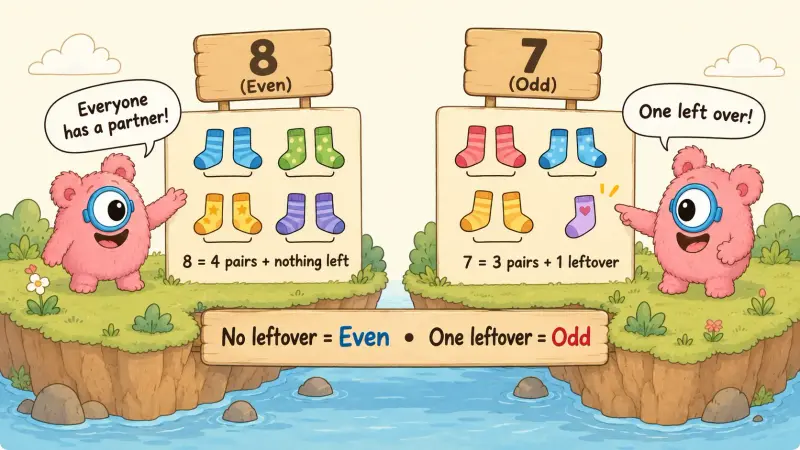
Why the last-digit rule causes trouble
Most of us learned to check the final digit. Ends in 0, 2, 4, 6 or 8, it's even. Ends in 1, 3, 5, 7 or 9, it's odd.
The rule is correct and it's fast. The problem is that it's a lookup, not a reason. A child who only has the rule can sort numbers all day and still be unable to tell you what makes a number even, which means they can't do anything else with the idea.
You'll see the gap when the questions get slightly harder. For example -
Is zero even?
Why does an odd number plus an odd number come out even?
Why can't you share an odd number of sweets fairly between two children?
Each of those follows immediately from the pairing idea and maybe only partially from the digit rule.
Teach the pairing first. The digit shortcut can arrive later, and it'll make more sense when it does, because the child will understand what it's a shortcut for.
A sequence that works
Ten minutes at a time is plenty. You'll want a pile of small identical objects: buttons, pasta, blocks, coins.
1. Make pairs, name nothing
Count out a small number of objects, say six, and ask your child to push them together in twos. Don't use the words even or odd yet, and don't explain what you're looking for.
Pairing rather than sharing into two piles is deliberate. Both would tell you whether a number is even, but dealing objects into two equal groups asks a five-year-old to distribute fairly, and if they misdeal they'll get the wrong answer for the right number. Nudging things together two at a time is hard to do wrong, and any leftover is immediately obvious without counting anything.
Do it several times with different quantities, some that pair cleanly and some that don't. What you're building is the physical habit of grouping by two. Move on when pairing is automatic and they're not recounting the whole pile each time.
2. Notice the leftover
Now do seven, and wait. Most children will point out the spare object themselves, often with some irritation. That reaction is useful, so let it happen rather than smoothing it over. Ask what they could do about it, and let them discover there's nothing to be done: the leftover is a property of seven, not a mistake they made. Go back and forth between numbers that leave one and numbers that don't, and ask them to predict before pairing.
3. Attach the words
Only now bring in the vocabulary. "No leftover means even. One left over means odd." Say it while the objects are still on the table, so the word attaches to something they just did with their hands. Then go through several numbers, having them pair, then name. Children at this stage often want to apply the label before checking, which is fine, as long as they check afterwards.
This step is more achievable than it sounds. In one classroom study, kindergarteners started out unfamiliar with the words "pair," "even" and "odd" entirely, and by the end of the teaching sequence all of them could define even and odd using a pairs strategy.
4. Bridge to the written numeral
Write the numbers 1 to 10 in a column and have your child pair out each one, marking E or O beside it. When the column is done, ask what they notice. The alternating pattern usually jumps out, and it's worth letting them find it rather than pointing at it. Then extend past 10 and let them test whether the pattern holds. This is where the digit shortcut can be introduced, as something they've discovered rather than been handed.
5. Push for reasoning
The last step is the one most people skip, and it's where the understanding gets locked in. Ask what happens if you add two even numbers together. Then an even and an odd. Let them try examples first, then ask why it always works.
The answer you're hoping for sounds something like this, from a first grader in that same study: "an odd number has a leftover and an even number doesn't have a leftover and if you combine an odd number with an even number, it equals an odd number." That child isn't listing examples. They're reasoning from the leftover, which is exactly the goal. Worth knowing that most children pass through a stage of arguing purely from examples before they get there, so if yours says "it's usually even because every time I count it comes out even," that's normal progress rather than a wrong answer.
The awkward questions
Is zero even? Yes. Zero objects split into two equal groups of nothing, with nothing left over, so it meets the definition. It also fits the pattern, sitting between odd 1 and odd −1. This one trips up a lot of adults, so expect to say it more than once.
Is one odd? Yes. One object can't be paired, so there's a leftover. Children sometimes resist this because one object doesn't feel like "left over" from anything.
What about big numbers? This is where the digit shortcut earns its place. Nobody pairs out 4,286. Once your child understands why the rule works, let them use it freely.
Can a number be neither? Not among whole numbers. Every whole number is one or the other. Fractions and decimals are a different matter, but that conversation can wait.
What parity is actually for
Parity looks like trivia until you notice how often it works as a check.
If your child calculates that 4 + 5 = 8, the answer is wrong and parity says so instantly: an even plus an odd has to come out odd. No recalculation needed. Children can use this kind of odd-even information as a quick plausibility check. When elementary schoolers were asked to verify multiplication answers, children in grades 3 to 5 were slower to reject false answers when the odd-even status of the wrong answer matched the right one, which is a sign they were using parity as a first-pass filter.
A child who understands parity has a free error check available on every calculation, and it costs nothing to point that out explicitly.
Parity also underpins halving, doubles, and later work on multiples and factors. Counting by twos lands on every even number in turn, which is why the two topics reinforce each other, and our guide to skip counting covers that side of it.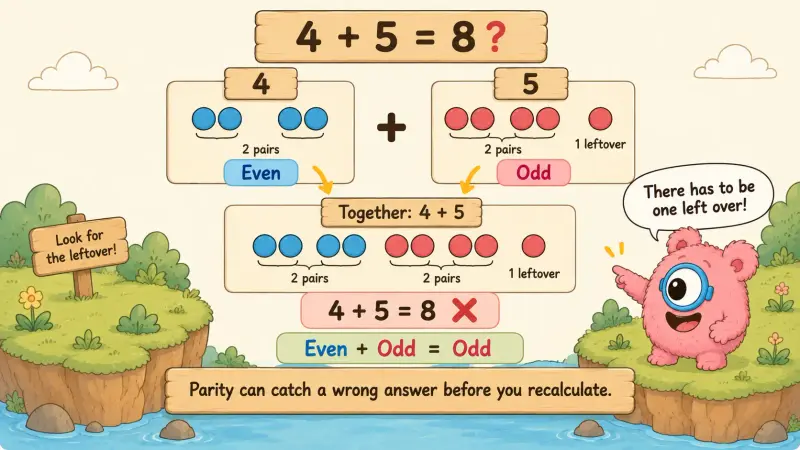
What to check before you move on
The test isn't whether your child can sort numbers. It's whether they can tell you why.
Ask them to explain how they know 9 is odd, with no objects in front of them. If the answer involves a leftover, they have the concept. If the answer is "because it ends in 9," they have the rule, which is worth having but isn't the same thing, and it's worth going back to the buttons for a few more sessions.
And don't rush step 5. A child who can reason about why two odds make an even has met something genuinely important: a claim that holds for every number, proved without checking them all. That's a bigger idea than parity, and even and odd numbers are one of the first places a six-year-old can get near it.
FAQs
What is an even number?
An even number is a whole number that can be split into two equal groups with nothing left over. Eight is even because it splits into two groups of four. In written numerals, even numbers end in 0, 2, 4, 6 or 8.
What is an odd number?
An odd number is a whole number that can't be split into two equal groups. Share seven between two and one is always left over. Odd numbers end in 1, 3, 5, 7 or 9.
Is zero an even number?
Yes. Zero splits into two equal groups with nothing left over, which meets the definition of even. It also fits the alternating pattern, sitting between the odd numbers 1 and −1. This is a common point of confusion for children and adults alike.
What age do children learn even and odd numbers?
Even and odd are usually introduced in kindergarten or first grade, around ages 5 to 7. Children can typically sort numbers correctly well before they can explain why a number is even or odd, and that fuller understanding often takes considerably longer.
How do I explain even and odd numbers to my child?
Use objects rather than numerals. Have your child pair up a small pile of buttons or blocks and see whether anything is left over. No leftover means even, one left over means odd. Introduce the words only after they've done the pairing several times, and save the "check the last digit" rule until they understand what it's a shortcut for.
Why does my child know which numbers are even but can't explain why?
They've most likely learned the last-digit rule, which gives correct answers without any understanding of what makes a number even. It's a useful shortcut but a poor foundation. Going back to pairing physical objects usually closes the gap within a few short sessions.
References
Blanton, M., Ristroph, I., Gardiner, A. M., Stephens, A., Stroud, R., & Knuth, E. (2022). Progressions in Grades K–1 students' understanding of parity arguments. Proceedings of the 44th Annual Meeting of PME-NA. https://files.eric.ed.gov/fulltext/ED656533.pdf
Lemaire, P., & Fayol, M. (1995). When plausibility judgments supersede fact retrieval: The example of the odd-even effect on product verification. Memory & Cognition, 23(1), 34–48. https://link.springer.com/content/pdf/10.3758/BF03210555.pdf