TL;DR: A fraction is a number representing part of a whole. A simple fraction is represented as two numbers on top of each other, separated by a horizontal line between them, or sometimes an inclined line (esp. in a digital article such as this one) - in this case a/b is a fraction, which means "a" parts of "b", "a" is called the numerator and "b" is called the denominator.
Till 3rd grade, numbers generally mean positive, whole numbers to kids - 0, 1, 2, 3... Numbers you can point to on a number line, can count on fingers and can add, subtract, multiply and divide easily.
Then suddenly in 3rd grade, you are introduced to the concept of fractions - parts of whole - and there are numbers that are between 1 and 2 on the number line, and look strange with two numbers on top of each other.
No wonder fractions is one of the most difficult math topics for 3rd graders.
Research (Gabriel et al, 2013) explains this well -
According to a recent theory of numerical development, children who have not yet learned fractions generally believe that the properties of whole numbers are the same for all numbers (Siegler et al., 2011). Indeed, one of the main difficulties when learning fractions comes from the use of natural number properties to make inferences on rational numbers, what Ni and Zhou (2005) called the “whole numbers bias.”
This bias leads to difficulties conceptualizing whole numbers as decomposable units.
What exactly is a fraction?
A fraction is a number that shows part of a whole.
Different categories of fractions
Fractions can be divided into four different categories - proportion, number, measure and part-whole/partition. (Gabriel et al, 2013)
Part-whole/partition refers to how much of an object (e.g., 1/2 pizza) or a collection (e.g., 1/2 of a bag of sweets) is represented by the fraction symbol (Hecht et al., 2003; Kieren, 1988).
Proportion represents the comparison between two quantities.
The numerical meaning of fraction refers to the fact that fractions represent rational numbers that can be ordered on a number line (Kieren, 1988).
Fractions as a measure is closely related to the metric system. The manipulation of fractions as a measure can be made by splitting units of length, area, volume, time, mass, etc.
Forms of fractions
Simple, Common or Vulgar fractions
Simple fractions (also called common fractions, or vulgar fractions when written in the form one number below the other separated by a horizontal line) are part-whole representations. The number at the bottom represents how many parts the whole is divided into, and the number on top represents how many of these parts have been taken.
For example -
1/2 Pizza means pizza is divided into two equal parts and 1 part out of it.
3/4 cup coffee means the cup volume is divided into 4 parts and 3 out of those are filled with coffee.
Proper and Improper fractions
A proper fraction is one where the numerator is smaller than the denominator.
For example - 1/2, 3/8, 4/5
An improper fraction is one where the numerator is equal to or greater than the denominator.
For example - 4/4, 7/3, 8/6
Ratios
A ratio is a representation of fraction that denotes how many times one number contains another.
For example - If you have 6 apples and 8 oranges, the ratio of apples to oranges you have is 6:8, which is equivalent to 3:4.
Decimals
Decimal is a representation of a fraction that is written as a whole number separated by the fractional number, separated by a decimal point.
For example, 5/4 can be written as 1.25, which is called the decimal notation.
The part after the decimal point is read as the number divided by a power of 10 containing the same number of zeroes as the digits in the fractional part. So 1.25 means 1 plus 25 parts out of 100.
Percentages
Percentage is a number represented as a fraction of 100, followed by a % sign. It literally means "per hundred" (from the Latin "per centum").
Example - if you ate 1 apple out of 4, then it means you have eaten 25% of the apples you had.
Mixed Numbers (or Mixed Fractions)
A mixed fraction is a number that combines a whole number with a proper fraction. Generally, improper fractions can be re-written as mixed fractions, which can make it easier to locate them on the number line.
For example, 8/3 can be rewritten as "2 ⅔", which makes it easy to see it's somewhere between 2 and 3 on the number line.
To get the whole number, you just divide the numerator of the improper fraction by the denominator, use the quotient as the whole number, and then replace the numerator with the remainder.
In the above example, 8 divided by 3 gives 2 and 2 is the remainder, so 8/3 is equivalent to 2 ⅔
Fractions on a Number Line
Proper fractions fall between 0 and 1 on the number line.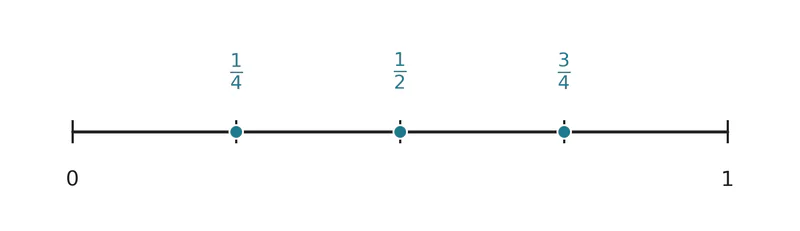
Improper fractions are at or beyond 1. If the top number is not fully divisble by the bottom number, then the fractions will be between any two whole numbers (similar to Mixed fractions).
Introducing young learners to Fractions
Fractions are incredibly important to understand for a wide range of latter applications. Research suggests that difficulties with fractions start early in the primary years, persist through middle school and then into secondary and even tertiary education or later in life. Challenges and misunderstandings faced by students can persist into adult life and pose problems in various fields such as medicine and health care, construction and computer programming. For instance -
In medicine, the implications of inadequate fractions understanding can be severe; for example, “pediatricians, nurses, and pharmacists...were tested for errors resulting from the calculation of drug doses for neonatal intensive care infants... Of the calculation errors identified, 38.5% of pediatricians' errors, 56% of nurses' errors, and 1% of pharmacists' errors would have resulted in administration of 10 times the prescribed dose" (Grillo, Latif, & Stolte, 2001, p.168).
Helping students have a strong foundation in fractions is therefore critical for their future success as well as for the society as a whole.
Research suggests a few guidelines to teach kids fractions
Current North American instruction focusses only part-whole meaning and proper fractions. Kids should meet all five meanings - part-whole, part-part, measure (distance from zero), quotient (division) and operator (fraction of something) - because relying on only part-whole leaves students unable to understand or handle fractions greater than 1.
Anchor everything in the unit fraction. This is based on Japanese, Korean and Taiwanese practice - teach 3/5 as "three one-fifth units" instead of three out of five. This makes comparison and other fraction operations much easier later.
Use precise language - Avoid "two over five" and "two out of five" - both push kids towards thinking of fractions as two different numbers. Instead use "two fifths".
Pick a few durable representations and drop the circles - Circles are hard to partition equally for anything but halves/fourths, so kids fall back on counting pieces instead of attending to equal area. The paper favors number lines and rectangular/bar (linear) models because they partition cleanly and carry all the way through to operations. Japanese resources use ~4 representations consistently versus ~25 in US ones, and that whichever model kids meet first tends to stick — so choose deliberately.
Make partitioning and iterating a physical, active process. Rather than handing kids pre-divided shapes to count, have them create the partitions (partitioning) and rebuild the whole from copies of a unit (iterating). Sequence it: repeated halving → even partitions → odd partitions → composite ones (like 12 as a 3×4 grid), which builds multiplicative reasoning.
Build number sense and estimation before procedures. Students should be able to reason that 1/12 + 7/8 is near 1 (because 1/12 ≈ 0 and 7/8 ≈ 1) without calculating. Emphasize benchmarking (½, ¼, 1/10), comparing and ordering, and explaining reasoning over getting an exact answer.
A stepping stone to fractions number sense is math fact fluency and number sense with arithmetic operations. For that, consider using Monster Math to build a strong foundation before moving to fractions.Delay the algorithms; let kids invent strategies. A recurring theme: premature symbolic procedures produce rules disconnected from meaning. One cited study claims that giving children ~three years to develop their own reasoning before formal algorithms produced dramatic gains in reasoning. Empson & Levi's rule of thumb: if a student has no intuitive strategy for a problem, they're not ready for the standard procedure.
Build on what kids already know. Start from informal fair-sharing and proportional intuitions rather than notation. One notable sequence (Moss & Case, 1999) even goes percents -> decimals -> fractions, starting from "the beaker is nearly full."
Introduce decimals alongside fractions. So the relationship is explicit, and also introduce improper fractions and mixed numbers early so kids don't cement the belief that a fraction must be less than one.
Neurodivergent learning with Fractions
There is currently very less body of research for fractions learning for neurodivergent kids. The strongest evidence is for kids with dyscalculia that the CRA approach works. For kids with autism, structured support such as video modeling helps with fractions. For kids with ADHD, there is least amount of fraction-specific evidence, but CRA approach in general works well for them.
Using tactile scaffolding such as fraction bars.
Using visual representation of fractions, especially for part-whole understanding, before moving to abstract notations.
Use the number line to help your child understand where the particular fraction lies on it.
For more, read our deep-dive into fractions learning for Dyscalculic students - many of the principles suggested there work for kids who have other forms of Neurodivergence as well.
FAQs
What is an improper fraction?
An improper fraction is one where the numerator is equal to or larger than the denominator — like 7/3 or 4/4 — so its value is at or above 1. It's the counterpart to a proper fraction, where the numerator is smaller and the value is below 1. Improper fractions often trip kids up because early instruction over-focuses on "part of a single whole," which makes a fraction bigger than one whole feel impossible. Introducing them early, and rewriting them as mixed numbers (7/3 = 2⅓) to place them on a number line, helps prevent that misconception.
Is fraction one number or two?
One. This is the single most important idea to get right. A fraction like 3/5 looks like two numbers stacked up, but it names a single quantity — one point on the number line, between 0 and 1. Reading it as "three one-fifth units" rather than "three out of five" keeps the focus on that single value and makes comparing and adding fractions much easier later. Treating the top and bottom as two separate whole numbers is the root of classic errors, like thinking 1/3 is bigger than 1/2 because 3 is bigger than 2.
What are equivalent fractions?
Equivalent fractions are different-looking fractions that name the same quantity — the same point on the number line. For example, 1/2, 2/4, and 4/8 are all equivalent. You can see why by splitting each part of a fraction into smaller equal parts (or merging them back together): the number of pieces changes, but the actual amount doesn't. The usual shortcut - multiplying or dividing the top and bottom by the same number - works, but it's worth building the visual understanding first, so kids see equivalence as "the same amount, named differently" rather than a rule applied to two separate numbers.
What is a mixed fraction?
A mixed fraction (or mixed number) combines a whole number with a proper fraction, like 2⅔. It's just another way of writing an improper fraction - 8/3 and 2⅔ are the same value. To convert, divide the numerator by the denominator: the quotient becomes the whole number and the remainder becomes the new numerator (8 ÷ 3 = 2 remainder 2, so 8/3 = 2⅔). Mixed numbers are handy because they make it easy to see where a fraction sits on the number line - 2⅔ is clearly between 2 and 3.
Are fractions useful in every day life?
Very. Fractions show up whenever you cook (½ cup of flour, ¾ teaspoon), split a bill or a pizza, measure for a DIY project, read a discount ("⅓ off"), or tell time (a quarter of an hour). They also underpin decimals, percentages, and ratios, so they appear anywhere money, measurement, or proportions are involved. Beyond daily tasks, a solid grasp of fractions is one of the strongest predictors of later success in algebra and higher math - and in fields like medicine, engineering, and construction, getting them right genuinely matters.
References
Behr, M. J., Lesh, R., Post, T. R., & Silver, E. A. (1983). Rational number concepts. In R. Lesh & M. Landau (Eds.), Acquisition of mathematics concepts and processes (pp. 91–125). New York, NY: Academic Press. [open access chapter]
Bruce, C., Chang, D., Flynn, T., & Yearley, S. (2013). Foundations to learning and teaching fractions: Addition and subtraction. Curriculum and Assessment Branch, Ontario Ministry of Education. [open access]
Empson, S. B., & Levi, L. (2011). Extending children's mathematics: Fractions and decimals. Portsmouth, NH: Heinemann. https://link.springer.com/chapter/10.1007/978-3-642-17735-4_22
Gabriel, F., Coché, F., Szucs, D., Carette, V., Rey, B., & Content, A. (2013). A componential view of children's difficulties in learning fractions. Frontiers in Psychology, 4, 715. [open access]
Grillo, J. A., Latif, D. A., & Stolte, S. K. (2001). The relationship between preadmission indicators and basic math skills at a new school of pharmacy. The Annals of Pharmacotherapy, 35(2), 167–172. https://doi.org/10.1345/aph.10205
Hecht, S. A., Close, L., & Santisi, M. (2003). Sources of individual differences in fraction skills. Journal of Experimental Child Psychology, 86(4), 277–302. https://doi.org/10.1016/j.jecp.2003.08.003
Kieren, T. E. (1976). On the mathematical, cognitive, and instructional foundations of rational numbers. In R. Lesh (Ed.), Number and measurement: Papers from a research workshop (pp. 101–144). Columbus, OH: ERIC/SMEAC. [open access]
Kieren, T. E. (1988). Personal knowledge of rational numbers: Its intuitive and formal development. In J. Hiebert & M. Behr (Eds.), Number concepts and operations in the middle grades (Vol. 2, pp. 162–181). Hillsdale, NJ: Lawrence Erlbaum. [book sample]
Moss, J., & Case, R. (1999). Developing children's understanding of the rational numbers: A new model and an experimental curriculum. Journal for Research in Mathematics Education, 30(2), 122–147. https://doi.org/10.2307/749607
Ni, Y., & Zhou, Y.-D. (2005). Teaching and learning fraction and rational numbers: The origins and implications of whole number bias. Educational Psychologist, 40(1), 27–52. https://doi.org/10.1207/s15326985ep4001_3
Siegler, R. S., Thompson, C. A., & Schneider, M. (2011). An integrated theory of whole number and fractions development. Cognitive Psychology, 62(4), 273–296. https://doi.org/10.1016/j.cogpsych.2011.03.001