TL;DR
Number bonds are a visual way to show part-part-whole relationships - that 7 is made of 5 and 2, or 6 and 1. They are not a replacement for traditional addition; they are the foundation that makes addition, subtraction, mental math, and later algebra make sense.
The research strongly supports building number sense first. Early math skill is one of the best predictors of later achievement, and reasoning strategies like "make a ten" have been shown in randomized trials to improve fact fluency - including for children who struggle with math.
Your child still learns standard addition and math facts. Number bonds are step one of a "concrete → pictorial → abstract" sequence. US standards deliberately delay the traditional stacked ("standard") algorithm until 4th grade so that fluency is built on understanding rather than rote memorization alone.
If your kindergartner or first grader came home drawing circles with numbers branching off them instead of stacking numbers in neat columns, you are looking at a number bond - and you are probably wondering what happened to the math you grew up with. The short answer: schools didn't replace traditional addition. They added a step before it, because decades of research show that children who understand how numbers come apart and fit back together learn arithmetic more deeply, remember their math facts better, and are better prepared for algebra later on.
This guide explains what number bonds are, why they show up in kindergarten, first-grade, and second-grade classrooms, what the peer-reviewed evidence actually says, and how you can practice number bonds at home in about five minutes a day.
What Are Number Bonds?
A number bond is a simple diagram showing how a whole number breaks into parts. Picture a "whole" circle with two "part" circles connected to it. The number 8, for example, can be shown as 8 (whole) splitting into 5 and 3 (parts).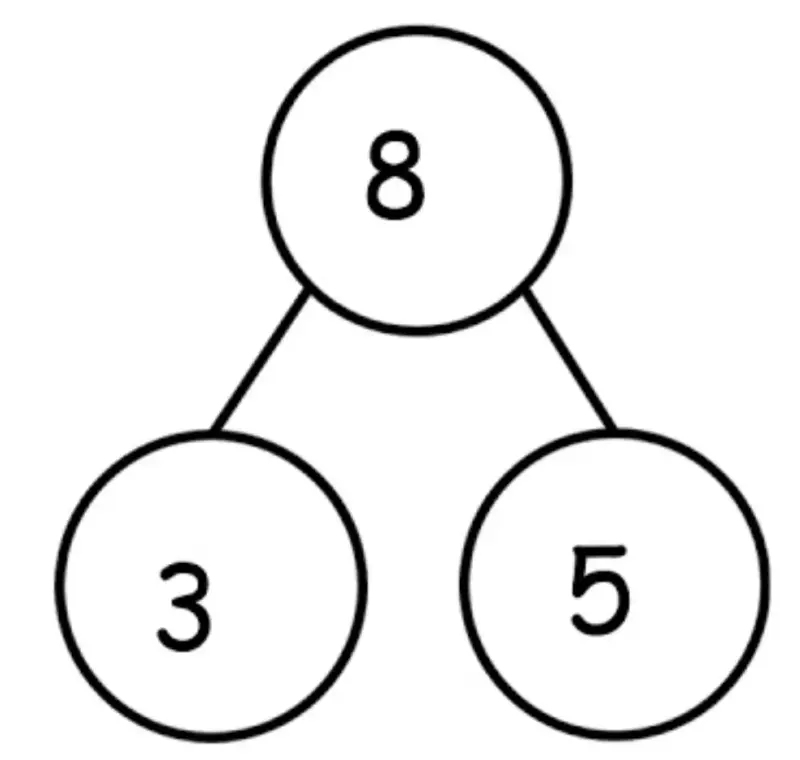
The same whole can split many ways: 8 is 7 and 1, 6 and 2, 5 and 3, 4 and 4.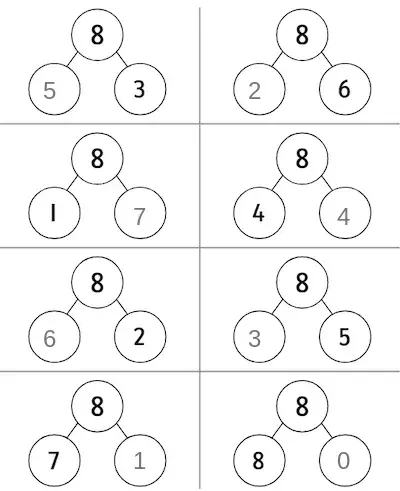
This is the part-part-whole model, and it captures one of the most important ideas in early math: numbers are made of other numbers. Once a child sees that 8 is "5 and 3," they can flip it into four related facts — 5 + 3 = 8, 3 + 5 = 8, 8 − 3 = 5, and 8 − 5 = 3. That single relationship (often called a "fact family") is the seed of both addition and subtraction.
Number bonds are usually introduced with physical objects first (counters, blocks, fingers), then drawn as diagrams, and only later written as equations. That progression is deliberate, and we'll come back to why.
Where Do Number Bonds Come From?
Number bonds and part-whole diagrams became widely known in the US largely through Singapore math, where the concrete-pictorial-abstract (CPA) approach has been a defining feature of mathematics teaching since the 1980s. The CPA sequence itself is built on the work of the American psychologist Jerome Bruner, who described how learners move through enactive (hands-on), iconic (picture-based), and symbolic (abstract) modes of understanding.
The idea is that a young child grasps a concept best when they first do it with real objects, then see it in a picture or diagram (the number bond), and finally write it as a symbolic equation. The number bond is the "pictorial" bridge between concrete counters and abstract math.
In the US, these ideas were woven into the Common Core State Standards, adopted by most states beginning in 2010. Standards for kindergarten explicitly ask children to "decompose numbers less than or equal to 10 into pairs in more than one way" and to find the number that makes 10 when added to a given number. First-grade standards ask children to add and subtract within 20 using "strategies such as counting on; making ten…decomposing a number leading to a ten…and using the relationship between addition and subtraction." Number bonds are simply the visual tool that makes these standards learnable.
Why Schools Teach This Way: What the Research Says
1. Early number sense predicts later math achievement
The strongest argument for teaching composing and decomposing early is that early number sense is one of the best predictors of how children do in school years later. In an influential meta-analysis of six longitudinal data sets, Duncan and colleagues found that early math skills had the greatest predictive power of any school-entry skill - ahead of early reading and attention.
Work by Nancy Jordan and colleagues shows why that early skill matters: kindergarten number competence - counting, comparing, and especially facility with number combinations - is strongly related to first- through third-grade math achievement and growth, and "early facility with addition and subtraction number combinations was most predictive of later achievement." A more recent synthesis describes early number sense as three interwoven strands — number, number relations, and number operations (which includes composition and decomposition) - that together prepare children for formal mathematics.
Crucially, that same synthesis notes number sense is malleable - most children can acquire these competencies through instruction. That is exactly why classrooms spend time on it.
2. Composing and decomposing builds real fact fluency — not just memorization
Here's the worry many parents have: "Are they just avoiding memorizing math facts?" The research answer is nuanced and reassuring. Fluency with basic facts is genuinely important - but the most reliable route to it runs through understanding, not around it.
Arthur Baroody, one of the leading researchers on early arithmetic, argues that fluency with basic number combinations "begins with and grows out of number sense." In this view, memorizing facts isn't about isolated drilling; it's about constructing a well-connected web of patterns, relationships, and reasoning strategies. Children typically progress through phases: counting strategies, then reasoning ("derived fact") strategies, then automatic recall.
The "derived fact" strategies are where number bonds pay off. A child who knows that 8 and 2 make 10 can solve 8 + 5 by breaking the 5 into 2 and 3: 8 + 2 = 10, then 10 + 3 = 13. This is the make-a-ten strategy, and it depends entirely on knowing number bonds to 10.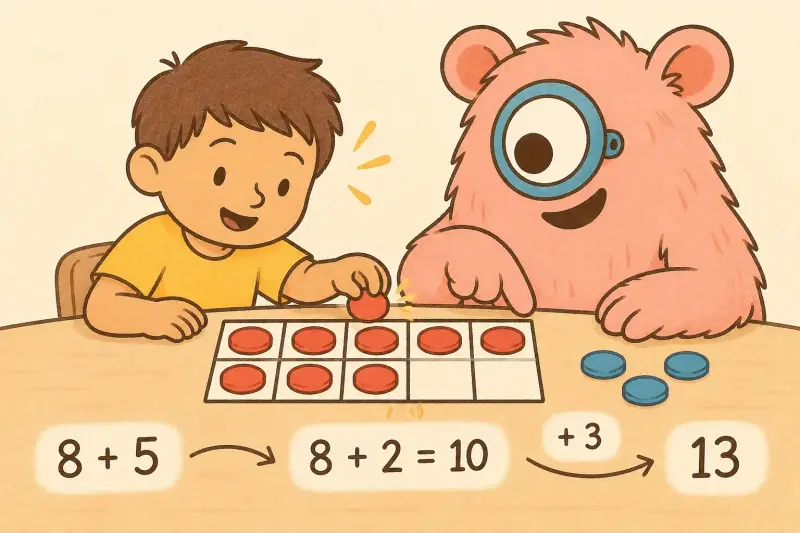
Similarly, "near doubles" (knowing 6 + 7 is one more than 6 + 6) rely on flexible decomposition.
Does teaching these strategies actually improve fluency? A randomized controlled trial by Baroody, Purpura, Eiland, Reid, and Paliwal found that it does: 85 K–3 students were randomly assigned to a "use-10" (make-a-ten), a subtraction-as-addition, or a drill condition across twelve weeks. At a delayed posttest, the "use-10 group achieved analogous results with unpracticed add-with-8 or -9 combinations," and the subtraction group "outperformed both comparison groups on progress toward fluency and fluency rate with unpracticed subtraction items" — meaning the reasoning transferred to problems the children had never drilled. A recent review of the science of learning likewise concludes that time invested in fluency is worthwhile and that some instructional methods build it better than others, with meaning-based strategies functioning as "both a precursor to and an outcome of arithmetic fluency."
3. It lays the groundwork for algebra
Part-part-whole thinking is quietly algebraic. When a child works with a number bond where the whole is known but one part is missing (5 and ___ make 8), they are solving for an unknown — the core move of algebra.
There's also the matter of the equal sign. A large body of research shows that many children come to read "=" as "the answer comes next" rather than "the same as." In a well-known study, Falkner, Levi, and Carpenter reported that all 145 sixth graders they surveyed answered either "12" or "17" to the problem 8 + 4 = ___ + 5 - treating the equal sign as a command to compute rather than a statement of balance. Number bonds and fact families help children see equality as a relationship, and research shows that even kindergarten and first-grade students can develop this relational view of the equal sign with the right instruction — an understanding that supports later success in algebra.
4. Visual, hands-on representations help — especially for younger learners
Because number bonds start concrete and pictorial, they align with what a meta-analysis of 55 studies (7,237 students, kindergarten to college) found about manipulatives: teaching math with concrete objects produced small-to-moderate benefits (Cohen's d ≈ 0.37) over abstract symbols alone, with larger effects for younger, concrete-operational children than for older learners who can already reason abstractly. Number bonds are essentially a structured way to move from those objects to symbols — though, as we note below, the same review found the benefit depends heavily on how the materials are used.
5. It can help children who find math hard
This matters a great deal for neurodiverse learners and children at risk for math difficulties. Number sense is often exactly where these children need support - difficulties with subitizing (instantly recognizing small quantities), comparing numbers, and composing/decomposing are common markers of math learning difficulties. The encouraging news is that targeted number-sense instruction works: in a randomized study by Dyson, Jordan, and Glutting, 121 low-income kindergartners at risk for math difficulties received an eight-week program of small-group sessions targeting number competencies (including composing and manipulating sets). The intervention group made meaningful gains over controls on early numeracy and even "performed better than controls on a standardized test of mathematics calculation at immediate posttest."
If you'd like a deeper dive into math learning difficulties, Monster Math has a companion guide on dyscalculia statistics and what the research actually shows.
"But This Isn't How I Learned It" - Common Parent Worries
"Why not just teach 7 + 5 the old way?" They will - but understanding first. The traditional stacked algorithm with carrying is powerful precisely because it's efficient and abstract. That abstraction is also why US standards hold off on requiring the "standard algorithm" for multi-digit addition and subtraction until 4th grade. Kindergarten through 2nd grade is spent building the place-value and part-whole understanding that makes carrying and borrowing meaningful rather than mysterious. If you want to see how the "old way" fits in later, our guide on addition and subtraction with regrouping walks through it.
"Will my child still memorize math facts?" Yes. Fluency with facts remains an explicit goal of the standards — fluency for addition and subtraction within 10 by the end of 1st grade, and within 20 by the end of 2nd grade. Number bonds are the on-ramp to that fluency, not a detour around it.
"This seems slower." In the short term, reasoning strategies can look slower than flashcard recall. But the research consensus is that strategy-based fluency is more durable and transfers to new problems, whereas memorization without understanding tends to be fragile.
"Isn't this just extra confusing?" For some kids, too many representations at once can be overwhelming - a genuine caveat we discuss below. The goal is one clear model (the number bond), practiced consistently, not a pile of competing methods.
How to Practice Number Bonds at Home (5 Minutes a Day)
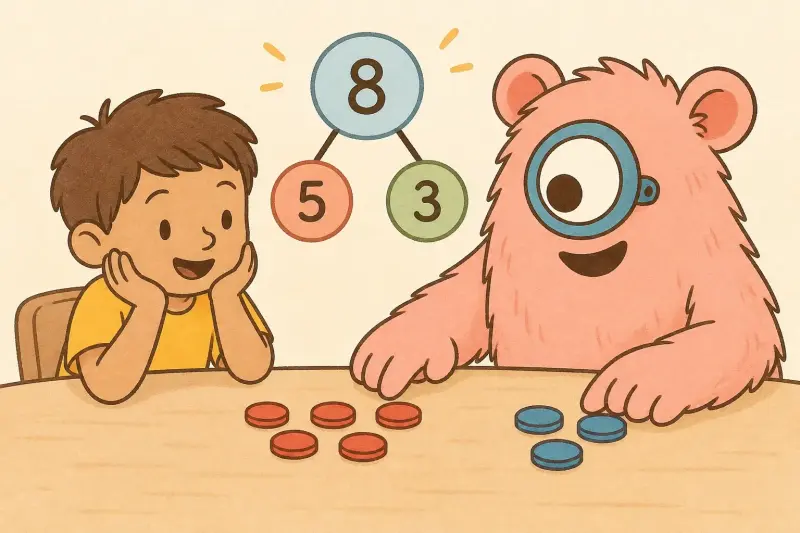
You don't need worksheets or special materials. Try these:
Shake and spill. Put a fixed number of coins, buttons, or dry beans (say, 7) in a cup. Shake and spill them on the table. Count how many land "heads" and how many "tails," and say the bond: "4 and 3 make 7." Do it again — different split, same whole.
Hide and find. Show 10 objects, then hide some under a cup. Show the rest and ask, "How many are hiding?" This builds bonds to 10, the single most useful set.
Make-ten snacks. With 10 crackers or grapes, ask your child to split them onto two plates different ways. Then connect it: "8 and 2 make 10 - so if you have 8, how many more to get to 10?"
Fact-family flips. When your child says "3 + 5 = 8," ask for the other three facts in the family (5 + 3, 8 − 3, 8 − 5). This cements the part-whole link between addition and subtraction. (read more in our article explaining the relation between number bonds and fact families)
Draw the bond. Have your child draw the circle-and-branches diagram for a number of the day. Keep it playful - one number, a few ways to break it.
Play with dot patterns. Dice, dominoes, and ten-frames help children subitize (see quantities without counting) and see numbers as composed of parts - the perceptual root of number bonds.
The key is little and often: five focused, low-pressure minutes beats a long, stressful session. And keep it un-timed - a point worth taking seriously given the research below.
Balanced Caveats and Limits of the Evidence
Good research reporting means being honest about what the evidence does not say:
Correlation vs. causation. Much of the "early number sense predicts later achievement" research is correlational. It shows a strong, consistent relationship, but prediction is not the same as proving that any one teaching tool causes higher achievement. The strongest causal evidence comes from the smaller set of randomized intervention studies (like the Baroody and Dyson trials above).
Number bonds are a tool, not magic. The peer-reviewed literature supports the underlying concepts - part-whole understanding, composing/decomposing, derived-fact strategies, and the CPA/manipulatives approach. There is far less research on the specific circle-and-branch diagram by name. The diagram is a vehicle for well-supported ideas, not itself a separately proven intervention.
Manipulatives and visuals aren't automatically better. The manipulatives meta-analysis found benefits were moderated by how materials were used; poorly chosen or overly "flashy" objects can distract. Representations help when they're clear and tightly connected to the math.
Even strategy research is mixed at the margins. In the Baroody team's trials, some strategy conditions produced significant fluency transfer while others did not clearly beat well-designed practice. The takeaway is that guided strategy instruction works, but it is not a guaranteed win in every contrast.
Fluency still requires practice. Understanding is the foundation, but children do need repeated, meaningful practice to reach automatic recall. Strategy instruction and practice are partners, not rivals.
Timed pressure is a real consideration. Some research links timed tests to math anxiety, while other studies find timed practice can support fluency; the evidence is genuinely mixed. For young and anxious learners, low-stakes, un-timed practice is the safer default at home.
Individual differences matter. What helps most children can overwhelm a few, especially some neurodiverse learners who may benefit from fewer representations and more consistency.
The Bottom Line
Number bonds aren't a fad or a rejection of "real math." They're a research-aligned way to make sure children understand why arithmetic works before they speed it up. Your child will still learn to add in columns and to recall math facts quickly — but with number bonds first, that fluency rests on a foundation of genuine number sense that pays dividends all the way to algebra. If you want a playful, low-pressure way to build these skills, a game-based tool like Monster Math can reinforce part-whole thinking and fact fluency at your child's own pace.
Frequently Asked Questions
What is a number bond in simple terms?
It's a diagram showing how a whole number splits into two parts — for example, 9 is made of 6 and 3. It shows the part-part-whole relationship at the heart of addition and subtraction.
Are number bonds the same as fact families?
They're closely related. A number bond shows the parts and whole (6, 3, 9); the fact family is the set of four equations you can write from it (6 + 3 = 9, 3 + 6 = 9, 9 − 6 = 3, 9 − 3 = 6).
Why do schools use number bonds instead of traditional addition?
They don't replace traditional addition — they come before it. Number bonds build the number sense and mental-math strategies (like make-a-ten) that make traditional addition, subtraction, and later algebra easier to understand and remember.
Do kids still learn to add the "normal" way with carrying?
Yes. US standards introduce the traditional standard algorithm for multi-digit addition and subtraction in 4th grade, after the earlier grades build the place-value and part-whole understanding that makes carrying meaningful.
Will my child still memorize math facts?
Yes. Fact fluency is an explicit goal — within 10 by the end of 1st grade and within 20 by the end of 2nd grade. Number bonds are the pathway to that fluency.
At what age or grade do number bonds start?
Typically kindergarten, with number bonds to 5 and 10, expanding through 1st and 2nd grade to bonds within 20 and beyond.
How can I help if my child is struggling with number bonds?
Go back to concrete objects (counters, snacks), focus on bonds to 10 first, keep sessions short and un-timed, and use dot patterns and ten-frames. If difficulties persist, it may be worth exploring whether a math learning difficulty is involved.
References
Baroody, A. J., Bajwa, N. P., & Eiland, M. (2009). Why can't Johnny remember the basic facts? Developmental Disabilities Research Reviews, 15(1), 69–79. https://onlinelibrary.wiley.com/doi/abs/10.1002/ddrr.45
Baroody, A. J., Purpura, D. J., Eiland, M. D., Reid, E. E., & Paliwal, V. (2016). Does fostering reasoning strategies for relatively difficult basic combinations promote transfer by K–3 students? Journal of Educational Psychology, 108(4), 576–591. https://doi.org/10.1037/edu0000067
Carbonneau, K. J., Marley, S. C., & Selig, J. P. (2013). A meta-analysis of the efficacy of teaching mathematics with concrete manipulatives. Journal of Educational Psychology, 105(2), 380–400. https://doi.org/10.1037/a0031084
Duncan, G. J., Dowsett, C. J., Claessens, A., Magnuson, K., Huston, A. C., Klebanov, P., … Japel, C. (2007). School readiness and later achievement. Developmental Psychology, 43(6), 1428–1446. https://www.apa.org/pubs/journals/releases/dev-4361428.pdf
Dyson, N. I., Jordan, N. C., & Glutting, J. (2013). A number sense intervention for low-income kindergartners at risk for mathematics difficulties. Journal of Learning Disabilities, 46(2), 166–181. https://pmc.ncbi.nlm.nih.gov/articles/PMC3566272/
Falkner, K. P., Levi, L., & Carpenter, T. P. (1999). Children's understanding of equality: A foundation for algebra. Teaching Children Mathematics, 6(4), 232–236. https://doi.org/10.5951/TCM.6.4.0232
Jordan, N. C., Devlin, B. L., & Botello, M. (2022). Core foundations of early mathematics: refining the number sense framework. Current Opinion in Behavioral Sciences, 46, 101181. https://ldaustralia.org/wp-content/uploads/2023/04/Jordan-et-al-2022.pdf
Jordan, N. C., Glutting, J., & Ramineni, C. (2010). The importance of number sense to mathematics achievement in first and third grades. Learning and Individual Differences, 20(2), 82–88. https://www.sciencedirect.com/science/article/abs/pii/S1041608009000533
Leong, Y. H., Ho, W. K., & Cheng, L. P. (2015). Concrete-Pictorial-Abstract: Surveying its origins and charting its future. The Mathematics Educator, 16(1), 1–19. https://math.nie.edu.sg/wkho/Research/My%20publications/Math%20Education/Yew%20Hoong%20et%20al%20(Final).pdf
Hartnett, J. E. (adaptation of Bruner's enactive–iconic–symbolic framework); and Nunes, T., Bryant, P., Evans, D., Bell, D., Gardner, S., Gardner, A., & Carraher, J. (2007). The contribution of logical reasoning to the learning of mathematics in primary school. British Journal of Developmental Psychology, 25(1), 147–166. https://bpspsychub.onlinelibrary.wiley.com/doi/10.1348/026151006X153127