TL;DR:A number bond is a simple diagram that shows how a whole number breaks into two parts - for example, 8 splitting into 5 and 3. It makes the part–whole relationship visible, and that relationship is the foundation of addition, subtraction, fact families, and later mental-math strategies. This guide explains what number bonds are, why they matter, how they support neurodivergent learners, and how to teach them step by step using our free Number Bonds Visualizer.
Ask a young child "what is 8?" and many will count to it: one, two, three… all the way up. That's a fine first step. But a child who can also say "8 is 5 and 3 - or 6 and 2, or 4 and 4" understands something deeper. They see 8 not as only a number, but as a quantity made of smaller quantities that can be taken apart and put back together. That flexible, part–whole view of number is exactly what a number bond captures.
Number bonds sit at the heart of how addition and subtraction are taught in Singapore math, the Common Core approach, and most modern early-years curricula. Yet for many parents - and even teachers - the diagram itself can feel mysterious at first.
What Is a Number Bond?
A number bond is a visual model showing the relationship between a whole and its parts. It's usually drawn as three circles: the whole on top, connected by short lines (called branches) to two parts below. The bond for 8 might show 8 at the top with 5 and 3 underneath - meaning 5 and 3 combine to make 8, and 8 splits back into 5 and 3.
That two-way reading is the whole point. More than a sum to be solved, number bond is a relationship to be understood. The same diagram tells you that 5 + 3 = 8 and that 8 − 3 = 5. Number bonds are sometimes called part–part–whole models, and they're closely related to ten frames. They typically appear in kindergarten and first grade, starting with bonds to 5 and 10. (They build directly on subitizing — the ability to see small quantities at a glance.)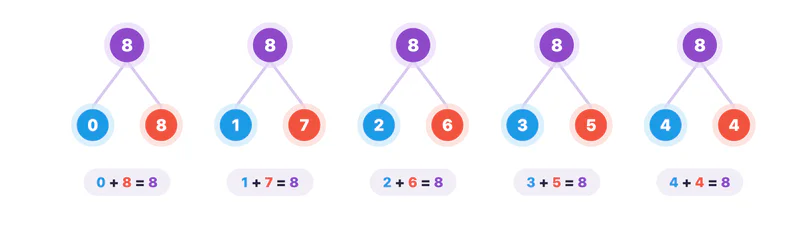
Why Part–Whole Thinking Matters
Number bonds teach a concept psychologists and math educators consider foundational: part–whole reasoning. A child who truly grasps this can:
Decompose numbers flexibly - knowing 8 can be 5 + 3, 6 + 2, or 7 + 1, and choosing whichever split is most useful.
Understand subtraction as a missing part. "8 − 3 = ?" becomes "8 is made of 3 and what?" rather than a separate, scary operation.
See addition and subtraction as inverses, because the same bond holds all the related facts.
Build toward mental-math strategies like making ten, bridging, and near-doubles - all of which depend on splitting numbers into convenient parts.
For detailed guidance on the most important of these, see how to teach the Make 10 strategy.
Resnick described how children move from a counting-based view of number toward a part–whole conception in which quantities are understood as compositions - a shift that underpins flexible calculation. Decomposition and composition of numbers also appear explicitly in Clements and Sarama's learning-trajectory research, which places "composing and decomposing number" among the core competencies of early mathematics.
Teaching Number Bonds with the Free Visualizer
The fastest way to make these ideas click for students is to show them, not just describe them. Our free Number Bonds Visualizer is built around three teaching moves that map directly to how children build part–whole understanding - splitting a whole into parts, moving between representations, and seeing one bond as a whole family of facts. Here's what each looks like, followed by a step-by-step lesson sequence you can run straight from the tool.
Splitting a Whole into Parts
The clearest way to understand a number bond is to watch a whole come apart into parts - and notice that the whole never changes even as the parts shift. As one part grows, the other shrinks; together they always rebuild the same total. That invariance is the conceptual heart of part–whole thinking, and seeing it happen live makes the idea stick in a way a static diagram can't.
Symbolic or Counters: Two Views of the Same Bond
The Visualizer lets you flip between a symbolic view (just the numbers) and a counters view (each part shown as a group of dots). A bond like 7 + 3 = 10 is the same relationship a child sees when seven counters sit in one part and three in the other. Moving fluidly between representations is exactly what the Concrete–Representational–Abstract (CRA) approach recommends.
From One Bond to a Whole Fact Family
A single bond contains an entire fact family - the related addition and subtraction facts built from the same three numbers. The bond for 9, 6, and 3 holds all four facts at once:
Instead of memorizing four separate facts, a child who understands the bond understands all four as one connected idea. This dramatically reduces the load of building math fact fluency and makes subtraction less intimidating: "9 − 6" is simply "I know 6 and 3 make 9, so the missing part is 3."
Wondering how this compares to teaching fact families directly? See number bonds vs fact families.
A Step-by-Step Lesson Sequence
You can teach the entire number-bonds progression with nothing but a projector and the Visualizer. Each step below maps directly to a button or mode in the tool.
Start with a small whole. Set the whole to 5 using the "Try These Numbers" buttons. Stay in Explore Bonds mode so students see every way 5 splits. Ask: "How many ways can we make 5?"
Make it concrete first. Switch to ⚫ Counters view so each part shows as a group of dots. This mirrors splitting real objects into two piles.
Connect counters to the symbol. Toggle to 🔢 Symbolic. Flipping between views shows students the dots and the numbers describe the exact same quantity - the heart of the CRA approach.
Explore all the bonds. Change the whole to 10 and walk through every pair. Turn on Show flipped pairs to make the point that 4 + 1 and 1 + 4 use the same parts. The bonds of ten are worth overlearning - they power the make-ten strategy later.
Check fluency and reveal the fact family. For this - switch to Find the Missing Part mode. The tool shows the whole and one part; students name the missing part before you hit Reveal. It's subtraction in disguise - a perfect quick formative check. Just below the bond, the Fact family panel shows all four related sentences (two addition, two subtraction), so students see addition and subtraction as two sides of the same relationship right alongside the missing-part challenge.
Fade the support. Move from showing every bond on screen, to picturing it mentally, to recalling the facts outright.
Open the Number Bonds Visualizer and try it with your next lesson.
Number Bonds and Neurodivergent Learners
For children with dyscalculia, ADHD, or autism, number bonds can be especially helpful - for different reasons.
(For strategies that span conditions, see our guide to neurodivergent math learning.)
Children with dyscalculia often struggle to hold numerical relationships in mind and fall back on slow one-by-one counting. A number bond externalizes the relationship - making "8 is 5 and 3" something you can see rather than hold in working memory - which reduces cognitive load. This aligns with recommended practice for math difficulties, where visual representations and explicit part–whole structure are consistently emphasized.
See also how to build number sense in kids with dyscalculia.
For children with ADHD, the difficulty in math is frequently about working memory and sustained attention. A compact bond diagram gives a single visual anchor to return to, so a child who loses their place mid-problem can reorient quickly.
For autistic learners, who often respond well to structure and visual systems, the consistent format of a bond - same shape, same rules, every time - can be reassuring.
Related: Our guide to skip counting and why it's a foundation for multiplication.
FAQs:
What is a number bond in simple terms?
A small diagram showing how a whole number is made of two parts - for example, 7 = 4 + 3. It pictures the relationship between a whole and its parts so children see that numbers can be taken apart and put back together.At what age or grade are number bonds taught?
Number bonds usually appear in kindergarten and first grade, starting with bonds to 5 and 10 before extending to 20 and beyond.What is the difference between a number bond and a fact family?
They describe the same relationship. A number bond is the diagram (whole and two parts); a fact family is the four addition and subtraction sentences written from that bond - for example, 4 + 3 = 7, 3 + 4 = 7, 7 − 4 = 3, and 7 − 3 = 4.How do number bonds help with subtraction?
They reframe subtraction as finding a missing part. Instead of "take away," a child thinks "the whole is 9 and one part is 6, so the other part must be 3" - making subtraction feel connected to addition rather than separate.
References:
Clements, D. H., & Sarama, J. (2009). Learning and Teaching Early Math: The Learning Trajectories Approach. Routledge.
https://books.google.co.in/books?id=fA6RAgAAQBAJ&printsec=frontcover#v=onepage&q&f=falseResnick, L. B. (1983). A developmental theory of number understanding. In H. P. Ginsburg (Ed.), The Development of Mathematical Thinking (pp. 109–151). Academic Press.
https://files.eric.ed.gov/fulltext/ED251328.pdf