TL;DR:Unschooling - a form of homeschooling where children learn through self-directed play, interests, and everyday life rather than a fixed curriculum - has genuine appeal for neurodivergent families, and there are real reasons it can work for some autistic and ADHD kids. But the peer-reviewed evidence base is thin and largely parent-reported, and research on structure for neurodivergent children adds an important caveat. Below: what the science actually says, who unschooling tends to suit, the honest risks, and how to decide whether it fits your child.
What unschooling actually means
Unschooling sits at the far end of the homeschooling spectrum. Instead of recreating school at the kitchen table, families let the child's curiosity drive learning - a kid fascinated by dinosaurs might absorb biology, geology, and reading through that single passion. The largest study of the approach, a survey of 232 unschooling families by psychologists Peter Gray and Gina Riley, found parents reported improved learning, better attitudes toward learning, and greater family harmony, with the biggest challenge being social pressure from people who disapproved.
For families raising neurodivergent kids, that flexibility is often the entire draw. A child who melts down under fluorescent lights, fixed timetables, and forced transitions might thrive when those pressures disappear.
Why unschooling appeals to neurodivergent families
Many parents of autistic and ADHD children arrive at unschooling after mainstream school stops working. Evidence from the pandemic offers a partial window into this: a qualitative survey of parents whose adolescents with ADHD and autism shifted to COVID-era distance learning found that, alongside real challenges, some families reported benefits at home such as more schedule flexibility, greater independence, and in some cases lower stress. Those positives were strongest when a supportive adult and predictable routines were in place. School, for some of these children, can be a daily source of sensory overload and social exhaustion - though emergency pandemic schooling is an imperfect stand-in for a deliberately chosen approach like unschooling.
There's also an interesting clue from child development research. One study of six-year-olds found that kids who spent more time in free, unstructured activities were better at setting their own goals and following through without being told what to do. The researchers were careful to say this is just a link, not proof that free time causes the difference. Still, it hints that giving children room to direct themselves may help them practice the very planning and follow-through skills they need.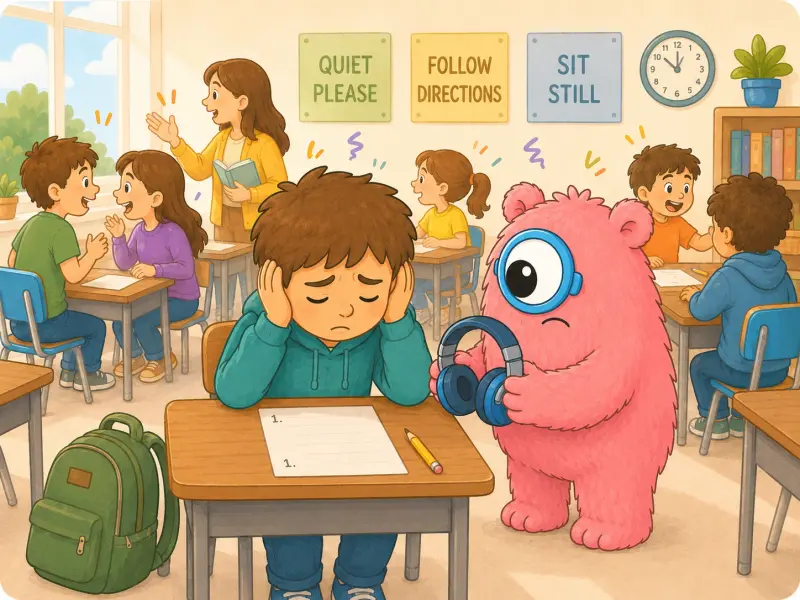
What the research genuinely supports
One of the strongest ideas in education psychology backs up part of what unschooling tries to do. In a major review, researchers Ryan and Deci show that kids learn and stay motivated best when they feel three things: a sense of choice, a feeling of getting good at something, and a connection to others. Unschooling naturally offers two of these - plenty of choice, and learning that happens through close relationships. But the same researchers also found that kids build skills best when that freedom comes with some structure, not none at all. In other words, "free to learn" and "no structure at all" are not the same thing.
This matters doubly for neurodivergent learners, who in conventional settings often have decisions made for them and few chances to exercise genuine choice. An environment built around the child's own interests can restore a sense of agency that traditional classrooms strip away.
The honest caveats every parent should hear
Here's where honesty matters. The same freedom that helps some kids can unsettle others, because many neurodivergent children do better with structure and routine. In a review of studies asking autistic students about their own wellbeing at school, the children themselves said that predictability, routines, and clear daily timetables helped them feel safe and manage anxiety. Pure, hands-off unschooling can make a day feel unpredictable in exactly the way some of these kids find hard to handle.
It's also worth being honest about the load on parents. Raising a neurodivergent child is demanding, and unschooling puts even more on the parent's plate, since they become the main source of learning, structure, and calm. A study of mothers of autistic and ADHD children found that parents felt more stress when their child struggled with emotions, behavior, or sleep, and that having strong personal support made a real difference. Going it alone, without that support, can leave a parent stretched thin.
The evidence base itself is also genuinely limited. Most unschooling research relies on parent self-reports from families who already believe in the approach, with small samples and no comparison groups. We have promising signals, not proof. Reading, writing, and especially math can suffer when a child never gravitates toward them on their own - a real concern given how foundational early numeracy is.
Making it work: a middle path
The most realistic version of unschooling for neurodivergent kids usually sits between rigid curriculum and total free-rein. Many families land on "structured autonomy": predictable rhythms to the day and gentle access to core skills, with wide freedom inside that frame. A morning anchor, a loose menu of activities, and interest-led afternoons can deliver both the routine that calms an anxious nervous system and the autonomy that fuels motivation.
For skills that rarely emerge spontaneously - math being the classic example - low-pressure, play-based tools help bridge the gap without recreating school stress. Our guide to tactile math games for kids who process numbers differently and our collection of low-prep math games using everyday household items are designed exactly for this: keeping numeracy alive through play rather than worksheets.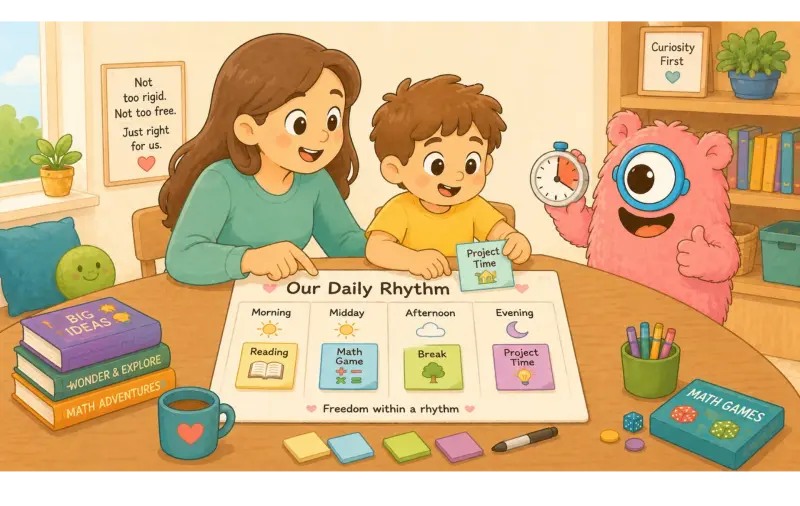
So, can it work?
For some neurodivergent children - particularly those who are deeply curious, self-motivated, and crushed by the sensory and social demands of school - unschooling can genuinely flourish. For others who rely heavily on external structure, a more guided home-education approach may serve them better. The answer depends far less on the philosophy than on the specific child in front of you, and on whether the home environment can offer both freedom and enough scaffolding to keep core skills from falling through the cracks.
The takeaway
Unschooling tends to work when a child is intensely curious and self-driven, is genuinely struggling in a conventional classroom, and has a parent who can build steady daily routines and quietly keep core skills like reading and math on track. It tends to fall short when a child leans heavily on external structure to feel calm, or when the home can't offer consistent routine and support - that's when anxiety climbs and skill gaps widen.
So watch your own child: if freedom energizes them and the basics keep moving - and if you have the bandwidth to help them with the learning - unschooling could genuinely help them.
On the other hand, if they drift or unravel without a framework, or if you are already occupied with other work, a more structured home-schooling approach or even school could be the better choice.
FAQs
Is unschooling legal for neurodivergent children?
Homeschooling, including unschooling, is legal across the US and many other countries, though requirements vary by state and nation. Some places require notification, portfolios, or periodic assessments. Families of children with diagnosed disabilities should check how withdrawing from school affects access to therapies and services, which are sometimes tied to enrollment.
Does unschooling work better than traditional school for autistic kids?
The research is too limited to answer that broadly, and almost none of it looks at unschooling specifically. A survey of parents whose autistic and ADHD teens shifted to learning at home during COVID school closures found a mix of real challenges alongside some benefits, such as more flexibility and, for some families, lower stress. But emergency pandemic schooling is a poor stand-in for chosen home education, and most unschooling studies rely on parent reports from families who already believe in it. It comes down to the individual child.
What about socialization for neurodivergent unschoolers?
Socialization is a common worry, but unschooling doesn't mean isolation. Interest-based groups, co-ops, and community activities can offer social contact on terms that suit the child, often with less of the overwhelm that crowded classrooms create.
How do unschoolers learn math if they don't choose it?
This is one of the most cited challenges. Many families weave numeracy into daily life - cooking, budgeting, games - and use play-based tools to keep math skills developing without formal lessons. If you are an unschooling parent, you could also look at Monster Math to help build foundational math skills.
Do neurodivergent kids need more structure than unschooling provides?
Often, yes. Research links predictable routines to better outcomes for autistic and ADHD children, which is why many families adopt a "structured autonomy" approach rather than fully hands-off unschooling.
References:
Gray, P., & Riley, G. (2013). The challenges and benefits of unschooling, according to 232 families who have chosen that route. Journal of Unschooling and Alternative Learning, 7(14), 1–27. https://jual.nipissingu.ca/wp-content/uploads/sites/25/2014/06/v72141.pdf
Barker, J. E., Semenov, A. D., Michaelson, L., Provan, L. S., Snyder, H. R., & Munakata, Y. (2014). Less-structured time in children's daily lives predicts self-directed executive functioning. Frontiers in Psychology, 5, 593. https://pmc.ncbi.nlm.nih.gov/articles/PMC4060299/
Ryan, R. M., & Deci, E. L. (2020). Intrinsic and extrinsic motivation from a self-determination theory perspective: Definitions, theory, practices, and future directions. Contemporary Educational Psychology, 61, 101860. https://stial.ie/resources/Ryan%20and%20Deci%202020%20self%20determination%20theory.pdf
Thorell, L. B., Klint Carlander, A.-K., Demetry, Y., Marainen, L., Nilsson, S., & Skoglund, C. (2024). Parental experiences of distance learning in families with and without an adolescent with ADHD/ASD: A large qualitative survey study. International Journal of Environmental Research and Public Health, 21(4), 388. https://pmc.ncbi.nlm.nih.gov/articles/PMC11049798/
Pardo-Salamanca, A., Rosa-Martínez, E., Gómez, S., Santamarina-Siurana, C., & Berenguer, C. (2024). Parenting stress in autistic and ADHD children: Implications of social support and child characteristics. https://pmc.ncbi.nlm.nih.gov/articles/PMC12167323/
Boshoff, K., Redmond, G., Slee, P., & Robinson, S. (2024). The perceptions of Autistic school students of their well-being at school: A meta-synthesis. European Journal of Special Needs Education, 1–18. https://www.tandfonline.com/doi/full/10.1080/08856257.2024.2421108