TL;DR:A six-year-old learning place value needs to grasp one idea - that ten ones can become one ten, and both are still the same amount. You can teach it with straws and rubber bands. Ten minutes a day for five days is enough, if you choose materials where a ten already exists as a single object rather than a loose pile, and if you get your child to say what they're doing out loud.
Place value sounds like a school topic. It's really a single, slightly strange idea: that a digit means different things depending on where it sits, and that ten separate things can be treated as one thing.
Adults find this obvious. Six-year-olds mostly don't. Ask a child what the 4 in 43 means and a lot of them will tell you "four" - because that's what the symbol looks like. Nothing on the page suggests it means forty.
Here's how to build that understanding at the kitchen table, with things you already own.
What a six-year-old actually needs to get
Not columns. Not the words "tens" and "ones" recited on cue. Plenty of children can chant those correctly while having no idea what they mean.
The idea underneath is called unitizing: understanding that a group of ten can be counted as one unit without changing how much you have. A bundle of ten straws is simultaneously ten things and one thing. Holding both of those at once is the leap.
Everything else in place value - regrouping, expanded form, comparing numbers, eventually decimals - sits on that one idea. Which is why it's worth going slowly.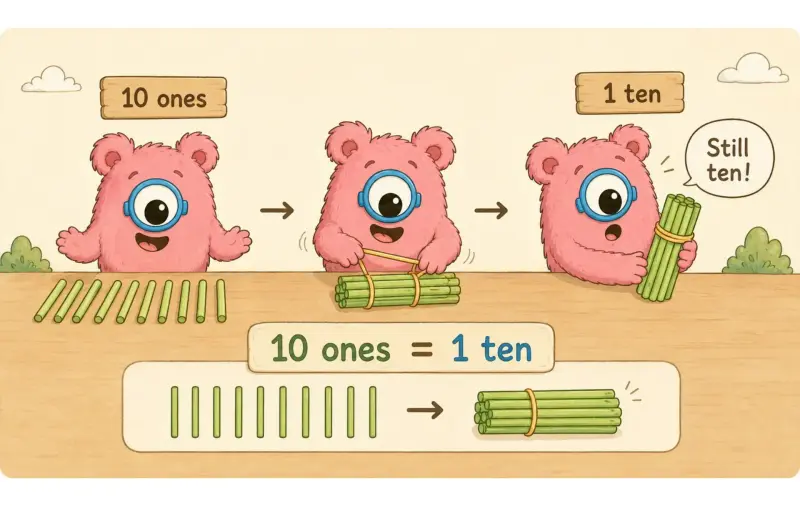
Choose your items carefully - this matters more than you'd think
Not all objects work equally well, and this is where most kitchen-table attempts go wrong.
In one study, second-graders were given three kinds of materials to build two- and three-digit numbers with: loose attachable beads, pipe cleaners already bundled into tens, and beads strung together in tens with the individual ones still visible. The pre-bundled materials produced far better place-value understanding than the loose ones. Among children at risk for math learning difficulties, 69% of responses showed proper place-value thinking with the pipe cleaners, compared with 39% using the loose beads. Notably, whether the individual ones within each ten were visible didn't add anything on top - what mattered was that the ten already existed as a single object the child could pick up.
The reason is worth understanding. Given a pile of loose items, a child asked to show 23 will often just count out 23 individual things. They've answered correctly and learned nothing about tens. When a ten is a physical object that already exists, they have to think in tens to use it.
Good household choices:
Straws with rubber bands - the classic, and hard to beat. A bundle of ten is visibly made of ten but behaves as one thing.
Popsicle sticks or craft sticks - same principle, bundle with a rubber band or a hair tie.
Ten LEGO bricks pressed into a stick - the stick holds together, and it's obviously ten bricks long.
Egg cartons - cut down to ten holes, filled with dried beans. The full carton is a ten; loose beans are ones.
Pipe cleaners - one short piece for a one, a piece ten times as long for a ten. The length difference does the teaching.
Less good: a bowl of pasta, buttons or coins with nothing holding tens together. Loose objects let a child count in ones forever. If loose items are all you have, make the bundling itself the activity rather than skipping to representing numbers.
One more thing: pick boring objects. Your child's favorite toy cars will pull attention toward the cars.
A five-day sequence you can actually run
Ten minutes a day is plenty. Shorter and calmer beats longer and fraught.
Day 1: Make tens, don't use them yet
Count out ten straws together, slowly, then wrap the band around them. Say "ten straws, one bundle" as you do it. Then make another. And another, until you have five or six bundles and a small pile of leftovers. That's the whole session - no numbers written down, no questions to get wrong. What you're building is the physical memory of ten becoming one, and the more times their hands do it the more solid it gets. Move on when they can make a bundle without recounting halfway through.
Day 2: Prove a bundle is still ten
Put one bundle next to ten loose straws and ask which is more. Many six-year-olds will say the loose pile, because it looks like more stuff. Don't correct them - unwrap the bundle and count them together onto the table, then rewrap it. Do this a few times with different bundles. This is the single most important session in the sequence, because a child who doesn't believe the bundle is still ten will treat every later step as an arbitrary rule. Move on when they answer "the same" without needing to unwrap.
Day 3: Build numbers, say them properly
Ask for 23. They should take two bundles and three singles. Now the key part: have them say it out loud - "two tens and three ones, that's twenty-three." Say it with them the first few times. The saying isn't decoration; a meta-analysis of research on prompting children to explain their reasoning while learning math found consistent gains in conceptual and procedural knowledge across studies. Do five or six numbers. Move on when they stop counting bundles in ones.
Day 4: Go backwards
You build a number, they tell you what it is. Then you say a number and they build it - but include a couple with no leftovers, like 30 or 40, and one with no tens, like 7. Those edge cases catch the child who's pattern-matching rather than understanding. If 40 stumps them, go back to Day 3 for another day. There's no cost to that and a real cost to pushing on.
Day 5: Bring in the written numeral
Build 34 with bundles and singles, then write "34" on paper beside it. Point at the 3 and ask what it means. If they say "three," point back at the three bundles and ask how many straws are there. Keep going until they say thirty. Write it as 30 + 4 underneath. This is the bridge that matters - the written symbol has to point at something the child has physically held, or it stays decorative. Our guide to the concrete-representational-abstract approach explains why this ordering works.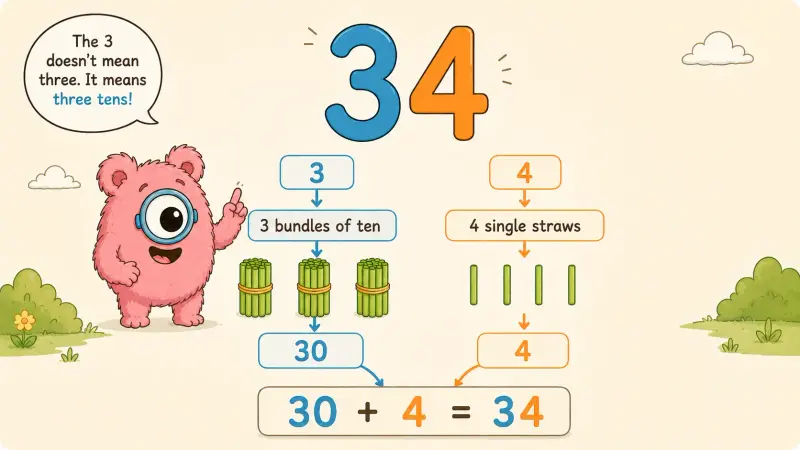
Phrases that help, and one to avoid
Say "one ten and four ones" before you say "fourteen." English number words actively hide the structure - "fourteen" gives no clue there's a ten inside, where the Mandarin equivalent literally translates as "ten four." Cross-cultural research has linked this feature of English to specific difficulties children have with the teens, well documented in comparisons with East Asian counting systems. Teen numbers are the hardest ones for exactly this reason, so name the structure first and the word second.
Ask "how do you know?" when they get something right, not just when they get it wrong. Otherwise the question becomes a signal that they've made a mistake.
Avoid using language like "the 3 is in the tens column." It's true and it's useless - it describes a position, not a quantity. "The 3 means three bundles, which is thirty" says something a child can act on.
When it isn't clicking
Go back to Day 2. Almost every place value problem traces back to a child not fully believing that the bundle and the loose ten are the same amount.
Slow down rather than switching materials. Changing from straws to blocks to an app mid-topic adds load without adding understanding - pick one thing and stay with it.
Where this goes next
Once your child can build, name and write two-digit numbers confidently, the same bundles carry straight into addition and subtraction with regrouping - trading a bundle for ten singles is the whole of "borrowing," done with their hands before it's done on paper.
If you'd rather work with proper base-ten blocks or a digital version, our step-by-step guide to teaching place value with base-ten blocks covers that route, including a free tool for showing numbers breaking apart on screen.
FAQs
What age should a child understand place value?
Tens and ones are typically introduced in first grade, around age 6, with three-digit numbers following in second grade. Understanding develops gradually over several years rather than arriving at once, so a six-year-old who's still shaky is well within the normal range.
What household items work best for teaching place value?
Anything where ten can be bundled into a single object - straws or popsicle sticks with rubber bands, LEGO bricks pressed into sticks, or an egg carton holding ten beans. Research suggests materials with pre-existing, non-separable groupings work better than loose objects, because loose items let children keep counting in ones.
Why does my child say the 4 in 45 means "four"?
Because nothing about the written numeral tells them otherwise - both digits look identical in size. This is the core difficulty of place value and it's completely normal. Physical materials fix it by making the difference between forty and four something a child can see and hold.
How long should we practice each day?
Around ten minutes. Short daily sessions work better than long weekend ones, and stopping while your child is still engaged is more useful than pushing to the point of frustration.
My child can say "tens and ones" but still gets numbers wrong. What's happening?
They've learned the vocabulary without the underlying idea, which is very common. Go back to comparing one bundle against ten loose items and asking which is more - until "the same" is obvious to them, the terminology is just words.
References
Lafay, Anne, Osana, Helena P., & Levin, Joel R. (2023). Does conceptual transparency in manipulatives afford place-value understanding in children at risk for mathematics learning disabilities? Learning Disability Quarterly, 46(2), 92–105. https://doi.org/10.1177/07319487221124088
Rittle-Johnson, Bethany, Loehr, Abbey M., & Durkin, Kelley (2017). Promoting self-explanation to improve mathematics learning: A meta-analysis and instructional design principles. ZDM Mathematics Education, 49(4), 599–611. https://www.researchgate.net/publication/313794629_Promoting_self-explanation_to_improve_mathematics_learning_A_meta-analysis_and_instructional_design_principles
Miller Kevin F., & Stigler, James W. (1987). Counting in Chinese: Cultural variation in a basic cognitive skill. Cognitive Development, 2(3), 279–305. https://doi.org/10.1016/S0885-2014(87)90091-8