TL;DR: Reward charts - a simple, visual form of what researchers call a token economy - are one of the most well-supported behavioral tools for children with ADHD. Research suggests that children with ADHD are often especially responsive to immediate, consistent rewards because of differences in reward processing and motivation, making reinforcement systems particularly effective for supporting focus, persistence, and self-regulation. And a major meta-analysis also confirms that behavioral approaches improve children's behavior and the parent-child relationship. They work best when goals are specific, rewards are immediate, and you keep expectations realistic: a chart helps with behavior and motivation, not with curing ADHD itself. Below: what the research says, how to build a chart that actually sticks, and a free printable to get you started.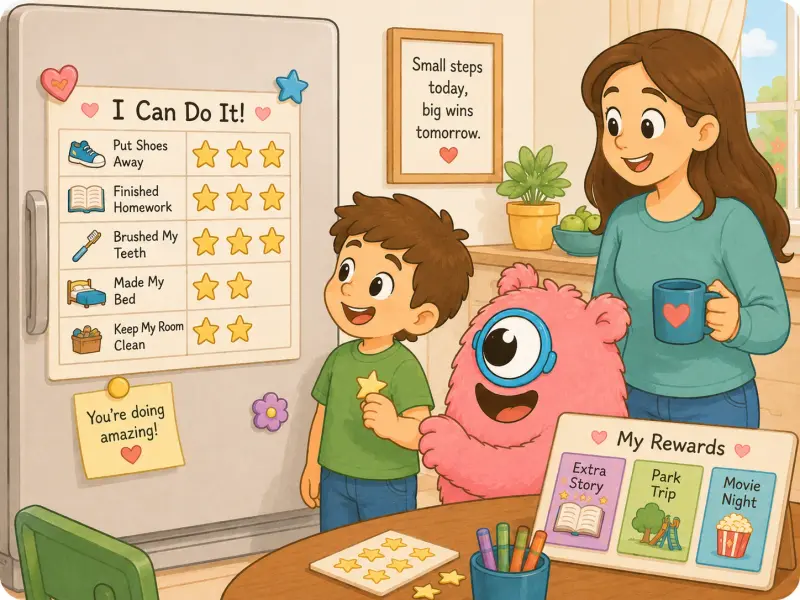
Why reward charts suit the ADHD brain
Children with ADHD aren't lazy or unwilling - their brains are wired to respond differently to motivation and delayed consequences. The reward system in the ADHD brain tends to need more immediate, more frequent, and more concrete feedback to stay engaged. That's exactly what a reward chart provides: it takes an abstract expectation ("get ready for school") and turns it into a visible, trackable, rewardable goal.
This isn't just intuition. In a controlled study, researchers found that reinforcement improved cognitive task performance in children with ADHD, often to a greater degree than in their typically-developing peers, because of their heightened trait sensitivity to reward. For a child who struggles to start and finish tasks, that external nudge can bridge the gap until a habit forms.
What the research actually supports
Reward charts are a household version of a token economy - a behavioral system where good behaviors earn tokens (stars, points, stickers) that can later be traded for a reward. Token economies have decades of research behind them. A recent controlled trial showed that a token-based system reduced disruptive, externalizing behavior in children with ADHD and even enhanced the effects of stimulant medication rather than competing with it.
The biggest-picture evidence comes from a landmark meta-analysis of randomized controlled trials. The review found that behavioral interventions for ADHD produce clear benefits for conduct, parenting quality, and the parent-child relationship - the everyday functioning that makes family life workable. Follow-up research has also shown that these improvements in children's behavior and positive parenting tend to be sustained for months after the program ends, not just during it.
One honest caveat is worth knowing. The same big review found that while reward-based approaches change behavior, they don't clearly reduce the core symptoms of ADHD itself - the underlying trouble with focus and sitting still - especially when judged by people who didn't know which kids were getting the reward system. In plain terms, a reward chart can genuinely change what your child does day to day and make routines smoother, but it won't make the ADHD go away. Use it to support good habits and a calmer relationship, and you're using it for exactly what the research backs.
How to set up a reward chart that actually works
Plenty of reward charts fail, and it's usually down to a few fixable mistakes. Here's how to build one that sticks.
1. Pick one to three specific goals. Vague targets like "behave well" give a child nothing concrete to aim at. "Put shoes on by 8:00" or "Finished homework before screen time" are clear and checkable. Start small - too many goals at once overwhelms both of you.
2. Reward immediately. This is the single most important rule for ADHD. The longer the gap between the behavior and the reward, the weaker the effect. Hand over the star the moment it's earned, and let small rewards happen daily rather than making your child wait a whole week.
3. Choose rewards together. A reward only motivates if your child actually wants it. Sit down and build the list as a team - extra screen time, a favorite snack, choosing dinner, a trip to the park. Mixing small daily rewards with a bigger weekly one keeps motivation alive across the week.
4. Focus on catching them being good. Reward charts work through positive reinforcement, not punishment. Resist the urge to take stars away for bad behavior, which can spiral into discouragement. If you want to address slip-ups, a separate, calm conversation works better than erasing hard-won progress.
5. Keep it visual and consistent. Put the chart somewhere your child sees it constantly - the fridge, their bedroom door. Review it at the same time each day so it becomes part of a predictable routine, which is itself calming for many neurodivergent kids.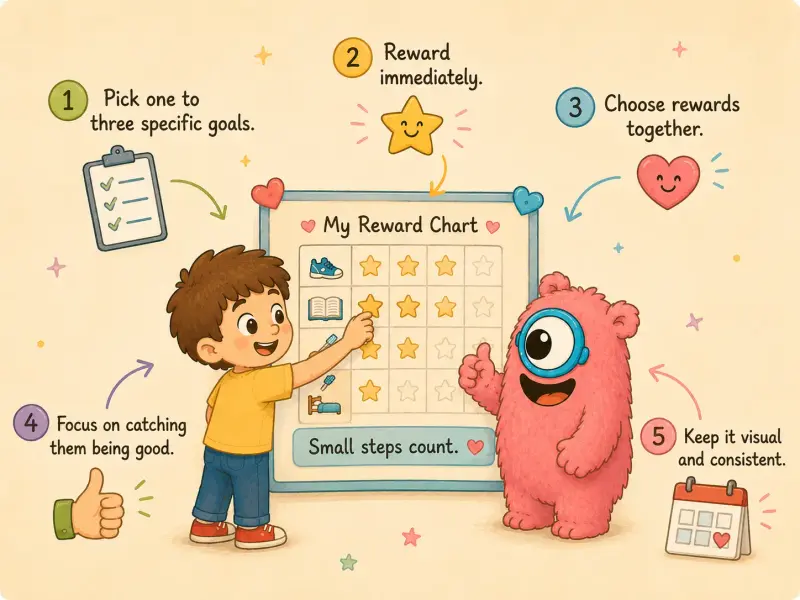
Common mistakes to avoid
A few traps catch well-meaning parents.
Making goals too hard means a child never earns the reward and gives up.
Switching the system constantly stops your child from building trust in it.
Using the chart as a threat ("you'll lose a star!") turns a positive tool into a source of anxiety.
Expecting a chart to single-handedly manage ADHD sets everyone up for disappointment - it works best alongside other supports like routines, school accommodations, and, where appropriate, professional guidance.
It's also worth remembering that motivation tools extend well beyond charts. If you're wary of leaning too hard on rewards, our guide to reward systems that motivate ADHD kids without slipping into bribery is a useful companion to this one, and for the bigger picture our overview of strategies that actually work for motivating an ADHD child covers approaches that go beyond any single chart or system.
Download your free ADHD reward chart
To make this easy, we've put together a free, printable weekly reward chart designed with ADHD-friendly principles built in: space for a few specific goals, a clear star grid, a section to write rewards you choose together, and a tiered small/medium/big reward setup so motivation stays fresh all week. Print it, stick it on the fridge, and start tonight.
Download the free printable ADHD reward chart (PDF)
The takeaway
A reward chart gives children with ADHD what their brains crave - immediate, visible, motivating feedback - and the research backs it up as a genuine tool for improving behavior, task completion, and family harmony. Keep your goals specific, your rewards immediate, and your expectations grounded in what charts can actually do. Pick a couple of goals tonight, choose the rewards together, and start small. Consistency, not perfection, is what makes it work.
FAQs
Do reward charts really work for kids with ADHD?
Yes, for behavior and motivation. Research consistently shows that token-based reward systems improve task completion and reduce disruptive behavior in children with ADHD. The key caveat is that they support day-to-day functioning rather than reducing the core symptoms of ADHD itself, so they work best as one part of a broader plan.
What age is a reward chart suitable for?
Reward charts work well for roughly ages 3 to 11, with the design adjusted to suit. Younger children respond to stickers and immediate daily rewards; older kids may prefer a points system they can save toward something bigger. Teens usually need a more collaborative, less "chart-like" approach.
Should I take away stars for bad behavior?
Generally, no. Most experts recommend keeping the chart focused on positive reinforcement - catching and rewarding good behavior. Removing earned stars can feel punishing and discouraging, which undermines the whole system. Handle difficult behavior separately and calmly.
How many goals should be on the chart?
Start with just one to three clear, specific goals. Too many at once overwhelms a child with ADHD and dilutes their focus. Once a behavior becomes a habit, you can retire that goal and add a new one.
Why isn't the reward chart working anymore?
Charts commonly lose steam when rewards become predictable or the novelty fades. Refresh the reward menu, adjust goals as your child grows, and make sure rewards are still immediate and genuinely motivating. If a chart stops working entirely, it may simply be time to evolve the system rather than abandon the approach.
Can a reward chart replace ADHD treatment?
No. A reward chart is a helpful behavioral tool, but it isn't a substitute for professional care. Research suggests behavioral strategies work best alongside other supports and, where recommended by a clinician, can even strengthen the effects of medication. Always work with your child's healthcare provider on an overall plan.
References
Fosco, W. D., Hawk, L. W., Rosch, K. S., & Bubnik, M. G. (2015). Evaluating cognitive and motivational accounts of greater reinforcement effects among children with attention-deficit/hyperactivity disorder. Behavioral and Brain Functions, 11(20). https://link.springer.com/article/10.1186/s12993-015-0065-9
Daley, D., van der Oord, S., Ferrin, M., Danckaerts, M., Doepfner, M., Cortese, S., & Sonuga-Barke, E. J. S. (2014). Behavioral interventions in attention-deficit/hyperactivity disorder: A meta-analysis of randomized controlled trials across multiple outcome domains. Journal of the American Academy of Child & Adolescent Psychiatry, 53(8), 835–847. https://pubmed.ncbi.nlm.nih.gov/25062591/
Hornstra, R., Groenman, A. P., van der Oord, S., Luman, M., Dekkers, T. J., van der Veen-Mulders, L., Hoekstra, P. J., & van den Hoofdakker, B. J. (2023). Sustained improvements by behavioural parent training for children with attention-deficit/hyperactivity disorder: A meta-analytic review of longer-term child and parental outcomes. JCPP Advances. https://www.ncbi.nlm.nih.gov/pmc/articles/PMC10501699/
Kim, S.-C.(2025). Verification of the effectiveness of a token economy method through digital intervention content for children with attention-deficit/hyperactivity disorder. https://www.ncbi.nlm.nih.gov/pmc/articles/PMC12561863/