TL;DR
Twelve picture books that teach math, from kindergarten to 3rd grade. Start with Mouse Count or Quack and Count in kindergarten, The Doorbell Rang or How Big Is a Foot? in 1st and 2nd grade, and A Remainder of One or Full House in 3rd grade. The other six are below.
The story is the hook. It gets your child interested in a number problem. The question you ask and five minutes with real objects afterward do most of the teaching.
The research is modest and mixed. In kindergarten studies, math picture books gave a small gain on a math test and a clearer gain in math words like "more" and "equal". Two other trials found little or no effect.
Read it twice. Read once just for the story, then reread with one question and a handful of counters, cookies or toy ducks.
Your child will sit through the same bedtime story for the ninth night in a row, then slide off the chair at the sight of a math worksheet. Picture books that teach math put that patience to work. A good one puts a real number problem inside a story your child already cares about: a snake counting mice into a jar, a plate of cookies that has to be shared again every time the doorbell rings, a bug who keeps getting left out of the parade.
Below are 12 math picture books for kindergarten to 3rd grade, roughly youngest to oldest, each with its concept, the grade it suits and a few questions to ask while you read. The prep is a library card and your kitchen drawer: buttons, dried beans, crackers, a ruler. Many of the follow-ups are tiny games, so they pair well with our 12 math games for 1st grade kids who hate worksheets.
Why do so many kids push back on math practice but never on a story?
A story asks your child only to listen. A page of sums asks them to perform, alone, and get it right, which can feel like a test to a six-year-old still unsure what numbers mean.
That worry starts early. When researchers tested 154 first and second graders, those who were more anxious about math had lower math achievement, but only among children with stronger working memory. The study can't say anxiety caused the lower scores, but math worry is clearly there by 1st grade.
Parents' feelings matter too. In a study of 438 first and second graders, children of math-anxious parents learned less math over the school year, but only when those parents often helped with math homework. No one has tested whether reading together avoids that effect, but if math makes you tense, a story is an easier place to start than a worksheet.
Do math picture books actually help kids learn math?
Somewhat. The gains in studies are small, and the clearest one came when parents counted and talked about the numbers with their child. Here is what the studies found, including the ones that found little:
Kindergarten picture books gave a small boost. In 18 Dutch kindergarten classes (384 children), teachers read math-rich picture books for three months. Compared with the control classes, the increase in the reading classes was 22% larger (d = 0.13) on a test of number, measurement and geometry, which is a small effect. It was significant for girls but not for boys, and the authors say they are not completely sure the program was run as intended.
Stories taught math words more than math skills. In a trial with 124 kindergartners who were behind in early number skills, small groups heard math storybooks over 24 half-hour sessions. They beat the other groups on math vocabulary such as "equal", "more" and "less", but showed no gain on general math measures. The authors suggest pairing the vocabulary work with more intensive teaching of number concepts.
A classroom program that was only partly carried out showed no clear gain. When 36 kindergarten teachers were randomly assigned to a math read-aloud program of up to 18 weeks or to teaching as usual, children in the read-aloud classes scored a little higher on two math tests, but the difference was not significant. The authors say limited use of the program may explain the result.
At home, counting books with "how many" talk caused gains in younger children. One hundred families of two- to four-year-olds were asked to read specially written books every day for four weeks, counting the objects and saying the total. Books about sets of one to three moved children further along in understanding number words than books with no numbers. The sample was small, the books were designed by the researchers, and whether the gains last is still open.
Not every picture-book program works. In a trial where trained staff read picture books in small groups with 234 children aged three to five, the effects of the picture-book interventions "were not as clear, nor as robust, as had been expected".
Two caveats. Most of this research is with preschoolers and kindergartners; we found no peer-reviewed, free-to-read trial of shared math picture-book reading in 2nd or 3rd grade. And none of these studies used the 12 books below. As a 2014 review of the field puts it, simply selecting and using a book with mathematics learning experiences "does not guarantee learning".
So treat the books as a way into math talk. In a Chicago-area study of 44 children, how much parents talked about numbers between 14 and 30 months predicted children's grasp of what number words mean at 46 months, even after accounting for family income and education. The study was correlational, but it is why every book below comes with a question and something to do with real objects.
What math should a K-3 child know, and which books fit?
The Common Core standards, which many US states use or adapt, name a few big areas per grade. Here is how the books line up.
The grade labels below are our suggestion, based on the math in each story. Use them to pick the question you ask, not who is allowed to read the book.
12 math picture books for K-3 at a glance
The 12 books
1. Mouse Count by Ellen Stoll Walsh
Concept: Counting to 10 one at a time, and counting back from 10
Best for: Kindergarten
You need: 10 small toys (or crackers) and a jar or cup
What happens: Ten mice are napping in a meadow when a hungry snake finds them and counts them into a jar for his dinner. After a clever trick, the mice escape and count themselves back out of the jar, from ten down to one.
While you read:
Point out that the snake says the next number only after a mouse lands in the jar: "He drops one in, then he says the number."
Before you turn a page, ask "How many mice are in the jar now? How many after the next one?"
On the second read, act it out with 10 toys and a jar. Your child drops one in and says the number, then counts them back out: "Ten, nine, eight..."
Easier: Use five toys and stop halfway through the count. Harder: Hide the jar under a tea towel and ask "There are 7 in the jar. If one more goes in, how many?" without letting them recount.
Why it works: The snake says one number for each mouse, the one-number-one-object match kindergartners are still learning, and the escape runs the same count in reverse.
2. Quack and Count by Keith Baker
Concept: The different ways to make 7 (early addition)
Best for: Kindergarten to 1st grade
You need: 7 small objects (rubber ducks, buttons, raisins) and two plates
What happens: Seven ducklings play in a marsh. On each spread they split into a new pair of groups, starting with 6 plus 1 and shifting one duckling at a time from one page to the other, so the book works through the combinations that make 7. The cut-paper ducklings sometimes overlap or hide among the ferns and grasses, so finding all seven takes a careful look.
While you read:
On each spread, count the ducks on the left page, then the right, then all of them: "Five here, two there. Still seven?"
Ask your child to predict the next split before you turn the page.
After the book, put seven objects on two plates and ask "How else can we split 7 ducks?" Write each split down, 4 + 3, 5 + 2, until you run out.
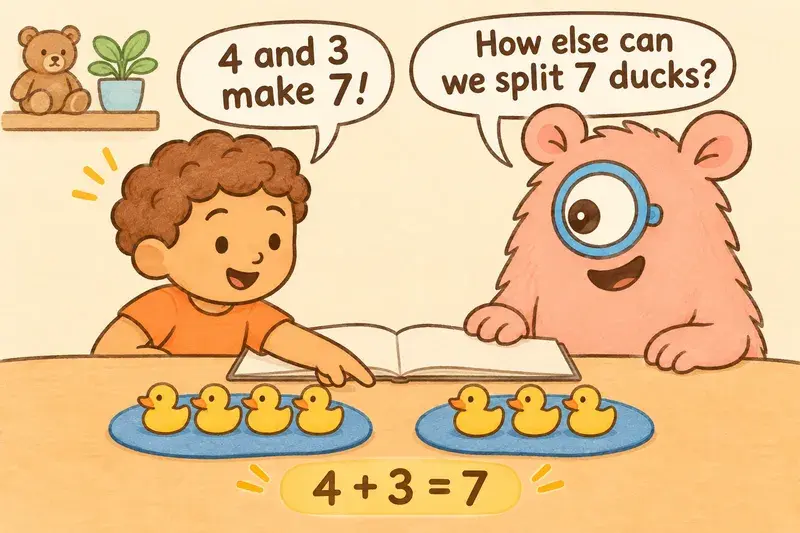
Easier: Do the same with five objects. Harder: Hide some ducks under a cup: "There are 7 altogether and I can see 3. How many are hiding?"
Why it works: Knowing that 7 is made of 4 and 3 (and 5 and 2, and 6 and 1) is the base for adding without counting every object from one. If your child still counts everything from one, our explainer on counting on and when kids stop counting all covers what comes next.
3. One Is a Snail, Ten Is a Crab by April Pulley Sayre and Jeff Sayre, illustrated by Randy Cecil
Concept: Building numbers from parts, adding, and counting by tens
Best for: Kindergarten to 2nd grade
You need: The feet in your family
What happens: A counting book where the things counted are feet. A snail has one foot and a crab has ten (counting its claws), and beach creatures are combined to make each number. Later pages count bigger numbers in groups of ten.
While you read:
Before you show each answer, ask "How could we make this number with these animals?"
Count on from the bigger part: "A dog has four feet. Add a snail. Four... five."
After reading, count the feet in your family, then ask how many there would be if the dog joined you.
Easier: Stay with the numbers up to 10. Harder: "How many crabs would make 30 feet? How many people?"
Why it works: Seeing one number as a sum of others is the thinking behind addition facts, and the groups of ten set up place value.
4. The Greedy Triangle by Marilyn Burns, illustrated by Gordon Silveria
Concept: Naming shapes by their sides and corners
Best for: Kindergarten to 2nd grade
You need: Straws, craft sticks or uncooked spaghetti
What happens: A busy triangle gets tired of its life and asks a shapeshifter for one more angle, which makes it a quadrilateral. Then it wants another, becoming a pentagon, and it keeps going. In the end it decides it was happiest as a triangle.
While you read:
Each time the shape changes, ask "How many sides now? How many corners?" and count them on the page together.
Afterward, build the triangle with three straws and add one straw at a time, naming each shape.
Easier: Stop at four sides. Harder: "Is every shape with four sides a square?" Make a long, thin four-sided shape to find out.
Why it works: Building and changing a shape one side at a time shows that its name comes from its sides and corners, not from how it's turned or how big it is.
5. Two of Everything by Lily Toy Hong
Concept: Doubling and doubles facts
Best for: 1st to 2nd grade
You need: A pot or bowl and a pile of small objects
What happens: In this retelling of a Chinese folktale, a poor farmer digs up an old brass pot, and he and his wife, the elderly Haktaks, discover it makes a copy of whatever falls into it. Then Mrs. Haktak falls in, and Mr. Haktak after her, and the couple have to work out what to do with two of themselves.
While you read:
Each time something goes into the pot, pause: "One went in. How many will come out?"
After reading, play "magic pot". You drop in a number of beans, your child says how many will come out, then you count out the double.
Easier: Keep to numbers up to 5. Harder: Work backward: "Eight came out. How many went in?"
Why it works: Doubles like 6 + 6 become anchors for near-doubles (6 + 7 is one more), and the pot gives doubling a picture. Working backward is an early taste of halving.
6. The Doorbell Rang by Pat Hutchins
Concept: Fair sharing, the start of division
Best for: 1st to 2nd grade
You need: 12 crackers or cookies and a stack of small plates
What happens: Two children are about to share a plate of 12 freshly baked cookies, six each, when the doorbell rings. Friends arrive, so now four children get three each, and the doorbell keeps ringing until everyone has only one. Then Grandma arrives with a big tray of cookies.
While you read:
Each time the doorbell rings, stop before the page turns: "How many children now? How many cookies will each one get?"
Let your child deal 12 crackers onto plates, one to each plate in turn, like dealing cards.
Ask "What if 5 children came? Could they share 12 fairly?"
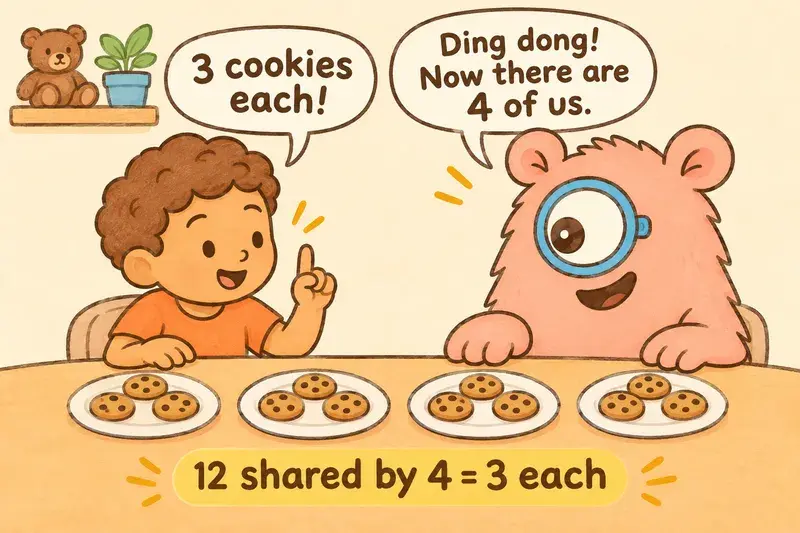
Easier: Start with six crackers and two or three plates. Harder: Write each share as a sentence: "12 shared by 4 is 3 each", then "4 groups of 3 is 12."
Why it works: Dealing objects out one at a time is how young children solve sharing problems long before they meet the ÷ sign, and the same 12 cookies show that more sharers means smaller shares. The question about 5 children opens up leftovers, which A Remainder of One picks up later.
7. Earth Day—Hooray! by Stuart J. Murphy, illustrated by Renée Andriani
Concept: Place value: ones, tens, hundreds and thousands
Best for: 2nd to 3rd grade
You need: A big bag of dried beans or pasta, plus small cups or zip bags
What happens: The Maple Street Save-the-Planet Club decides to collect aluminum cans and use the recycling money to buy flowers for a local park on Earth Day. Their advisor works out they'll need 5,000 cans, and the children bag them in groups of 10, 100 and 1,000 to keep track.
While you read:
When the club bags the cans, ask "Why put them in bags of ten instead of counting them one by one?"
Afterward, grab a handful of beans and bag them in tens. Count the bags and the leftovers: "3 bags of ten and 4 loose. That's 34."
Easier: Stay with tens and ones up to 50. Harder: Make ten bags of ten and ask what you'd call that group (one hundred), then how many hundreds make 1,000.
Why it works: Bundling real objects into tens is how many classrooms teach place value, and the cans give it a reason. For more hands-on practice, see our place value and regrouping games for 2nd grade.
8. How Big Is a Foot? by Rolf Myller
Concept: Why we measure with standard units
Best for: 1st to 2nd grade
You need: Paper, a pencil, scissors and a ruler
What happens: A King wants to give the Queen a bed for her birthday, but beds haven't been invented, so nobody knows how big one should be. The King paces it out with his own feet, 3 feet wide and 6 feet long, yet the bed comes out too small for the Queen and the apprentice who built it lands in jail. He has to work out what went wrong, and by the end the bed fits.
While you read:
When the bed turns out too small, ask "It was 6 feet long. So why doesn't it fit?" Let your child guess, then compare your foot with theirs.
Afterward, trace both your feet on paper, cut them out and measure the same rug or table with each. Then measure it with a ruler.
Easier: Measure one thing with both paper feet and compare. Harder: Find things in the house that are about 1 foot (12 inches) long and about 2 feet long.
Why it works: In the Common Core, 1st graders measure by repeating any unit and 2nd graders move to standard units. The apprentice's mistake shows why that move is needed.
9. One Hundred Hungry Ants by Elinor J. Pinczes, illustrated by Bonnie MacKain
Concept: Equal rows (arrays) and the ways to split 100
Best for: 2nd to 3rd grade
You need: 20 small objects (cereal, beans), plus 100 of them or a printed 100 chart for the harder question
What happens: One hundred ants march in single file toward a picnic. The littlest ant thinks they're too slow and has them regroup: 2 lines of 50, then 4 lines of 25, then 5 lines of 20, and finally 10 lines of 10. All that rearranging costs them time, and when they finally arrive the picnic food is gone.
While you read:
At each new formation, ask "Are there still 100 ants? How do you know?"
Afterward, lay out 20 pieces of cereal and find every way to make equal rows: 2 rows of 10, 4 rows of 5, and so on.
Easier: Use 12 objects instead of 20. Harder: Ask "Could 100 ants march in 3 equal lines?" and test it.
Why it works: The same 100 ants in new rows show that the total doesn't change when the arrangement does, the idea behind arrays in 3rd grade multiplication.
10. A Remainder of One by Elinor J. Pinczes, illustrated by Bonnie MacKain
Concept: Division with remainders
Best for: 3rd grade
You need: 25 counters, buttons or coins
What happens: The queen of the bugs wants her squadron of 25 to march in even lines. When they march in two lines, one bug, Joe, is left over and has to sit out. Joe tries three lines and then four, and each time he is still the one left over, until five lines of five leave no remainder and Joe can finally march.
While you read:
Before each new parade, ask "Will anyone be left over this time? How many?"
Build each formation with 25 counters as you read: 2 equal lines, then 3, then 4, then 5.
When you reach five lines of five, ask "Why did 5 work when 2, 3 and 4 didn't?"
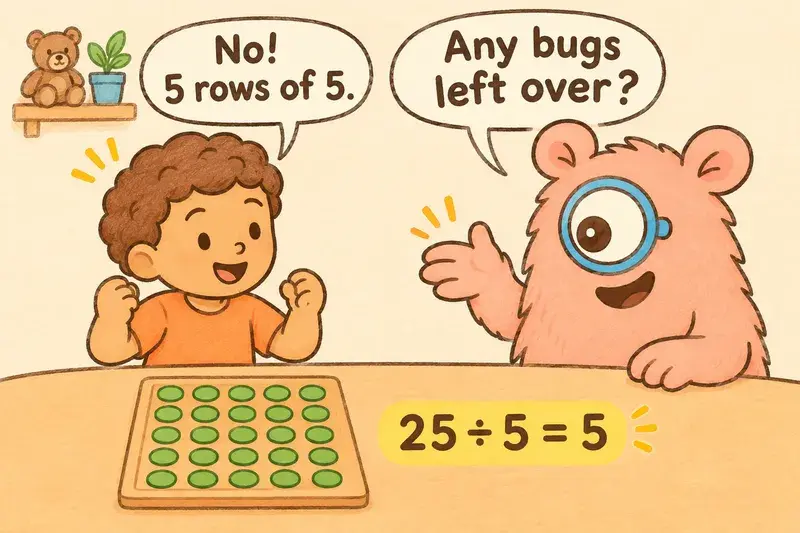
Easier: Do it with 10 counters and try 2, 3 and 5 equal lines. Harder: "If the squadron had 24 bugs, how many equal lines could they make?"
Why it works: In the Common Core, finding quotients and remainders is a 4th grade standard, so this is a stretch book for 3rd graders. Building the rows makes "left over" visible long before your child has to write "r 1".
11. Spaghetti and Meatballs for All! by Marilyn Burns, illustrated by Debbie Tilley
Concept: Area and perimeter
Best for: 3rd grade
You need: 8 square sticky notes or square crackers
What happens: Mr. and Mrs. Comfort are hosting a family reunion. Mr. Comfort cooks his spaghetti and meatballs while Mrs. Comfort carefully sets out eight tables and thirty-two chairs so everyone has a seat. Then the guests arrive and start pushing tables together so they can sit with each other, and every push loses seats.
While you read:
Each time the guests move tables around, ask "Did they gain seats or lose them?"
Lay out eight square sticky notes as eight separate tables, one chair on each side. Count the seats.
Push two together and count again. Then try all eight in one long row, and in a 2 by 4 block.
Easier: Use just two or three tables. Harder: "Which way of arranging all eight tables seats the most people? Which seats the fewest?"
Why it works: The tabletop space (area) stays the same however the tables are arranged, but the edge where people sit (perimeter) changes. Telling those two apart is a 3rd grade Common Core goal.
12. Full House: An Invitation to Fractions by Dayle Ann Dodds, illustrated by Abby Carter
Concept: Fractions of a group and of a whole, in sixths
Best for: 2nd to 3rd grade
You need: A paper circle "cake" and a pencil
What happens: Miss Bloom runs an inn with six rooms, and a parade of guests, from a sea captain to a Duchess with her pampered dog, checks in. The illustrations light up the inn's windows as rooms fill and show the matching fraction. When a cake gets shared out, there is one-sixth left for Miss Bloom.
While you read:
Each time a guest arrives, ask "How many of the six rooms are full now? How many are empty?"
Say it as a fraction together: "Two out of six rooms. Two-sixths."
Afterward, cut a paper cake into six roughly equal slices and share it out among family members and teddies. What fraction did each get?
Easier: Cut the cake in halves, then fourths. Harder: "Is one-sixth more or less than one-half? How can you tell from the slices?"
Why it works: The book shows a fraction two ways, as part of a group (rooms) and part of a whole (cake), and 3rd grade standards focus on unit fractions like one-sixth. A cake in sixths beside one in halves quickly settles whether a bigger bottom number means a bigger piece.
A simple week with one book
You don't need a new book every night. One book across a week, five to ten minutes a day, is plenty.
This is a practical starting point; no study has tested this exact schedule.
What if my child has ADHD, autism, dyslexia, dyscalculia or math anxiety?
Picture books keep the math short and tied to a story, which suits many neurodivergent children. A few adjustments help:
ADHD: keep the math part short and physical. Read the story straight through, then ask one question, not five. Let your child hold the counters or deal the crackers while you read.
Autism: reread and keep the routine. The same book in the same chair makes the math question the only new thing. Explain phrases that don't make literal sense, such as "left over" or "a remainder of one".
Dyslexia: you do the reading. The math is in the pictures and the talk, so your child doesn't need to decode a word to do the thinking.
Dyscalculia or early number difficulties: go small and slow. Use real objects for every number and stay with small quantities until they feel solid. In a study of two- to four-year-olds, children who only knew what "one" and "two" meant gained from books about sets of one to three, but not from books about four to six. Those children were younger than K-3 and the subgroups were small, but the principle of starting where your child is carries over.
Math anxiety: never turn the story into a quiz. Ask questions you're curious about ("I wonder how many cookies they'll get now?"), accept guesses, and drop the question if your child just wants the story.
Where does a math app fit in?
Books build the ideas and the words. Children also need regular practice until facts like 4 + 3 come quickly, and an app can help on days you can't sit down together.
The evidence for digital practice is fairly good, though results vary. A meta-analysis of 15 randomized trials with 1,073 children who had math learning difficulties found that digital interventions generally improved math performance (mean effect size 0.55), though results varied a lot between studies. It found no evidence that video games did better than digital drill or tutoring, so a game format is no guarantee on its own.
Monster Math is our game-based math fact fluency app for grades K–3, built for neurodivergent kids, including those with ADHD and autism. It runs in the browser and on iPad, iPhone and Android, with no timers, and it moves from number sense through addition and subtraction into multiplication. Those studies didn't test Monster Math specifically, and it is no substitute for reading and talking about numbers together. We built it for untimed practice of the facts these books introduce. You can start a free trial of Monster Math and see whether your child enjoys it.
Start with one book and one question this week
Pick the book that matches what your child is working on in school: Quack and Count or Mouse Count for a kindergartner, The Doorbell Rang for a 1st or 2nd grader, A Remainder of One or Spaghetti and Meatballs for All! for a 3rd grader.
Read it once for fun. On the second read, ask one question and get out the crackers or counters. If your child enjoys it, keep going for the week. If not, try a different book. The questions only work with a story your child wants to hear again.
FAQs
What are the best picture books to teach math in kindergarten?
Good kindergarten choices are Mouse Count by Ellen Stoll Walsh (counting to 10 and back), Quack and Count by Keith Baker (the ways to make 7) and One Is a Snail, Ten Is a Crab by April Pulley Sayre and Jeff Sayre (building numbers from parts). They match the kindergarten focus on counting and comparing sets of objects. Pair each with real objects your child can count.
Do math picture books actually improve math skills?
They help a little, and the talk around the book seems to matter. In a Dutch study of 384 kindergartners, three months of math picture books produced a small gain on a math test (d = 0.13), and in a US trial with 124 struggling kindergartners, math storybooks improved math vocabulary but not general math scores. A US classroom read-aloud program that was only partly carried out showed no significant effect.
How do I read a math picture book with my child?
Read it once for the story, then reread it and ask one math question before you turn a page, such as "How many cookies will each child get now?" Afterward, spend five minutes acting out the math with crackers, beans or toys, and accept guesses so it never feels like a test.
What picture book teaches division to kids?
The Doorbell Rang by Pat Hutchins is a classic for early division: two children share 12 cookies, and every ring of the doorbell brings more friends, so the shares shrink from six each to three each and finally one each. For 3rd graders, A Remainder of One by Elinor J. Pinczes shows division with remainders as 25 bugs try marching in 2, 3, 4 and 5 lines.
Are math picture books good for kids with ADHD or dyscalculia?
They can be, because the story holds attention and the math comes in small, concrete pieces. With ADHD, keep it to one question per read and let your child handle objects; with dyscalculia, use real objects for every number and start small. No study has tested these 12 books with neurodivergent children specifically.
What picture books teach fractions and area for 3rd grade?
Full House: An Invitation to Fractions by Dayle Ann Dodds shows sixths through an inn with six rooms and a shared cake. Spaghetti and Meatballs for All! by Marilyn Burns shows area and perimeter as relatives keep rearranging eight tables and thirty-two chairs at a family reunion. Both match 3rd grade Common Core goals on unit fractions and area.
References
Benavides-Varela, S., Zandonella Callegher, C., Fagiolini, B., Leo, I., Altoè, G., & Lucangeli, D. (2020). Effectiveness of digital-based interventions for children with mathematical learning difficulties: A meta-analysis. Computers & Education, 157, Article 103953. Open access: https://www.research.unipd.it/bitstream/11577/3345422/2/1-s2.0-S0360131520301512-main.pdf (DOI: 10.1016/j.compedu.2020.103953)
Common Core State Standards Initiative. (n.d.). Mathematics standards: Kindergarten, Grade 1, Grade 2 and Grade 3 introductions; Grade 3 Measurement and Data; Grade 4 Number and Operations in Base Ten. https://www.thecorestandards.org/Math/Content/K/introduction/
Flevares, L. M., & Schiff, J. R. (2014). Learning mathematics in two dimensions: A review and look ahead at teaching and learning early childhood mathematics with children's literature. Frontiers in Psychology, 5, Article 459. https://pmc.ncbi.nlm.nih.gov/articles/PMC4033191/
Gibson, D. J., Gunderson, E. A., & Levine, S. C. (2020). Causal effects of parent number talk on preschoolers' number knowledge. Child Development, 91(6), e1162–e1177. Author copy: https://cogdevlab.uchicago.edu/files/2017/01/Child-Development-2020-Gibson-Causal-Effects-of-Parent-Number-Talk-on-Preschoolers-Number-Knowledge.pdf (DOI: 10.1111/cdev.13423)
Hassinger-Das, B., Jordan, N. C., & Dyson, N. (2015). Reading stories to learn math: Mathematics vocabulary instruction for children with early numeracy difficulties. The Elementary School Journal, 116(2), 242–264. Open access: https://pmc.ncbi.nlm.nih.gov/articles/PMC4696600/ (DOI: 10.1086/683986)
Levine, S. C., Suriyakham, L. W., Rowe, M. L., Huttenlocher, J., & Gunderson, E. A. (2010). What counts in the development of young children's number knowledge? Developmental Psychology, 46(5), 1309–1319. Open access: https://pmc.ncbi.nlm.nih.gov/articles/PMC2998540/
Maloney, E. A., Ramirez, G., Gunderson, E. A., Levine, S. C., & Beilock, S. L. (2015). Intergenerational effects of parents' math anxiety on children's math achievement and anxiety. Psychological Science, 26(9), 1480–1488. Author copy: https://sites.temple.edu/cognitionlearning/files/2013/09/Maloney-et-al-in-press.pdf
Powell, S. R., Moore, C. E., Vander Tuin, M., Fall, A.-M., & Roberts, G. (2024). Investigation of the initial feasibility of extended mathematics read-alouds used by kindergarten teachers. Frontiers in Education, 9, Article 1379491. https://www.frontiersin.org/articles/10.3389/feduc.2024.1379491/full
Purpura, D. J., O'Rear, C. D., Ellis, A., Logan, J. A. R., Westerberg, L., Ehrman, P., King, Y. A., Vander Tuin, M., Nordgren, I., Anderson, K., Cosso, J., Zippert, E., Napoli, A. R., Hornburg, C. B., Schmitt, S. A., & Dobbs-Oates, J. (2024). Unique and combined effects of quantitative mathematical language and numeracy instruction within a picture book intervention: A registered report. Journal of Educational Psychology, 116(1), 1–19. Public access copy: https://par.nsf.gov/servlets/purl/10526155 (DOI: 10.1037/edu0000820)
Ramirez, G., Gunderson, E. A., Levine, S. C., & Beilock, S. L. (2013). Math anxiety, working memory, and math achievement in early elementary school. Journal of Cognition and Development, 14(2), 187–202. Author copy: https://sites.temple.edu/cognitionlearning/files/2013/09/Ramirez-et-al-2013.pdf
van den Heuvel-Panhuizen, M., Elia, I., & Robitzsch, A. (2016). Effects of reading picture books on kindergartners' mathematics performance. Educational Psychology, 36(2), 323–346. Open access: https://pmc.ncbi.nlm.nih.gov/articles/PMC4720050/ (DOI: 10.1080/01443410.2014.963029)