TL;DR: PDA (Pathological Demand Avoidance) is an anxiety-driven profile found within the autism spectrum where even low-stakes requests - like "open your math book" - can trigger intense avoidance. Traditional rewards, structured routines, and pressure-based strategies tend to make things worse. What helps is reducing the sense of demand: offering real choices, framing tasks as collaborative, using indirect language, and letting the child lead wherever possible. Math, with its timed drills, worksheets, and "right answer" pressure, is a particularly tough arena for PDA learners - but with the right approach, it can become one where they genuinely thrive.
You ask your child to do three math problems. They were happily drawing monsters two minutes ago. Now there is a meltdown, a negotiation, a sudden urgent need for a snack, or simply a blank wall of refusal. You try rewards. You try consequences. Nothing works - or worse, everything works briefly and then stops working entirely.
If this sounds familiar, your child may have a PDA profile. And if math is the battleground where demand avoidance shows up hardest, you are in exactly the right place.
What Is PDA?
PDA stands for Pathological Demand Avoidance (also called Persistent Drive for Autonomy or Extreme Demand Avoidance). It describes a profile found within the autism spectrum, characterised by an intense, anxiety-driven need to avoid everyday demands and expectations. The key word here is anxiety. Do not look at it as wilful defiance. It is in fact a nervous system that reads "do this task" as a genuine threat.
The profile was first described by British clinician Elizabeth Newson and colleagues in their foundational 2003 paper, which proposed PDA as a distinct presentation within the pervasive developmental disorders. Newson observed that children with PDA often used socially strategic behaviors to avoid everyday demands -such as distraction, negotiation, role play, or excuse-making - in ways she argued differed from other developmental presentations recognized at the time.
Research also found that many conceptualizations of PDA describe it as involving an extreme avoidance of everyday demands, often linked to anxiety, emotional regulation difficulties, and a strong need for control.
PDA is not currently listed as a standalone diagnosis in the DSM-5 or ICD-11, but it is widely recognised by clinicians and educators - particularly in the UK - as a distinct and identifiable profile within autism.
Why Math Feels Like a Minefield for PDA Learners
Math class is practically designed to trigger demand avoidance. Think about it from a PDA child's perspective: a specific task is assigned, at a specific time, with a specific method, and there is a correct answer that someone else already knows. Every element of that equation screams "you have no control here."
Executive-functioning difficulties and autistic differences in processing social expectations can make everyday demands feel abrupt and intrusive. A request that seems routine to a teacher may feel as though it has come out of nowhere to a child with a PDA profile, triggering anxiety and resistance rather than a smooth transition between activities. In math, where tasks change constantly - from number sense to word problems to timed facts - these jolts happen over and over.
Add to that the specific pressure points math brings:
Timed drills create urgency and remove autonomy entirely.
Worksheets are static, non-negotiable lists of demands.
Single correct answers remove room for interpretation or creativity.
Public performance (answering in class, showing work on the board) adds social scrutiny.
Research confirms that PDA appears across the full range of intellectual ability - in children with high academic capability just as much as in those with additional learning needs. The barrier to engagement with tasks like math is anxiety and the perception of demand, not cognitive capacity. When demand pressure is reduced, that existing capability has room to become visible.
What the Research Says About Supporting PDA Learners
One of the most frequently reported observations in the PDA literature is that traditional behaviour-management strategies often make things worse rather than better. Reward charts, point systems, and consequence-based approaches may increase anxiety and resistance instead of reducing them. O'Nions and Eaton note that conventional behavioural strategies are often ineffective for individuals with PDA, suggesting that punishment can heighten the anxiety associated with demands, while contingent rewards may also provoke distress by reinforcing external control. In both cases, the result can be greater demand avoidance rather than improved compliance.
A peer-reviewed study surveyed parents of autistic children with extreme demand-avoidance behaviours and found that this group experienced higher rates of school exclusion, placement difficulties, and negative educational experiences than autistic children without demand avoidance. Parents consistently reported that successful placements were associated with educators who understood the child's profile and adapted their approach accordingly, highlighting the importance of flexibility, relationship-building, and individualized support.
O'Nions and Eaton describe a low-demand, low-arousal approach as what parental and clinical reports consistently point toward as more effective for PDA. This means reducing the number and intensity of perceived demands, keeping the environment calm, and building the relationship before attempting any task engagement.
The 2024 scoping review suggests that educational approaches commonly used in autism support - particularly those that rely heavily on compliance, routine, and externally imposed structure - may be less effective for some learners with PDA. Across the literature, more successful approaches tended to emphasize flexibility, collaboration, autonomy, and genuine choice, allowing demands to be introduced in ways that reduced anxiety and preserved the child's sense of control.
Teaching Math to a PDA Learner: What Actually Works
1. Reframe Tasks as Invitations, Not Instructions
Language matters enormously. "Do these five problems" is a demand. "I wonder if you could help me figure out why this answer looks wrong" is a collaboration. Indirect language, genuine curiosity framing, and placing the child in the role of expert or helper can dramatically reduce the demand signal. Try "I need your brain on this" rather than "it's time for math."
2. Offer Real Choices Within the Task
Choice removes the sense of being controlled. But it must be genuine - a choice between two equally undesirable options is not a choice. Let your child pick which problems to do first, whether to write or dictate, whether to sit at the table or on the floor, whether to use a pencil or a whiteboard marker. The math content stays; the autonomy increases.
3. Use Play and Role Play as Entry Points
PDA learners often engage readily through play, especially when the "learning" is embedded invisibly. A child who refuses a subtraction worksheet may happily run a pretend shop and make change, plan a Minecraft build that requires measuring areas, or play a board game that involves mental arithmetic. The demand disappears when the frame is play rather than work. Our article on neurodivergent math learning strategies has more on game-based approaches that sidestep anxiety triggers.
4. Drop Timed Activities Entirely
Timed math drills are the single most demand-heavy math activity in common use. For a PDA learner, the timer itself becomes the threat. Remove it. Speed and fluency can be built through repeated, low-pressure exposure over time. Accuracy matters far more than pace, and rushing a PDA child produces shutdown, not mastery.
5. Co-Create the Learning Plan
The Child Mind Institute notes that children with PDA make more progress and maintain it over time when they see that their ideas are considered. Invite your child to help plan their own math learning. Which topics feel interesting? Which ones feel scary? What would make a math session feel okay? This is not just good relationship-building - it is evidence-based practice.
6. Keep Sessions Short and Ending on Their Terms
A five-minute math session that ends well beats a thirty-minute session that ends in meltdown. Predictable, short windows with a clear endpoint give PDA learners a sense of control over the demand. Let them signal when they need to stop - and honour that signal. Over time, tolerance for math engagement grows when the child trusts that their limits will be respected.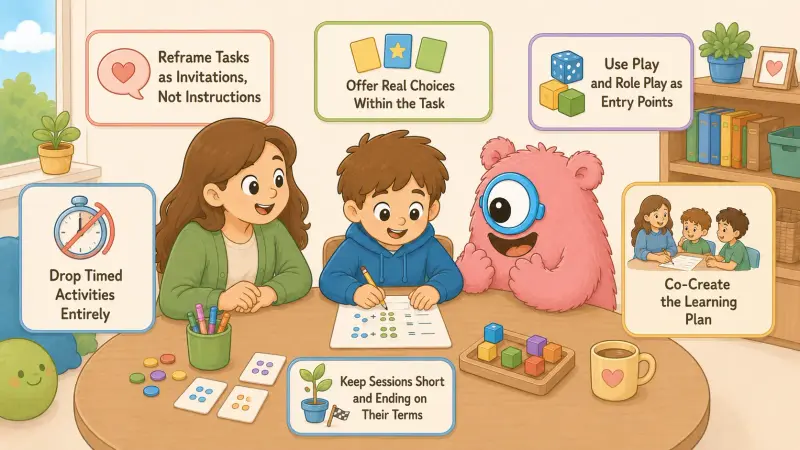
Tools That Can Help
Digital math tools can work well for PDA learners precisely because the demand comes from a screen rather than a person - and therefore feels less socially charged. The key is choosing tools that offer genuine autonomy: the ability to choose where to start, stop freely, and navigate at their own pace without timers or competitive pressure.
Avoid platforms that use countdown timers, public leaderboards, or consequence-based progression systems. These replicate the exact demand conditions that trigger avoidance. Look instead for tools that are self-directed, visually engaging, and low-stakes - where the child controls the pace. For a detailed comparison of neurodivergent-friendly math programs, our guide to the best online math programs for neurodivergent kids walks through what to look for and what to avoid.
PDA, Math Anxiety, and the Cycle That Can Develop
PDA and math anxiety are not the same thing, but they can amplify each other powerfully. A child whose demand avoidance leads to repeated math refusals misses learning opportunities. Gaps accumulate. When math tasks do occur, unfamiliarity adds a second layer of threat on top of the demand avoidance. The result is a compounding cycle where avoidance causes gaps, gaps cause genuine struggle, and genuine struggle intensifies the anxiety that drives avoidance.
Research on teacher support and math anxiety shows that students who perceive their math teacher as supportive, and who have a warm teacher-student relationship, report significantly lower math anxiety - making the relational dimension of teaching far more than a soft add-on. Our deeper dive into math anxiety in autism, ADHD, and dyscalculia explores the condition-specific patterns that are useful to understand alongside a PDA profile.
A Note for Teachers
If you have a PDA learner in your classroom, the single most important reframe is this: what looks like defiance is anxiety. The child who argues about every math instruction, who derails the lesson, who produces elaborate excuses - that child is not trying to make your life difficult. Their nervous system is in a threat response.
As suggested by O'Nions and Eaton, indirect language, genuine choices, and a low-arousal environment form the practical foundation of effective PDA support. Token economies and standard reward systems - approaches that work for many ADHD learners - may actually increase anxiety and avoidance in PDA students, a distinction Christie and colleagues have consistently highlighted in the PDA literature.
Working collaboratively with parents and involving the child in their own support plan is the most evidence-consistent approach available. The goal is safety first, learning second - and for PDA learners, these two things are deeply linked.
Frequently Asked Questions
Is PDA the same as Oppositional Defiant Disorder (ODD)?
No. ODD is typically characterised by defiance directed at authority figures, often in specific contexts. PDA is anxiety-driven, pervasive across settings and relationships, and rooted in a neurological drive for autonomy - not a pattern of deliberate rule-breaking. PDA learners often comply with requests they generate themselves, which is not a feature of ODD.
Will reward systems work for my PDA child in math?
In most cases, no - or only briefly. Research consistently shows that reward-and-consequence systems that work well for other children tend to produce short-term compliance followed by increased avoidance in PDA learners. The underlying anxiety is not addressed by rewards, so the avoidance returns, often stronger. Low-demand, collaborative, autonomy-based approaches have stronger evidence.
My child loves certain math topics but refuses others. Is that PDA?
Selective engagement is very common in PDA. A child may dive deeply into math topics they chose (prime numbers, geometry, probability) while flatly refusing some topics when assigned. The key variable is who initiated it. Math that feels chosen or discovered tends to bypass the demand signal.
How do I tell if it's PDA or just math anxiety?
Math anxiety typically centres on the difficulty or perceived failure risk of math itself. PDA avoidance centres on the demand - the fact of being asked - rather than the content. A PDA learner may refuse easy, familiar math tasks just as intensely as hard ones, simply because the request came from outside rather than from themselves. The two can absolutely coexist, but the drivers are different.
What age does PDA typically become visible in math learning?
PDA traits often become more pronounced once formal schooling begins, when the density and frequency of external demands increases sharply. Math tasks - with their structured, externally-set expectations - often become one of the first clear flashpoints. Many parents report that the mismatch between their child's clear intelligence and their complete refusal to engage with formal math tasks was one of the things that first raised the question of a PDA profile.
References
Newson, E., Le Maréchal, K., & David, C. (2003). Pathological demand avoidance syndrome: A necessary distinction within the pervasive developmental disorders. Archives of Disease in Childhood, 88(7), 595–600. https://pmc.ncbi.nlm.nih.gov/articles/PMC1763174/pdf/v088p00595.pdf
Truman, C., Crane, L., Howlin, P., & Pellicano, E. (2021). The educational experiences of autistic children with and without extreme demand avoidance behaviours. International Journal of Inclusive Education, 28(1), 57–77. https://www.tandfonline.com/doi/full/10.1080/13603116.2021.1916108
O'Nions, E., & Eaton, J. (2020). Extreme/'pathological' demand avoidance: An overview. Paediatrics and Child Health, 30(12), 411–415. hhttps://help4psychology.co.uk/wp-content/uploads/2021/10/ONions-Eaton-Extreme-pathological-demand-avoidance-an-overview.pdf
Haire, L., Symonds, J., Senior, J., & D'Urso, G. (2024). Methods of studying pathological demand avoidance in children and adolescents: A scoping review. Frontiers in Education, 9, 1230011. https://www.frontiersin.org/journals/education/articles/10.3389/feduc.2024.1230011/full
Fei, W. (2024). The effect of student-perceived teacher support on math anxiety: Chain mediation of teacher–student relationship and math self-efficacy. Frontiers in Psychology, 15, 1333012. https://www.frontiersin.org/journals/psychology/articles/10.3389/fpsyg.2024.1333012/full