TL;DR:This is a 5-day lesson plan for teaching number bonds to Grade 1 students, moving from physical counters (Days 1-2) to drawings and ten-frames (Days 3-4) to abstract equations (Day 5). Each day includes the materials you need, the actual activity script, a quick neurodivergent-friendly tip, and a simple way to check understanding. No need to teach all 5 days back to back - pace it to your class.
Number bonds - the idea that a number can be split into two parts that together make the whole - are one of the most useful early building blocks in math. Once a student can flexibly see that 8 is "5 and 3" or "6 and 2," addition and subtraction within 20 stop being separate skills and start feeling like two views of the same idea.
This lesson plan follows the concrete-pictorial-abstract (CRA) progression, a sequence well-supported in math education research for building durable number sense rather than rote memorization. Each day builds on the one before it, so plan to spend roughly a week on this sequence - though some classes (and some individual students) will need more time at the concrete stage, and that's fine.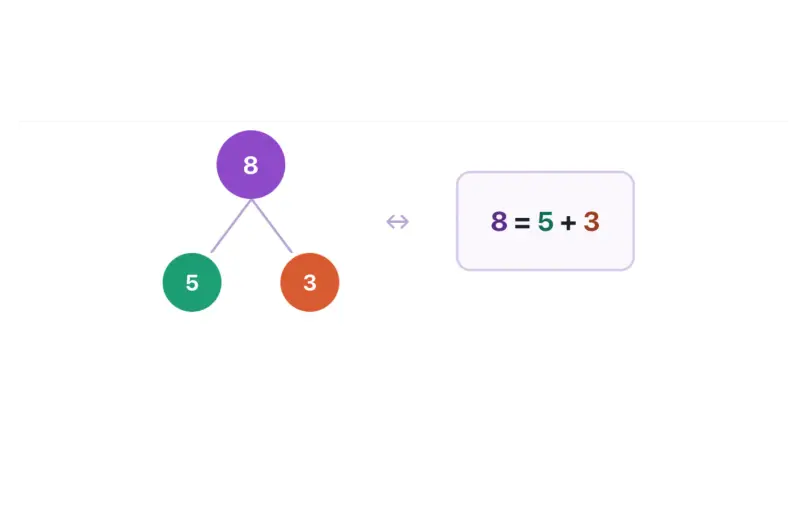
What you'll need for the week
Two-color counters or small blocks/buttons (about 20 per pair of students)
Paper plates or simple mats, one per pair (to act as a "whole" boundary)
Blank ten-frame printouts (a handful per student)
Crayons or markers in two colors
Whiteboard or chart paper
Index cards or small whiteboards for Day 5 number sentences
Day 1 - Building Bonds with Counters (Concrete ~45 min)
What you need: Two-color counters (about 20 per pair), one paper plate or simple mat per pair.
Warm-up (~5 min)
Count out 5 counters together as a class. Ask, "If I split these into two groups, what could that look like?"
Teach it (~10 min)
Split the 5 counters into 3 and 2 in front of the class, and say the bond aloud: "5 is 3 and 2."
Then split the same 5 a different way - 4 and 1 - and repeat.
Make the point explicit: the whole didn't change, only how we split it.
Practice together (~20 min)
Hand each pair their own 5 counters and a plate. Their job is to find every split they can, saying each one aloud using "[whole] is [part] and [part]" before moving to the next.
Once a pair finds all three splits of 5 (5+0, 4+1, 3+2), give them 8 counters and let them keep going (8+0, 7+1, 6+2, 5+3, 4+4).
Walk the room and listen for the sentence frame, not just the right split.
Neurodivergent tip: Keep each "part" a single consistent color throughout - this helps dyscalculic students track groups visually rather than recounting. Cap the activity at two whole numbers (5, then 8); repetitive splitting loses ADHD attention fast once the novelty fades.
Check for understanding (~5-10 min)
Can the student say the bond out loud in the "whole is part and part" frame without you modeling it first?
Day 2 - Bond Hunt with a Target Number (Concrete ~45 min)
What you need: Same counters and plates from Day 1, plus number cards 1–10.
Warm-up (~5 min)
Quick review: call out "5 is 3 and ___" and have students fill in the blank out loud as a class.
Teach it (~10 min)
Show a target whole (7) and one known part (4) on cards.
Count out 4 counters in one color, then add counters in a second color until the plate holds 7 total, saying "4 and 3 makes 7."
This flips yesterday's activity - instead of splitting freely, students are now solving for an unknown part.
Practice together (~20 min)
Run as a rotation: one partner sets a target and known part using cards, the other builds it with counters and says the bond aloud, then they swap roles.
Start with wholes from Day 1 (5, 8) before moving to new ones: try 7 (4+3, 6+1, 5+2), then 9 (5+4, 6+3, 7+2).
Neurodivergent tip: For autistic students, write the routine as a 4-step reference card ("1. Count known part. 2. Add more. 3. Stop at whole. 4. Say it.") rather than relying on verbal instructions alone.
Check for understanding (~5-10 min)
Given a whole and one part, can the student find the missing part with counters without recounting from scratch?
Day 3 - Drawing Bonds and Ten-Frames (Pictorial ~45 min)
What you need: blank ten-frame printouts, crayons or markers in two colors.
Warm-up (~5 min)
Show a completed ten-frame (6 filled, 4 empty) and ask the class to say the bond it shows.
Teach it (~10 min)
Draw a ten-frame on the board, color 6 boxes one color and 4 boxes another, and write "10 is 6 and 4" underneath.
This moves from physical counters to drawings, which forces students to represent quantity without rearranging it.
Practice together (~20 min)
Give each student a blank ten-frame and a whole number. They color two parts using two colors, then write the matching sentence below.
Have them trade with a partner and read each other's bonds aloud. Use 6 (4+2, 5+1, 3+3), 9 (6+3, 7+2, 5+4), and 10 (6+4, 8+2) across the sitting - three or four numbers is plenty.
Neurodivergent tip: Keep the same two colors assigned to "first part" and "second part" all activity long - switching meaning between problems confuses dyscalculic students using color as their tracking cue.
Check for understanding (~5-10 min)
Does the student fill the ten-frame in order (left to right, top row first) rather than scattering colors randomly?
Day 4 - Bond Trees and Part-Whole Diagrams (Pictorial ~45 min)
What you need: whiteboard or paper, the Number Bonds Visualizer if you have classroom display access.
Warm-up (~5 min)
Draw a circle on the board and ask, "If this is 8, how could we split it into two parts?"
Teach it (~10 min)
Introduce the bond diagram: a circle for the whole on top, branching down to two smaller circles for the parts.
If you have a screen, project the Number Bonds Visualizer in Mode 1 ("Explore bonds") and let students call out splits as the tool displays them.
Practice together (~20 min)
Switch to Mode 2 ("Find the Missing Part") and have students predict the hidden part before you reveal it. (See the Number Bonds Visualizer guide for step-by-step instructions.)
No display? Draw the diagram by hand and have students copy it into notebooks for 8 (5+3, 6+2, 7+1), 9 (6+3, 5+4), and 10 (7+3, 6+4).
Neurodivergent tip: Before using Mode 2, narrate the process aloud first - "I'll show a whole and one part, you guess the missing part, then I'll reveal" - so the unknown is in the answer, not the process.
Check for understanding (~5-10 min)
Can the student read a bond diagram and state it as a sentence without help?
Day 5 - From Pictures to Number Sentences (Abstract · ~45 min)
What you need: index cards or small whiteboards.
Warm-up (~5 min)
Show yesterday's bond diagram for 8 (5 and 3) and ask, "How could we write this as a math sentence instead of a picture?"
Teach it (~10 min)
Draw a bond diagram like Day 4 - whole on top, parts below - and write the matching equation next to it: 8 = 5 + 3.
Ask what's the same (same numbers, same relationship) and different (no drawing, just symbols).
Practice together (~20 min)
Give students filled bond diagrams for 7 (4+3), 9 (6+3), and 10 (7+3) and have them write the matching equation for each.
Then flip it: give an equation (6 + 4 = 10) and have them sketch the bond diagram that matches it. Close by having one student narrate counters → diagram → equation out loud for a Day 1 number.
Neurodivergent tip: Let students who need it keep counters on their desk even during this "abstract" day - moving to symbols doesn't mean removing access to concrete tools the moment they're introduced.
Check for understanding (~5-10 min)
Given either a bond diagram or an equation, can the student produce the other without re-deriving it from scratch?
Try it with the Number Bonds Visualizer
The free Number Bonds Visualizer pairs well with Days 4 and 5 above - it lets you display bond diagrams and missing-part puzzles without drawing them by hand, and switches between counter and symbol views to match wherever your class is in the CRA progression.
FAQ
Do I need to teach all 5 days in one week?
No. This sequence is designed to be flexible. Some classes move through Days 1-2 in a single day; others need two or three days at the concrete stage before moving on. Use the quick check at the end of each day as your guide, not the calendar.
What if a student is still struggling on Day 5?
That's a sign to loop back to Day 3 or 4 rather than push forward. The CRA progression isn't a one-way staircase - moving back to pictures or concrete materials when abstract symbols aren't sticking is normal and expected, especially for students with dyscalculia.
Can I use this for whole-class instruction and small groups?
Yes. The activities are written for partner or small-group work, which scales down easily to a single small group during a math rotation, or up to whole-class with a shared display for Day 4's bond diagrams.