
TL;DR
A child who can't say the answer may still know it. Tests that depend on talking or pointing often make autistic kids look far behind when they aren't. So the first step is giving them other ways to show what they understand.
You can teach and check math without relying on speech. Hands-on objects, clear step-by-step teaching, short video demos, and tablet games all have solid research behind them. Kids can answer by choosing from a few options, tapping a screen, looking at the right picture, or using a communication device.
Early number skills are a great place to start. Young autistic children often handle counting and "how many" tasks much like their peers. Build on their visual strengths, use their favorite topics, and assume they can learn.
Not being able to speak doesn't mean not knowing
This is the most important idea in the whole article, so it comes first.
Many autistic children speak very little or not at all. Researchers call this group "minimally verbal," and it's bigger than most people realize: an estimated 30% of autistic children stay minimally verbal even after years of support. For a long time, these kids were left out of research and were hard to test well.
Here's the problem with most standard tests: they ask a child to speak or point on demand, sit with a stranger, and follow spoken directions. If a child struggles with those things, the test measures the child's response method, not their actual thinking.
One school study showed this beautifully. When researchers gave 30 minimally verbal autistic children a standard IQ test, almost none could complete it - but when the same ideas were tested in a way that didn't require pointing, most kids finished and many scored in the normal range. Same children, different format, completely different picture.
That's why many educators and researchers recommend a simple starting stance: presume competence - assume the child can understand and learn, and give them a fair way to show it. (One caution: "presuming competence" is a mindset, not a green light for techniques like facilitated communication or "spelling to communicate," where an adult guides the child's hand or board. Those aren't backed by solid evidence. Instead use methods where the child responds independently.)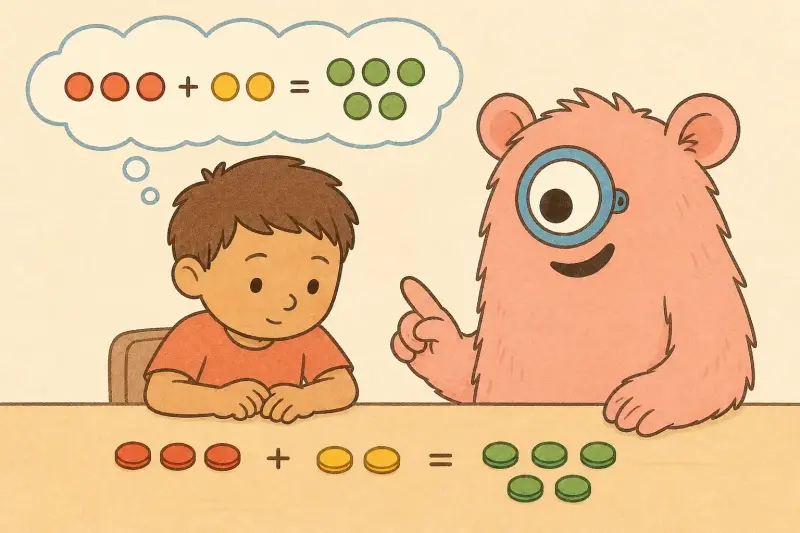
What young autistic kids can actually do with numbers
Math ability in autism varies a lot. On average, autistic students score a bit lower than peers, but with a much wider range — some struggle, and some are genuinely strong. A few studies even find autistic children who outperform their peers on number problems.
The early-childhood news is encouraging. Several studies show that preschool and kindergarten autistic children handle basic number skills much like other kids their age — things like counting, comparing amounts, and "subitizing" (instantly seeing that there are three dots without counting). In primary school, autistic and non-autistic children can show similar arithmetic and word-problem skills, with some differences in quick estimating.
The takeaway: early math is teachable and worth your energy. Visual, hands-on, pattern-based entry points often play to autistic kids' strengths.
How to teach it
The good news is that we're not guessing. A research review of math teaching for autistic students found several approaches that reliably work: clear step-by-step instruction, hands-on materials, video demos, and structured help with word problems. Here are the most useful ones for K-3.
Teach clearly and in small steps, with hands-on objects. Model the skill, give immediate feedback, and offer just enough help to keep the child successful, then slowly pull that help back. Physical objects (counters, blocks, ten-frames) give kids something concrete to think with.
Use the "concrete → picture → symbol" path (CRA). Let children handle real objects first, then move to drawings or pictures, then to the numbers and symbols. This sequence is an evidence-based way to teach math, and it works for autistic learners too.
For a full walkthrough, see our guide to the CRA method in math.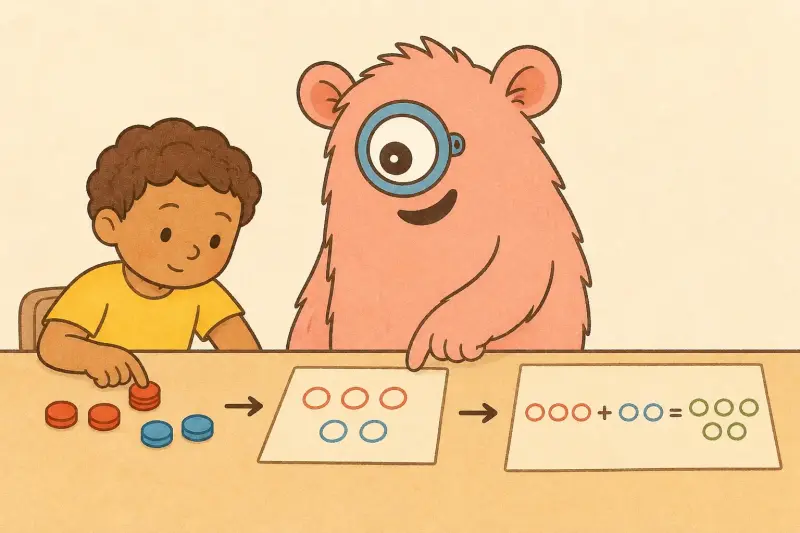
Try short, daily, story-based number lessons. In one classroom study, 15-minute daily story-math lessons taught by the regular teacher helped kindergarteners with autism learn to compare sets, spot patterns, and use early measurement skills — and the gains held up on standard tests.
Show, don't just tell. Video modeling — a short clip demonstrating exactly how to solve a problem — works well. One study taught a five-year-old autistic child addition and subtraction using online video demos plus on-screen objects, reaching full accuracy.
Lean on tablets and apps. A review of tablet-based math programs found very strong results for autistic and similar learners, and effects were often larger when the child controlled the device themselves — exactly what a well-made math app like Monster Math is built for.
Use what they love. Building a child's special interest into the math — trains, dinosaurs, a favorite character — pays off. In one study, task completion shot up when lessons used the child's interests and choices, with one child going from less than one problem a minute to nine. This is the real reason game-based math helps: it's motivating, predictable, and rewarding.
How to let kids show what they know
Teaching is only half the job. You also need a fair way for a non-speaking child to answer. A few options, all used in research:
Choosing from options. Lay out a few cards or pictures and ask the child to pick ("Which one shows 4?"). Selecting, sorting, or building with objects lets kids respond without a single word.
Looking (eye-gaze). Where a child looks can reveal what they know. Studies show that eye-gaze answers line up with pointing answers, and that hard response demands can hide what a child actually understands. That said, no single method works for every child — in some cases pointing works better than gaze — so it's worth trying a few and using what fits each kid.
Tapping a screen. Touchscreens are a natural, low-pressure way to respond, and they pair perfectly with app-based practice.
Communication devices (AAC). For kids with little or no speech, communication tools help. A study comparing a high-tech talking device with a low-tech picture-exchange system found both helped, with no clear winner — so you can match the tool to the child. The same selection screens can hold math answer choices.
A simple rule: if a child shows a skill in any way — choosing, looking, tapping, building — count it as known and move on. Don't make a spoken answer the price of admission.
A few honest cautions
Much of the teaching research includes children who have autism and an intellectual disability, and many studies are small. The strategies are sound, but every child is different - watch what works for the one in front of you.
If a skill stalls for a couple of weeks, change how the child responds or how you show the idea before deciding it's "too hard."
Presuming competence doesn't mean assuming every child has hidden advanced skills. It means giving every child a fair way to show what they know — and the teaching to build more.
The bottom line: a quiet classroom isn't an empty one. Give these kids the right tools to show their thinking and the right way to learn, and the math will come.
Frequently Asked Questions
Can a non-speaking or minimally verbal autistic child still learn math?
Yes. Speech and math ability are separate things. In fact, when tests are changed so they don't require talking or pointing, many minimally verbal autistic children score far higher than standard tests suggest. Assume the ability is there, then give the child a way to show it.
How can a child who doesn't talk show what they know in math?
Lots of ways: choosing from a few picture or number cards, building or sorting objects, tapping a touchscreen, looking at the correct answer, or using a communication device (AAC). Research shows eye-gaze answers can match pointing answers, and that different children do best with different methods — so offer a few options and use what works for that child.
What's the best way to teach math to a minimally verbal autistic child?
Clear, step-by-step teaching with hands-on objects, moving from concrete objects to pictures to symbols (the CRA approach). Short video demonstrations and tablet practice also work well, especially when the child gets to control the device.
Are math apps and games actually good for autistic kids?
The research is positive. A review of tablet-based math programs found strong results for autistic learners, with bigger gains when the child operated the device. Games also tap motivation - building a child's special interests into tasks boosts engagement.
When should we start teaching number skills?
Early. Young autistic children often handle early number skills much like their peers, so preschool and kindergarten are great times to build counting, comparing amounts, and recognizing small quantities at a glance.
What does "presume competence" mean?
It means starting from the assumption that the child can understand and learn, then giving them a fair way to demonstrate it — instead of assuming a quiet child doesn't know the material. It's a mindset, not a specific technique (and not a reason to use unproven methods like facilitated communication).
References
Tager-Flusberg, H., & Kasari, C. (2013). Minimally verbal school-aged children with autism spectrum disorder: The neglected end of the spectrum. Autism Research, 6(6), 468–478. https://pmc.ncbi.nlm.nih.gov/articles/PMC3869868/
Courchesne, V., Meilleur, A.-A. S., Poulin-Lord, M.-P., Dawson, M., & Soulières, I. (2015). Autistic children at risk of being underestimated: a school-based pilot study of a strength-informed assessment. Molecular Autism, 6:12. https://pmc.ncbi.nlm.nih.gov/articles/PMC4359559/
Li, X., Ke, X., Li, J., et al. (2025). A systematic review and meta-analysis of the proficiency and variability of mathematical ability in populations with autism spectrum disorder. Nature Human Behaviour. https://www.nature.com/articles/s41562-025-02384-2
Iuculano, T., Rosenberg-Lee, M., Supekar, K., et al. (2014). Brain organization underlying superior mathematical abilities in children with autism. Biological Psychiatry, 75(3), 223–230. https://pmc.ncbi.nlm.nih.gov/articles/PMC3897253/
Titeca, D., Roeyers, H., Josephy, H., Ceulemans, A., & Desoete, A. Early numerical competencies in 4- and 5-year-old children with autism spectrum disorder. https://www.researchgate.net/publication/321679175EarlyNumericalCompetenciesin4-and5-Year-OldChildrenWithAutismSpectrumDisorder
Polo-Blanco, I., et al. (2024). Early numerical skills and mathematical domains in autistic students in primary school. Frontiers in Psychiatry, 15:1509137. https://www.frontiersin.org/articles/10.3389/fpsyt.2024.1509137/full
Karal, M. A., & Riccomini, P. J. (2024). Meta-analysis of mathematics interventions for learners with autism spectrum disorder. Education and Training in Autism and Developmental Disabilities, 59(3), 257–273. https://doi.org/10.1177/215416472405900303
Bouck, E. C., Satsangi, R., & Park, J. (2018). The concrete–representational–abstract approach for students with learning disabilities: an evidence-based practice synthesis. Remedial and Special Education, 39(4), 211–228. https://eric.ed.gov/?id=EJ1185546
Root, J. R., Henning, B., & Jimenez, B. (2020). Building the early number sense of kindergarteners with autism: a replication study. Remedial and Special Education, 41(6), 378–388. https://eric.ed.gov/?id=EJ1273319
Yakubova, G., Defayette, M. A., & Chen, B. B. (2023). Mathematics learning through online video-based instruction for an autistic child. Journal of Autism and Developmental Disorders. https://pmc.ncbi.nlm.nih.gov/articles/PMC8934015/
Liu, D., Mao, Y., Cai, W., Lei, Q., Kang, R., & Zeng, Y. (2024). Meta-analysis of tablet-mediated interventions to teach mathematics for individuals with autism spectrum disorder and/or intellectual disability. Focus on Autism and Other Developmental Disabilities, 39(3). https://journals.sagepub.com/doi/abs/10.1177/01626434231180579
Koegel, R. L., Singh, A. K., & Koegel, L. K. (2010). Improving motivation for academics in children with autism. Journal of Autism and Developmental Disorders, 40(9), 1057–1066. https://pmc.ncbi.nlm.nih.gov/articles/PMC2926912/
Brady, N. C., Anderson, C. J., Hahn, L. J., Obermeier, S. M., & Kapa, L. L. (2014). Eye tracking as a measure of receptive vocabulary in children with autism spectrum disorders. Augmentative and Alternative Communication, 30(2), 147–159. https://pmc.ncbi.nlm.nih.gov/articles/PMC4047176/
Plesa Skwerer, D., Jordan, S. E., Brukilacchio, B. H., & Tager-Flusberg, H. (2016). Comparing methods for assessing receptive language skills in minimally verbal children and adolescents with autism spectrum disorder. Autism, 20(5), 591–604. https://pmc.ncbi.nlm.nih.gov/articles/PMC6988895/
Gilroy, S. P., Leader, G., & McCleery, J. P. (2018). A pilot community-based randomized comparison of speech generating devices and the picture exchange communication system for children with autism spectrum disorder. Autism Research, 11(12), 1701–1711. https://pubmed.ncbi.nlm.nih.gov/30475454/