TL;DR: The gap between reciting numbers and understanding them shows up in every child, and in studies of autistic children without intellectual disability, they grasp "how many" about as well as peers of the same age. What often differs is how they get there, with more slow deliberate counting and less rapid recognition of small amounts. So watch how your child counts.
Your child reels off numbers to 100 without hesitating. Then you ask for four crackers and get a fistful. Or they count "one, two, three, four, five" over a pile of six blocks and look perfectly satisfied with the answer.
With autistic children it is easy to miss, because fluent recitation often gets read as a sign of mathematical talent. The counting sounds advanced, so the gap underneath it can go unnoticed for a long time. We've written about a similar pattern before, where a child does advanced calculation but stalls on word problems.
What you’re watching is a normal stage that almost every child goes through. Autism does make a difference, mostly to how your child counts and less to when they understand.
Reciting and understanding are different skills in every child
When a child first learns to count, they're doing something much closer to singing the alphabet than to doing math. They've memorized the order of the number words, but may not yet understand what those numbers represent. Researchers have documented how children can learn to recite the counting sequence before fully understanding the quantities those words represent.
The meaning comes later, one number at a time. Between roughly two and a half and four, children work out what "one" means, then "two," then "three" and sometimes "four," each one taking several months.
At some point after that, a child grasps that counting a group tells you how many objects are in it, and that the final number word gives the total. Researchers call this the cardinal principle. Before this understanding develops, counting is largely a sequence they can recite. Afterward, it becomes a tool they can use to work out how many.
What's different for autistic children, and what isn't
The research on this is fairly reassuring.
When researchers compared 41 autistic children aged four to seven against 41 peers matched for age and sex, none with intellectual disability, both groups showed similar mastery of cardinality. An earlier study of 30 autistic five- and six-year-olds against 30 matched peers tested five separate early number skills and reported no general deficits in early numerical competencies. Both studies point the same way. On average, autistic children this age understand "how many" about as well as their peers do.
The differences showed up in method and speed. Autistic children took longer on the counting tasks, and as a group leaned more on verbal counting with pointing while using rapid recognition less often, even for small sets. Shown three dots, one child might see three straight away while another points and counts them off.
The second difference was conservation, the understanding that moving things around doesn't change how many there are. The autistic children scored lower on those tasks. In the autistic group, children who used rapid recognition more often tended to do better on conservation, a link that didn't show up among the non-autistic children, where conservation success tracked age instead. The study can't say whether one skill helps build the other.
The researchers themselves point out that there was much more variation within the autistic group than within the comparison group. Both studies were also fairly small, and both looked only at autistic children without intellectual disability, so neither will speak for every autistic child. Treat it as a group picture your own child may not match.
Try the give-me-four activity tonight
There's a simple way to see how your child connects counting with quantity, using things already in your kitchen. Researchers use a carefully structured version of this, called the Give-N task, with its own procedures and scoring. What follows is the kitchen-table version. It will tell you something useful about how your child thinks, but it isn't a test and won't diagnose anything.
Put about ten small objects on the table. Blocks, buttons, raisins. Then ask your child, "Can you give me four?"
How they go about it tells you more than whether the number comes out right. Some children count objects out one at a time and hand you four. Others reach in and grab. In the early research on this task, the children who counted were mostly older than three and a half, while younger ones mostly grabbed.
Researchers watching the children who grabbed noticed something else. When asked how many they'd given, a child might count the pile perfectly well, one, two, three, four, five, and then, asked to fix it so there are four, be unable to do it. The child can count the pile but can't yet use that count to fix it.
Try asking for two, three, five and six as well, and notice which numbers your child handles comfortably. One sitting won't tell you much by itself. A child can grab because they're distracted, because "four" didn't register, or because they'd rather be doing something else. Run it across a few days before reading anything into it.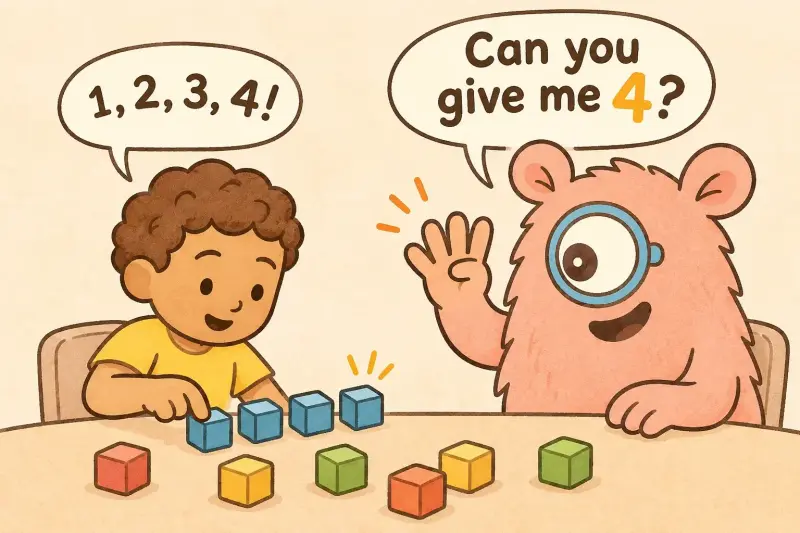
Try the spreading-out test too
This one targets conservation, the area where autistic children had more difficulty in the counting study, and it takes about thirty seconds.
Lay out two rows of five counters, lined up so the rows match. Ask your child whether the rows have the same number. Then, while they watch, spread one row out so it's longer, and ask again.
A child who has conservation says they're still the same, sometimes with a look suggesting you've asked something silly. A child who hasn't will say the longer row now has more, because it looks like more. Nothing was added, but the row looks bigger, and for now they go by how it looks.
If your child says the spread-out row has more, that's useful to know. It's common at four and five. It tells you that counting and quantity haven't fully fused yet, and it gives you something specific to work on.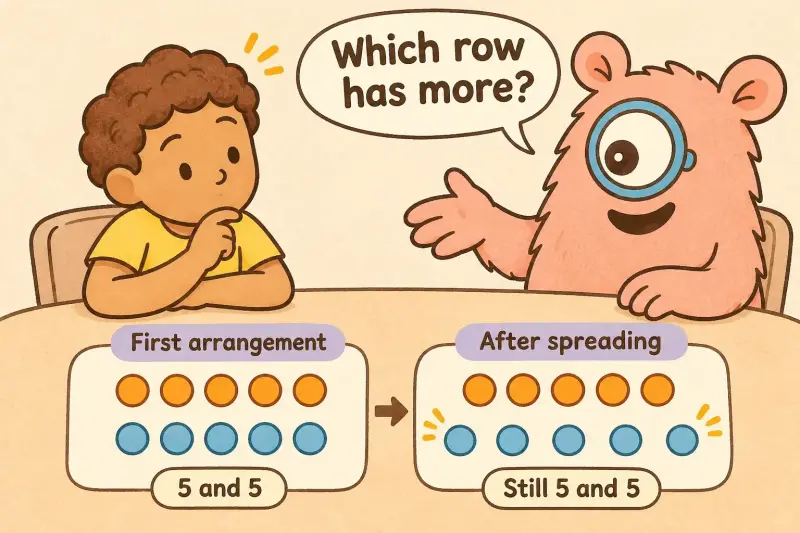
What helps
Build instant recognition of small amounts. If your child counts three dots one by one every time, that's the habit to work on. Flash a small number of objects for a second, cover them, and ask how many. Dice, dominoes and dot cards all work, and our guide to subitizing and how to build it has activities you can run in five minutes. Researchers have suggested teaching this skill to children who don't pick it up on their own, but so far that is a proposal for future study and no trial has tested it.
Say the last number twice, with meaning. When you count things together, finish by repeating the final word as an answer. Don't let it trail off as the end of the sequence. "One, two, three, four. Four crackers." Sweep your hand over the whole group as you say it. This is the link your child is missing, and adults rarely spell it out when they count.
Let the pointing happen. Pointing and counting aloud is slower, and in the counting study it still supported cardinality perfectly well. It's a working strategy, so there's no need to stop your child using it while you build the faster one alongside.
Watch the language load. In another study from the same research group, of autistic four- to seven-year-olds, a combination of visuo-spatial and linguistic abilities was the strongest predictor of mathematical performance. If your child is still building language, keep the instructions short and consistent. "Give me four" every time beats varying the phrasing to sound natural.
Keep sessions short and frequent. Five minutes at the kitchen table most days beats one long weekend session, and it keeps the whole thing low-pressure enough that your child will sit down again tomorrow.
When to look more closely
Autistic children do face higher odds here. The same study of four- to seven-year-olds found a higher prevalence of mathematical difficulties among autistic children compared with typically developing children, judged against the test's published norms because the study had no comparison group of its own. So the worry is reasonable, even though the counting study suggests that foundational skills like understanding "how many" can develop similarly in autistic and non-autistic children.
That study also found that there were no significant differences according to autism severity. These were all children without intellectual disability, and within that group autism severity didn't track how the math was going. So it's worth assessing the math on its own.
Raise it with the school if your child is five or six and still hands over a random handful when asked for a number, or if they count a group accurately but restart from one every single time you ask how many, with no change over several months. Difficulty saying which of two clearly different groups has more is worth mentioning too.
Where to start this week
Run both tests on a few different days. The give-me-four test shows whether the counting-to-quantity link is built, and the spreading-out test shows whether it holds up when appearances change. It takes about ten minutes each time, and it tells you more than listening to your child recite numbers will.
Then pick one thing and do it for five minutes a day. Most parents find "say the last number twice" easiest to start with, since it attaches to counting you were doing anyway. The fluent counting your child already has will help once they understand what the numbers mean.
FAQs
Why can my autistic child count to 100 but not count objects?
Reciting the number sequence and understanding what the numbers mean are separate skills, and the sequence usually comes first for all children. From around age two, children can recite the count list as a memorized rhyme with no numerical meaning attached. Counting to 100 shows good sequence memory and says little about whether your child understands quantity yet.
Do autistic children understand "how many" later than other children?
Not necessarily. In a study of autistic four- to seven-year-olds without intellectual disability, autistic children and matched peers showed similar mastery of cardinality. The differences were in how they got there, with autistic children taking longer and using rapid recognition of small amounts less often.
What is conservation and why does it matter?
Conservation is understanding that moving objects around doesn't change how many there are. If you spread out a row of five counters and a child thinks there are now more, they don't yet have it. Autistic children in one study performed lower on conservation tasks than matched peers, and it's a skill you can check at home in under a minute.
Should I stop my child pointing and counting out loud?
No. Pointing and counting aloud is slower but it works, and in one study it supported cardinality just as well as faster strategies did. Build quick recognition of small amounts alongside it, and let them keep the method they rely on.
References
Polo-Blanco, I., Fernández-Cobos, R., & Vicente, A. (2026). Counting, cardinality and conservation in autistic children. Autism Research, Article e70323. https://doi.org/10.1002/aur.70323
Fernández-Cobos, R., Polo-Blanco, I., Castroviejo, E., Juncal-Ruiz, M., & Vicente, A. (2025). What predicts early math in autism? A study of cognitive and linguistic factors. Journal of Autism and Developmental Disorders, 56(6), 2136–2147. https://pmc.ncbi.nlm.nih.gov/articles/PMC13222179/
Wege, T. E., Bourque, T., Merkley, R., & Cheung, P. (2025). Thirty years of the Give-N task: A systematic review, reflections, and recommendations. Journal of Numerical Cognition, 11, Article e10577. https://jnc.psychopen.eu/index.php/jnc/article/view/10577/10577.pdf
Titeca, D., Roeyers, H., Ceulemans, A., & Desoete, A. (2015). Early numerical competencies in 5- and 6-year-old children with autism spectrum disorder. Early Education and Development, 26(7), 1012–1034. https://core.ac.uk/download/55709997.pdf