TL;DR: The end of third grade is a curriculum target, not a deadline after which multiplication stops being learnable. What matters more than instant recall of 7 × 8 is whether your child has a reliable route to 56, because that route is what you build fluency on. Targeted fact-fluency work produces real gains for children who struggle, and in the research those gains didn't differ significantly by grade level.
Third grade ends, the times tables haven't stuck, and somewhere in the back of your mind a clock starts ticking. Fourth grade is going to want multi-digit multiplication. Fifth grade wants fractions. If the multiplication facts aren't in place now, does the whole thing start coming apart?
It's a reasonable worry, and the answer has two parts. The deadline is softer than it sounds. But there's a distinction worth paying attention to.
Where the third grade deadline actually comes from
The pressure you're feeling has a specific source. The Common Core standard for third grade says children should fluently multiply and divide within 100, and by the end of Grade 3 know from memory all products of two one-digit numbers.
That's a real expectation and schools take it seriously. It's worth being clear about what kind of thing it is, though. The standard sets out what students are expected to learn by the end of third grade. It doesn't mean that children who haven't mastered those facts by then have lost the ability to learn them.
Fourth grade doesn't treat multiplication as finished, either. It builds on it. The Grade 4 standard asks students to multiply a whole number of up to four digits by a one-digit whole number, and multiply two two-digit numbers, using strategies based on place value and the properties of operations, illustrated with equations, rectangular arrays and area models.
What matters more than recall?
Here's the distinction worth making, and it's more useful than asking whether your child "knows" their tables.
Ask them 7 × 8 and watch what happens next. Some children pause, and you can see them working: they know 7 × 7 is 49, so this is 49 and 7 more, so 56. That takes a few seconds and it's slower than a classmate who just says "56." But that's a child who understands multiplication and is on the way to fluency.
Other children pause and there's nowhere to go. No route to the answer, no way of working it out, nothing to fall back on. They either guess or they stop.
Those two children need quite different things. The first needs practice and time. The second needs the underlying idea built before practice will do much good.
Most children aren't purely one or the other, though. A typical third grader has some facts solid, some reachable with a strategy, a few sets that are genuinely shaky, and maybe one corner of the table where the concept hasn't landed at all. The useful question is "which facts fall into which category" for your child, because that's what tells you where to start.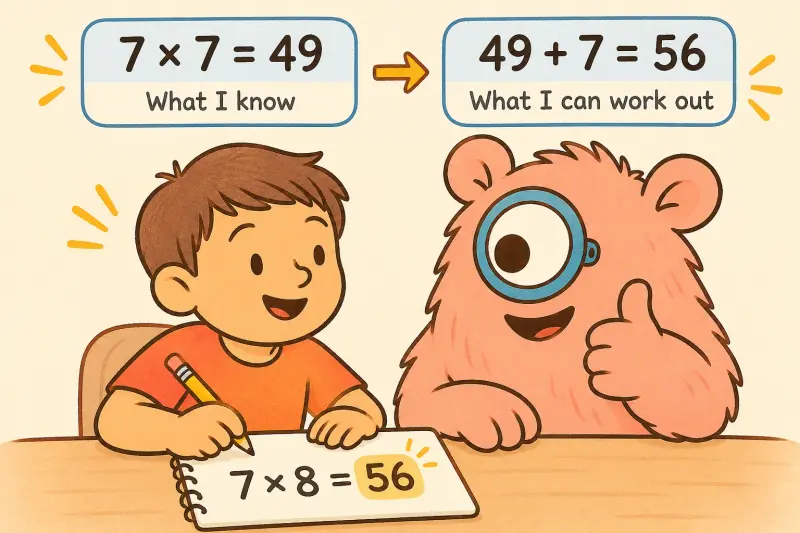
Why fluency is still worth building
Being able to work out 7 × 8 is a good sign, and it's the right thing to build on. Over time, though, it helps if some of those answers become ones your child simply knows.
What fluent recall mostly buys is speed and headroom. When the facts come quickly, long multiplication, fractions and later algebra take less effort, because your child isn't stopping to solve a small problem inside every step of a bigger one. That's a real advantage, and it's worth working toward.
What it isn't, is a prerequisite. Children don't need to have every multiplication fact memorized before they can begin learning more advanced math concepts. A child can learn what fractions mean, how area works, or why long multiplication works the way it does while the times tables are still coming together, leaning on a chart or a strategy for the numbers they need along the way. Understanding and recall grow alongside each other, and the recall often firms up precisely through being used.
Does working on multiplication facts after third grade help?
Yes. This is what the worry about the deadline is really asking, and it's the part with a clear answer.
Researchers recently pooled 35 studies of programmes designed to build fact fluency in children who struggle with math, covering addition, subtraction, multiplication and division, with students from kindergarten through high school. The programmes produced an educationally meaningful average effect of 0.76. And grade level was not a significant moderator, meaning the researchers found no reliable difference in how well the programmes worked for older and younger students. Nothing in the evidence suggests the window closes after third grade.
One caveat - results varied a lot from study to study, so no single programme is a guarantee for your child. What the research backs is the general approach of short, deliberate work on facts rather than any particular product.
When the facts won't stick at all
Some children have a persistent difficulty pulling basic math facts out of memory, and it's worth knowing what that looks like, because it's easy to misread.
One study that followed children through the early grades identified a small group whose difficulty retrieving addition facts was at least as debilitating as that of children with a mathematical learning disability, and showed less improvement across grades. That's a reason to seek support from the school rather than relying on more practice at home alone.
It also wasn't what a parent might assume. The retrieval difficulty wasn't related to intelligence, reading ability, or speed of processing. Struggling to remember facts doesn't mean a child isn't bright or isn't trying.
And it can be easy to miss. These retrieval difficulties wouldn't be identifiable with standard untimed mathematics achievement tests. A child might perform reasonably well when given time to work out answers, yet struggle to recall basic facts on demand. If that gap is what you're seeing, it's worth mentioning to their teacher.
The good news about working it out
Here's the encouraging part, and it points toward something useful.
When researchers followed children from first through fifth grade, they looked at more than whether facts came back instantly. They also tracked whether children could work out harder sums by breaking numbers apart. On that skill, children with persistent low achievement began to catch up with their typically achieving classmates, though they hadn't fully closed the gap by fifth grade.
The study examined addition, not multiplication. But the underlying idea is familiar: a child who knows 7 × 7 = 49 can use that fact to work out 7 × 8 by adding another 7.
That example also shows why recall and working it out grow together rather than separately. You can only reach 7 × 8 that way if 7 × 7 is already in memory. In the study, these children's growing use of the strategy went hand in hand with growing recall, which the researchers saw as consistent with reliance on memory retrieval for use of both of these strategies. The children who recalled the fewest facts, those with a mathematical learning disability, made the least progress with it.
So the facts your child already knows aren't a separate track from the strategies. They're what the strategies are built from. Each fact that becomes secure opens up the ones next to it, which is why it's worth practising known facts and building ways to work out new ones side by side.
What to do now
Find out which facts sit where. Sit down with a short list of facts and ask your child to think aloud as they answer. You're listening for whether there's a method underneath, not just checking answers. "I know 5 × 6 is 30, so 6 × 6 is 36" tells you the concept is there and recall needs time. A guess with no reasoning attached points somewhere else. One sitting won't tell you anything definitive, since plenty of children use a strategy perfectly well without being able to narrate it, so look for patterns across a few short sessions and compare notes with their teacher if the picture stays murky.
Where the concept is missing, build it before drilling it. More repetition won't install an idea that isn't there, and it tends to produce the tears that make the subject harder to approach next time. Go back to what multiplication means, using equal groups and arrays your child can see and move, until "4 × 6" reliably means four groups of six. Our guide to building multiplication from skip counting to arrays walks through that concrete-to-abstract sequence, and it's worth running whether or not dyscalculia is in the picture.
Where the concept is there, build out from the facts they already own. Most children have 2s, 5s and 10s first. Those sets, plus squares, plus doubling and adding or subtracting a group, will reach most of the table without memorizing it fact by fact. Our post on multiplication and division strategies sets out which facts to secure first and which strategies derive the rest, in the order that makes each easiest to learn.
Then practise for recall, including against the clock. Once your child has the concept and a strategy, practice is what makes facts automatic, and quick timed activities have a legitimate place. The federal practice guide for students struggling with math recommends teachers regularly include timed activities as one way to build fluency in mathematics. How your child practises matters as much as how long: trying to recall a fact from memory builds fluency better than chanting the answer aloud. So cover the answer and let them reach for it before they check, rather than reading the table over and over. Concepts and strategies first, short fluency work after, and never a stressful speed test as the main event.
Keep sessions short, regular and narrow. Five to ten minutes on a small set of facts, revisiting ones already learned while adding a few new ones, beats trying to cover the whole table at once. Consistency is what does the work here.
Don't let it block fourth grade. Your child doesn't need every fact automatic before learning multi-digit multiplication. A multiplication chart lets them concentrate on place value and the structure of a bigger problem while fact practice continues separately, and the aim is to lean on that support less as fluency improves.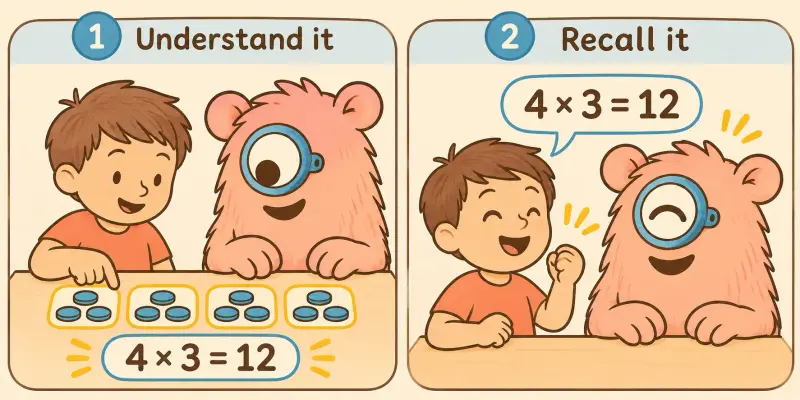
When it's worth asking for help
Some signs are worth taking to the school rather than waiting another year.
If your child has no reliable route to an answer after a term of steady work, flag it. The same goes if they can do a fact correctly one day and have no idea the next, with no pattern to it. And difficulty that extends beyond multiplication, to telling time, estimating quantities or handling money, points at something broader than times tables and deserves a proper look.
Talking to your child's teacher is a useful first step. They can help identify where the difficulty lies, arrange targeted support, and discuss whether a more formal assessment would be helpful. It's how you find out whether what you're doing at home is the right thing to be doing.
So, is it too late?
It isn't. Fourth and fifth grade both keep building on multiplication, and the intervention research shows solid gains from targeted fluency work, with no significant difference by grade.
What the end of third grade gives you is information, not a verdict. Some children need more practice turning familiar strategies into quick recall. Others need help understanding what multiplication means, or a set of strategies they can rely on. Plenty need some of both. None of those needs comes with an expiry date.
FAQs
Should my child know all their times tables by the end of 3rd grade?
That's the target. The Common Core standard for third grade asks children to know from memory all products of two one-digit numbers by the end of the year. It's a curriculum expectation rather than a developmental deadline, and some children continue developing that fluency in fourth grade.
Can a child learn multiplication facts after third grade?
Yes. Third grade is a curriculum milestone, not the end of the learning window. A review of 35 studies found that targeted fact-fluency instruction produced meaningful gains for students who struggle with math, and grade level didn't significantly change the results.
Is it normal for a 4th grader not to know their multiplication facts?
On its own, it isn't a cause for alarm. Fourth grade doesn't treat multiplication as complete: the Grade 4 standards build directly on it with multi-digit multiplication. What matters more than the timing is whether your child has a reliable way to reach an answer, and whether those answers are gradually becoming quicker.
Will more flashcards help?
They can, once your child understands what multiplication is. In a classroom study of 48 second-graders, practising with flashcards produced greater gains in multiplication fact fluency than chanting the tables out loud, both five minutes later and a week later. The caveat is what the flashcards are replacing: they work as practice for facts your child has the concept for, and don't substitute for building that concept.
My child can work out the answer but can't remember it. Is that a problem?
It's a better position than it feels like, because a working method is what fluency gets built from. Working out 7 × 8 from 7 × 7 is a strategy built on a fact your child already knows, and in one five-year study children's use of this kind of strategy grew alongside their recall. Build on the method they have, and keep practising so more of those answers become ones they simply know.
Should my fourth grader use a multiplication chart?
A chart is a reasonable temporary support during multi-step work like long multiplication, where the goal is for your child to concentrate on place value and procedure rather than stalling on a fact. Keep separate, short fact practice going alongside it so the chart becomes less necessary over time.
How do I know if it's dyscalculia?
You can't tell from multiplication facts alone. In one study, a severe fact retrieval difficulty wasn't related to children's intelligence or reading ability, and wouldn't have shown up on standard untimed school tests. If difficulty extends to telling time, estimating quantities or handling money, that broader pattern is worth raising with your child's school.
References
Douglas, G. P., Myers, J. A., Mason, K. K., Powell, S. R., & Lariviere, D. O. (2026). A meta-analysis of mathematics fact fluency interventions for students with mathematics difficulties (MD). Journal of Learning Disabilities, 59(3), 135–160. https://doi.org/10.1177/00222194261424914. Open access: https://pmc.ncbi.nlm.nih.gov/articles/PMC13069136/
Fuchs, L. S., Newman-Gonchar, R., Schumacher, R., Dougherty, B., Bucka, N., Karp, K. S., Woodward, J., Clarke, B., Jordan, N. C., Gersten, R., Jayanthi, M., Keating, B., & Morgan, S. (2021). Assisting students struggling with mathematics: Intervention in the elementary grades (WWC 2021006). National Center for Education Evaluation and Regional Assistance, Institute of Education Sciences, U.S. Department of Education. https://ies.ed.gov/ncee/WWC/Docs/PracticeGuide/WWC2021006-Math-PG.pdf
Geary, D. C., Hoard, M. K., & Bailey, D. H. (2012). Fact retrieval deficits in low achieving children and children with mathematical learning disability. Journal of Learning Disabilities, 45(4), 291–307. https://doi.org/10.1177/0022219410392046. Open access: https://pmc.ncbi.nlm.nih.gov/articles/PMC3163113/
Geary, D. C., Hoard, M. K., Nugent, L., & Bailey, D. H. (2012). Mathematical cognition deficits in children with learning disabilities and persistent low achievement: A five-year prospective study. Journal of Educational Psychology, 104(1), 206–223. https://doi.org/10.1037/a0025398. Author copy: https://sites.uci.edu/dhbailey/files/2014/07/Geary-et-al.-2012-J.-Educational-Psy.pdf
National Governors Association Center for Best Practices & Council of Chief State School Officers. (2010). Common Core State Standards for Mathematics, CCSS.Math.Content.3.OA.C.7. https://www.thecorestandards.org/Math/Content/3/OA/C/7/
National Governors Association Center for Best Practices & Council of Chief State School Officers. (2010). Common Core State Standards for Mathematics, CCSS.Math.Content.4.NBT.B.5. https://www.thecorestandards.org/Math/Content/4/NBT/B/5/
Ophuis-Cox, F. H. A., Catrysse, L., & Camp, G. (2023). The effect of retrieval practice on fluently retrieving multiplication facts in an authentic elementary school setting. Applied Cognitive Psychology, 37(6), 1463–1469. https://doi.org/10.1002/acp.4141