TL;DR: Making change is one of the hardest everyday math tasks because it stacks skip counting, place value, and subtraction into one fast, multi-step sequence. Kids who struggle with numbers usually need the process broken into a checklist they can touch and check off, not more worksheets. Start with real coins, teach a simple counting-up strategy, and let a calculator carry the parts that aren't the actual skill you're teaching.
If your child can count to a hundred but panics the moment a cashier hands back change, you're not imagining a contradiction. Counting and making change are different skills wearing the same costume. One is reciting a sequence; the other asks a child to hold a price in mind, figure out what's still owed, and count coins and bills in order, fast, often with someone watching.
For kids with dyscalculia, ADHD, or autism, that combination is exactly where things fall apart. Money math has also been studied more directly than almost any other everyday math skill, since it's one of the clearest markers of independence for older kids and teens. The strategies below come from that research and from what actually holds up once you break the task down small enough.
Why Money Math Trips Up Kids Who Struggle With Numbers
Making change asks a child to do several things at once: recognize coin and bill values, count by 5s, 10s, and 25s instead of by 1s, hold a target number in mind while counting toward it, and do subtraction without writing anything down. Any one piece can be shaky in a neurodivergent learner. Put them together under time pressure and the whole thing collapses.
Skip counting is usually the first crack, since coins only work if a child can count by 5s and 10s fluently, and that's precisely the kind of counting many dyscalculic kids find hardest, as our guide to skip counting for dyscalculia covers in more depth. It doesn't help that a dime is worth more than a nickel despite being physically smaller, so kids can't lean on "bigger equals more" the way they can with bills.
For kids with ADHD, the problem usually isn't that numbers look fuzzy or confusing to them. Researchers tested this directly. They measured how well kids could judge which of two groups had more dots just by looking, a skill called number sense, and compared that to how the same kids did on real math problems. Kids with ADHD scored fine on the number-sense test, but they still made significantly more errors on math problems, even after accounting for how strong their number sense was. In other words, it's not that these kids see quantities less clearly. Something else, most likely attention and working memory, gets in the way once they have to actually work through a problem.
Start With Coins a Child Can Touch, Not a Worksheet
Before any strategy, a child needs to physically sort and stack coins. Give them a pile of mixed change, have them sort it into cups by type, then count each cup separately before combining totals. This lets a child see and feel that a stack of four quarters is a dollar, rather than just being told so.
Once sorting is solid, move to counting mixed coins in a fixed order every time: quarters, dimes, nickels, pennies, largest to smallest. A consistent order turns "count this pile" from an open-ended puzzle into a routine the child can run on autopilot, which frees up working memory for the counting itself. For more practice along these lines, our roundup of hands-on money-learning activities for ADHD kids has additional low-stakes games, including a mock "family store," that build the same coin fluency outside of a formal lesson.
Teach the Counting-Up Method for Making Change
The strategy that has the strongest support for this kind of purchasing skill is usually called “next dollar,” “one-more-than,” or “counting on.” Instead of asking the child to calculate exact change or subtract the price from the amount paid, the child learns a simpler rule: look at the price and pay the next whole dollar. So if something costs $3.29, they give $4. This is not just a classroom trick. A research-based practice brief found support for this approach across three single-case studies with students with autism, Down syndrome, and other developmental disabilities, where the strategy was taught in school and community settings. Here’s how to teach it as a sequence, not as one big instruction: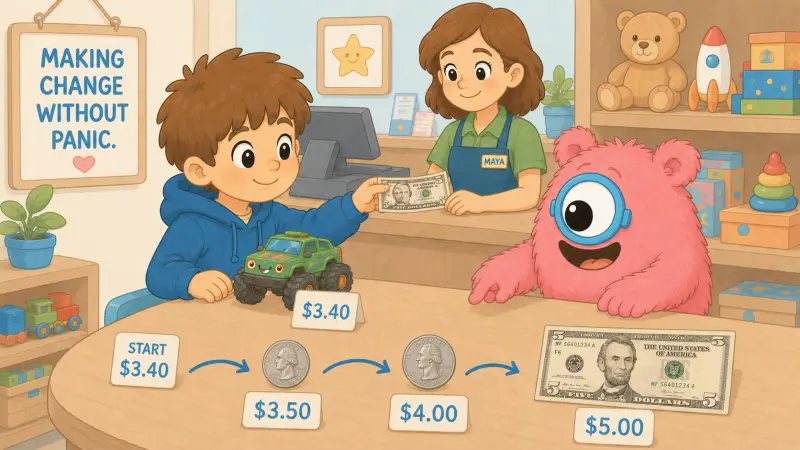
Step 1: Say the price out loud, then say the amount handed over. Before any counting starts, the child states both numbers: "The toy costs $3.40. I gave $5." Skipping this is the single biggest source of errors, because a child who hasn't anchored both numbers out loud tends to lose one of them mid-count. Have them repeat both a second time if needed, and move on only once they can state both without prompting.
Step 2: Count up in coins to the next whole dollar. Starting from $3.40, the child counts coins forward to $4.00: a dime brings it to $3.50, then two quarters to $4.00. This is where coin-sorting and skip-counting practice pays off directly. If a child stalls here, it usually means that groundwork needs more repetition before moving forward, so don't rush past a shaky Step 2 just to reach the "real" change-making step.
Step 3: Count up in whole dollars to the amount given. From $4.00, the child counts "one dollar" to reach $5.00. For amounts spanning several dollars, this is a plain skip count by ones, usually the easiest part of the sequence. Let them say each dollar out loud with a small pause, since this is often where the strategy starts to click.
Step 4: State the total change back as one phrase. Add up what was counted in Steps 2 and 3 out loud: "sixty cents, plus one dollar, so a dollar sixty in change." Saying it as one combined phrase, rather than leaving the two amounts separate, is what actually cements the answer for next time.
Step 5: Check the work with a self-monitoring checklist. A picture-and-text checklist a child physically checks off after each step turns an abstract process into something concrete and repeatable. This isn't just a nice add-on. In a study of general addition and subtraction word problems, not money specifically, six of eight elementary and middle schoolers with moderate intellectual disability mastered every step of a checklist-based routine and were able to apply it to brand-new problems they hadn't practiced before. The same principle carries over to making change: a checklist that breaks the process into visible steps matters as much as the counting strategy itself.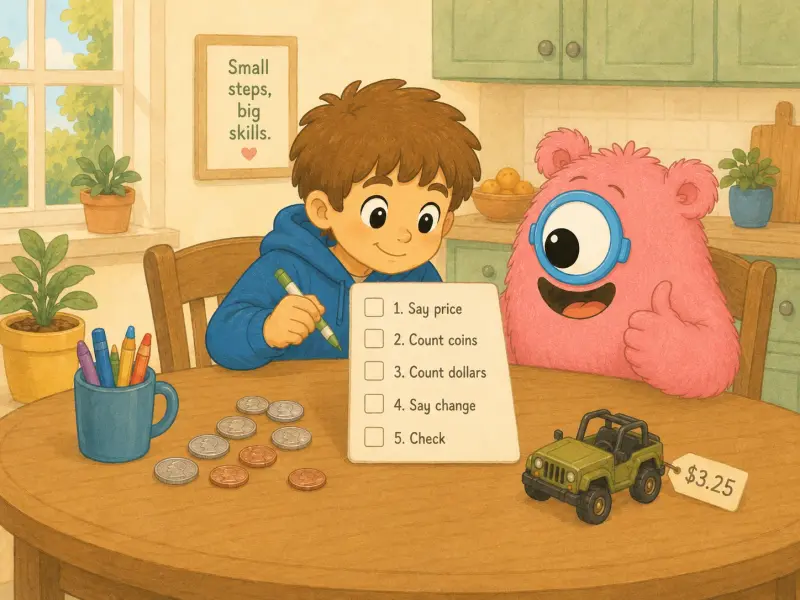
Handling Sales, Tips, and Two-Step Money Problems
Once basic change-making is steady, kids run into a harder category: prices that shift because of a sale or a tip. These add a decision before any counting starts, namely whether the number in front of them should be added to or subtracted from the starting price.
Researchers tested exactly this with three middle schoolers with moderate intellectual disability, using a picture-and-text checklist alongside a handheld calculator to solve sale-price and tip word problems. Each student reached mastery within three to five sessions of practice, including one who started the study unable to solve a single problem independently, and all three then carried the skill over to a calculator app on a phone or tablet. A calculator here isn't cutting corners; it offloads the arithmetic so the child's effort goes toward the actual skill being taught, recognizing whether a situation calls for adding or subtracting.
Troubleshooting Common Snags
Two problems show up constantly once you start practicing at home. A child who jumps straight to guessing an amount, skipping the steps, has usually been burned by counting too slowly in front of someone before, so slow the process down deliberately and remove any audience until the sequence is automatic. A child who starts strong and then loses their place mid-count, forgetting whether they were counting coins or dollars, is dealing with a working-memory snag more than a money one, and our piece on why multi-step math is a memory problem, not a numbers problem covers ways to lighten that load, like breaking instructions into single steps and using physical objects so the brain doesn't have to hold every number at once.
Building Toward Independent Purchases
None of this sticks if it only ever happens at the kitchen table. Once the five-step sequence is solid with real coins at home, move practice into a store, even for something small like a candy bar. Let your child count out loud while you stand back rather than stepping in. Expect this to take weeks, not days, and expect real stores to feel harder than practice at home, since a cashier waiting is a different kind of pressure than a parent across the table. That's normal, and it's exactly why the checklist habit matters: it gives a child something steady to lean on once the setting gets less predictable.
FAQs:
What age should I start teaching my child to make change?
Start coin sorting and skip counting around age 6 or 7, once basic counting to 100 is solid. The full making-change sequence usually lands better between ages 8 and 10, though kids with dyscalculia, ADHD, or autism may need more time at each stage.
My child can count coins alone but freezes when asked to make change. What's happening?
Counting a pile of coins and making change are different skills. Making change adds holding a target number in mind while counting toward it, a working-memory task layered on top of counting. Go back to Step 1 and make sure your child can state both the price and the amount given before adding any counting.
Is it okay to let my child use a calculator for money math?
Yes, especially for sale prices, tips, or anything involving decimals. Research on teaching personal finance problem solving found a calculator let kids focus on the skill being taught, deciding whether to add or subtract, rather than getting stuck on arithmetic they hadn't mastered. Save calculator-free practice for basic coin counting, where counting is the skill itself.
Should I use real coins or play money?
Real coins whenever possible. The weight, size, and worn feel of real money helps kids build a physical sense of value that plastic play coins don't replicate as well. Save play money for early sorting practice if real coins feel overwhelming at first.
My child does money worksheets fine but falls apart in a real store. Why?
Worksheets remove the time pressure and audience that add real cognitive load in a store. Practice the same sequence in low-stakes settings, like a self-checkout with nobody behind you, before moving to a busy register.
References:
Anobile, G., Bartoli, M., Masi, G., Tacchi, A., & Tinelli, F. (2022). Math difficulties in attention deficit hyperactivity disorder do not originate from the visual number sense. Frontiers in Human Neuroscience, 16, 949391. https://pmc.ncbi.nlm.nih.gov/articles/PMC9649814/
Browder, D. M., Spooner, F., Lo, Y., Saunders, A. F., Root, J. R., Ley Davis, L., & Brosh, C. R. (2018). Teaching students with moderate intellectual disability to solve word problems. The Journal of Special Education, 51(4), 222–235. https://files.eric.ed.gov/fulltext/EJ1166253.pdf
National Technical Assistance Center on Transition: the Collaborative. (2021). Practice description: Using one-more-than strategy to teach purchasing skills. The University of North Carolina at Charlotte. https://transitionta.org/wp-content/uploads/docs/PD_OneMoreThan_Final.pdf
Root, J., Saunders, A., Spooner, F., & Brosh, C. (2017). Teaching personal finance mathematical problem solving to individuals with moderate intellectual disability. Career Development and Transition for Exceptional Individuals, 40(1), 5–14. https://files.eric.ed.gov/fulltext/EJ1129039.pdf