TL;DR: Dyscalculia isn't named in federal special education law, which trips up a lot of parents, but eligibility still works because the regulations list "mathematics calculation" and "mathematics problem solving" as qualifying areas. Below is a full list of accommodations to ask for, sorted by category, with the primary sources you can cite in the meeting.
Getting support for dyscalculia in a US school runs into a problem in the first five minutes: the word doesn't appear in the regulation. Parents hear "dyscalculia isn't a recognized disability" and leave the meeting with nothing.
That reading is wrong, and the Department of Education has said so in writing. Here's the legal ground first, then the accommodations, then the honest answer about how well any of this works.
One note before we start: everything here is US-specific.
The eligibility problem, and why it isn't fatal
Under IDEA, a specific learning disability is defined as a disorder in the basic psychological processes involved in understanding or using language that may manifest itself in the imperfect ability to listen, think, speak, read, write, spell, or to do mathematical calculations, including conditions such as perceptual disabilities, brain injury, minimal brain dysfunction, dyslexia, and developmental aphasia.
Five conditions named. Dyslexia is one of them. Dyscalculia isn't.
Two things fix this. The first is that eligibility doesn't run through the named conditions at all. It runs through areas of achievement, and the regulation lists eight of them, including mathematics calculation and mathematics problem solving. A child whose math achievement is inadequate for their age or grade standards can qualify without the word dyscalculia appearing anywhere.
The second is a letter. In October 2015, the Office of Special Education and Rehabilitative Services wrote to clarify that there is nothing in the IDEA that would prohibit the use of the terms dyslexia, dyscalculia, and dysgraphia in IDEA evaluation, eligibility determinations, or IEP documents. It goes further, saying plainly that although the regulations contain a list of conditions under the specific learning disability definition, "the list is not exhaustive."
Print that letter. Take it with you. It answers the objection before it's made.
If you haven't yet started the evaluation process, our step-by-step guide to requesting a math evaluation covers how to open that door.
504 plan or IEP?
These are different laws with different tests, and the distinction decides what you can ask for.
An IEP comes from IDEA. The bar is higher: your child has to need specially designed instruction, not just adjustments to how the class already runs. In return, the IEP has to spell out what the school will actually do, including a statement of the special education and related services and supplementary aids and services to be provided, plus any changes to the programme.
One wording quirk is worth knowing before you walk in. In IDEA, "accommodations" refers specifically to state and district tests. The everyday classroom supports are called "supplementary aids and services."
That matters for one practical reason. If you ask for classroom accommodations and someone tells you those aren't accommodations, it's a naming problem rather than a no. Ask for the same things as supplementary aids and services and you're using the regulation's own words.
A 504 plan comes from Section 504 of the Rehabilitation Act. The bar is lower. Your child needs an impairment that substantially limits a major life activity, and learning is on the regulation's own list of those activities. The same section names specific learning disabilities as a qualifying impairment, so dyscalculia fits without an argument.
Schools have to serve every child who qualifies, regardless of the nature or severity of the disability.
A small oddity: the word "accommodation" doesn't appear anywhere in Section 504's K-12 subpart. "504 accommodations" is how everyone talks, not what the regulation says. It speaks instead of related aids and services. Nothing turns on this, but it's useful to know the regulation's vocabulary if someone starts quoting it at you.
In practice, a child with dyscalculia severe enough to need different instruction is heading for an IEP. A child who understands the math but needs tools and time is often served by a 504.
Accommodations versus modifications
This distinction causes more trouble for dyscalculia families than almost any other, and it's worth understanding before you start asking for things.
An accommodation changes how a child accesses or demonstrates learning, without changing the learning expectation. A modification changes what they're expected to learn or demonstrate.
For example - a calculator can be an accommodation on a word-problem test, where the point is mathematical reasoning. On the other hand, on a computation test, where the point is computation itself, the same calculator may change the skill being measured, and a school may reasonably say no. The productive move is to ask which skill each assessment is measuring, then argue for the tool on the assessments where that skill isn't the target.
One thing is worth knowing before a meeting gets stuck on terminology. Both words appear in federal regulations, but not with the tidy meanings schools give them: IDEA uses "accommodations" mainly for state and district assessments. And the Office for Civil Rights has said plainly that public schools do not need to determine whether something is a reasonable modification as compared to a reasonable accommodation, because OCR does not differentiate between modifications and accommodations in the elementary and secondary education context. Whatever the label, the question is whether your child has meaningful access.
So if a meeting stalls on what to call something, that's your cue to steer it back to access.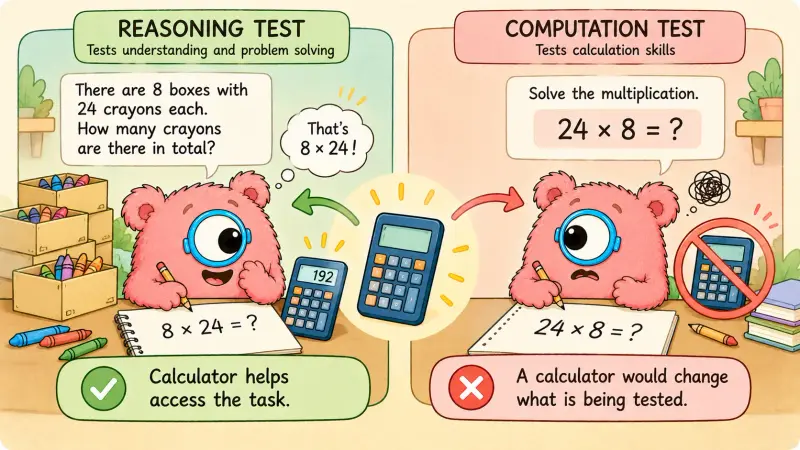
The list
Worth knowing before you start: accommodations for dyscalculia rest on clinical reasoning and state guidance rather than on trials with dyscalculic children specifically. That research barely exists.
Presentation and materials
A multiplication and addition fact chart, permanently available. Difficulty retrieving arithmetic facts is one of the most consistent features of dyscalculia: the most consistently observed behavioral hallmark is impaired arithmetic fact retrieval, with typically developing children recalling around three times as many facts. New Jersey's education department puts it bluntly, noting that time, money and place value are very hard for these students to master and they may never memorize their basic math facts. A chart removes a bottleneck that has nothing to do with the math being taught.
A number line on the desk, not just on the wall. New Jersey's guidance states that students with dyscalculia don't develop a mental number line, and that manipulatives, reference sheets and other external supports can help provide structure and reinforce number concepts.
Fewer problems per page. Not less work, less visual density.
Problems presented vertically rather than horizontally. Column alignment does some of the place-value work for the child.
Pre-printed grids or graph paper. Keeps digits in their columns so a place-value slip doesn't wreck otherwise sound work.
Colour-coding to draw attention to easily missed details. New Jersey's secondary guidance suggests using colour to increase focus on important details like intercepts, angles, and negative signs.
A reference card for time, money and place value. New Jersey groups these three as the "Dyscalculia Trifecta," and recommends extra scaffolding to build understanding across all of them.
Response and recording
Oral explanation as evidence of reasoning. Let the child talk through their thinking when writing it is the barrier.
Manipulatives during assessments, not only instruction. New Jersey recommends offering manipulatives through 4th grade, especially during assessments, which is the part schools most often resist.
Support for copying problems accurately. A child who loses marks transferring a problem from the board rather than solving it is being assessed on the wrong thing.
Guaranteed scratch space on every test. Sounds trivial. Get it written down, because tests are often printed without it.
Self-checking built into the routine. New Jersey advises having students check their work so they have repeated exposure to the correct answer rather than rehearsing their own errors.
Timing and scheduling
Exemption from timed, graded fact drills. Timed drills measure speed of fact recall, which is the skill dyscalculia most reliably affects, so a child can understand the math perfectly well and still score badly. Ask for a non-graded version rather than dropping the practice altogether.
Extended time on assessments. Specify the amount rather than writing "extra time as needed," which is unenforceable.
Math scheduled earlier in the day. Demanding work placed before fatigue accumulates.
Assessments split across sessions. Especially for multi-topic tests.
Assistive technology
Calculator access where computation isn't the skill being assessed. This has some of the strongest accommodation evidence on the list. A federal review of accommodation research found that twelve studies found students with disabilities performed better on mathematics assessments when they had access to, and used, a calculator. New Jersey lists it among the support tools that can support students during classwork, homework, and assessments.
Text-to-speech for word problems. Separates the reading load from the mathematical load. Federal reviewers found that oral delivery accommodations, including text-to-speech, supported some improvement in scores for students with disabilities, though the effects were mostly conditioned on student characteristics or testing conditions.
Digital manipulatives on the device your child already uses.
Assessment and grading
Credit for correct method despite computation slips. A child who sets a problem up correctly and then misadds should not score the same as one who didn't understand it at all.
Partial credit for correct process, in writing. It's often treated as teacher discretion otherwise.
Fact fluency graded separately from reasoning. Given that fact retrieval is the most persistent difficulty, folding it into a single math grade means a child who understands fractions well is marked down for slow recall of times tables.
Alternative formats for demonstrating understanding. An oral explanation or a built model in place of a written test.
Progress measured against the plan's goals, not only the class mean.
Do these actually work?
The evidence varies by accommodation. Extended-time studies generally found positive effects on assessment scores for students with disabilities. Calculator findings were positive but nuanced. Read-aloud and text-to-speech produced some improvement, but the effects often depended on the student or testing conditions. And in math specifically, a National Center on Educational Outcomes review found inconsistent findings about whether the accommodations changed what the tests were measuring.
That last point is the one a doubtful school will raise, and there's no clean answer to it.
So pick the accommodations that match what actually goes wrong for your child, write them precisely, and check after a term whether they made any difference.
Getting them written in
Three things make the difference between a plan that works and a document in a drawer.
Name the barrier, not the label. "He can't recall times tables under time pressure, so he loses marks on problems he can actually solve" gets further than "he has dyscalculia and needs accommodations."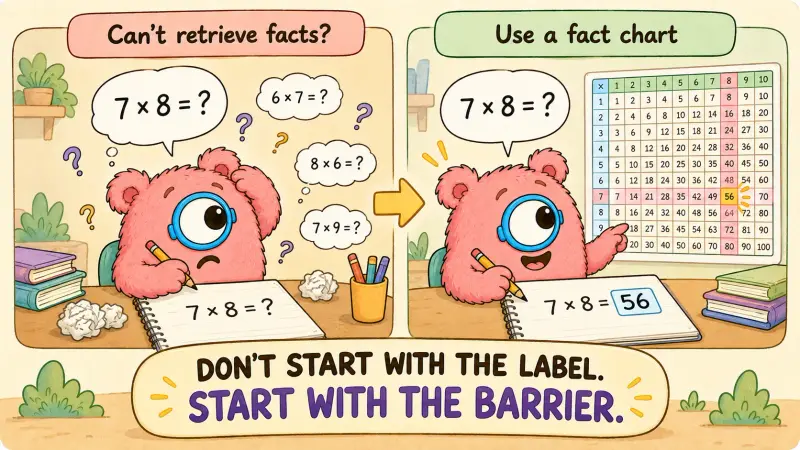
Specify who, when and how much. "Calculator permitted on all assessments except the weekly computation quiz" is enforceable. "Calculator as needed" isn't.
Ask how it will be reviewed. Need for accommodations can drift. A named check-in date keeps you and the school team up-to-speed.
If you're still working out whether dyscalculia is what you're dealing with, our parent's guide to dyscalculia covers the signs and what distinguishes it from other maths difficulties.
What to do with this list
Don't take all of it. A plan with thirty accommodations gets implemented as a plan with none.
Pick the three or four that address what actually goes wrong for your child, get those written precisely, and add more later once they're working.
And bring the 2015 letter. The meeting goes differently when the words "there is nothing in the IDEA that would prohibit the use of the terms dyslexia, dyscalculia, and dysgraphia" are sitting on the table in the Department of Education's own type.
The thing to hold onto is that none of this is a favour the school is doing you or your child. A child who understands fractions but can't recall times tables quickly is not bad at math, and a plan that stops measuring the second thing as though it were the first isn't lowering the bar. It's finally pointing the bar at the right skill.
FAQs
Is dyscalculia covered under IDEA?
Yes, though not by name. IDEA's definition of specific learning disability names dyslexia but not dyscalculia. Eligibility works through the areas of achievement instead, which include mathematics calculation and mathematics problem solving. A 2015 Department of Education letter confirmed there is nothing in IDEA preventing the term dyscalculia being used in evaluations, eligibility determinations or IEPs.
What accommodations help a child with dyscalculia?
The most commonly recommended are a permanent multiplication and addition fact chart, a number line on the desk, calculator access on tasks where computation isn't being assessed, manipulatives allowed during assessments and not just instruction, extended time, and credit for correct method when the answer contains a computation slip. New Jersey's state guidance also recommends extra scaffolding for time, money and place value, which it groups as the "Dyscalculia Trifecta."
Does dyscalculia qualify for a 504 plan or an IEP?
Either, depending on severity. An IEP requires that your child needs specially designed instruction, not just adjustments. A 504 plan requires an impairment that substantially limits a major life activity, and learning is explicitly one of those. A child who needs different math teaching is heading for an IEP; a child who needs tools and time is often served by a 504.
What's the difference between an accommodation and a modification?
An accommodation changes how a child accesses learning or shows what they know. A modification changes what they're expected to learn. Both words appear in federal regulations, but not with the tidy meanings schools give them, and the Office for Civil Rights has said it does not differentiate between the two in K-12. What matters is whether your child has meaningful access.
Can my child use a calculator with a 504 plan?
On tasks where computation isn't what's being assessed, yes, and it's reasonable to request. On a computation fluency test, a calculator may remove the very skill being measured, and a school may decline on that specific assessment. Write the condition into the plan explicitly so it isn't relitigated each term.
References
34 CFR § 300.8 - Child with a disability. Electronic Code of Federal Regulations. https://www.ecfr.gov/current/title-34/section-300.8
34 CFR § 300.309 - Determining the existence of a specific learning disability. Electronic Code of Federal Regulations. https://www.ecfr.gov/current/title-34/section-300.309
34 CFR § 300.320 - Definition of individualized education program. Electronic Code of Federal Regulations. https://www.ecfr.gov/current/title-34/subtitle-B/chapter-III/part-300/subpart-D/subject-group-ECFR28b07e67452ed7a/section-300.320
34 CFR § 104.3 - Definitions (Section 504). Electronic Code of Federal Regulations. https://www.ecfr.gov/current/title-34/section-104.3
34 CFR § 104.33 - Free appropriate public education (Section 504). Electronic Code of Federal Regulations. https://www.ecfr.gov/current/title-34/section-104.33
Office of Special Education and Rehabilitative Services (2015, October 23). Dear Colleague Letter on the use of the terms dyslexia, dyscalculia and dysgraphia. US Department of Education. https://sites.ed.gov/idea/files/idea/policy/speced/guid/idea/memosdcltrs/guidance-on-dyslexia-10-2015.pdf
Office for Civil Rights. Frequently asked questions: Disability discrimination. US Department of Education. https://www.ed.gov/laws-and-policy/civil-rights-laws/disability-discrimination/frequently-asked-questions-disability-discrimination
New Jersey Department of Education, Office of Special Education. Dyscalculia: An overview of the math disability. https://www.nj.gov/education/specialed/programs/additionalsupports/mathsupports/docs/DyscalculiaOne-PagersOverview.pdf
New Jersey Department of Education, Office of Special Education. Dyscalculia: Instructional considerations for young learners. https://www.nj.gov/education/specialed/programs/additionalsupports/mathsupports/docs/DyscalculiaOne-PagersYoungLearners.pdf
New Jersey Department of Education, Office of Special Education. Dyscalculia: Secondary instructional strategies. https://www.nj.gov/education/specialed/programs/additionalsupports/mathsupports/docs/DyscalculiaOne-Pagers_Secondary.pdf
Price, G. R., & Ansari, D. (2013). Dyscalculia: Characteristics, causes, and treatments. Numeracy, 6(1), Article 2. https://digitalcommons.usf.edu/cgi/viewcontent.cgi?article=1112&context=numeracy
National Center on Educational Outcomes. Accommodations toolkit: Calculator research. University of Minnesota. https://publications.ici.umn.edu/nceo/accommodations-toolkit/calculator-research
Rogers, C. M., Lazarus, S. S., & Thurlow, M. L. (2014). A summary of the research on the effects of test accommodations, 2011–2012 (Synthesis Report 94). National Center on Educational Outcomes, University of Minnesota. https://files.eric.ed.gov/fulltext/ED600717.pdf