TL;DR: What are the best IXL alternatives for kids?
Best overall for grades 1–3 (esp. neurodivergent kids): Monster Math
Best free IXL alternatives: Khan Academy Kids (ages 2–8) and Zearn (K–8)
Best adaptive curriculum: DreamBox Math
Best for math-curious, puzzle-loving kids: DragonBox
Best for preschoolers and kindergartners: Funexpected Math
Best for kids who want a big video-game world: Prodigy Math
If IXL is leaving your 1st, 2nd or 3rd grader frustrated, the best IXL alternative for most young kids is a calmer, game-based app that teaches strategies instead of scoring every answer.
Why switch though? IXL is a strong question bank, but its SmartScore gets tougher near mastery, and it drills more than it teaches. A study of 154 first and second graders (Ramirez et al., 2013, Journal of Cognition and Development) linked math anxiety to lower math achievement as early as 1st and 2nd grade, so if IXL is causing tears and anxiety for your child, the tool may be doing more harm than good.
Want a low-pressure option your child will actually ask to play?Try Monster Math free → No timers, no penalties, and a free tier you can use forever.
Why are parents looking for IXL alternatives?
IXL is one of the most widely used practice platforms in U.S. schools; the company says it reaches "1 in 4 students in the US." And to be fair, it does several things very well. It covers Pre-K to 12th grade, it lines up closely with state standards, and teachers love its reports.
But if you've searched "why does my child hate IXL," you're not alone. We collected hundreds of parent and teacher comments in our deep dive on IXL reviews from real users, and the same themes keep coming up.
How does IXL work?
IXL gives your child a skill (say, "subtract two-digit numbers") and then an unlimited stream of questions. Progress is tracked by a SmartScore from 0 to 100.
Here's the part that frustrates many families. According to IXL's own SmartScore guide, once a child reaches 90 they enter the "Challenge Zone." There, correct answers earn only 1–2 points, while wrong answers cost 3–8 points. Kids may need to answer as many as 10 questions correctly in a row to reach 100.
For a confident 5th grader, that's a fair challenge. For a 6-year-old who just made a typo, watching the score go backwards can feel crushing.
What do parents complain about most?
The SmartScore dropping after one mistake near the finish line
Tears, refusal and "I hate math" moments, especially in K–3
It quizzes more than it teaches. There are explanations after wrong answers, but little up-front, hands-on instruction
Repetitive, worksheet-style practice that doesn't hold young kids' attention
Subscription and billing frustrations, including auto-renewal
Why does this matter for young kids?
Math feelings form early. In a study of 154 first and second graders, researchers found that math anxiety was linked to lower math achievement even in early elementary school, and the effect was strongest in kids with higher working memory, the very children we'd expect to do well.
The good news: anxiety isn't fixed. A study of Taiwanese 1st and 2nd graders found that six weeks of game-based digital math training reduced math anxiety, especially for the children who started out most anxious.
The takeaway isn't "screens are bad" or "IXL is bad." It's that how a math app is designed matters, especially for kids who are still building confidence.
What IXL does well (to be fair)
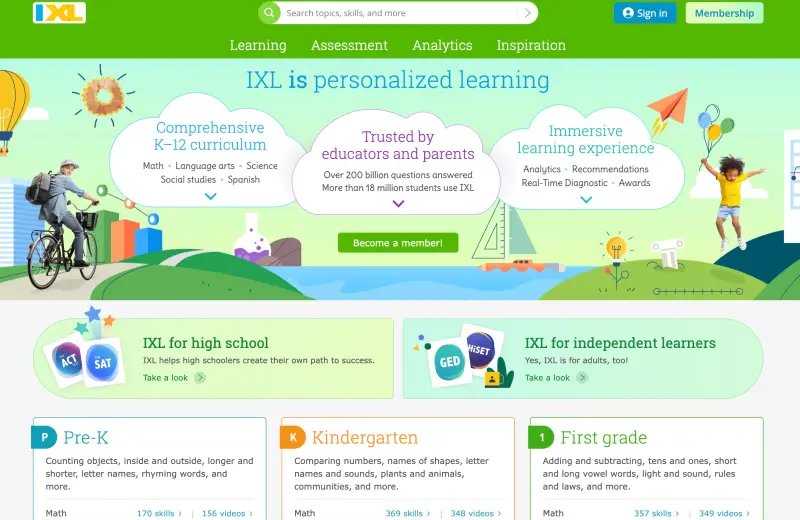
If your child is confident, enjoys a challenge and doesn't get upset by the Challenge Zone, IXL can work fine as a supplement. The alternatives below are for everyone else.
How we evaluated these IXL alternatives
We looked at each app through the lenses that matter most to parents of 1st–3rd graders:
Learning quality: Does it build real understanding, or just reward speed and streaks?
Stress and pressure: Timers, penalties, losing progress, failure screens
Age fit: Is it actually designed for 6- to 9-year-olds?
Home access: Can a parent sign up directly, or is it school-only?
Parent experience: Price, free options, ads and upsells
We also leaned on research. A meta-analysis of 24 studies found that math video games produced a small, marginally significant learning boost over traditional instruction (d = 0.13), with results that varied from study to study. So "game-based" isn't automatically better. The design has to be good.
IXL alternatives at a glance: comparison table
Prices are U.S. list prices for home use, checked in September 2026. They change often, so confirm on each official site.
1. Monster Math (Best Overall IXL Alternative for Grades 1–3)

If your child is between 5 and 9 and IXL has turned math into a daily battle, Monster Math is the gentlest, most effective swap we know of. It's the opposite of a drill app: a real game where kids see how numbers work while they move through a story.
Monster Math focuses on the foundations that 1st–3rd graders need most:
Number sense (see our parent guide: what is number sense?)
Addition and subtraction strategies, like making a ten
Early multiplication and division
Math fact fluency built on understanding, not memorizing
What Monster Math does better than IXL
No timers and no point penalties. Kids aren't racing a clock or watching a score drop.
Teaches strategies, not just answers. Visual models show why a strategy works before kids practice it.
Designed to be neuroinclusive. Calm pacing and a low-distraction environment make it a strong fit for kids with ADHD, autism or dyscalculia.
A real game, not a digital worksheet. Progress happens through play, so kids ask to keep going.
Free forever tier. Kids can play 10 levels a day at no cost. The limit resets daily.
Ad-free premium with offline play, so it works in the car or on a plane.
Free for teachers and schools, if you want to share it with your child's class.
Why does the no-penalty design matter? Feedback is powerful, but a major review found that feedback can either help or hurt learning depending on how it's given. Feedback that focuses on the task and the next step helps more than feedback that feels like a judgment. And a classic meta-analysis of 128 studies found that performance-contingent rewards (similar to what is used in IXL) tended to undermine intrinsic motivation, especially in children, while positive, informational feedback boosted it.
Pricing: Free tier (10 levels/day), then $59.99/year (that's $4.99/month billed yearly) with a 7-day free trial. A monthly plan is also available on the website.
Best for: Grades K–3, kids who cry or shut down with IXL, children with math anxiety, ADHD, autism or dyscalculia, and families who want low-pressure practice.
Not ideal if: You need one app for every subject or for grades 4 and up. Monster Math is deliberately focused on K–3 math foundations.
Want the full head-to-head? Read our IXL vs Monster Math comparison.
Ready for math without tears?Start playing Monster Math free → Use the free tier forever, or unlock everything with a 7-day free trial.
2. Khan Academy Kids (Best Free IXL Alternative for Younger Kids)

Khan Academy Kids is made by the nonprofit Khan Academy and is 100% free, with no ads or subscriptions. It's built for ages 2–8 and covers preschool through 2nd grade.
Kids work through playful activities, books and videos covering counting, shapes, addition and early problem-solving, plus reading and social-emotional skills. The app adjusts to each child's level.
What Khan Academy Kids does better than IXL
Completely free, with no upsells and no worksheets.
Gentle, playful pacing with lots of voice support for pre-readers
Covers reading and math in one app with fun characters.
Feels like play, not a test, especially for younger kids. (unlike Khan Academy website which is more video + worksheets for older kids).
Best for: Pre-K to 2nd grade, families on a budget, whole-child early learning.
Not ideal if: Your child is in 3rd grade or needs focused, deeper math-fact strategy work. Many kids outgrow it by around age 7-8.
See how it compares in Khan Academy Kids vs Monster Math. You can also use both these apps in parallel.
3. Zearn Math (Best Free Full-Curriculum Alternative)

Zearn is a nonprofit K–8 math platform that, by Zearn's own count, is used by 1 in 4 elementary students in the U.S. Families can sign up for a free individual account to use it at home, including for homeschooling.
Each Zearn lesson combines short videos with an on-screen teacher and interactive practice built around visual models. It follows a school-style sequence, so it's a strong free alternative to IXL if you want your child to keep pace with grade-level math.
What Zearn does better than IXL
Actually teaches each concept with video lessons before practice
Visual, concept-first approach
Free for families and teachers, with no ads
Zearn reports a "Strong" (Tier 1) rating from Evidence for ESSA, based on a large randomized study of students in grades 3–5
Best for: Kids who learn well from a video lesson, and families wanting a free, school-aligned curriculum.
Not ideal if: Your child needs more game-like motivation. Zearn is more "online lesson" than "game," and some kids find the pace demanding.
Exploring Zearn too? See our Zearn alternatives for grades 1–3.
4. DreamBox Math (Best Adaptive Curriculum)

DreamBox Math is an adaptive K–8 program that adjusts lessons in real time based on how your child solves problems, not just whether the answer is right. Kids use virtual manipulatives like number lines and ten frames, and parents get a Family Dashboard with progress reports.
Unlike some school-focused tools, DreamBox still offers home subscriptions directly to parents.
What DreamBox does better than IXL
Adapts to how a child thinks, not just right/wrong answers
Hands-on virtual manipulatives build conceptual understanding
Lessons feel more like guided exploration than a worksheet
Family plans cover up to four children
Pricing (home): Individual plans from $12.95/month or $99.95/year; family plans (up to 4 kids) from $19.95/month or $149.95/year. There's a 14-day free trial.
Best for: Parents who want a personalized, curriculum-style program for K–8.
Not ideal if: You want a free option, or your child needs lots of game-style fun to stay motivated.
5. DragonBox Apps (Best for Deep Conceptual Games)

DragonBox is often praised by educators — and for good reason.
Each DragonBox app focuses on a specific mathematical idea, such as:
Number sense
Geometry
Basic algebra
The games are beautifully designed and deeply intuitive. Kids often learn complex ideas without realizing they’re doing math at all.
What DragonBox Does Better Than IXL
Deep conceptual engagement with core math ideas
Highly intuitive visuals that reduce reliance on text
Puzzles that naturally build understanding from play
Less emphasis on reward loops and more on reasoning
However, DragonBox is not a full curriculum replacement. Think of it more like a set of powerful learning tools rather than an all-in-one solution.
Best for: Conceptual understanding, enrichment, math-curious kids
Not ideal if: You want one app that covers everything
6. Funexpected Math (Best for Preschoolers)

Funexpected Math is designed primarily for very young learners — typically ages 3 to 6.
Instead of worksheets or drills, it offers short, playful mini-games that introduce:
Counting
Shapes
Patterns
Early logic
If IXL feels far too advanced for your child or far too boring, Funexpected can be a gentler entry point into math.
What Funexpected Math Does Better Than Prodigy
Playful, non-intimidating introduction to math concepts
No timed questions or performance stress
Mini-games that feel like play, not school
Great for early attention spans and basic logic
That said, school-going children often outgrow it quickly. There’s limited depth once basic concepts are mastered. Much more suited for preschoolers and maybe 1st graders.
Best for: Ages 3–6, early exposure to math
Not ideal if: Your child is already working on arithmetic
7. Prodigy Math (Best for Kids Who Want a Big Video Game)

Prodigy Math is a fantasy role-playing game for grades 1–8, where kids battle monsters by answering curriculum-aligned math questions. The educational content is free; optional memberships add extra game features.
What Prodigy does better than IXL
Feels like a "real" video game, which some kids love
Math content is free to play
Covers grades 1–8
Pricing: Free to play. Memberships start at $9.95/month or $58.95/year (Core), up to $19.95/month or $118.95/year (Ultra).
Best for: Game-motivated kids who enjoy battles and exploration.
Not ideal if: You want low-distraction learning. Some parents find the battles, cosmetics and upgrade prompts pull focus from the math, and some questions are timed. See our full Prodigy alternatives guide.
Honorable mention: Reflex. Reflex is a well-known fact-fluency game for grades 2+. For home users it's sold through Time4MathFacts ($54.95 per student per year). It's great for speeding up facts a child already understands, but it's built around speed, so it's a poor first choice for anxious kids.
How to choose the right IXL alternative for your child
Quick-pick guide by your child's need
What should I look for in a math app for 1st, 2nd or 3rd grade?
Look for these five things:
No harsh penalties or timers for kids who are still building confidence.
Visual, hands-on models like number lines and ten frames, not just symbols.
Teaching, not just testing. The app should show strategies, not only mark answers.
Short, bounded sessions, so your child can stop on a win.
Honest pricing with a real free tier or trial.
Well-designed apps really can help young kids. In a randomized controlled trial with 389 children aged 4–5, structured, content-rich interactive math apps raised early math achievement. And a meta-analysis of 15 randomized studies found that digital interventions generally improved math performance for children with mathematical learning difficulties (average effect size 0.55), although results varied widely between programs.
Is IXL good for kids with ADHD, autism or dyscalculia?
It depends on the child, but many neurodiverse kids struggle with IXL's design. Long, open-ended sessions and visible point losses can be especially hard for kids with ADHD or low frustration tolerance.
Math anxiety and math difficulty are also not the same thing. In a study of 1,757 children, 77% of children with high math anxiety had typical or high math performance, while children with dyscalculia were twice as likely to be highly anxious. So a pressure-heavy app can let down both the anxious-but-capable child and the child who genuinely finds math hard.
On the positive side, a small study of three 2nd–4th graders with ADHD found that computer-assisted math instruction improved math performance and on-task behavior compared with independent seatwork. It's early evidence, but it suggests the right digital format can help.
For more, read our guide to the best online math programs for neurodivergent kids and our explainer on math anxiety in autism, ADHD and dyscalculia.
Final thoughts: which IXL alternative is right for you?
There's no single "best" math app for every child, but there is a best fit for what your child needs right now.
If your child needs strong foundations without stress → Monster Math
If you want a free option for younger kids → Khan Academy Kids
If you want a free, full curriculum → Zearn
If you want adaptive, personalized lessons → DreamBox Math
If your child is advanced and loves puzzles → Beast Academy Online
If you like structured lessons for several kids → Mathseeds
If video-game motivation is everything → Prodigy Math
IXL is a powerful question bank, and for some confident kids it works. But for many 6- to 9-year-olds, math should feel like something they can do, not a score they're afraid to lose. Choose the tool that fits how your child thinks, and watch for the signal that matters most: are they asking to play again?
Fun math learning for your kids. Build math fact fluency and number sense with a game your child will love. Try Monster Math free now →
FAQs about IXL alternatives
What is the best alternative to IXL?
For kids in grades 1–3, the best IXL alternative is Monster Math, a game-based, no-timer app built around visual strategies and designed for neurodiverse learners. For a free option, choose Khan Academy Kids (ages 2–8) or Zearn (K–8). For math-curious kids who love puzzles, try DragonBox.
Is there a free alternative to IXL?
Yes. Khan Academy Kids is 100% free with no ads or subscriptions for ages 2–8. Zearn offers free individual accounts for families covering K–8. Monster Math has a free-forever tier of 10 levels per day, and Prodigy Math is free to play.
Why does my child hate IXL?
The most common reasons are the SmartScore dropping after mistakes (especially in the Challenge Zone above 90), long sessions with many similar questions, and a quiz-first format that doesn't teach much up front. For young kids, this can quickly turn into math anxiety, and research shows that anxiety is linked to lower math achievement as early as 1st and 2nd grade.
Is IXL good for kids with ADHD?
IXL can work for some kids with ADHD who like instant feedback, but many struggle with its unbounded sessions and visible point losses. If you use it, set a time limit instead of a SmartScore goal. Calm, game-based, low-penalty apps like Monster Math are usually a better fit.
What is better than IXL for 1st grade?
For 1st grade, Monster Math, Khan Academy Kids and Funexpected Math are all better fits than IXL. They use visual, playful activities that build number sense rather than drilling questions. Monster Math is best for kids who get frustrated easily, Khan Academy Kids is the best free pick, and Funexpected suits kids at the start of 1st grade who are still getting comfortable with numbers.
What is a good IXL alternative for preschool or kindergarten?
For ages 3–6, try Funexpected Math (short, playful mini-games with no timed questions) or Khan Academy Kids (completely free). Both introduce counting, shapes and early logic through play. Once your child moves into 1st grade arithmetic, Monster Math is a natural next step.
What are some apps like IXL but more fun?
If you want the skill practice of IXL with more fun, try Monster Math (a story-driven game for K–3), Prodigy Math (a fantasy RPG for grades 1–8) or DragonBox (puzzle games where kids discover math ideas through play).
Is IXL worth it for 2nd and 3rd graders?
It can be, if your child is confident and uses it for short review sessions. IXL's math plan costs $9.95/month or $79/year. But if your 2nd or 3rd grader is anxious, still building basics or losing interest, an alternative that teaches strategies will usually give better results. See our full IXL reviews for details.
Can I use an IXL alternative alongside school IXL?
Yes. Many families keep IXL for assigned school homework and add a calmer app at home to rebuild confidence. A short daily Monster Math session alongside school IXL can help your child feel successful with math again.
References
Benavides-Varela, S., Zandonella Callegher, C., Fagiolini, B., Leo, I., Altoè, G., & Lucangeli, D. (2020). Effectiveness of digital-based interventions for children with mathematical learning difficulties: A meta-analysis. Computers & Education, 157, Article 103953. https://www.sciencedirect.com/science/article/pii/S0360131520301512
Deci, E. L., Koestner, R., & Ryan, R. M. (1999). A meta-analytic review of experiments examining the effects of extrinsic rewards on intrinsic motivation. Psychological Bulletin, 125(6), 627–668. https://doi.org/10.1037/0033-2909.125.6.627
Devine, A., Hill, F., Carey, E., & Szűcs, D. (2018). Cognitive and emotional math problems largely dissociate: Prevalence of developmental dyscalculia and mathematics anxiety. Journal of Educational Psychology, 110(3), 431–444. https://www.repository.cam.ac.uk/handle/1810/271729
Hattie, J., & Timperley, H. (2007). The power of feedback. Review of Educational Research, 77(1), 81–112. https://doi.org/10.3102/003465430298487
Mautone, J. A., DuPaul, G. J., & Jitendra, A. K. (2005). The effects of computer-assisted instruction on the mathematics performance and classroom behavior of children with ADHD. Journal of Attention Disorders, 9(1), 301–312. https://doi.org/10.1177/1087054705278832
Ng, C.-T., Chen, Y.-H., Wu, C.-J., & Chang, T.-T. (2022). Evaluation of math anxiety and its remediation through a digital training program in mathematics for first and second graders. Brain and Behavior, 12(5), e2557. https://pmc.ncbi.nlm.nih.gov/articles/PMC9120910/
Outhwaite, L. A., Faulder, M., Gulliford, A., & Pitchford, N. J. (2019). Raising early achievement in math with interactive apps: A randomized control trial. Journal of Educational Psychology, 111(2), 284–298. https://www.ncbi.nlm.nih.gov/pmc/articles/PMC6366442/
Ramirez, G., Gunderson, E. A., Levine, S. C., & Beilock, S. L. (2013). Math anxiety, working memory, and math achievement in early elementary school. Journal of Cognition and Development, 14(2), 187–202. https://sites.temple.edu/cognitionlearning/files/2013/09/Ramirez-et-al-2013.pdf
Tokac, U., Novak, E., & Thompson, C. G. (2019). Effects of game-based learning on students' mathematics achievement: A meta-analysis. Journal of Computer Assisted Learning, 35(3), 407–420. https://doi.org/10.1111/jcal.12347